


Riding a heat wave
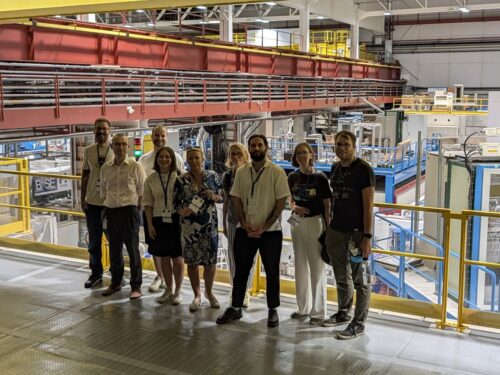
The OAPEN Tech team met with the Open Science (OS) teams at CERN in Geneva, Switzerland, on the 25th and 26th of June. After rebuilding the team following several staffing changes in the latter half of 2025, it was important for us to meet with partners who are supporting our mission and helping us to maintain our technical infrastructure. In addition, there are a few other OS teams located in CERN with whom it was beneficial to meet with.

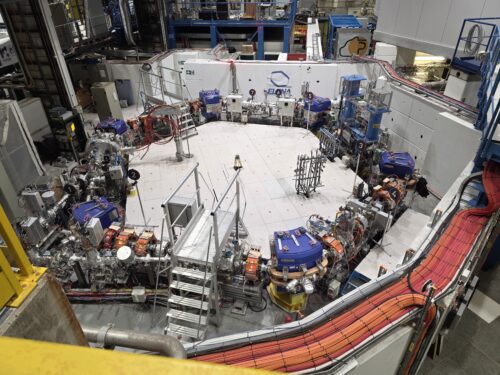
During our visit, we experienced CERN’s hospitality and walked through the corridors where the World Wide Web was born, as well as many other inventions that have revolutionised our world. We were shown the Antimatter Factory, where antiprotons are decelerated and captured. We also learned what motivated humanity to build such complicated installations, how they work in simple terms, and the history of CERN. We feel very lucky to have had this experience.
Our arrival coincided with a heat wave that hadn’t been felt in June in Switzerland for over twenty years. However, the heat didn’t prevent our productivity.
We were able to discuss our ideas on how to prevent bots if the current measures, about which we had informed like Anubis, weren’t enough. We had time to agree on the details of our cooperation and explore possible ways to upgrade our services in the future. We hope to be able to share the details soon!
Sneak peak into the future
We learned how the Model Context Protocol (MCP) could potentially be implemented in the OAPEN Library and/or the Directory of Open Access Books (DOAB), and what benefits this could bring.
But first, what is MCP? Creators compare it to USB-C, which allows others to plug into your AI for an efficient, easy, and standardised way to connect to your system, giving them access to crucial information and enabling them to perform tasks.
Essentially, adding MCP to the OAPEN Library and DOAB could enable agentic users to connect more efficiently without causing high traffic and access issues for regular users. This would enable agentic users to perform more efficient searches using AI, which would have access to all metadata and, in the future, potentially to full texts.
We also discussed ideas for bringing home applications hosted by providers, improving them or rebuilding them from scratch to make them more secure and efficient with more options.
The CERN team also showed us some open-source tools that they use, which we could potentially leverage. Some of these tools are promising ideas that could improve the user experience, such as implementing Open Search instead of relying on SOLR. Another idea was to move our main websites from Strapi to WordPress for better security and maintenance. We also explored the potential usage of business intelligence tools such as Superset, which could potentially be used in the future to create dashboards with far greater possibilities for libraries, publishers, and funders.

Exchanging experiences
We also had the opportunity to meet a few other OS teams and brainstorm ways to improve the SCOAP3 for Books collection and how to progress with our future cooperation, particularly in terms of aligning processes following the recent staffing changes within the OAPEN Tech team.
Another interesting experience was meeting Zenodo. We exchanged experiences and had the opportunity to ask about things that interested us, such as traffic handling, issues they have encountered with the repository, and more technical or metadata-focused aspects of repositories. This has further reinforced our belief that the community is facing very similar problems to those we are facing, relating not only to how operating systems and scientific communication are changing, but also to the world in which we live because of AI.

Overall, our visit to CERN strengthened our partnership, confirmed that the Open Science community is facing many shared challenges, and inspired new ideas for building more open, secure, and sustainable services in a rapidly changing world.

OpenEdition suggests that you cite this post as follows:
Wiktor Florian (July 15, 2026). OAPEN goes to Switzerland: A visit to our partner CERN. OAPEN: A world of scholarly books: Open to all, built to last. Retrieved July 19, 2026 from https://doi.org/10.58079/16kqd