


Flocks, Families, and Colonies: Exploring Communal Wildlife Species

“All ethics so far evolved rest upon a single premise: that the individual is a member of a community of interdependent parts… The land ethic simply enlarges the boundaries of the community to include soils, waters, plants, and animals, or collectively: the land.” – Aldo Leopold
A winter evening in North Carolina might bring thousands of crows together in a single roost, while a colony of bats settles in a cave and a beaver family works together to maintain its lodge. These animals have different social structures, but each offers a glimpse into the many ways wildlife lives together.
When we see wildlife, it can be tempting to view each animal as an individual, separate from a larger group, but many species live as part of a collective, engaging in different forms of communal behavior.
Giving Tuesday is December 1st, and you can help protect and conserve the wildlife, wildlife habitats, and communities that make North Carolina special. Your generosity gives wildlife a better future.
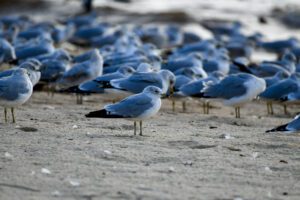
Ring billed seagulls (Larus delawarensis) by Sarah Price, NCWF Photo Contest Submission
What Is Communal Living in Wildlife?
Communal wildlife isn’t a strict scientific classification. It describes animals that exhibit group living or behavior. Some species are consistently social, while others gather only seasonally or under particular environmental conditions. Communal living in wildlife can be animals that gather or live in groups and engage in shared behaviors, such as nesting, roosting, foraging, raising young, or defending against predators.
Keep in mind that communal living doesn’t always mean cooperative living. In some cases, animals actively work together, such as the cooperative breeding behavior seen in red-cockaded woodpeckers. Conversely, great blue herons may nest in rookeries with hundreds of other birds, but they typically hunt and forage alone. In some cases, they even defend feeding territories against other herons.
There are too many styles and variations of communal living to feature them all in this post, but let’s explore a few examples. For a more comprehensive look at wildlife family units and mating behaviors, check out our blog post Family Matters – Explore North Carolina’s Wildlife Family Units.
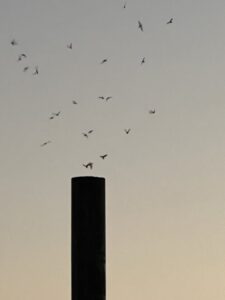
Chimney swifts (Chaetura pelagica) by Margaret Martin, USFWS
Some Examples of Communal Wildlife
Roosting: Chimney Swifts
Anyone who has witnessed the tornado-like swirling of chimney swifts into a roosting site knows how unforgettable it is.
Chimney swifts (Chaetura pelagica) are migratory birds that engage in communal roosting, sometimes gathering by the hundreds or thousands inside a single chimney during migration. They are an example of how communal living doesn’t always mean cooperative living. While chimney swifts may occasionally receive help from other adults when raising their young, they generally nest as individual breeding pairs and share roosting sites outside the breeding season.
One benefit of communal roosting is heat conservation. Gathering inside a sheltered structure helps these small birds conserve energy and escape the elements.
Family Group Cooperation: Beavers
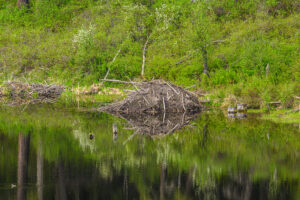
Beaver dam by Bridget Mayfield, USFWS
Beavers (Castor canadensis) are a good example of what communal living can look like within family structures.
These incredible wildlife architects construct dams and lodges from sticks, branches, mud, and other vegetation, creating ponds that can transform entire landscapes. Their lodges and bank dens provide shelter, and their dams help maintain the deep water that makes their homes safer and easier to access.
Beavers typically live in family groups consisting of an adult pair and their offspring from the current and previous breeding seasons. A family may include the parents, kits (young beavers in their first year), and yearlings from the previous year. As the young grow, they remain with their family and contribute to activities around the lodge and territory.
Beaver families share resources and help maintain their home, including repairing structures and preparing food stores for winter. Their family-based social structure allows young beavers to grow and develop in a protected environment before eventually dispersing to establish territories of their own.
From Solitary to Communal: Eastern Gray Squirrels
Eastern gray squirrels (Sciurus carolinensis) are primarily solitary outside of breeding and rearing young, and they’re often well known for their
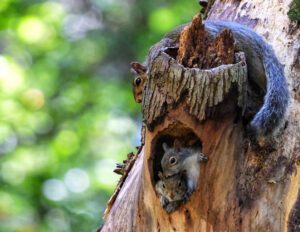
Eastern gray squirrels (Sciurus carolinensis) by Karen Horner, NCWF Photo Contest Submission
territorial behavior. They may compete with other squirrels for food, nesting cavities, and access to resources.
However, while they typically nest alone throughout much of the year, gray squirrels may share nests during cold weather. This behavior, known as communal nesting, helps squirrels conserve body heat during winter.
These shared nests, called dreys when constructed from leaves and twigs, can shelter multiple squirrels at once. Although the number varies, two or three squirrels may share a den or nest. This seasonal shift demonstrates how even a largely solitary species can benefit from social behavior when environmental conditions make it advantageous.
Eusocial Communities: Bald-Faced Hornets
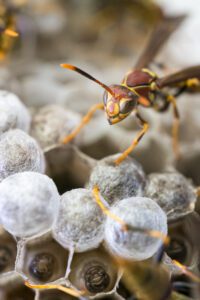
Paper wasps (genus Polistes) – another eusocial species by Jacob Long, NCWF Photo Contest Submission
Some communal living structures are so complex they boggle the mind.
Bald-faced hornets (Dolichovespula maculata) are eusocial wasps native to North Carolina. Like carpenter ants, termites, yellow jackets, and non-native European honeybees, they live in colonies with a reproductive queen and non-reproductive workers. Instead of excavating wood, however, they construct distinctive, enclosed paper nests from chewed wood fibers mixed with saliva.
A colony typically grows through the summer, often reaching around 100–400 workers by late summer. As a eusocial species, bald-faced hornets exhibit a complex social structure in which individuals perform specialized roles. The queen lays eggs, while workers expand and maintain the nest, forage for food, defend the colony, and feed developing larvae.
In fall, the colony produces new queens and males. After mating, the new queens overwinter and establish colonies the following spring, while the original colony dies off.
Unlike animals that gather temporarily or live together in family groups, bald-faced hornets demonstrate a highly organized form of communal living in which the colony’s survival depends on the different roles its members perform.
Seasonal Social Groups: Elk
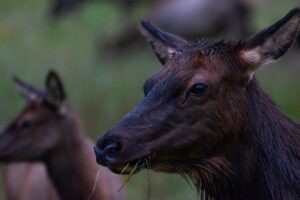
Elk (Cervus elaphus) by JohnAndrew Lovins, NCWF Photo Contest Submission
Elk (Cervus elaphus) are a good example of how communal living changes with the seasons. They typically gather in herds, with females and their young forming groups separate from adult males for much of the year.
Female elk, known as cows, raise their calves within these groups, while males, called bulls, often form smaller bachelor groups or spend time alone. As calves grow, they begin spending more time with the herd, and the composition of these groups shifts throughout the year.
During the breeding season, known as the rut, bulls compete for access to females through bugling, displays of dominance, and sometimes antler sparring. Dominant bulls may gather groups of females, but these associations are temporary and change as the breeding season progresses.
Elk demonstrate that communal living doesn’t always mean staying in the same group year-round. Instead, their social relationships shift with the seasons, helping them navigate raising young, finding food, and reproducing.
Fission-Fusion: Eastern Wild Turkeys
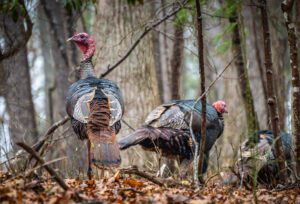
Eastern wild turkeys (Meleagris gallopavo) by Amber Parler, NCWF Photo Contest Submission
In fission-fusion societies, groups frequently split into smaller subgroups and reunite, with individuals moving between different groupings over time. This flexible social structure allows group size and composition to change in response to factors such as food availability, breeding, and the age and sex of individuals.
Eastern wild turkeys (Meleagris gallopavo) are among North Carolina’s largest game birds and can be found throughout the state. As social birds, they spend much of the year traveling in flocks, but the composition of those flocks changes seasonally.
During the spring breeding season, winter flocks break apart as hens establish nesting areas and raise their broods. Through summer and fall, hens and their poults (young turkeys) may form larger groups with other family units. Male turkeys may also form bachelor groups, which can remain together outside the breeding season.
As winter approaches, these smaller groups may merge into larger flocks before dispersing again as breeding season returns. This shifting social structure allows turkeys to maintain social connections while adapting to the changing demands of the year.
Nesting Colonies: Brown Pelicans

Brown pelicans (Pelecanus occidentalis) by Shanna Stawicki, NCWF Photo Contest Submission
In North Carolina, brown pelicans (Pelecanus occidentalis) gather in large flocks along coastal waters and nest in colonies on small islands, particularly in the Cape Fear River, Pamlico Sound, and Bogue Sound.
During the breeding season, pairs work together to build nests, incubate eggs, and feed their young. Outside the nesting period, pelicans congregate at communal roosts on sandbars, beaches, pilings, and other suitable resting sites. These gatherings provide places to rest and preen while remaining near other birds.
Although brown pelicans are highly social, they don’t typically share parental duties across the entire colony. Each breeding pair primarily raises its own offspring.
Protecting Wildlife Means Protecting Communities
From the enormous flocks of chimney swifts gathering at dusk to the complex social structures of bald-faced hornets, communal wildlife shows us that there is no single way to live together.
Some animals depend on cooperation, while others benefit from sharing shelter or nesting in the same place. Still others move between solitary and social behaviors as the seasons change. Each example offers a glimpse into the many relationships that help wildlife survive.
Aldo Leopold’s land ethic asks us to look beyond individual animals and recognize the larger community of which they are a part. Protecting wildlife means protecting not only individual species, but also the habitats and ecological relationships that sustain them.
Whether it’s preserving a chimney swift’s roosting site, protecting a pelican nesting island, or maintaining the wetlands that support beavers, conservation helps ensure these communities can continue to thrive.
Giving Tuesday is December 1st, and you can help protect and conserve the wildlife, wildlife habitats, and communities that make North Carolina special.
Your generosity gives wildlife a future. Give today to help wildlife and the habitats we all depend on thrive.
Written by:

– Bates Whitaker, NCWF Creative Content Manager
– Dr. Liz Rutledge, NCWF VP of Wildlife Resources

– Carrie Smith, NCWF VP of Communications & Marketing