Tag: ClinVar

Coming Soon! Improving Representation of Functional Data in ClinVar

Coming Soon! Improving Representation of Functional Data in ClinVar

NCBI is improving the way that functional data are submitted to ClinVar and how they are represented in the XML format and on the website. Almost half of the variants in ClinVar are variants of uncertain significance (VUS). It’s unclear what clinical action to take for these variants, creating a challenge for clinicians. One potential way to resolve VUS is to develop functional assays to determine the effect the variant has on the gene product, at either the transcript or the protein level. While ClinVar can currently accept functional data, we are striving to make submission easier and more efficient and to make the data easier to find and use.   Continue reading “Coming Soon! Improving Representation of Functional Data in ClinVar”
MedGen Users, We Want Your Feedback!

MedGen Users, We Want Your Feedback!

Do you use NCBI’s MedGen? If so, then you probably know it’s NCBI’s one-stop-shop for genetic phenotype information. If you are a healthcare provider, genetic professional, researcher, or anyone who uses MedGen, we want to hear from you to help us make this resource better meet your needs!  

We want to know: 

  • How you currently use MedGen 
  • How we can make MedGen data more useful to you 
How to provide feedback

Continue reading “MedGen Users, We Want Your Feedback!”

Submit Your Somatic Variation Data to ClinVar

Submit Your Somatic Variation Data to ClinVar

NCBI’s ClinVar is now accepting submissions for somatic variants classified for cancer. As recently announced, we updated the ClinVar website as part of our effort to better support the display of submitted somatic variation data 

Access to somatic variation data is essential for understanding tumor biology and will help researchers advance cancer treatment. It also helps clinical cancer testing laboratories provide better patient reports. Make ClinVar as useful for somatic variants as it is for germline by contributing your data! To submit your data, use our new somatic spreadsheet template (SubmissionTemplateSomatic.xlsx) and follow these step-by-step instructions. Once your submission is prepared, you can go to the ClinVar Submission Portal to upload and send your file. See an example below.   Continue reading “Submit Your Somatic Variation Data to ClinVar”

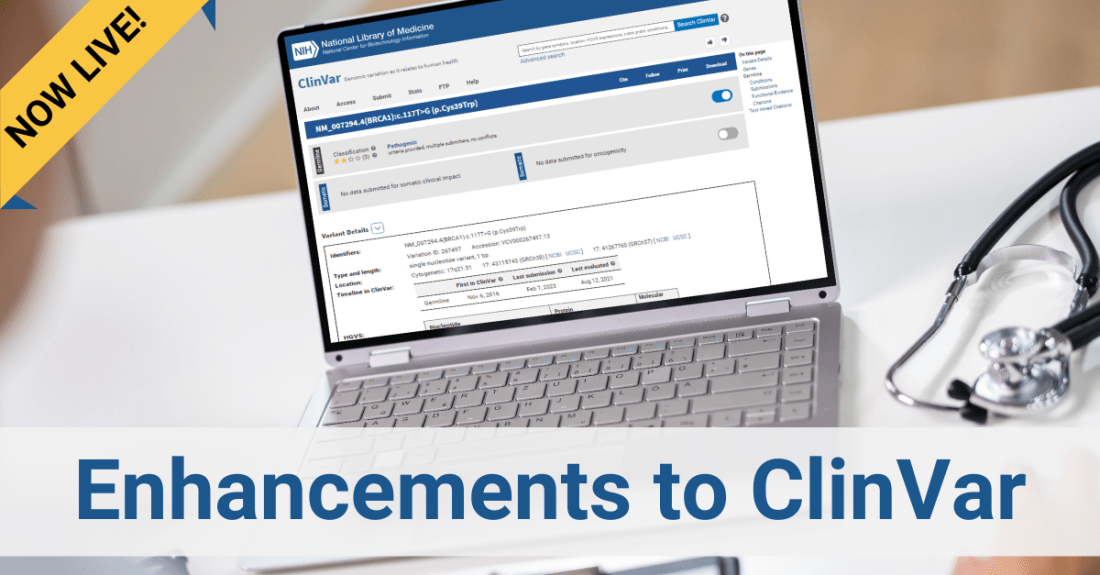
Enhancements to ClinVar Website Now Live

Enhancements to ClinVar Website Now Live

Important Note: Support for both the old XML formats has been extended through the end of December 2024. To prepare for these changes, please preview the updated XML schema and supporting documentation on GitHub.

As previously announced, we updated the ClinVar website as part of our effort to better support the display of submitted somatic variation data. 

What changed? 

Continue reading “Enhancements to ClinVar Website Now Live”

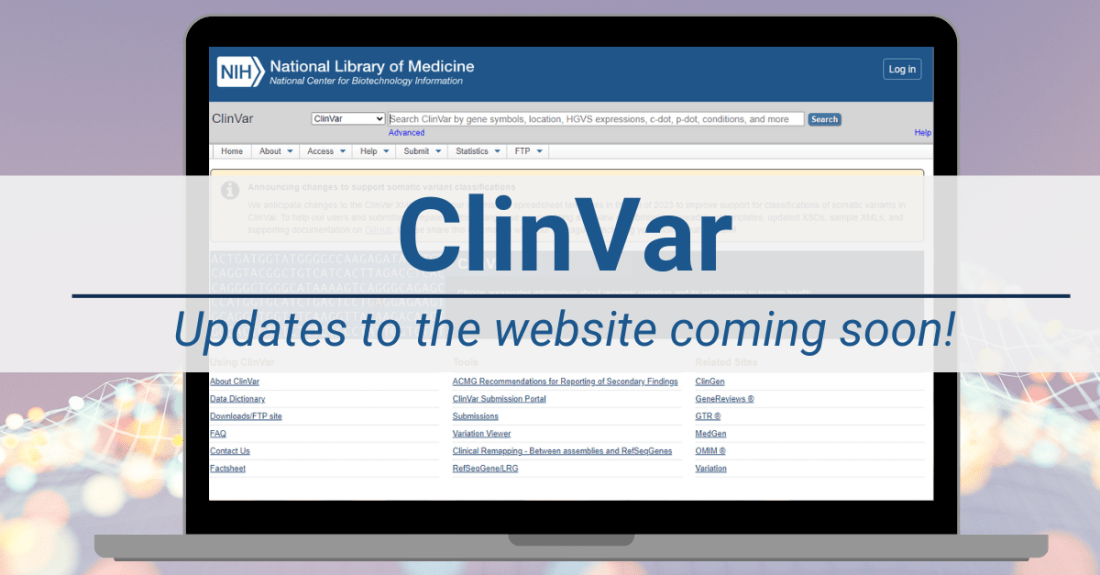
Coming Soon! Updates to the ClinVar Website

Coming Soon! Updates to the ClinVar Website

In order to support the inclusion of submitted somatic variation data, we are updating the ClinVar website. In early 2024, you will begin to see some changes.

What will change?

Variant (VCV) record pages will have an updated look and feel:

  • Simpler layout with no tabs
  • New sections will display somatic classifications
    • Summary section will be divided into germline classification and display the two types of classifications for somatic variants – somatic clinical impact and oncogenicity
    • Sections for conditions, submitted records, functional evidence, and citations will be provided for both germline and somatic classifications
    • A toggle will allow you to select and show just information pertaining to germline or somatic data 

Continue reading “Coming Soon! Updates to the ClinVar Website”

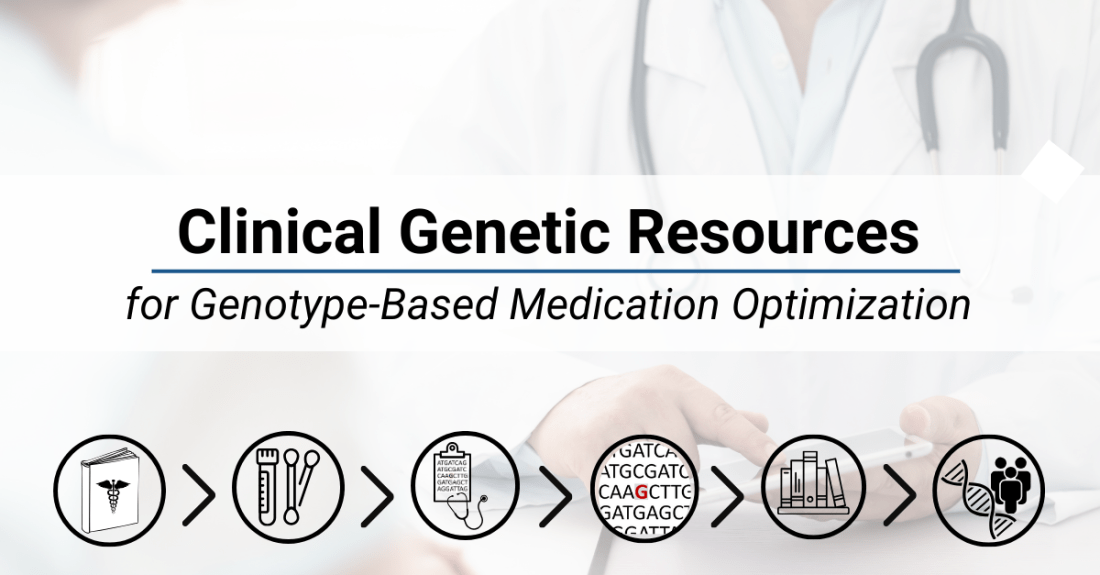
Using NCBI Resources for Genotype-Based Medication Optimization

Using NCBI Resources for Genotype-Based Medication Optimization

NCBI offers a variety of clinical genetic resources to help you research, diagnose, and treat diseases and conditions. You can quickly and easily access our data and tools through the Medical Genetics and Human Variation page of the NCBI website.  

How and why should you use our resources? Consider the example below.

Your patient is a 58-year-old woman who has been diagnosed with Acute Coronary Syndrome, scheduled for an angioplasty, and she will need to take clopidogrel for at least three months. She mentions that her father died of a stroke while taking the drug and is concerned. You look into pharmacogenetic influences on clopidogrel response and use the results of your patient’s genetic test to determine if a change in the prescription is needed.   Continue reading “Using NCBI Resources for Genotype-Based Medication Optimization”

Join NCBI at ASHG 2023

Join NCBI at ASHG 2023

November 1-5 in Washington, D.C. 

We look forward to seeing you in person at the American Society for Human Genetics Annual Meeting (ASHG 2023), November 1-5, 2023, in Washington, D.C. We will participate in a variety of activities and events including hosting an exhibit booth where you can stop by to meet NCBI experts, ask questions, provide feedback, or just chat! We’re especially excited to share our recent efforts on our clinical and human genetic resources and provide an update on the NIH Comparative Genomics Resource (CGR). 

Check out NCBI’s schedule of activities and events: 

Continue reading “Join NCBI at ASHG 2023”

ClinVar Partners with ClinGen to Review & Curate Submitted Records

ClinVar Partners with ClinGen to Review & Curate Submitted Records

Do you currently use or submit clinical variation data? NCBI now has a new mechanism to improve ClinVar data quality. Since ClinVar’s founding over 10 years ago, the amount of information in this free resource has expanded dramatically with submissions from research and clinical laboratories all over the world. Because of the large volume of data and the importance of data quality, we are working with ClinGen biocurators to address problematic records for variants that do not require the efforts of an expert panel. 

What’s new?

ClinVar and ClinGen have established a new process for ClinGen biocurators to review submitted records in ClinVar. A problematic record will be curated by ClinGen as a candidate to be flagged in ClinVar. We will notify relevant submitters giving them an opportunity to review and update their data. If the submitter does not provide an update, the problematic record will be flagged in ClinVar, so that it does not contribute to the overall classification. The record, however, will remain accessible in the database (Figure 1). This will reduce the number of variants with a conflict in the classification and improve the accuracy of the ClinVar dataset.   Continue reading “ClinVar Partners with ClinGen to Review & Curate Submitted Records”

Coming Soon to ClinVar! Somatic Variants & Changes to the XML

Coming Soon to ClinVar! Somatic Variants & Changes to the XML

Important Note: Support for both the old XML formats has been extended through the end of December 2024. To prepare for these changes, please preview the updated XML schema and supporting documentation on GitHub.

Do you rely on ClinVar XML files for your application or analytical pipeline? We are significantly updating ClinVar’s XML format to support the inclusion of new somatic variation data provided by submitters. In the coming months, you may need to make changes to your tool or pipeline code to continue to use the ClinVar XML.

What will change?

Continue reading “Coming Soon to ClinVar! Somatic Variants & Changes to the XML”

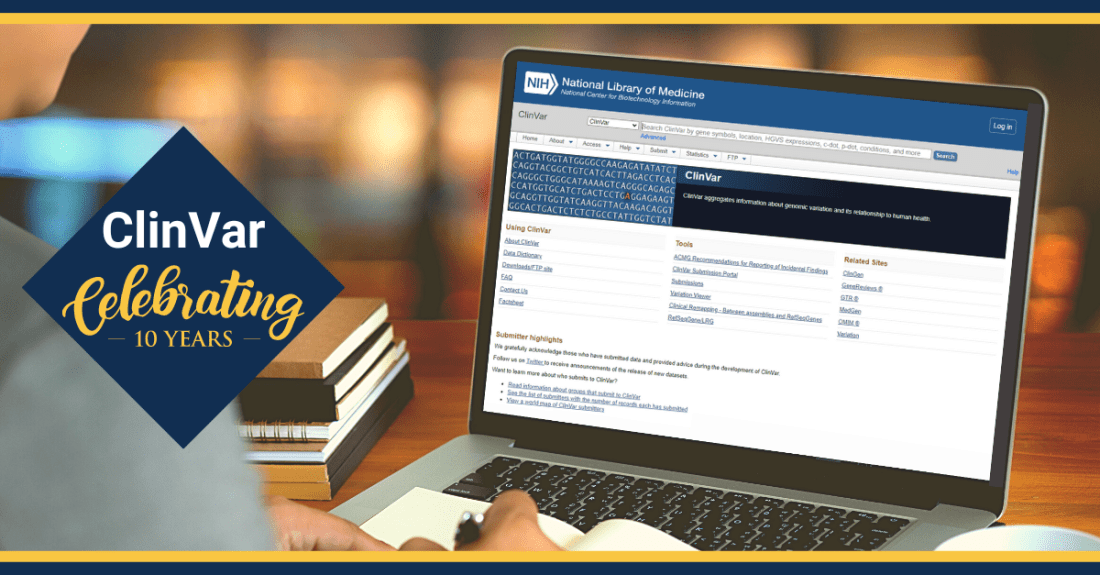
Celebrating 10 Years of ClinVar: Why it is More Important Than Ever!

Celebrating 10 Years of ClinVar: Why it is More Important Than Ever!

Identifying genetic variants and their impact on health is key to tailoring patient care. However, most variants are rare! As such, it is imperative for health care professionals to compare findings from multiple labs, examine evidence, and read related publications to provide accurate interpretations of genetic testing results as well as to develop treatment plans for their patients. ClinVar, a free and publicly available database, was established 10 years ago with this fundamental need in mind. 

10 years of ClinVar 

The field of variant discovery and classification for diseases has increased rapidly in the last decade!   Continue reading “Celebrating 10 Years of ClinVar: Why it is More Important Than Ever!”