
It’s been fun to be Norwegian these past couple of weeks. The 2026 Winter Olympics wrapped up today, and guess which nation came out on top? Yes—little Norway. We won the most gold medals and the most medals overall. In fact, it was our most successful Winter Olympics ever. And what makes it all the more satisfying is that we are a country of fewer than six million people.
Enough patriotic splatter—it’s already history.
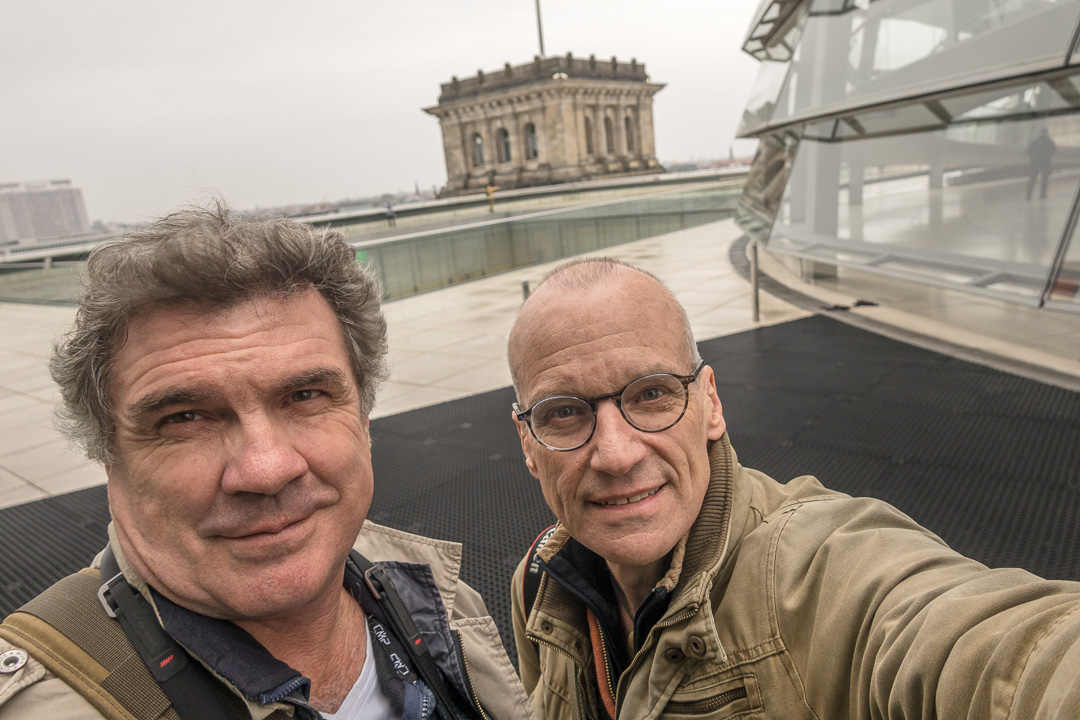
However, while I’ve enjoyed watching fellow Norwegians excel in Italy, my friend and colleague Morten Golimo and I have been busy with something far less athletic, but no less competitive in its own way: refining our shared exhibition, which we hope to show somewhere here in Norway.

The working title has been Individuals. We’ve gone full circle through a number of alternatives, but it seems we’re returning to where we started. Sometimes the first instinct is the right one.
We’ve now arrived at a final selection of images. Much of our recent work together has focused on the titles of each paired set. We’ve searched for wordplay that is both precise and open—titles that invite interpretation rather than dictate it. Two of the pairs are shown here, though unfortunately the Norwegian titles don’t translate particularly well into English.
I wrote about this collaboration in the post A Step in the Right Direction. As I mentioned there, we have paired our photographs across very different approaches, methods, and subject matter. My work is rooted in street photography, Morten’s emerges from close observations in nature. Despite these differences, both bodies of work circle the same question: what does it mean to be an individual?

The pairs are not meant to explain each other, but to enter into dialogue. When these two visual worlds are placed side by side, something third emerges. A human gaze meets nature’s gaze. An urban space encounters a natural habitat. It is in this space between the images that the exhibition finds its voice. Here, categories begin to loosen. The boundaries between human and nature, between type and individual, grow less distinct.
In Also sprach Zarathustra, Friedrich Nietzsche writes about human types—not as rigid classifications, but as stages, forces, and ways of being in the world. Our exhibition draws loosely on this idea: that humans, animals, and even plants can be seen as carriers of will, character, and individuality—not as representatives of something general, but as singular beings.
With this exhibition, we invite viewers to read the images together—to let them mirror and challenge one another—and perhaps to reconsider what truly separates us from what we so easily call nature.
This Week’s Book Read
 Only Barely Still – On Women and Wilderness by Catherine Lemblé is one of those photobooks that lingers with me after I’ve put it down. It quietly challenges the traditionally masculine narrative of Arctic exploration—without ever raising its voice.
Rather than repeating the familiar story of conquest and heroic endurance, Lemblé turns her attention to the lives of women in Svalbard. Through intimate portraits, landscapes, and archival photographs, she constructs a counter-narrative rooted in coexistence rather than domination.
Svalbard is often imagined as a harsh, mythic outpost where only the toughest men survive. In the visual history shaped by early exploration, women are largely absent. At the same time, the polar landscape itself has been described in feminised terms—“virgin,” “barren”—as something to be conquered or protected. Lemblé’s work unsettles these inherited metaphors.
What I appreciate most is the book’s restraint. It does not replace one heroic myth with another. Instead, it centres female presence as steady and matter-of-fact. The endurance depicted here is not spectacle, but lived experience. The inclusion of historical photographs of women in Svalbard quietly reclaims a forgotten visual archive.
An essay by Abi Andrews, drawing on ecofeminist thought and Ursula K. Le Guin, deepens the reflection by asking what heroism might look like if defined by presence rather than conquest. That idea stayed with me.
This book is not only about Svalbard. It is about how we tell stories—about landscapes, about gender, about belonging. And it gently invites us to reconsider those stories.




 Artist and writer Austin Kleon has written three stimulating, funny, generous, and indispensable little books. They are must-reads for anyone in need of creative oxygen. Are you running on empty? Searching for new ideas? Stuck in a rut? Then pick up Steal Like an Artist, Show Your Work, and Keep Going.




 In Flow with Otto