The 7 (1/2) Deaths of Evelyn Hardcastle

The Seven Deaths of Evelyn Hardcastle
U.S. Title: The 7 1/2 Deaths of Evelyn Hardcastle
by Stuart Turton
Originally published 2018
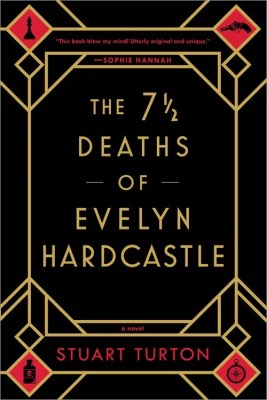
A man wakes up early in the morning, lying in the middle of a forest. The name “Anna” is on his lips. He doesn’t know who she is—he doesn’t know who he himself is. He has no memories of his life or identity before waking up. As he stumbles to his feet, continuing to call for Anna, he sees a woman in the distance—is it she?—pursued by a figure in black. Then a gunshot rings out.

Thus opens The Seven Deaths of Evelyn Hardcastle, and the reader is as disoriented as the protagonist. We (and he) eventually discover that he has woken up on the grounds of an estate called Blackheath, where he is one of the houseguests. Gradually, painfully, he learns the rules of the game that he has found himself playing. A murder will occur that day, after dinner. Our hero (whose real name is Aiden Bishop) must discover who the murderer is before the end of the day, and present the proof to a mysterious man in a plague doctor costume. If Bishop doesn’t solve (or perhaps, prevent) the murder, the day begins anew, and he will live the day over again, in the body of a different houseguest (cycling through eight, in total). This temporal loop will repeat continuously, until he, or one of the other “souls” trapped at Blackheath, solves the murder. But only the first one to solve the murder can escape.

Continue reading

The Adventures of Hercules Not-Poirot

In 1920, with her first novel The Mysterious Affair at Styles, Agatha Christie introduced the world to the retired Belgian police detective, Hercule Poirot.

Agatha Christie.
Agatha Christie (1890-1976). Source: Wikipedia

Yet this quaint dandified little man…had been in his time one of the most celebrated members of the Belgian police. As a detective, his flair had been extraordinary, and he had achieved triumphs by unravelling some of the most baffling cases of the day.

–- from The Mysterious Affair at Styles

Vain, obsessively neat, with an eye for physical and psychological detail, Poirot featured in more than eighty stories (novels and short form) over some fifty years. Christie herself might have grown to hate him, but whodunnit fans love him to this day.

Also in 1920, British author Marie Belloc Lowndes came out with The Lonely House. This romantic thriller is set in France, and features a retired French police inspector named—Hercules Popeau. Popeau is shrewd, observant, and gallant. He doesn’t seem particularly vain, but he’s certainly authoritative, respected and admired by law enforcement officials in France and beyond.

Marie Belloc Lowndes (1869-1947). Source Wikipedia


“…remember, good friend, that I’m always at your service. It was a black day for us when you left.”

–- Inspector Jean Copain to Popeau,
“A Labour of Hercules”

I only made it about three of four chapters into The Lonely House before I gave it up as too obvious, and rather slow. That was far enough, however, to wonder about the similarities between Popeau and Poirot. And skimming through the rest of the novel, I noticed a passage where Popeau, who has been quietly looking out for the (rather stupid naive) English heroine, urges her to call upon “Papa Popeau” should she find herself in need of assistance.

I checked, and yes: Poirot refers to himself as “Papa Poirot” twice in Styles, while trying to win the confidence of (and to help) a woman involved in the mystery. Hmmmm…..

Continue reading

The Woman of Atlantis

I’ve posted another of Victor Rousseau’s “Dr. Immanuel, occult physician” stories to Dark Tales Sleuth.

In “The Woman of Atlantis,” Dr. Immanuel’s latest patient is a writer whose most recent novel is a tragic love story, set in Atlantis. The writer, Field, falls in love with the heroine of his novel—and out of love with his fiancé, Cynthia. Naturally, Dr. Immanuel diagnoses this as another case of unresolved past life issues. Can the doctor help Field to overcome the the past life memories that are tearing his life and relationships apart?

Woman of atlantis meet again.
Illustration from The Evening Republican, March 27, 1917. Source: Hoosier State Chronicles.

This is story number six, of the nine Dr. Immanuel stories that appeared in the Indiana Evening Republican in 1917. The seventh story is called “A Fisher for Souls.” It’s not a terrible story, but it expresses some opinions that are a bit too racist for my taste. So rather than transcribe it, I’ll just link to it over at the Hoosier State Chronicles archive, for the curious who still wish to read it.

You can find that link, as well as all the Dr. Immanuel stories that I’ve transcribed or linked to so far, at the project page.

Enjoy!

Two about Ovine Investigators

Animal detectives, anyone? Here are two fun mystery novels featuring non-human investigators.

Three Bags Full
by Leonie Swann, translated from the German by Anthea Bell
Originally published 2005, English translation published 2005

Three bags full deluxe edition website 397x600.

A flock of sheep outside the Irish village of Glennkill discover their shepherd, George, lying dead in the meadow one morning, impaled by a spade. They decide it’s their duty to find George’s killer, and bring them to justice.

Apparently, this novel is being made into a movie, which is why it’s recently been reissued. I discovered it by accident, while browsing a bookstore. It seemed like a fun variation on a classic whodunnit—and I love whodunnits—so I gave it a try. I’m glad I did!

Continue reading

The Professor’s Peach Trees

I’ve posted another story from the series Dr. Immanuel, Tracer of Egos, to the Dark Tales Sleuth blog.

Dr. Immanuel and his friends.
Source: Hoosier State Chronicles

In “The Professor’s Peach Trees,” Dr. Immanuel tells his skeptical friends the tale of a woman who reincarnated herself as vegetation–for love. Specifically, as peach trees and flowers that thrived in the presence of her beloved. All the more reason to admire those with a green thumb, perhaps….

You can read “The Professor’s Peach Trees” here, at Dark Tales Sleuth.

This story also contains a mention of that famous ship-guiding dolphin, Pelorus Jack, whom I’ve blogged about before.

On the Dr. Immanuel project page, I’ve also added a link to the subsequent Dr. Immanuel story, “Mr. Axel’s Shady Past.” I’m not fond of that story–too misogynistic–so rather than transcribing it, I’ve linked to a scan of one of the story’s newspaper appearances, at the Hoosier State Chronicles.

Enjoy.

The Carfax Curse

About a month and half ago, I introduced the series Dr. Immanuel, Tracer of Egos, an occult investigator series by Victor Rousseau. Dr. Immanuel is a physician who treats his patients from the perspective that most mental maladies stem from unresolved past-life issues.

A bearded man approaches a distressed-looking boy in the ruins of a church. Image caption: "The boy trembled and seemed to be struggling with some overwhelming interior enemy."
Illustration from The Evening Republican Feb. 21, 1917. Source: Hoosier State Chronicles

I transcribed and posted one Dr. Immanuel story, and linked to another, and then life got in the way. But today, I’ve got another one!

In “The Carfax Curse,” Dr. Immanuel and his unnamed chronicler meet Sir John Carfax, whose family has suffered under a curse since the 16th century. This curse kills the first-born son in every generation, and Sir John’s son is next. Can Dr. Immanuel find a way to defeat the curse?

You can read “The Carfax Curse” here, at Dark Tales Sleuth.

Continue reading

Updated Links on Native American Code Talkers Post

For the sake of my health and sanity, I’ve been avoiding the news since January. But some inevitably leaks through, so I’ve arrived a bit late to the whole removal and apparent replacement of Navajo Code Talker history from DoD websites. I wrote an article about Native American code talkers way back in 2014, and by coincidence, I boosted that post last month, on the anniversary of the death of Navajo veteran Joe Kieyoomia (not a code talker, but connected to them).

After hearing about this incident, I went back to my old post to check the links. Indeed, some of them were dead, one or two because of recent events, others because the website died organically, so to speak. I’ve restored as many dead links as I could, with links from the Internet Archive. I chose versions of the pages from around the date of the original post. The only one I couldn’t restore was a link to the U.S. Marine Corps History Division. In fact, as of this writing, that entire website seems to be down, not just the Navajo Code Talkers section. It has never been crawled by the Internet Archive.

Anyway, here is the post, repaired as best I could:

The article discusses not just the Navajo Code Talkers, but also the Choctaw Code Talkers of World War I, and the history of Joe Kieyoomia, as mentioned above. I also include a link to an article about the Comanche Code Talkers of both World Wars I and II.

This Snopes article provides links (and archive links) to DoD websites that still contain information about the Code Talkers, at least as of March 19, 2025. Here is another Snopes article, about the removal of pages about Ira Hayes, a Pima veteran who was in the famous photo of soldiers raising the American flag on Iwo Jima.

It’s always a part of our history worth remembering, lived by people worth honoring.

Multo (Ghost), February 2025

Reading The Invisible Host

The Invisible Host
by Gwen Bristow and Bruce Manning
1930

In New Orleans, eight people get a telegram:

CONGRATULATIONS STOP PLANS AFOOT FOR SMALL SURPRISE PARTY
IN YOUR HONOR BIENVILLE PENTHOUSE NEXT SATURDAY EIGHT O'CLOCK
STOP ALL SUB ROSA BIG SURPRISE STOP MAINTAIN SECRECY STOP 
PROMISE YOU MOST ORIGINAL PARTY EVER STAGED IN NEW ORLEANS
                                            YOUR HOST
Invisible Host, by Gwen Bristow and Bruce Manning. First edition, The Mystery League
Source: AbeBooks

Intrigued, they all show up to the penthouse that Saturday evening, wondering who is throwing the party in their honor. But no one at the party admits to having sent the invitations. After dinner, a mysterious voice comes over the radio and claims to be their host. The voice informs them that they are now trapped in the penthouse by electrified doors, and that, one by one, before the evening is over, each of the guests will die….

Sound familiar? It’s substantially similar to the plot of Agatha Christie’s And Then There Were None, first published in 1939 under a title we can’t use anymore. And Then There Were None is the world’s best selling mystery, and one of the best selling books of all time, in any language or category.

But The Invisible Host, by husband and wife Gwen Bristow and Bruce Manning, came out in 1930—almost a decade before Christie’s novel. In fact the novel was adapted both into a play and a film (1934’s The Ninth Guest) before And Then There Were None appeared. Hmmmm….

Continue reading

Not in the Newspapers

I’m still working on my Austin Philips project! Today I have another Post Office crime story, from The Strand, February 1912.

This way miss gale.
Illustration by Albert Gilbert for “Not in the Newspapers,” Strand Magazine, Feb. 1912. Image Source.

In Not in the Newspapers, plucky postal clerk Miss Gale becomes involved in a situation of international significance.

The story is very much of its time, but Miss Gale is a great character! I wish that we had a continuing series of her adventures, especially if Philips could have worked her Post Office knowledge into the stories.

But at least we have this. Do enjoy!

Phileas Immanuel, Tracer of Egos

A bearded man in a chair speaks to two men, one seated facing him, the other standing and facing him.
Dr. Immanuel expounds to the narrator and Paul Tarrant. Source: Hoosier State Chronicles

Moving forward with my series on The Occult Detectives of Victor Rousseau: today we’ll start Rousseau’s second series, Dr. Phileas Immanuel, Tracer of Egos.

The Tracer of Egos series differs from Rousseau’s first series, in that the Immanuel stories are all about reincarnation. Dr. Immanuel treats his patients by helping them to resolve the issues in their past lives that are interfering with their current existence.

You can read my full discussion at Dark Tales Sleuth.

I particularly like the idea of this series, because, in a way, it matches one of my favorite subgenres of folklore and the supernatural:

…in a sense, the Dr. Immanuel stories are a modern updating of classic Chinese and Japanese ghost stories: stories of reincarnation and the karmic cycle, events replaying until the souls’ underlying issues are resolved. That’s what (to me) makes the best of The Tracer of Egos more interesting than The Surgeon of Souls.

I’ll be transcribing some of the stories, and linking to others. Today I’m sharing the first story, “The Amulet of Marduk,” in which we meet Dr. Immanuel and his two sidekicks: the unnamed narrator and the millionaire Paul Tarrant. Dr. Immanuel explains his theories of reincarnation, and then applies them to the case of the Tarrant family’s kleptomaniac governess.

You can read “The Amulet of Marduk” here. (Dark Tales Sleuth).

It’s a fun tale, and sets the stage for the rest of the series. I’ve found nine of the twelve stories in the series, and I’ll be bringing them out a few at a time on the project page.

Hope you enjoy them!