Washingtonia

It was a great pleasure to read my friends Kostis Kourelis and David Pettegrew’s (with Nikos Poulopoulos, Albert Sarvis, Alexandra Shehigian) article “Washingtonia 1829: an American refugee colony in Greece” in the most recent issue of the Journal of Greek Archaeology.

For those of you who don’t know, Washingtonia was the name of an early 19th century refugee settlement on the Isthmus of Corinth set up by Samuel Gridley Howe, managed by George Finlay, authorized by the Greek state, and briefly settled by refugees from the Greek War of Independence.

There more to this story than that, though. David Pettegrew has been searching for Washingtonia since around 2000. While working on the Eastern Korinthia Archaeological Survey, there was constant buzz about the location and character of this strange 19th century settlement set up by Samuel Gridley Howe. This prompted numerous efforts to locate the settlement, Howe’s house, the hospital, and other features (including the konak of Kiamil Bey). Over time, we came to realize that most of these features have simply disappeared without leaving much of a trace on the surface of the ground or in the architecture of various villages of the region. This was a sobering realization to us as survey archaeologists. Instead of the survey representing a palimpsest of past use, certain features including elite residences, institutional architecture, and entire settlements have disappeared leaving very little trace in the surface record. 

[Full disclosure: It was never in my best interest to try to record the number of hours I spent driving slowly around the village of Hexamilia with Tim and Lita Gregory and David Pettegrew looking for traces of Washingtonia. Most recently, in 2023 (I think?), we managed one more slow speed driving field day through Hexamilion before one of us cracked and demanded that we stop this madness and get ice cream. This was well before one of us who had been in a small rental car, driving slowly through a village, tested positive for COVID. I am very pleased that they have been able to find traces of Washingtonia in Hexamilia, and part of me is also very happy to perhaps not talk about Washingtonia for a few years or… you know… ever again.]

Kostis, David, and their colleagues have used documents to fill the gap in the surface and architectural record and to reconstruct the landscape of Washingtonia. They have identified the location of the “manor house” of Samuel Gridley Howe which overlooked (and presumably supervised) the settlement. There is abundant room for metaphor here especially in relation to the idea of Greece as a crypto-colony. Howe’s interest in providing a school and a hospital as well as the panoptic perspective offered from his manor reads like a page from 1960s Foucault especially as Howe occupied the rebuilt the konak of the Ottoman Bey. The drone images offer an intriguing (and deliberate) parallel to the panopticism of Howe’s rebuilt house. This article is too modest in some ways; their analysis makes visible the colonialism of Howe’s philanthropy and reinforces his patronizing view of his mission.

This is a paper that was over 20 years in the making and embodies the best aspects of slow archaeology. Not only did the team demonstrate incredibly familiarity with the local landscape, but also brought together a remarkable array of evidence from 19th century maps, diaries, and archival documents to drone photography, artifacts on the surface, and contemporary architectural study. This patient approach to landscape not only helps us understand the Howe’s view of his work, but also traces the complex processes that transformed the Late Ottoman and Early Modern landscape. In the place of persistent places, the maps and landscape offer traces of settlement — ruined villages, clusters of houses, vanished and ruined buildings. Whatever persistence archaeology assumed in the countryside vanishes beneath modern buildings, agricultural activities, and vegetation leaving only the barest traces.

Their patience in reconstructing the landscape of the early 19th century (as well as early and later traces) reveals how ephemeral even early modern architecture and activities can be even under the scrutiny of 21st century archaeologists’ gaze. This is a vital reminder of the limits of archaeology not only for the most recent past, but for antiquity and the complexities of formation processes in shaping what we can see, recognize, and analyze. It seems almost certain that there is more work to do here especially near Kenchreai. This does little to undermine the significance of their work. David, Kostis, and their colleagues have managed to do what we 20 years ago seemed impossible:  reconstructed the landscape of Samuel Gridley Howe’s Isthmus. 

Some Concluding Thoughts on Isthmia from Summer 2025


Our time at Isthmia this summer was remarkably productive. Not only did we manage to move through 2500 batches of context pottery from both very recent and older excavations, but we also had a chance to study broad range of inventoried artifacts including the large quantity of Early Byzantine material. More importantly, though, we had the opportunity to talk and think about the later history of the Roman bath at Isthmia, how various groups used the building, and what traces they left behind.

At the same time that I was thinking and working through these things, I was also reading about rubble, especially Gastón Gordillo 2014 book Rubble: The Afterlife of Destruction, and Bettina Stoetzer’s The Ruderal City: Ecologies of Migration, Race, and Urban Nature in Berlin (2022). 

The intersection of the careful study of the bath at Isthmia (and its transformation from ruin to rubble to ruin again), its larger context, and modern thinking about rubble supported this brief conclusion to my report. It’s not great, but it’s a start and sometimes just getting words on the page is the catalyst one needs to think more deeply about a project.

This survey of the later history of the Roman bath at Isthmia allows for three conclusions.

First, the presence of a series of horizons at Isthmia capture more than just discrete interventions in the life of the Roman bath. While it may be that Lamp Deposit and the material found beneath sections of collapsed wall in Room I and Room II is closely associated with the construction of the Hexamilion wall, continued activity on the floors of Room I, II, III-IV-V, and Room VI suggest that the construction of the wall itself did not lead to the abandonment of the bath. In fact, the digging of a trench across the northern part of the mosaic in Room VI, the creation of a new drainage system in Room IV, and the modification of the drains in Room I and II indicate that not long after the construction of the wall the bath building saw renewed investment. The shelter provided by the vaults of Room VI and the still standing walls elsewhere in the bath undoubtedly offers benefits worth repeated visits as the robust assemblage of 6th century material demonstrates. As the bath continued to collapse, it likewise continued to attract visitors. By situating the simple apsidal shelters of the so-called “Dark Age Settlement” within the larger context of the activity at the bath (and the site at Isthmia [e.g. Phase IV from Rife, Isthmia IX, 135-143), it becomes possible to see the 7th and 8th century activity at the bath as part of a continued use of the bath building as a place of shelter and investment. It becomes particularly important to consider the possibility of overlap between assemblages associated with the floor of the bath (and the burials in Room II) and the Early Byzantine surfaces. The closer these are in date, the more difficult it becomes to argue that the builders of the Early Byzantine surfaces at the site were unaware of the earlier burials and therefore a distinct (possible “Slavic”) community. As Rife notes in Isthmia IX (44), there is every indication that these are the same community who occupied the area around the bath in earlier centuries.

These conclusions are broadly similar to those reached by scholars studying Early Byzantine and Dark Age activities elsewhere in Greece where it is increasingly clear that handmade pottery, for example, does not necessarily represent new arrivals in the Balkan peninsula, but rather appears as a part of larger shift toward highly local ceramic production practices, changes in food preparation practices, and demographic change. The appearance of long-lived forms of ceramics — such as Late Roman 2 transport amphora and various wheelmade jugs, basins, and cookpots — with handmade forms of pottery reveals the process of material change at site.

In this geographic and chronological context, then, the assemblage at Isthmia reflects the ongoing development of life in the Corinthia and the Southern Balkans more broadly rather than a marked and catastrophic grand brèche. In this area, our work echoes that arguments advanced by scholars such as Thansis Vionis (as well as many others) who see the 7th and 8th centuries as a period of prolonged but incremental change rather than abrupt discontinuities. In this context, the period from the final, perhaps abortive, renovations of the Roman bath through to the so-called “Dark Age” settlement represents a continuous stretch of investment in both the bath building as well as the larger sanctuary. Continuous efforts to revise the chronology of widely distributed Late Roman ceramics complements work on locally produced cooking pots and utility wares to show that some of the best known forms dated traditionally to the 5th and 6th centuries may, in fact, date to a century (or more!) later. Deposit B9 at Koutsongilla (Kenchreai) for example produced both the latest forms of imported African Red Slip (e.g. 99) and Late Roman C ware (e.g. 3f) as well as “Slavic ware” in a fabric similar to that at Isthmia (no. 275). Intensive pedestrian survey in the Eastern Korinthia likewise noted the dispersed presence of contemporary activity in the fields east of Xylokeriza including ARS 99 and 104-6, a Group N juglette base, and a later amphora rim (see units 20, 502, 516, 519, and 527). The growing recognition of these assemblages across the region and Greece more broadly has made it possible both to connect the Early Byzantine or Dark Age period clearly to long standing Late Antique economic and cultural practices, especially through the continuity of ceramic types, and to demonstrate ongoing activity at urban, rural, and ex-urban sites such as Koutsongilla and Isthmia.

The modest character of the Dark Age settlement at Isthmia, with its surfaces and apsidal structures build atop the collapsing walls of the Roman bath, perhaps encouraged scholars to mark these activities as a significant change from those that preceded them. Our arguments for the continuity of activity and use of the bath, however, suggest that modern views toward collapsed structures and rubble more broadly influenced attitudes toward historical continuity. It seems likely that the collapsing walls of the bath and growing strata of rubbly debris continued to draw visitors to the site. These visitors likely appreciated the availability of shelter and building material on the most basic level. They may have also understood the site’s location as part of the trans-Isthmian Hexamilion Wall and the visibility of the bath’s crumbling remains as bearing witness to the long-term importance of the place. The presence of a burial in the Room II drain of the bath and investment necessary to adapt the changing shape of the bath to the needs of Late Roman and Early Byzantine visitors suggests that activities at the site were not simply opportunistic. In fact, the presence of rubble would not have marked the bath as a place of discontinuity or marginal or waning use as it might in our modern era, but as a site persistent value and significance.

Abandoned Villages on Cyprus

On my long flight home, I read Andrea Villani’s “Vanishing Villages: Exploring Habitation and Abandonment in the Dhiarizos Valley, Cyprus, and Surrounding Areas,” in the International Journal of Historical Archaeology (2025). The article studies the abandoned villages in the Dhiarizos Valley in the Paphos districted. Villani does this through field work, of course, but also through careful study of aerial photos and maps, census data, and earlier studies of vernacular architecture. Of particular note is the PRIO project website which collects information on the displacement of Greek and Turkish Cypriots after the 1974 war. I’ve been deeply curious about the situation in the Chrysochou valley around the village of Polis in the 1950s, 1960s and 1970s. The PRIO project website collects information no the villages of Polis, Chrysochou, Androlikou, Evretou, Meladeia, Melandra, Makounta, Myrimikoph, Gialia, Neo Chorio, Prodromi, Pelathousa, Ay. Isodoros, Tremythousa, and other predominantly Turkish-Cypriot settlements in the region.

Anyone who has spent any time in the Cypriot countryside knows that it is laced with abandoned villages. The reasons for the abandonment varied, but the intercommunal violence of the 1950s and the 1974 war represent major episodes of settlement reorganization which left numerous villages abandoned in the western part of the island. There were other opportunities for abandonment, of course, including in the Dhiarizos valley, earthquakes and dangers of landslides and slips. One of the more interesting observations offered by Villani is that the cause of abandonment not only impacts what was left at the site, but also subsequently post-abandonment formation processes. The removal of doors, windows, and roof tiles, for example, from a village abandoned because of the risk of landslips tends to accelerate the decay of the structures. Buildings abandoned as a result of the 1974 war tended to be more intact at the time of abandonment because their owners didn’t have the opportunity to come back and remove parts of the build that still had value. This ensured that many of these structures remained standing longer. 

Villani was also attentive to the materials used in the abandoned villages and how these impacted site formation. While it is widely known that mud brick will deteriorate if not maintained over a period of 50-70 years, the interplay of mud-brick, cinder blocks, cement roofs, and other building materials creates more complex processes. The tendency for heavy cement roofs which became common in mid-century Cyprus to collapse onto the floors of houses in ways that made them inaccessible (and therefore difficult to study) further impacts how we understand abandonment. Villani notes that the re-use of buildings by shepherds, for example. Shepherds tended to abandon the buildings used to house sheep or goats when they became filled with dung and other detritus. This suggests a strategy that either recognized an abundance of abandoned buildings or saw their opportunism as a short term strategy. 

Finally, it was particularly interesting to compare the PRIO data to the Kitchener maps from 1882 for the Chrysochou Valley. Over the last 10 years or so, I’ve been so immersed in the nitty gritty from the Princeton excavations that I’ve lost a bit of perspective on the larger region. I knew, of course, that many of the villages in the region were either Turkish Cypriot or had large Turkish-Cypriot populations and as a result were abandoned.

Three Things Thursday: Final Week at Isthmia Edition

This summer I’ve been trying to limit my blogging to a few times a week (excluding my “Foto Phriday” feature. Slowly, but surely, I’ve started to feel pressure to blog more and my discipline and focus have started to falter. My excuse is that is very hot here in the Corinthia and I’m getting excited about the end of the field season. This isn’t a very good excuse though.

Today, I’m giving in to my impulse to write with a short and sweet three things Thursday.

Thing the First

I’ve been thinking more and more about two metaphors that seem popular in today. First is life in the shadow of empire. This seems fitting to describe the Dark Age settlement that I’m studying at Isthmia which literally emerged in the shadow of the Late Roman Hexamilion Wall. 

The other metaphor is life amid ruins. This first captured my attention in Anna Tsing’s Mushroom at the End of the World: On the Possibility of Life in Capitalist Ruins (2015) and has sort of lingered around the edges of my thinking for the last decade or so. At Isthmia, of course, life amid ruins is quite literal. The 2nd century Roman Bath that forms a key character in the story we’re trying to tell is literally falling down throughout our narrative. In fact, the act of ruination appears to be more than simply a narrative distraction, but is fundamental to our understanding of the life at the Roman bath. As the partially deconstructed building falls down people who are living (or at least visiting) the Roman bath and the shadow of the Hexmilion Wall make do and adapt their surroundings.

Thing the Second 

As someone who received his PhD at the turn of the millennium, I hope that I can be excused for continuing to be preoccupied with the notion of continuity or change. Most of us studying Late Antiquity were talking about it as much to justify the period as a reasonable object of study as to argue that our focus on the period offered insights into both antiquity and the Middle Ages. Today, the study of Late Antiquity feels on more solid ground and less in need of justification, but the specter of continuity or change continues to exert an influence over how archaeologists (in particular) study the 4th to 8th centuries.

Our study of the Roman bath at Isthmia, puts the issue of continuity into relief. We’re trying to discern whether how much time passed between the last activities on the floor of the bath building (while it was partially deconstructed and falling down) and the activities on top of leveled surfaces that stood atop the rubble of collapsed walls which made the floor of the bath inaccessible. The nearer in date the two deposits, the better we can argue for continuity at the site. This is significant because the assemblage atop the collapsed walls of the bath includes handmade pottery that does not appear on or near the floor.

Thing the Third 

One of my great weaknesses as a scholar (other than, say, the compulsive blogging or my inability to focus on one thing at a time and so on) is that I need to write to think. As a result, I fill my world (and often the world of other people) with words, half baked ideas, and convoluted arguments. 

Right now, I’m in writing mode here at Isthmia. I’m trying to narrate the history of the afterlife of the Roman bath. It’s fun, frustrating, and energizing in turn. It is also incredibly inefficient and the embodiment of a kind of slow practice that requires patience for iterative aspects of writing (and thinking). 

Two Weeks at Isthmia

As my time working at Isthmia hits the two week mark, our routine of ceramic analysis is giving me the bandwidth to start to think more broadly about the situation at Isthmia.

For those who don’t read the blog regularly, I’ve been working with my colleagues Richard Rothaus and Scott Moore to analyze the after life of the Roman bath. To do this we’ve studied the way in which people used the bath not only for the construction of the Hexamilion Wall, but also for other activities including eventually settlement at the site.

The elephant in the room, of course, is the wall itself. Not only would it have loomed figuratively over the ruined bath, but also literally.

I continue to struggle to think about how the wall (and the bath) shaped the experience and behaviors of the individuals living in its ruins and shadow. As a way to think about this differently, I followed a tip by University of Virginia graduate student James Razumoff who suggested that I read some of Lori Khatchadourian’s work and provided me with a copy of “Life Extempore: Trials of Ruination in the Twilight Zone of Soviet Industry” from Current Anthropology 37.2 (2022), 317–348.

This article features how two Armenian informants leveraged the ruins of Soviet industrialization to make a living in the 21st century. Khatchadourian introduced the concept of “trails of ruination” which described the efforts to make a living from ruins when “time and temporality, matter and materiality rebuff with opposing force.” She deploys this concept to understand the tension between Soviet and capitalist forms of engagement with the materiality and time. 

At a site like Isthmia, of course, there are fewer traces of ideological change much less the kind of abrupt ideological change that occurred with the collapse of the Soviet empire. One wonders, however, how the memory of a particularly vibrant phase of Roman building in the Corinthia (and the institutional apparatus that made such a phase possible) lingered in the wall (and the earlier bath). 

This summer, I’ve spent far less time thinking about the wall and the bath and more time thinking about the material from individuals “lots” or stratigraphic (loosely defined) units. The finds from each unit will help us be able to tell the larger story of the post-Roman bath. Thus far, we have studied almost 2000 sherds from context pottery and over 100 inventoried finds from the bath. Our plan is to produce the definitive publication of the bath’s afterlife with a thorough, if not complete, artifact catalogue.

Stay tuned for more!

Writing Wednesday: Projects for the Fall

Lately, I’ve struggled a bit to find the enjoyment in writing. I’m not exactly sure what the deal is. Perhaps I’ve been writing too much technical stuff and not enough creative stuff. Maybe I’m just feeling a bit like I’m on a treadmill or writing too far ahead of my reading.

Whatever the reason, I’m struggling to get motivated to do something that I fear will be a drudgery. To help my precarious state of mind, I’ve signed up for a writing group with the idea that maybe the social aspect of writing will help me get motivated again. It should be timely too boot. I have five writing projects this fall. If the prospect of writing for pleasure fails to motivate me, deadlines will have to suffice.

Here are my writing project (and by extension what you’ll be reading on this blog over the next couple of months):

1. Polis I. I’ve written most of my section of the first Polis volume which is due to the publisher by the first of the year, but I’ve still offered to write the conclusion. In some ways, I’m in a holding pattern until I see the various parts of the book, but it is on the schedule.

2. Grants. I have two grant proposals: one for Polis and one for our work in Greece. These are nice things to write because they get me working toward next summer’s fieldwork and thinking through how to articulate our historical and archaeological questions. More than that, neither of these are particularly long grant applications (I think they’re both about 1000 words).

3. Walls as Place Paper for Michigan State. I’ve been reading about walls lately and thinking about ways to talk about the Hexamilion Wall. Right now, I want to do something that emphasizes how the Hexamilion is not a border wall (in a traditional sense of, say, Hadrian’s wall or the Anastasian Walls in Thrace). Perhaps it served to protect both the Peloponnesus as well as a corridor between the mass of Mt. Oneion and the Isthmus through which traffic could move to Corinth and to the city’s western ports.

More than that, over its life, the wall became a landmark and a material asset for communities in the region. The Roman bath at Isthmia which forms part of the southern face of the wall appears to have undergone adaptation that suggests the continued use of the structure for centuries after the bath itself went out of use. While the reuse of monumental buildings in the countryside is not particularly unusual in Greece, it does suggest that the afterlife of the bath and the ongoing presence of the wall created new opportunities for settlement.

This is not particularly profound, but it is work in progress!     

4. City of Work Paper for ASOR. Scott Moore, Nancy Serwint, and I are giving a paper at ASOR in November and I will write the first draft. The goal of the paper is to dig into some of the evidence for industrial activities at the area of E.F2 at Polis with particular attention to the lamp deposit. In particular, I want to toy around with the argument for the construction of industrial terraces on either side of the drainage that runs through the area and connect one of these terracing activities with a unique deposit of lamps. These terraces not only created flat surfaces for buildings, but also produced odd opportunities for the reuse of earlier industrial remains for new (if hard to understand) functions. 

5. Pseudoarchaeology Paper for ASOR. Finally, I’m giving a very short paper on pseudoarchaeology for a workshop session at ASOR. This will be a nice opportunity to present some of my ideas and get some feedback. I also should be fun.

Two Thing Tuesday: Waste

I’m taking a bit longer to re-enter my regular routine than usual after a week visiting family in Florida. Yesterday, though, I managed to spend an hour reading a couple of articles on waste.

First, I read another of the little gaggle of previewed articles from a forth coming special issue of the Historical Archaeology on urban archaeology. This article is by Jonathan Gardner and titled, “What Makes a Wasteland? A Contemporary Archaeology of Urban Waste Sites.” Gardner continues his interesting work on the site of the 2012 London Olympics (see also his interesting piece in a JCA forum similarly dedicated to waste: JCA 10.1 [2023])

Gardner’s piece for Historical Archaeology explores two urban wastelands: one became the site for the 2012 London Olympics and the other a coastal site in the city of Edinburgh, Scotland. Both sites witness dumping at various points in their histories which facilitated the reclaiming of ground that was often inundated. Moreover, the Olympic site was home to business, industrial establishments, and neighborhoods. The decision to declare this site as a “wasteland” (or a brownfield in UK terms which means a site that had been developed and was available for future development) underscored the tension between concepts of urban wasteland as underutilized (and therefore possessing wasted potential) and as expired land with little value beyond complete redevelopment. For Gardner, the coastal area of Edinburgh, which also saw large scale dumping of construction debris represents another waste zone. Unlike the London Olympic site that saw large scale redevelopment, the stretch of debris laden beach in Edinburgh saw the potential of waste sites as places of recreation, creative work, and history. His study of the bricks, for example, offered a window in the thriving Scottish brick industry of the early 20th century. The use of construction debris for spontaneous expressions of creativity and temporary recreational installations for bonfires, barbecues, and beachside afternoons. Like the London Olympic site, this site showed the continued potential was not just implicit in waste sites, but emergent through their daily use. Thus waste constantly blinks between its potential and actual role in urban areas and Gardner stresses this aspect as “dissonance and dialectical seeing” present in waste sites.

Leila Papoli-Yazdi and William Hogland’s offer similar perspectives on wastelands and waste in their recent article in the European Journal of Archaeology, “Wreckage Installation: Towards an Archaeology of Southern Sweden’s HeterotopiasEJA 26.2 (2022). In their piece they studied collections of abandoned vehicles, farm equipment, and everyday objects arranged within and around farms on the island of Öland in south-eastern Sweden. Papoli-Yazdi and Hogland argue that these spaces are Foucauldian heterotopias where different functions, “slivers of time,” and spatial arrangements demonstrate the power of heterotopic places as creative as well as mnemonic. In the abandoned, but curated collection of discarded automobiles and farm equipment on Öland the authors found the same tensions that define and describe wastelands in London and Edinburgh.

This work fascinates me in part because I’ve had a long interest in wastelands and under utilized spaces in urban areas. For example, I’ve been mulling over a project that documents surface parking lots in Grand Forks, ND and documents material found in these lots. This material should reveal the diversity of activities taking place in these places which are often suspended between “waste” — especially as understood as wastes of space — and as potential spaces for a wide range of activities from recreation to simple survival.

What Would You Say That You Do: Isthmia Final Report

One of the most consistent assumptions about my summers is that I’m digging. I used to try to tell people that I don’t really dig (much less LIKE to dig), but I’ve more or less given up on that. This is partly because it invariably prompts the response: if you don’t dig, what would you say… you do there?

This summer in Greece, my colleagues, Richard Rothaus and R. Scott Moore, and I worked on the Late Roman and Early Byzantine phases of the 2nd-century Roman bath at Isthmia. We were particularly interested in evaluating the conclusions of Tim Gregory in his 1995 preliminary report and Birgitta Wohl in her 1981 article on a deposit of lamps from the bath

The main outcome of this year’s season is a 9,800 word preliminary report on our research. This has focused on the abandonment levels. Our goal was to evaluate the evidence for the dating of the abandonment of the bath (and the building of the Hexamilion wall),  to contextualize later material present at the bath, and to inform how we understand the re-use of this monumental structure. Be aware that these are all provisional and at time tentative conclusions.

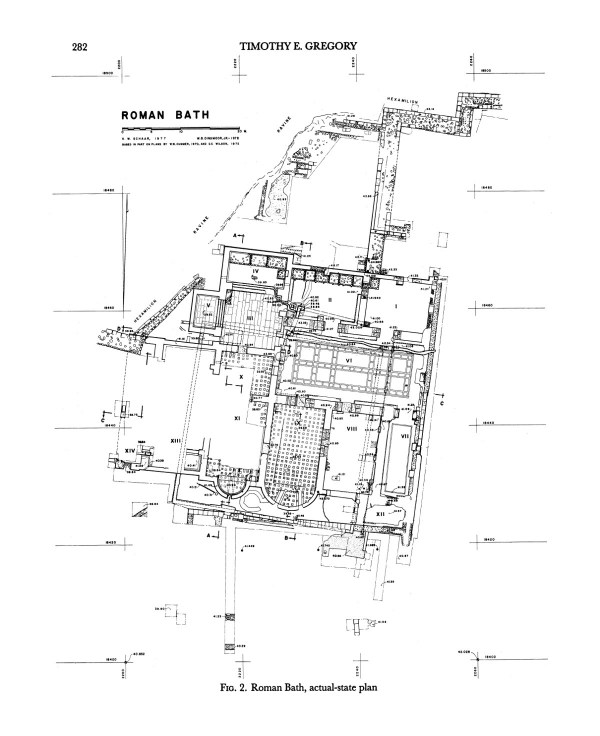
Here’s a labeled plan of the bath which will help make the report linked at the end of this blog post make sense. 

Final report from “Slavic Team” at Isthmia.

Pyla-Kokkinokremos

In an effort to catch up on some reading this past week, I spent some time with Joachim Bretschneider, Athanasia Kanta, Jan Driessen, Excavations at Pyla-Kokkinokremos: Report on the 2014-2019 Campaigns. Louvain 2023. This book documents five seasons of field work at the Late Bronze Age site of Kokkinokremos which is in the coastal region of Pyla village. It stands on a prominent, heart-shaped hill overlooking the Koutsopetria plain and immediately to the east of the site of Pyla-Vigla which occupies another prominent coastal height. Readers of this blog know that we conducted intensive survey of the region including the Kokkinokremos hill. Bretschneider, Kanta, and Driessen’s excavations at Kokkinokremos is the fourth campaign at the site which was initially excavated by Porphyrios Dikaios in 1934 and then over two seasons by Vassos Karageorghis and his colleagues in the 1980s and from 2010-2012. 

In 2008 and 2009, my little project excavated a series of trenches on the site as well, in a very minor series of excavations designed largely to ground truth a campaign of remote sensing on the site and to assess whether the site’s casemate style of architecture continued around the entire hill. Michael Brown, who directed this part of our project’s work published most of his results in his 2012 dissertation which is available here.

Bretschneider, Kanta, and Driessen’s book is intensely (and intensively) descriptive in a way reserved for archaeological reports. This is fine, but it doesn’t really entice the reader to dive deeply into the text, immerse oneself in a narrative, or reflect on the thousands of small decisions that go into an excavation. This isn’t so much a criticism of the book as a characterization of its approach to reporting on a site. It’s old school and very much in keeping with the kind of book that I’m working on these days describing our nearly contemporary excavations at Vigla and Kokkinokremos. These books have a place in archaeology, I think, but I also acknowledge that they’re a dying breed.

I won’t try to describe or assess the book here, but I’ll offer a few observations that are largely relevant to our work at Vigla.

1. Single Period. One of the most remarkable things about Kokkinokremos is that even after almost a dozen seasons of work at the site, there is no evidence for more than one main period of occupation. Bretschneider, Kanta, and Driessen acknowledge that our survey produced Roman and Late Roman material from the surface, but also claimed that their excavations produced very little similar material. 

More significantly, the excavations did not produce any compelling evidence for multiple phases at the site. In fact, excavations at Kokkinokremos did not appear to even produce evidence for adaptation, discard, or abandonment. This suggests a site that was active for a short period of time — maybe only 50 years — and did not experience a gradual abandonment or decline. 

This is interesting for a number of reasons largely to do with our understanding of the Late Bronze Age on Cyprus and the transition to the Iron Age. For our work, however, this is interesting because the adjacent site of Vigla shows a similar pattern of use during the Early Hellenistic period. While our excavations at Vigla revealed at least some evidence for clean up and adaptation of the site — which distinguishes it from Kokkinokremos — there is little evidence that this activity took place over an appreciable length of time. Fifty years of intensive occupation seems about right for Vigla.

After the period of intensive occupation… nothing. Later activity at both sites is limited to scatter of later ceramics perhaps identified with quarrying stones or agricultural activity at the sites. 

2. Function and Form. The form of Kokkinokremos is especially vexing. The main architectural feature of the site is the massive casemate style wall. The excavators note, however, that the casemate walls are not especially thick, suggesting that they were neither high nor especially formidable. In other words, these walls as well the position of the site on a high coastal plateau appear to be more of a deterrent than an actual fortification against an enemy incursion.

The significant number of pithoi and deep pits around the site suggest that the casemate walls likely served to protect a community who had invested in the storage of food and water. In fact, it is unlikely (and probably impossible) that the site had a natural water supply. This meant that storage of water was almost certainly a priority if one imagines the casemate walls as a form of fortification.

It is also striking that the site seems to have had very few buildings inside the casemate walls. While this awaits further investigation, one wonders whether this area was reserved for fertilized and irrigated gardens. 

3. Connectivity. One of the coolest things about the excavations at Kokkinokremos is that they’ve demonstrated that the residents of the site were connected to expansive networks of exchange. The excavators recovered ceramics from Crete, mainland Greece, Syria, Asia Minor, and — most spectacularly to my mind — Sardinia. While the authors of this report do not offer a definitive understanding of why such a diverse assemblage of material is present at Kokkinokremos, it is clear that its coastal location and the probable existence of an inlet, wetland, or embayment facilitated connections with maritime routes (and the parallels with the contemporary site at Hala Sultan Tekke). That said, the location of a site on the coast doesn’t necessarily produce the range of connections present at Kokkinokremos.

Again, it is interesting that the MUCH later Roman site of Koutsopetria showed a similarly wide range of economic connections across the Mediterranean. One wonders whether the situation of Kokkinokremos and Koutsopetria on the southern coast of Larnaka Bay situated near Hala Sultan Tekke/Kition and on the overland route to Enkomi/Salamis predisposed sites in the region to accumulate regional connections whether in the Bronze Age or in later Roman times.

Finally, and this just a side note, the site produced some absolutely amazing finds. We’re talking plaster spheres with folded gold objects inside, bronze figures of Astarte, and alabaster flask filled with precious objects. As the old saying goes: come for the rigorously documented archaeology, stay for the glorious color photos of cool stuff.

Modern and Early Modern Greek Landscapes

Over the last few weeks, I’ve been distracted and honestly a bit fried. I feel like just keeping on top of my classes and shooting the wolf closet to the sled was about all I could muster. I did, however, carve out some time to read Faidon Moudopoulos-Athanasiou’s book on the archaeology (and history) of the Zagori: The Early Modern Zagori of Northwest Greece: An Interdisciplinary Archaeological Inquiry into a Montane Cultural Landscape (2023).

As a little side note: Sidestone Press does make the book available as a PDF at a really reasonable cost of $15 which is more than fair for a book that is well designed and lavishly illustrated. Some of the photographers are fantastic! More than that, you can read the book for free on their website. Check it out here

The book is sweeping and complex and represents not only Moudopoulos-Athanasiou’s immersion in the local landscape, but also his familiarity with a wide range of local histories, ethnographic sources, and archival material. Through these sources he produces a new history of the region from the 15th century though the late-20th, that is attentive to both the material remains of the past as well as the recent efforts to make the region a tourist and natural heritage landmark. 

The book is good and represents another meaningful contribution to the recent wave of significant work on the Greek landscape. As per my usual practice, I’m not going to review this book, but highlight a few things that made it compelling to me:

1. Walking. One of the most striking things about Moudopoulos-Athanasiou’s is his forthright attitude toward the challenges of doing fieldwork in a region that is rugged and afforested. He makes clear that most topographic and even economic knowledge of this landscape came from individuals who gained their understanding of the region on foot. To make sense of the historical landscape, then, required an appreciation of how one might engage the region on foot. Walking the landscape as a modern archaeologist offered one perspective on this historical knowledge. That said, Moudopoulos-Athanasiou made clear that this was not an appeal to a kind of ahistorical phenomenology, but rather another contributing element to a grounded understanding of region which is nothing without an appreciation of how various agents produced past and present knowledge. 

2. Economies. Among the most useful (and familiar) narrative in the book is a solid regional understanding of Zagori’s economic development. Despite the seeming isolation of the region and its tradition of local independence politically, Moudopoulos-Athanasiou shows that settlement and land use in Zagori developed in response to economic stresses   originating in provincial centers — in this case Janina — and in some cases stretching beyond the Mediterranean region itself. At the same time, Moudopoulos-Athanasiou recognized that local responses to these stresses by both the elites and the peasants who made the Zagori home. In particular, Moudopoulos-Athanasiou connects the monetization of taxes to the increased mobility of the local population and demonstrates that 19th century travelers whose remittences shaped so much of the region’s architectural and artistic flourishing, were an expression of the same forces that promoted movement from mountain villages to Ottoman çiftliks or as transhumant pastoralism.  

3. Elites. One of my favorite elements of Moudopoulos-Athanasiou’s book is his discussion of the continuity among local elites. He manages to trace the status of local elites from the end of the Byzantine Despotate of Epirus through the rise of Ali Pasha in Janina (and beyond). In this context, the vaunted independence of the Zagori region appears to have less to do with the persistence of a kind of indefatigable autochthonous Orthodoxy and Hellenic culture (and long-held trope familiar to anyone who has studied the emergence of Greek nationalism) and more to do with the persistence of a class of elites whose political allegiances sought to preserve their positions of power. 

4. Local Knowledge. Moudopoulos-Athanasiou demonstrated a remarkable familiarity with local archives, interlocutors, folk stories, and histories. This is understandable, of course, because his family comes from the region and in good ethnographic fashion, he resided in the region for a long stretch of time owing to the COVID pandemic. He recognizes when local narratives have absorbed national or regional ones while at the same time finding utility in unpacking some of the more distinctive stories told by residents of the region. As a completely unprofessional aside, I found the stories in the book to be fascinating and in some cases charming!  

5. Early Modern Landscapes. As someone interested in Modern and Early Modern landscapes, Moudopoulos-Athanasiou’s book is a great case study for how to approach modern landscapes as both artifacts of the priorities of the Greek state and as palimpsest for unpacking the regional level settlement and economic concerns. His grasp of both the local situation and the larger historiography of “post-Byzantine” archaeology is Greece is really great and makes my modest efforts to contribute to the archaeology of Modern and Early Modern Greece look one sided (if harmlessly so) by comparison.