


1. Once again, new material about the manuscript collector and dealer Friedrich Grote (1861-1922) found its way to me. You can find the first four posts of this series here, here, here, and here. This time, I must thank Christoph Rauch, head of the Oriental Department at the Berlin State Library and PI of the manuscript portal Qalamos. At the end of December 2025, Christoph drew my attention to a report written in 1925 by the Orientalist and librarian Gotthold Weil (1882-1960), one of his predecessors. This report, which is kept in the General State Archives in a collection of files entitled “Completion of the Royal Library – 1920-1934” (file number: I. HA Rep. 76, Vc Sect. 2 Tit. XXIII Litt. B No. 11 Vol. 24), dates from a few years after Grotes death. It discusses a sales offer made by Grote’s widow Käthe Grote-Hahn (1894–1976) to the State Library.1
2. The negotiations with the Berlin library are also known from Georg Graf’s correspondence with Emil Gratzl.2 However, the new material sheds interesting light on three aspects: (1) the collection’s interests and which manuscripts were considered for purchase and which were not; (2) earlier scholars’ engagement with the Grote collection and how personal entanglements were viewed by contemporaries; (3) unclear provenance, which was already considered problematic at that time and was an important reason why no manuscripts from Grote-Hahn were purchased.
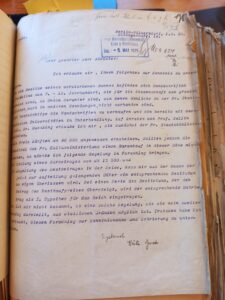
3. Let us begin with Grote-Hahn’s sales offer, which is also included in the files (see fig. 1). She wrote it on 1 May 1925. The letter is addressed to the Minister of Science, Art, and Education, who at that time was none other than the famous Orientalist Carl Heinrich Becker (1876-1933). (Here you can read a letter from February 1925 in which Becker informs his siblings about his appointment as minister.) Since Becker was appointed minister in the same year, the offer will not have been made coincidentally at this point in time. Perhaps Grote-Hahn calculated that Becker might be favourably disposed towards a purchase. Her letter moreover documents that she attempted already in 1925 to sell the entire Grote collection. It’s also interesting how she characterises it: She mentions that the manuscripts date from the 7th to 12th centuries CE and that there are “unica” among them, a phrasing that is reminiscent of Karl W. Hiersemann’s Katalog 500, which is known to have contained Grote manuscripts.3
4. In her letter, she also says that she is in negotiations with American universities (perhaps Harvard, to which Grote himself sold six fragments in 1922;4 Weil talks of the University of Michigan in his report, which, according to him, didn’t end up buying manuscripts from Grote). The Old Testament scholar Ernst Sellin (1867-1946) and the Orientalist Hugo Duensing (1877-1961) are said to have advised her to sell it to the Berlin library instead. The price she asked for the entire collection is 60,000 Marks – roughly three times the annual salary of a senior civil servant in the Weimar Republic.5 Grote-Hahn is well aware that this is not an easy sum even for the state to pay, which is why she proposes that 15,000 Marks be paid in cash and the rest as “appropriate property” (real estate?).
5. To give some context, Käthe Grote-Hahn was 31 years old at the time and had just enrolled as a student of political science at Humboldt University in Berlin. This must have been a point in her life in which she was trying to make up for what she had missed out on in favour of her marriage to Grote, who was more than 30 years her senior (and she was not to remarry until 1962).6 In the same year as her husband, she also lost their two-year-old child.7 Hence, she might be said to have been in the process of reorganising her life and retaking control of it, for which financial independence would obviously have been a great advantage. What the letter highlights is an impression one also gets from other sources. Grote-Hahn carefully attempted to marshall the social power of certain learned networks and, even if it remained unsuccessful, focused on contacting the right people and dropping the right names.
6. This leads us to Weil’s report. It is quite detailed, comprising five pages (almost 30 lines per typewritten page). Right at the beginning, Weil says that it was not just based on Grote-Hahn’s letter, but also on a list (perhaps the same inventory list that Graf was mailed in 1924)8 as well as another report by Duensing. Neither seems to be part of the files at the General State Archives. Weil notes that only four manuscripts from the entire collection should actually be considered for purchase (they are designated with the numbers 1, 2, 13 and 19). The others, which include prints and Christian Arabic fragments, as we learn on the following pages, are “of no particular value”, according to Weil. By contrast, he considers the four separate numbers to be of interest because they are Christian Palestinian Aramaic (CPA) manuscripts. He therefore continues to explain to Minister Becker the value of such literary witnesses in this language and highlights which other European collections possess CPA manuscripts (St Petersburg, British Museum, Bodleian Library, “British private collectors”).9 Weil also immediately mentions St Catherine’s Monastery: “Remnants of this literature are also preserved in the Sinai Monastery, but nothing definite can be said about how extensive they are” (“Im Sinaikloster werden auch Reste dieser Literatur autbewahrt, über deren Umfang jedoch nichts Bestimmtes gesegt werden kann”).
7. So, on the one hand, Weil concedes that acquiring the four numbers would be attractive, but then jumps into presenting the counterarguments on page two. First of all, there is the price, which he calls “exorbitant” (on page 5 he again calls it “exceeding the normal amount many times over”). He then cites four further reasons against the purchase. I will summarise them here: (1) the state of preservation, which he cannot assess without having seen the manuscripts, and he expresses his fear that it is rather “pitiful” (“erbärmlich”), which suggests conservation costs and possibly little scholarly value; (2) some, or perhaps most, of the legible texts from the fragments have already been published by Duensing and Friedrich Schulthess (1868-1922), which means that they are probably no longer relevant for research;10 (3) the negotiations with American universities that Grote-Hahn brings up must be seen as a means of exerting pressure; Weil here mentions in passing that the Grotes had already conducted unsuccessful negotiations with the Berlin library “during the years of inflation”, i.e. probably between 1918 and 1923; (4) the last reason is what Weil calls “the mystery of the origin and acquisition of these manuscripts” (“das Geheimnis der Herkunft und Erwerbung dieser Handschriften”), something which he says he feels the need to draw the minister’s attention to — his remarks on this subject go on to fill almost two pages.
8. In the following, Weil lays out what essentially sounds like an academic feud between Duensing and Schulthess.11 This feud arose over the CPA manuscripts, which, according to Weil, were “in the hands of Mr. Duensing” until 1906, indicating “that he [i.e. Duensing] had a close relationship with the owners”. For Weil, this is also confirmed by a vague remark on provenance in Duensing’s 1906 book Christlich-palästinisch-aramäische Texte und Fragmente.12
9. Weil goes on to quote from Schulthess’s review of Duensing’s book, in which Schulthess criticises Duensing for failing to provide the necessary provenance information. Weil comments on this with the following words: “The suspicion must therefore be raised that someone acquired these manuscripts unlawfully” (“Es muß daher der Verdacht einer unrechtmäßigen Erwerbung dieser Handschriften durch irgendwelche Personen geäußert werden”). He adds that Grote-Hahn herself gives rise to this suspicion because one of the numbers in her inventory (no. 8) is described as “fragments from manuscripts of the Sinai Monastery”. Schulthess already articulated the suspicion concerning the Sinaitic origin in his review and, as Weil also knows, Agnes Smith Lewis confirms this in a published note on Schulthess’s review.13 At the end of his remarks on provenance, Weil contrasts the value of the Arabic and Syriac manuscripts, practically deeming the Arabic ones to be worthless.
10. Weil finally arrives at the following conclusion: It does not inspire confidence that “more than 20 years” surrounded the origin of the manuscripts. In his view, this is in line with the fact that Grote-Hahn is not offering the collection for viewing prior to sale, which would otherwise be the usual procedure. Duensing’s statements in the separate report must be disregarded because he “has friendly relations with the owners”. Furthermore, Weil says the report is undated and apparently incomplete (possibly suggesting that it was tampered with). The fact that Ernst Selling, the second academic authority mentioned alongside Duensing, has not yet commented on the collection either publicly or to the Berlin library also does not speak for the credibility of the offer. In the end, however, Weil is willing to consider purchasing the four CPA manuscripts for 15,000 marks. However, this is conditional on the manuscripts being available for inspection and Grote-Hahn providing “proof of acquisition” for the manuscripts. She did not have such proof, of course, and the purchase ultimately did not go through.
11. The fact that the Berlin Library nevertheless holds manuscripts that can be traced back to Grote is due to the dealer (and later “collector”) having already made sales through other channels earlier on (the two manuscripts Berlin, State Library, Ms. or. oct. 1108 and Ms. or. oct. 1839 certainly go back to Grote and there is evidence suggesting that Ms. or. 1019 might as well). Weil apparently wasn’t aware of this. I see the value of his report primarily in the fact that it proves that already during Grote’s lifetime, his contemporaries were aware of the Sinaitic origin of his manuscripts. However, shortly after his death at the latest it became clear to more and more people that he was actively trying to conceal it. For his widow, they were an investment, but they also became something of a burden because it turned out to be rather hard to sell an unprovenanced collection. Duensing’s involvement with the Grotes in particular did not reflect well on him in Weil’s eyes. Weil was one of the few who saw through the game of building credibility through networks of collectors, academics, and purchasing institutions. And he was not willing to play it.
- On Käthe Grote-Hahn, see Peter Tarras, “The Collector’s Heir: Käthe Rehfeld (Previously Grote, Née Hahn)“, COMSt Bulletin, 9 (2023 [2024]), pp. 115-128; idem, “Friedrich Heinrich Ludwig Grote (1861-1922) und die christlich-orientalischen Diasporahandschriften vom Sinai: Biographie eines Sammlers”, Oriens Christianus, 106 (2023 [2024]), pp. 209-280, at pp. 265-279. [↩]
- See P. Tarras, ‘Collector’s Heir’, p. 122. [↩]
- See Karl W. Hiersemann, Katalog 500: Orientalische Manuskripte: Arabische, syrische, griechische, armenische, persische Handschriften des 7.-18. Jahrhderts [sic]: meist theologischen, vorzüglich kirchen- u. liturgiegeschichtlichen Inhalts von hoher Bedeutung z. gr. Tl. Inedita und Unica (Leipzig: Karl W. Hiersemann, 1922); see also Grigory Kessel, “Membra disjecta sinaitica I: A Reconstruction of the Syriac Galen Palimpsest“, in: André Binggeli, Anne Boud’hors, Matthieu Cassin (eds), Manuscripta Graeca et Orientalia: Mélanges monastiques et patristiques en l’honneur de Paul Géhin, Orientalia Lovaniensia Analecta, 243 (Leuven, Paris, and Bristol, CT: Peeters, 2016), pp. 469-496, at p. 485; Peter Tarras, “A Note on Georg Graf’s Nachlass”, Biblia Arabica Blog (4 December 2018), URL = <https://biblia-arabica.com/a-note-on-georg-grafs-nachlass/>. [↩]
- See Grigory Kessel, “Membra disjecta sinaitica II: Three Syriac Fragments in the Harvard Library“, Harvard Library Bulletin, 25/3 (2014 [2016]), pp. 30-54; see also this eralier post about one of the Christian Arabic fragments that Grote sold to Harvard’s Semitic Museum. [↩]
- I came across a recent publication on Google Books that seems to offer useful comparative figures, citing 18,000 Marks as the annual income of a law professor in Berlin for the year 1928; see Hartmut Berghoff, Manfred Grieger, Die Geschichte des Hauses Bahlsen: Keks – Krieg – Konsum 1911-1974 (Göttingen: Wallstein Verlag, 2024), p. 98. [↩]
- P. Tarras, “Collector’s Heir”, p. 119. [↩]
- P. Tarras, “Collector’s Heir”, p. 118. [↩]
- See P. Tarras, “Collector’s Heir”, p. 122; see also idem, “From Sinai to Munich: Tracing the History of a Fragment from the Grote Collection“, Comparative Oriental Manuscripts Bulletin, 6/1 (2020), pp. 73-90, at p. 78. [↩]
- Weil also mentions MS Sachau 295 = Petermann Syr. 28 (facsimile)as the ms of the Berlin library that may be said to be CPA [↩]
- The publications Weil is referring to are the following: Friedrich Schulthess, “Christlich-palästinische Fragmente“, Zeitschrift der Deutschen Morgenländischen Gesellschaft, 56 (1902), pp. 249-261; idem, Lexicon Syropalaestinum (Berlin: Georg Reimer, 1903 (Weil notes that Duensing did not give Schulthess access to the Grote fragments while compiling the lexicon); Hugo Duensing, Duensing, Christlich-palästinisch-aramäische Texte und Fragmente nebst einer Abhandlung über den Wert der palästinischen Septuaginta (Göttingen: Vandenhoeck und Rupprecht, 1906); Weil also mentions Schulthess’ review of Duensing’s book: Friedrich Schulthess, “[Review] P. Kokowzoff: Nouveau fragments syropalestinens; H. Duensing: Christlich-palästinische Texte und Fragmente”, Zeitschrift der Deutschen Morgenländischen Gesellschaft, 61 (1907), pp. 206-222. [↩]
- I have written about this myself, see P. Tarras, “Friedrich Heinrich Ludwig Grote”, pp. 225-258; see also my forthcming article “The Legacy of a Failed Amateur Enthusiast: Friedrich Grote’s ‘Sinaitic Discoveries’ and Their Post Sinaitic Fate”, in: Ute Pietruschka, Christoph Rauch, Torsten Wollina (eds), Oriental Manuscripts in Germany: Collection Histories between Academic Curiosity, Commercial Ambitions and Imperialism, Studies in Manuscript Cultures (DeGruyter). [↩]
- See H. Duensing, Texte und Fragmente, p. 1: “The texts and text fragments published here were found in manuscripts and manuscript fragments entrusted to me for review by a private man [“Privatmann”]. He allowed me to publish them in return for a favour, which I have done him by identifying these and many other manuscripts and manuscript fragments” (ET mine). [↩]
- See Agnes Smith Lewis, “Zu H. Duensing, Christlich-palästinische Texte und Fragmente“, Zeitschrift der Deutschen Morgenländischen Gesellschaft 61 (1907), pp. 630-632. [↩]

The text only may be used under licence Creative Commons Attribution 4.0 International
 . All other elements (illustrations, imported files) are “All rights reserved”, unless otherwise stated.
OpenEdition suggests that you cite this post as follows:
Peter Tarras (February 19, 2026). New Materials on Grote (Part 5). Membra Dispersa Sinaitica. Retrieved June 6, 2026 from https://doi.org/10.58079/15q7d