
The Ford circles, introduced by L. R. Ford in his 1938 paper (Reference 1), are a family of circles that are all tangent to the 


![C[p,q]](https://s0.wp.com/latex.php?latex=C%5Bp%2Cq%5D&bg=ffffff&fg=333333&s=0&c=20201002)


Plotting these circles reveals how special they are:

No two of the circles intersect at each other at two distinct points. More interestingly, we can characterize which circles are tangent to each other!
Theorem (Section 1 of Ford (1938)). Two Ford circles
are tangent to each other if and only if
.
The Ford circles are related to many different ideas in mathematics; I’ll just mention some of the properties I found interesting.
Theorem (Theorem 3 & 4 of Ford (1938)). If
, where
takes on all integral values. In particular, across all possible values of
, exactly two have denominators numerically smaller than
, and these correspond to the two tangent circles that are larger than
.
Consider the inequality

Dirichlet showed that:
- If
is irrational, then the inequality is satisfied by infinitely many fractions
, and
- If
is.
Ford used Ford circles to improve the result for irrational
Theorem (Theorem 5 of Ford (1938)). If
, then for each irrational
. However, if
, then there are irrationals
Ford circles are intimately connected with the Farey sequence: see References 1 & 3 for example.

Finally, the sum of the areas of the Ford circles involves the Riemann zeta function 
Theorem (Wikipedia). Let
be the total area of the Ford circles
. Then
.
References:
- L. R. Ford (1938). Fractions.
- Wikipedia. Ford circle.
- ThatsMaths. Ford Circles & Farey Series.

 gets increasingly fine as
  , and
, and  is a standard Wiener process (Brownian motion).
 that satisfy the following two assumptions (let’s call them the “Itô integral assumptions”):
 with probability 1 for every
  , and
, and![\displaystyle\int_0^t \mathbb{E}[X_s^2] ds < \infty](https://s0.wp.com/latex.php?latex=%5Cdisplaystyle%5Cint_0%5Et+%5Cmathbb%7BE%7D%5BX_s%5E2%5D+ds+%3C+%5Cinfty&bg=ffffff&fg=333333&s=0&c=20201002) . Then
. Then![\begin{aligned} \mathbb{E}\left[ \int_0^t X_s dW_s \right] = 0. \end{aligned}](https://s0.wp.com/latex.php?latex=%5Cbegin%7Baligned%7D+%5Cmathbb%7BE%7D%5Cleft%5B+%5Cint_0%5Et+X_s+dW_s+%5Cright%5D+%3D+0.+%5Cend%7Baligned%7D&bg=ffffff&fg=333333&s=0&c=20201002)
 is differentiable in
  and twice differentiable in
 of the form
 and
and  are non-anticipating processes satisfying the Itô integral assumptions and
  is a constant.
 be as above and let
  be a non-anticipating process. Then

 and
and  satisfy the appropriate properties so the integrals exist.
 . Then
![\begin{aligned} \mathbb{E} \left[ \left( \int_0^t Z_s dW_s \right)^2 \right] = \mathbb{E} \left[ \int_0^t Z_s^2 ds \right]. \end{aligned}](https://s0.wp.com/latex.php?latex=%5Cbegin%7Baligned%7D+%5Cmathbb%7BE%7D+%5Cleft%5B+%5Cleft%28+%5Cint_0%5Et+Z_s+dW_s+%5Cright%29%5E2+%5Cright%5D%C2%A0+%3D+%5Cmathbb%7BE%7D+%5Cleft%5B+%5Cint_0%5Et+Z_s%5E2+ds+%5Cright%5D.+%5Cend%7Baligned%7D&bg=ffffff&fg=333333&s=0&c=20201002)
 and
and  be independent random draws from the uniform distribution on
 ![[0,1]](https://s0.wp.com/latex.php?latex=%5B0%2C1%5D&bg=ffffff&fg=333333&s=0&c=20201002) .
. to the nearest integer. What is the probability that this integer is even?
 while the answer to part (b) involves
  ! More precisely, the answers are
  and
and  (natural log).
 pairs as points on the
 ![[0,1] \times [0,1]](https://s0.wp.com/latex.php?latex=%5B0%2C1%5D+%5Ctimes+%5B0%2C1%5D&bg=ffffff&fg=333333&s=0&c=20201002) square. Let’s solve (a) first. We want to find the areas of this square which correspond to
square. Let’s solve (a) first. We want to find the areas of this square which correspond to  lead to


 and
and  , which corresponds to the second red triangle below: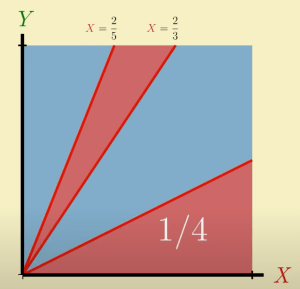
 , and so has area
  .
.


 (several proofs, one
  .
. be a function such that both
  are continuous in
  -plane, including
  ,
,  . Also suppose that the functions
  and
and  are both continuous and both have continuous derivatives for
 and
and  are constants, we have
 . What is the maximum number of points
  you can have such that they are equidistant, i.e.
  for all
  , where
  is some fixed constant?
 . Turns out it was pretty difficult to find a reference that proved this in an easy-to-understand presentation (for me), so I’m writing my own version (largely based on Reference 1).
 in two parts:
 , let
, let  be the vector with all zeros except for a 1 in the
  th position. For any
 , where
 , then
 are all equidistant from each other.
 are all equidistant, then the set of differences
  is a set of
  linearly independent vectors.
 and
and  . Assume that
  . Assume we have coefficients
  such that
 and take a dot product of both sides above with
  :
:


 applies for any
  with
with  , we must have
 are equal. But plugging this back into
  , or
, or  .
.
 be as above, and define the sequences
 generates the complete sequence of primes
  .
. is defined as an infinite sum involving all the primes themselves… if
  denotes the
  ), the Buenos Aires constant is defined as
 for all
  be a sequence of positive integers satisfying
  ). Define the sequences
 for all
  be a function so that
  is continuous on
 ![[a,b]](https://s0.wp.com/latex.php?latex=%5Ba%2Cb%5D&bg=ffffff&fg=333333&s=0&c=20201002) and satisfies
and satisfies  . Let
. Let  be a polynomial of degree
  that interpolates
 on the interval
 ![[0, \pi]](https://s0.wp.com/latex.php?latex=%5B0%2C+%5Cpi%5D&bg=ffffff&fg=333333&s=0&c=20201002) , and let
, and let  , which means we are looking at a quadratic approximation.
 , so we can set
  . The interpolating quadratic function needs to go through
  ,
,  and
and  , which by

 . As you can see from the y-axis on the right plot, the bound is pretty loose for this example.
 as well (cubic approximation). The 4th derivative of
  , so we can set
  ,
,  and
and 


 be a standard normal random variable. Then for any
  , defining

 from the perspective of numerical integration.
 in the original formula is replaced with a
  ):
):


 .
.



 be
be  , define the
 for “sum” and
  for “mean”. For
  , define
  .
.
 ,
,
 ,
,
 , which is simply the
  . We need to show that it is also true for
  . Fix the value of
  (
( resp.) denote the symmetric mean (sum resp.) for
  and let
  (
( resp.) denote the symmetric mean (sum resp.) for
  . Then, by considering whether
  is in the term or not,
![\begin{aligned} S_k &= \sum_{1 \leq i_1 < \dots < i_k \leq m} x_{i_1} x_{i_2} \dots x_{i_k} \\ &= \sum_{1 \leq i_1 < \dots < i_k \leq m-1} x_{i_1} x_{i_2} \dots x_{i_k} + x_m \sum_{1 \leq i_1 < \dots < i_{k-1} \leq m-1} x_{i_1} x_{i_2} \dots x_{i_{k-1}} \\ &= S_k' + x_m S_{k-1}', \\ M_k &= \dfrac{1}{\binom{m}{k}} \left[ \binom{m-1}{k} M_k' + \binom{m-1}{k-1} x_m M_{k-1}' \right] \\ &= \dfrac{m-k}{m} M_k' + \dfrac{k}{m} x_m M_{k-1}'. \end{aligned}](https://s0.wp.com/latex.php?latex=%5Cbegin%7Baligned%7D+S_k+%26%3D%C2%A0+%5Csum_%7B1+%5Cleq+i_1+%3C+%5Cdots+%3C+i_k+%5Cleq+m%7D+x_%7Bi_1%7D+x_%7Bi_2%7D+%5Cdots+x_%7Bi_k%7D+%5C%5C++%26%3D+%5Csum_%7B1+%5Cleq+i_1+%3C+%5Cdots+%3C+i_k+%5Cleq+m-1%7D+x_%7Bi_1%7D+x_%7Bi_2%7D+%5Cdots+x_%7Bi_k%7D+%2B+x_m+%5Csum_%7B1+%5Cleq+i_1+%3C+%5Cdots+%3C+i_%7Bk-1%7D+%5Cleq+m-1%7D+x_%7Bi_1%7D+x_%7Bi_2%7D+%5Cdots+x_%7Bi_%7Bk-1%7D%7D+%5C%5C++%26%3D+S_k%27+%2B+x_m+S_%7Bk-1%7D%27%2C+%5C%5C++M_k+%26%3D+%5Cdfrac%7B1%7D%7B%5Cbinom%7Bm%7D%7Bk%7D%7D+%5Cleft%5B+%5Cbinom%7Bm-1%7D%7Bk%7D+M_k%27+%2B+%5Cbinom%7Bm-1%7D%7Bk-1%7D+x_m+M_%7Bk-1%7D%27+%5Cright%5D+%5C%5C++%26%3D+%5Cdfrac%7Bm-k%7D%7Bm%7D+M_k%27+%2B+%5Cdfrac%7Bk%7D%7Bm%7D+x_m+M_%7Bk-1%7D%27.+%5Cend%7Baligned%7D&bg=ffffff&fg=333333&s=0&c=20201002)
 . To do that, apply the identity above to each term of
  , then apply the induction assumption and do some algebraic manipulation to get it to be
  . (Details in Reference 1.)
 Mathematical Odds & Ends