Mansfield Park


“But there certainly are not so many men of large fortune in the world as there are pretty women to deserve them.”

This tongue in cheek observation from Mansfield Park is what one would expect from Jane Austen’s pen but yet there is something different about the novel that sets it apart from the other works of the author. I am re-reading Jane Austen’s novels to honor the 250th anniversary of her birth. I started with Mansfield Park, Austen’s third novel published in 1814, which is considered as her least popular work. I wanted to understand why this novel is not as appealing as the other works of Austen. After reading it, I am even more perplexed that its main character Fanny Price is considered the least likable heroine in the Austen universe. Why has this novel been overlooked just like its protagonist who is overlooked by everyone in her social circle and in the literary world at large? Mansfield Park has a more sombre tone and marks a departure from Austen’s effervescent novels but that makes it even richer in my opinion. It delves into Austen’s frequently explored themes of marriage and morals, social class and mobility but with less levity and more psychological depth and even touches upon colonialism and slavery albeit peripherally.

Young Fanny Price is transplanted from her impoverished parents’ humble abode in Portsmouth to Mansfield Park, to live with the Bertrams, her wealthy aunt and uncle who take her in as an act of charity. She grows up with their four children: Tom, Edmund, Maria and Julia. She is constantly reminded of her place and denied the privileges afforded to her cousins. No wonder she is timid and submissive. She can only be valued as a people pleaser. Her benefactor and uncle Sir Bertram is an authoritarian figure who is frequently absent from home. Her aunt Lady Bertram lives in her own world and is neglectful of Fanny and the other aunt Mrs. Norris who is a frequent visitor to the house, belittles and bullies her constantly and deprives her of basic needs like a fireplace in her room.

“I am quite ashamed of you, Fanny, to make such a difficulty of obliging your cousins in a trifle of this sort— so kind as they are to you! Take the part with a good grace, and let us hear no more of the matter, I entreat.”
“Do not urge her, madam,” said Edmund…
“I am not going to urge her,” replied Mrs. Norris sharply; “but I shall think her a very obstinate, ungrateful girl, if she does not do what her aunt and cousins wish her— very ungrateful, indeed, considering who and what she is.” 

Fanny only finds solace in the kindness and friendship of her cousin Edmund and it is no surprise that she starts falling in love with him.

The fashionable and flamboyant siblings Henry and Mary Crawford arrive in town to disrupt the normal pace of life in the Bertram household. The sisters Maria and Julia fight over Henry’s attentions. The fact that Maria is engaged to another man doesn’t deter her from flirting with Henry. Meanwhile Edmund falls head over heels in love with Mary and Henry who at first flirts with both Bertram girls, eventually turns his attentions towards Fanny as she is the only one who seems to be resisting him. Edmund is so smitten that he has lost all perspective and overlooks Mary’s flaws.

The youngsters are emboldened by Mr. Bertram’s long absence from home. All propriety is thrown off the wind when Yates, a visiting friend of Tom’s suggests they perform Elizabeth Inchbald’s adaptation of the play, ‘ Lovers’ Vows’, a rather risqué production for the time. Edmund and Fanny oppose the plan though Edmund is eventually drawn into it. Fanny stays true to her principles and remains the silent observer who is perceptive about the behavior and actions of those performing around her. There are parallels between the amorous scenes acted out on stage and the desired attachments in real life that after a point it is hard to distinguish the acting selves of the characters from their real selves.

One reason Mansfield Park is not that popular is that a romance with a first cousin is off-putting for many readers. In the Regency era such marriages were legal and a way to keep wealth and property in the family. Marriages between first and second cousins still account for a good percentage of marriages in some cultures around the world. However it is not just the shared genes but the fact that Fanny and Edmund are raised together as siblings in the same house that perhaps offends our modern sensibilities even more.

Another reason why Mansfield Park has been vastly under appreciated is because of the heroine. Fanny Price is perceived as weak and insipid as she is too nice. She’s a passive soul lacking the sassiness and wit of some other Austen heroines. It’s true that she lacks the confidence and vivacity of a Elizabeth Bennett or Emma but we have to bear in mind that she is a dependent young woman who lacks the support of her family, a privilege which our other Austen heroines take for granted. The circumstances of her birth deny her the luxury of engaging in frippery and frivolity. She is told from childhood that she is dull and dependent and she internalizes that message.

I personally admired the silent strength of Fanny. Though she is considered to be a character who shows no growth, her journey to self-worth is a gradual process. With her unobstrusive presence, she faces challenges with resilience and quiet determination. She shows a lot of spunk and strength when she rejects the wealthy suitor that the whole family including Edmund wants her to accept. “Let him have all the perfections in the world, I think it ought not to be set down as certain, that a man must be acceptable to every woman he may happen to like himself.” Fanny’s foil , Mary Crawford, seems to be more like a typical Austen heroine. The Crawford siblings may be shallow and self-absorbed but they are also charming and amicable. They are way more interesting and portrayed with more nuance compared to the lackluster heroine.

It wasn’t the dull heroine or the romance with a first cousin that put me off. I loved this book till the last few chapters and was ready to consider it my favorite Austen till the ending ruined it for me. The love story is not satisfying. Fanny deserved better. I was almost rooting for Henry to win her over. All along she was pining over Edmund who is besotted with someone else. It is so painful to see Fanny witness Edmund’s infatuation, and to hear about it constantly from him and yet remain unswerving in her devotion to him. He is a good and principled man but he is not in love with Fanny.  His last minute change of heart seems contrived and insincere. He is disappointed with Mary who lacks the moral compass he expects from her and so he decides he’ll make do with Fanny. It wasn’t as though he loved her at a sub- conscious level and was just not aware of it. If that had been the case, it would have been a sweet love story and given our heroine the happy ending she deserved. But she is literally the second pick and it seems he is taking advantage of her. I didn’t find Edmund appealing at all as a romantic interest.

Fanny has a little bit of a martyr and masochist in her and takes the high road. This Austen novel has an ambiguous ending. Ostensibly, Fanny has married well. She is rewarded with a husband and the people who tormented her are punished and forced to flee Mansfield Park. If we keep in mind that marriage was the only way for a woman to climb the social ladder, she certainly made an advantageous match. Yet I am left with a bad taste in my mouth. This is not a romance novel with a happily ever after. Our Cinderella certainly got her castle but I am not convinced she got her Prince Charming!

Have you read Mansfield Park? Did you find it different from other Austen novels? What is your favorite and least favorite Jane Austen novel? And why?


The Sunday Philosophy Club

From Botswana to Edinburg, crossing continents and cultures, I took a break from the No.1 Ladies’ Detective Agency Series by Alexander McCall Smith and read the first book in The Sunday Philosophy Club series by the same author.

Isabel Dalhousie is a single and independently wealthy woman in her forties. She has a job but it is actually not a real job. She edits an obscure philosophy journal called ‘The Review of Applied Ethics’ but is left with plenty of time to pursue posh interests like attending concerts and whisky sniffing sessions and buying original artwork. She also loves solving crossword puzzles over her morning cup of coffee. Reviewing the journal is clearly something she does to occupy her time and mind, rather than as a source of income. She doesn’t have to worry about a mundane matter like money.

However the most curious thing about the book is the title. There is no Sunday Philosophy club. Isabel is part of a philosophy club that’s supposed to meet on Sundays but in reality they never meet because well..it’s hard to meet on Sundays. That does not deter Isabel from devoting her time to her own private philosophical thoughts. The cast of characters include her no-nonsense housekeeper Grace who is also her confidante and advisor, her niece Cat ( also independently wealthy) who runs a delicatessen, Cat’s current boyfriend Toby and her ex- boyfriend Jamie for whom Isabel seems to holds a torch herself.

At the Opera one night, she sees a man fall to his death from the highest balcony or ‘Gods’ and wonders if he was murdered or just fell. She had glanced at him when he plummeted to his death and decides that she has a moral obligation to solve the case as she happened to be in the vicinity. She is determined to get to the bottom of this mystery and find out if Mark Fraser was the victim of an accident, a suicide or a homicide. She talks to his roommates Hen and Neil to see if they can provide her with additional information. She learns that the gentleman Fraser was a mutual fund manager and wonders if his murder is related to insider trading? Or is that a red herring?

Isabel has an insatiable curiosity to the point of being meddlesome. She is often mistaken in her judgements of other people. She also comes across as pedantic and snotty and can be a sanctimonious prig at times. She has specific rules about answering the telephone and bemoans the loss of manners in society. Her penchant for philosophizing can be irritating. Most of her philosophical ruminations are trite. Is it okay to ignore a murder? Should you tell someone close to you that their partner was unfaithful? Is it morally acceptable to eat a piece a cake when people are dying of hunger in the world? Sometimes they are a little more profound. ‘Who is happier, those who are aware, and doubt, or those who are sure of what they believed in, and have never doubted or questioned it?” or ” Distant wrongs, she thought: an interesting issue in moral philosophy. Do past wrongs seem less wrong to us simply because they are less vivid?”

As far as the story is concerned, it is not a typical ‘ whodunnit’ murder mystery. In fact, the ending was very disappointing without any retributive justice. What’s the point in solving a mystery when justice is not going to be served? For a protagonist who rambles about ethics, the ending seemed far from ethical to me. Maybe the work is meant to be a light satire of a certain segment of Edinburg society.

The plot is only part of the story just like in The No.1 Ladies’ Detective Agency series. The focus is more on the musings of the protagonists who are quite alike in spite of belonging to different continents. They are both amatuer sleuths with trusted female sidekicks. The main difference is that Precious Ramotswe is a woman who has made something of her life as opposed to Isabel who has it handed over a silver platter. Her privileged lifestyle grates as opposed to the simple and more relatable world of Precious Ramotswe.

In spite of these flaws, there is something gentle and old-fashioned about McCall’s writing that draws the reader into the story. It is supposedly set in the early 2000s but feels anachronistic. It reflects the author’s yearning for the past or caters to a kind of lifestyle a reader might fantasize about. Isabel herself seems a lot older than her actual age. I also enjoyed the references to art and literature sprinkled throughout the book. When Isabel witnesses the fall from the balcony, her first thought was of Auden’s poem on the fall of Icarus.

 I’ll give this series another chance. Some things are an acquired taste. Perhaps Isabel will grow on me too like Precious did. Whether it’s rooibos or Scottish Breakfast, we have to let the tea steep for a while to get its flavor.

The Great Hippopotamus Hotel And The No.1 Ladies’ Detective Agency Series


Last fall I attended the book launch and signing event of The Great Hippopotamus Hotel, the latest installment in Alexander McCall Smith’s popular The No. 1 Ladies’ Detective Agency series! Attired in a traditional plaid kilt, the author gave a humorous and insightful speech on his journey as a writer! He is a prolific writer who effortlessly churns out books at regular intervals. Generally he comes out with two books a year. I was very impressed when he said that he wrote two chapters on a train ride between Boston and NYC – that’s a chapter in two hours. He also said that he just pours out his thoughts on paper and doesn’t pay attention to editing when he writes his initial draft which I thought was good advice for budding writers who are looking for perfection. I was most intrigued when he said he was influenced by Indian author R.K. Narayan’s style of writing and that the No. 1 Ladies’ Detective Agency series would not have come into existence if not for the impact Narayan’s Malgudi Days series about the slow paced and simple lifestyle of the people of a fictional village had had on him! That little detail made everything about the series make more sense to me!

Set in Botswana, on the edge of the Kalahari desert, the books in the series are uncomplicated mystery cases solved by Mma Precious Ramotswe (Mma is a title of respect in Setswana, similar to ‘Ms.’ or ‘Mrs.’), the founder of the No. 1 Ladies’ Detective Agency. She lives in Gabarone with her husband, Mr. J.L.B. Matekoni, the proprietor of Tlokweng Road Speedy Motors, and their adopted children. She is the sole female detective in the whole country who started her business by selling her inheritance after her father’s demise. Her tragic past which included an abusive first marriage and the harrowing experience of losing a child adds more interest and poignancy to her character. Mma Ramotswe’s partner in crime is Grace Makutsi, star student of the Botswana Secretarial College. To solve their cases, they often resort to the advice found in their business Bible, ‘The Principles of Private Detection’ by Clovis Andersen.

In the latest book of the series, The Great Hippopotamus Hotel, the manager of an upscale hotel approaches the detective agency concerned that someone is trying to sabotage the business that he runs with his three relatives. The reputation of the place is being ruined with cases of food poisoning, disappearing laundry and other unseemly incidents like the discovery of a scorpion. Mma Makutsi takes on the case ( After all she secured 97 per cent in the final examinations of the Botswana Secretarial College!) as Mma Ramotswe is indisposed herself with a case of food poisoning. She believes her old archenemy Violet Sephora may be involved and she is determined to solve the mystery. There usually is a problem and a secondary problem that crops up too in the mystery stories. In this novel it is men going through a mid-life crisis. One of JLB Matekoni’s customers wants his help in getting a fancy red Italian sports car but without the knowledge of his wife, raising moral questions on the right course of action to take. 

The title is somewhat a misnomer as technically these stories are not ‘mysteries’ but simple stories about the simple lifestyle of the residents of Gabarone. The women take on straightforward cases pertaining to the mundane lifestyle of the residents like stolen property, philandering husbands or a missing son or daughter and the narration is peppered with gentle philosophical musings and humorous but often profound observations about human nature. The mysteries do not fall under the conventional mystery genre. One could say that more than detective stories, they are incidents that occur in the life of Precious Ramotswe who just happens to be a detective.  

People either love the series or hate it. I confess that it took me time to warm up to the books as when I first started reading them, I found the stories to be simplistic and repetitive with predictable endings. Over time I started viewing them like comfort food. They are old -fashioned and reminiscent of a bygone era when people always knew of each other through friends and relatives and dropped in unannounced for tea. When I pick up a Precious book, I am ready to meet my familiar friends from Botswana and share some fruitcake and a pot of bush tea with them. There is a gentleness about the story that I find very soothing. And how refreshing to have a woman of ‘traditional built’ as the heroine of a novel!

 I immensely enjoy being transported to a different country and experience another culture. I confess I knew practically nothing about Botswana other than the fact that Gaborone is its capital. It was exciting to discover the flora and fauna, learn about linguistic peculiarities and local beliefs like ‘muti’ or witchcraft. Mma Ramotswe loves her country and is often overcome with patriotic emotion.

There was little variety: on the horizon there was a low range of hills, blue at this distance, but, for the rest, the land was without salience, a vast stretch of acacia scrub, grey-green vegetation on red-brown earth, presided over by a dome of empty sky. There were those who would see nothing in such a landscape, but for Mma Ramotswe, this was a distillation of the immense, brooding spirit of her country. It was a song for which you needed to have the right ear, but if you were attuned to it, it was a melody of peace and calm and abiding love.”   

Some readers are put off by the patronizing vibe in the stories and view them as a ventriloquised representation of black people’s experiences. We encounter witchcraft, snakes, and even a boy raised by a lion. Are these stereotypical images that would entertain a foreigner or things you would encounter in real Botswana? I suppose it is problematic when a white male writer writes about a black woman from a foreign country. On the other hand, I also believe in creative freedom. A writer needs to give free rein to his or her imagination. In my opinion, a writer should have the liberty to write about another culture as long as it is done with sensitivity and a conscious effort to avoid stereotypes.

Have you read the No.1 Ladies’ Detective Agency series? Do you enjoy reading the books or do you think they are overhyped, or worse, a condescending view of Botswana through a colonial lens? When I was first introduced to the series, I did feel that McCall Smith portrayed the characters as simpletons but as I continued reading, I realized that the author simply yearns nostalgically for a past era when life was indeed more simple. As I mentioned in my first paragraph of this post, after attending his talk where he said that he was inspired by R.K. Narayan, everything fell into place for me, absolving him of any cultural insensitivity however slight, I might have perceived in the past. I can see how Narayan’s creative vision and writing style might have influenced him!

Mma Ramotswe wisely quips: “As long as supplies of tea hold out, there is time to listen.” And I feel the same about McCall Smith and his charming series. As long as the supplies of the books hold out, there is time to read.

The Covenant of Water

Fiction is the great lie that tells the truth about how the world lives!” 

The Covenant of Water by Abraham Verghese is a sweeping multi-generational saga spanning almost eight decades and three generations. Set in Kerala, on India’s Malabar Coast, this behemoth of a book weaves a rich tapestry bringing together the various threads of love and relationships, caste and class, religion and education, British colonialism and independence, medicine and social progress.

The writing is so evocative that I am instantly transported to the setting. The Kerala backwaters comprise of a picturesque stretch of lagoons, lakes, canals and rivers that run parallel to the coast of the Arabian sea. These labyrinthine waterways are dotted with palm fringed houses, coconut groves, verdant pastures and rice paddies. The prose flows like these rivulets that make up the backwaters of the Malabar region and is lush like the landscape around.

In this land, coconut and palmyra palms are so abundant that at night their frilled silhouettes still sway and shimmer on the interiors of closed eyelids.”

Imagine the entire book written in this style!

The book is divided into ten parts and each part begins with an evocative black and white illustration by the author’s cousin, Thomas Varghese.

 The story begins in 1900 with the arranged marriage of 12 year old Mariamma to a widower, who is the owner of a large estate in the erstwhile Kingdom of Travancore in southern India. He waits till she comes of age to consummate the marriage as was the custom of the time, and turns out to be a good husband who treats her with respect. They slowly build their lives together with his son Jojo, and their family grows as daughter Baby Mol and son Philipose join the fold that includes colorful secondary characters like Shamuel, the loyal and trusted servant, a slew of Kochammas ( aunts) and Damo, the delightful elephant who is a family member in his own right. Mariamma eventually becomes the matriarch of the family and is lovingly called Big Ammachi ( Big Mother) by the extended family and workers on the property.

The only ripple in the placid waters of their lives is an affliction that has plagued the family for generations. Every so often some member or other of the family develops a morbid fear of water and becomes a victim of drowning. They refer to this mysterious generational curse as “The Condition”. Their beloved Jojo succumbs to it and tragedy strikes again in the next generation in Philipose’s conjugal life. Decades later, Ammachi’s granddaughter and namesake is determined to get to the bottom of the mystery and studies to be a doctor.

The family belongs to one of the oldest surviving groups in Christianity outside the western tradition. They are St.Thomas Christians, also called Syrian Christians of India who trace their origins to the arrival of St.Thomas the apostle to India in the 1st century. They are Malayalis and their mother tongue is Malayalam. Arundhati Roy in The God of Small Things had depicted this Christian community in Kerala but Verghese gives a more detailed picture with historical facts incorporated into the story. Thomas Christians being among the oldest minorities in India blended well within the local socio-cultural environment, and were even classified into the caste system according to their professions in the manner of Hindu custom, all while following the traditions of the eastern churches.  

Just as we are getting invested in Ammachi’s life, a parallel narrative emerges. We move to the story of Digby Kilbour, a Scottish doctor from Glasgow who joins the Indian Medical Service in Madras in British India. When his surgeon hands are damaged in a fire, he seeks the help of Dr. Rune Orquist, a Swedish doctor who dedicates his life to the care of leprosy patients. Though the brusque transition to another plot and set of characters is jarring, we know these individual stories, like rivulets in the backwaters, will flow into the same ocean. The lives of the characters will intersect at some point.

We eventually learn that ‘The Condition’ is in fact Von Recklinghausen’s disease, also known as Neurofibromatosis type 1 (NF1), an autosomal dominant genetic disorder which affects the skin and nervous system and results in neurological symptoms like deafness, loss of balance, seizures, and scoliosis. Verghese is an internal medicine physician and Professor at Stanford, and this book like his Cutting for Stone, tackles many medical topics like leprosy, deafness, addiction and cancer, apart from unraveling the mystery behind the baffling drowning condition. We also realize that Baby Mol suffers from cretinism or congenital hypothyroidism which explains her childlike behavior and stunted growth.

The story is a beautiful blend of history and fiction. As we follow the story of the family over seven decades, from the time Ammachi was a child bride to her granddaughter’s trajectory in medical school, we also witness how India transforms and gains independence from British rule and the social and political changes that follow in its wake. I was hooked on to the book from the first page but I can see it frustrate readers not familiar with the language or culture. It would have been useful to attach a glossary of native words for the foreign reader. I also feel the book which is over seven hundred pages long could have been pared down in size. There are too many detailed descriptions of medical ailments and procedures which sometimes give a text book feel to the otherwise lyrical writing. There are a few unbelievable coincidences and the melodramatic twist at the end reminds you of a soap opera or a Bollywood film.

In spite of these niggling issues, on the whole, the novel is breathtaking. We are transported to a different world of picture post card landscapes. Verghese brings India to life with his sensuous imagery. Water is an important element for the locals; it is their means of transportation and sustenance. Their happiness is tied to it but so are their sorrows and they are all connected to each other by this implacable force which exerts a powerful influence on them.

And now that daughter is here, standing in the water that connects them all in time and space, and always has. The water she first stepped into minutes ago is long gone, and yet it is here, past and present and future, inexorably coupled, like time made incarnate. This is the covenant of water: that they are all linked inescapably by their acts of commission and omission, and no one stands alone. She stays there, listening to the burbling mantra, the chant that never ceases, repeating its message that all is one. What she thought was her life is all maya, all illusion, but it is one shared illusion. And what else can she do but go on.”   

You can feel the love the author has for the country, and more specifically, his state of origin shine through every page of the book. Surprisingly, Verghese did not grow up in India. He was born and brought up in Ethiopia and lived for only a few years in India to get his medical degree from Madras University. He says that he drew on the stories his late mother wrote down for a grandchild about her life in India, as inspiration for the novel. These lines that describe Philipose’s state of mind on entering Kerala when he travels by train from Madras, could very well represent the author’s own sentiments: 

Even before his brain digests these sights, his body—skin, nerve endings, lungs, heart—recognizes the geography of his birth. He never understood how much it mattered. Every bit of this lush landscape is his; its every atom contains him. On this blessed strip of coast where Malayalam is spoken, the flesh and bones of his ancestors have leached into the soil, made their way into the trees, into the iridescent plumage of the parrots on swaying branches, and dispersed themselves into the breeze.

The story itself moves at a leisurely pace like the train passing through fields, villages and lush landscapes. The author has poured his heart and soul into this meticulously researched novel. You might wonder why you need to read yet another book set in India. But remember that when you read a book about India, it is never repetitive! India is such a large and diverse country that people say that if one statement is true about India, the exact opposite is equally true. I am originally from India and I, too, learned a lot about my culture. I hope you are not daunted by the size of the book. The story was certainly engaging but to me personally what stood out more was the way Verghese wrote it. I am in complete awe of his style of writing.

P.S. These images of the Kerala backwaters are taken from Wikipedia.

Where You’ll Find Me: Risk, Decisions, and the Last Climb of Kate Matrosova 

This is a true story that caught the national media by storm. No pun intended! 

 I have diverged from my usual blog posts as Where You’ll Find Me: Risk, Decisions, and the Last Climb of Kate Matrosova is not a literary work. Ty Gagne is not a writer by profession. It is the story that is more intriguing than the writing. It is a gripping human interest story. It hits close to home in many ways and I needed to write about it to process my own emotions.

On the 15th of February, in the year 2015, 32 year old Kate Matrosova of NYC attempted a solo traverse of the summits of the White Mountains in New Hampshire. Her plan was to undertake a light and fast traverse through several peaks in the Presidential Range. In other words, she intended to pack lightly but move quickly on the trails and begin her descent back the same day instead of camping overnight. She had a satellite phone, a GPS device and a personal locator beacon. Her husband was going to pick her up that very evening on the other side of the range. Kate Matrosova was an experienced hiker and physically fit. She had previously summited four of the seven highest peaks on each continent and was targeting Mount Everest next. She would have successfully scaled the summits on any other day. It just so happened that she chose the worst possible day to hike. 

A Nor’easter storm veered off its predicted course making it an extremely dangerous day to hike. Kate was mentally prepared for setting off in cold weather. Perhaps she was seeking a day with frigid temperatures and snow to train herself for Mount Everest. But she was unaware that the storm in the forecast was going to hit sooner than predicted. She had checked the weather the evening before but had embarked on the hike in the pre-dawn hours before the morning forecast was issued by the Mount Washington Observatory on what turned out to be the worst winter blizzard day that season: 

In the clouds with snow and blowing snow. White out conditions. High temps dropping to -20F. Winds NE shifting NW 45-60mph rapidly increasing mid-morning to 80-100mph with gusts up to 125 mph. Wind chills 65-75 below zero.

The following day rescuers found her frozen body. She was blown off a peak by the wind and had died of exposure.

Where You’ll Find Me: Risk, Decisions, and the Last Climb of Kate Matrosova is a detailed account of the ill-fated winter hike written by Ty Gagne, a corporate risk management executive and a certified wilderness responder. With data retrieved from her GPS and with the aid of photos, maps and venn diagrams, he meticulously pieces together the events leading up to the discovery of her frozen body the following day. He retraces her route and imagines her thought processes. He also follows the trajectory of two other guided hiking groups that set off on that day and unlike Matrosova, decided to turn back. The second half of the book describes the rescue and ultimately the recovery operation by brave and dedicated individuals who were risking their lives too in the treacherous weather and who grappled with the same decisions that Kate Matrosova had to face.

Gagne explores the psychology of risk. What makes us take the decisions we do? Gagne uses Matrosova’s story to analyze risk in the workplace. He tries to understand what could have gone wrong in her decision making. He withholds judgement though he points out her errors. He starts the book by giving an example of a hike he went on where he himself made mistakes. 

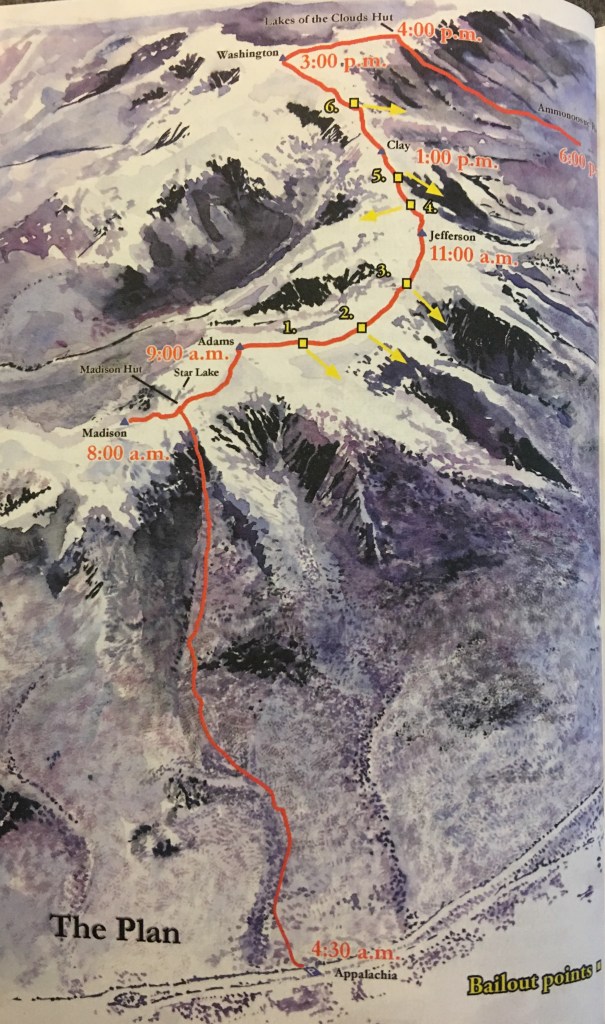
Above is a map from the book of Kate Matrosova’s projected route through the White Mountains.

Kate was dropped off at the Appalachia parking lot in the wee hours of the morning by her husband, Charles Farhoodi. She started up the Valley Way Trail and got up above treeline in tough conditions taking more time than usually required. She took a left off the main trail to climb up to the top of Mount Madison and then descended back down to join the main path and took a left on to the Star Lake Trail to tackle the next summit. She was already far behind schedule. She was hiking against 85 miles per hour winds but instead of abandoning her hike and turning back, she started climbing Mount Adams.

But less than 150 feet from the summit, ‘An impenetrable wall of wind’ finally prompted her to turn back and abandon the rest of the hike. Unfortunately it was too late. She would have become hypothermic by that point and unable to keep up with the winds which by then were approaching over 90 miles an hour and the temperature with wind chills were reaching close to -100F. At some point, in desperation, she activated her personal locator beacon but to no avail. It seems like she was hurled off the peak by the strong winds and probably hurt or unable to walk any more. I can’t even imagine how panic-stricken she must have been while waiting for help!

As her PLB erroneously reported multiple locations, the initial rescue team went looking for her on the wrong side of Madison and returned at 3 a.m. with no luck. The search resumed on Monday morning with a larger rescue team including the New Hampshire Army National Guard Black Hawk helicopter and a civil Air Patrol Cessna airplane. The rescue teams on the planes had to call off the search because of poor visibility. Her body was finally found by a ground rescue team 150 feet downslope off the Star Lake trail, close to the location indicated by the first signal from the beacon. It is likely she would not have made it even if the initial coordinates had been correct.

Matrosova had a solid plan with ways to opt out if she needed as is apparent in the map above. But why did she go solo in the dead of winter? Why did she not have sufficient gear? She had no sleeping bag or bivy sack and not even snow shoes with her and though she carried crampons, she does not seem to have used them. And why did the weather forecast not deter her in the first place? But having set out, when there was a point where she could have decided to turn back, what made her continue to scale the next peak despite the deteriorating conditions? She had done a winter climb to Madison Col a month earlier with her husband and they had camped up overnight in the mountains but they had to abandon going on Mount Adams as her husband could not keep up with her. Could it be that she did not want to miss the summit a second time having come all the way? Gagne delves into all these questions as he tries to analyze Kate Matrosova’s mindset.

Although Gagne was not among the team of rescuers, he pieces together the events that led up to the tragedy to analyze if it could have been prevented if other choices had been made. I wasn’t very comfortable with the fact that he uses her personal story to discuss risk management in the workplace. Yet it was a very engaging read and I was on edge the entire time even though I knew how this would end. The last chapter has a different tone from the rest of the work which is more factual. On the anniversary of her death, Gagne goes on the same hike that Matrosova had attempted and feels her ghostly presence in the mountains.

Kate Matrosova’s story affected me deeply. I am from New Hampshire and I know these mountains. I’ve hiked on some of the trails albeit in more forgiving weather. A friend from out of town who has hiked to Everest base camp remarked that scaling Mount Washington was even more challenging. The trails look deceptively simple because the mountains are at a much lower altitude. You don’t have to deal with the oxygen shortage that you encounter on a Himalayan trek but the terrain is still treacherous because the weather patterns are unpredictable in these mountains.

Kate’s story made me think about the power of Mother Nature, a force so formidable that it is still beyond human control in spite of the technological advances we’ve made, and it also brought many questions to mind:

What causes people to pontificate and pass judgements on others without understanding or compassion? The story went viral and invited a lot of vitriol. People were making conjectures about Matrosova’s behavior and character accusing her of being stupid, overly ambitious, and even of suffering from hubris as if she were a character from a Greek tragedy. She is not here to defend herself. These mistakes could have been made by anyone. She probably underestimated the changing weather conditions in the mountains. And who knows if hypothermia had clouded her judgement?

When there are so many similar stories, why do some stand out and capture the world’s attention? There have been close to 200 known fatalities within the Presidential Range. Most recently on Jan 19, 2024, an experienced hiker died on a solo hike in brutal conditions succumbing to frigid temperatures and harsh winds. His story died down with him and with the storm. Kate Matrosova was an accomplished young immigrant from Siberia who lived the American dream by getting a great education and achieving corporate success. She was an investment banker in NYC who was not only rich but very pretty too. Are these the reasons that made her story more noteworthy? 

And last but not the least, how to do you balance risk versus reward? Do we not have to be willing to take some amount of risk in order to live our dreams? Where do we draw the line between living a fulfilling life and recognizing our limits? Kate Matrosova’s story haunted me from the beginning. I found myself thinking about her for weeks after reading the book. Would I have ventured out in those conditions? I am a cautious person by nature and even I know that all it takes is a split second decision for things to go awry. I view this incident as a cautionary tale and I would recommend this book to outdoor adventure enthusiasts.

Ty Gagne brings up important points like developing soft skills and knowing when to make alterations to your original plan to avert a tragedy of this nature. He also talks about the advantages and disadvantages of going with a group as opposed to going by yourself. Kate never had to think on her own before as her previous hikes were guided trips. All these lessons apply not only to decisions taken on adventures but also when you you are faced with quandaries in life wondering whether to turn right or left and risk it all or play it safe. Kate undoubtedly made mistakes but she was also unlucky. Don’t we all struggle with similar decisions from time to time which make us exclaim, ‘But for the grace of God go I”?

Isn’t there a bit of Kate Matrosova in all of us?

The Bell Jar

Trigger Warning: Depression, Self-harm, Suicide, Suicide Ideation, Rape Attempt

I had been avoiding reading Sylvia Plath’s The Bell Jar, although it has been lying on my book shelf at home for decades. Who wants to read about a young woman’s mental breakdown especially when you are aware of the heartbreaking outcome in the life of the author she parallels? I remember being intrigued enough to read reviews about the book but they only strengthened my resolve to avoid it. A reviewer on Goodreads wrote that she preferred childbirth to reading this novel. I don’t know what made me finally muster the courage to read it but I am glad I did for it spoke to me as a woman and also educated me about mental illness. Besides, it wasn’t all doom and gloom as I expected it to be. Apart from being an insight into mental illness, it is also a commentary peppered with humor and satire on the American society of the time.

The Bell Jar describes the slow unraveling of the mind of its narrator-protagonist. Unlike her friends who come from wealthy families, Esther Greenwood is a brilliant student from a modest background who excels in high school and college by winning several awards and scholarships. At the age of nineteen, she was one of twelve young women selected to intern for a month at a New York fashion magazine. One would think that she would be thrilled to party and live the glamorous life of the rich and famous but she feels a sense of disconnection with her peers and a general disenchantment with life .

Esther Greenwood has a non conformist attitude towards marriage and motherhood and is ahead of her time for a woman living in the 1950s. She is in a relationship with Buddy Willard, a young medical student, but hates that she is expected to be pure while he has had sex with a waitress. She finds the double standard revolting and is eager to lose her virginity which “weighed like a millstone” around her neck, partly out of curiosity but mostly to get even with her boyfriend. To achieve that goal, she goes to any length even putting herself in dangerous situations with men she barely knows.

She is expected to marry Buddy but that would mean she would have to relinquish her ambitions of being a poet. She hates the thought of being tied down to the drudgery of domestic duties which would surely be “a dreary and wasted life for a girl with fifteen years of straight A’s…” She wants to break free from these constraints and forge her own identity in a male dominated world. There are so many opportunities dangling in front of her but she is paralyzed by indecision for if she picks a path, she will have to forgo others.

“I saw my life branching out before me like the green fig tree in the story. From the tip of every branch, like a fat purple fig, a wonderful future beckoned and winked. One fig was a husband and a happy home and children, and another fig was a famous poet and another fig was a brilliant professor, and another fig was Ee Gee, the amazing editor, and another fig was Europe and Africa and South America, and another fig was Constantin and Socrates and Attila and a pack of other lovers with queer names and offbeat professions, and another fig was an Olympic lady crew champion, and beyond and above these figs were many more figs I couldn’t quite make out. I saw myself sitting in the crotch of this fig tree, starving to death, just because I couldn’t make up my mind which of the figs I would choose. I wanted each and every one of them, but choosing one meant losing all the rest, and, as I sat there, unable to decide, the figs began to wrinkle and go black, and, one by one, they plopped to the ground at my feet.”

More than sixty years later, the fig tree metaphor still resonates with women. It has struck a chord with Gen Z women who grapple with the same feelings of isolation and existential angst and cite the passage frequently on Tiktok. Although women have come a long way since Plath’s time and are able to pursue many options, they still struggle with their choices wondering if one decision will rule out other opportunities.

Esther’s behavior starts becoming erratic as she feels more and more alienated from Buddy and from her friends. She is rejected from a summer writing course which is a tremendous blow to her ego as she has always been an outstanding student with many academic laurels. She slowly stops eating and refuses to wash her hair and change her clothes. She has trouble reading for words seem to jump off the page. She takes sleeping pills as she is unable to fall sleep. She starts hearing her own voice. She has obsessive thoughts about suicide and before long is admitted to a psychiatric clinic. It is terrifying to see how quickly Esther spirals down and is pushed over the edge.

She is institutionalized in an asylum near Boston where she undergoes electric shock therapy without anesthesia and is given insulin injections for treatment. The book highlights the stigma attached to mental illness and the limited scientific understanding of the condition at the time. Her mother, although well meaning, thinks of her depression as a passing phase. Esther’s doctor is arrogant and condescending. It is only when the sponsor of Esther’s college scholarship pays for Esther to go to a private hospital that she starts receiving state of the art care under a more compassionate lady doctor.

 Esther constantly thinks about how to kill herself. She is almost rational and methodical in her approach thinking of different scenarios that would work. The bell jar is the metaphor for the depression that traps her. It also symbolizes the suffocation experienced by women restricted by patriarchal expectations. There is no doubt that Esther Greenwood is Sylvia’s alter ego and her life parallels Plath’s own struggles with mental illness and societal expectations. There is a scene where Esther decides to write a novel and states:

“My heroine would be myself, only in disguise. She would be called Elaine. Elaine. I counted the letters on my fingers. There were six letters in Esther, too. It seemed a lucky thing.”

Plath’s heroine Esther wants to write a book about a character who is modeled after her, and Esther, in turn, mirrors her author. Interestingly, the name Sylvia is also composed of six letters.

The Bell Jar is an eye-opening read about a certain time in American society raising interesting issues about feminism and mental illness and its treatment. Despite the feminist leanings, I have to point out that there are racist and sexist undertones which are problematic and which would be considered offensive today. There is a passage where the way Esther treats a black male attendant in the hospital made me quite uncomfortable. Of course Esther is a fictional character but I can’t shake the feeling that along with her mental illness, she shares some of the prejudices of her creator.

Sylvia Path was essentially a poet. The Bell Jar was the only novel written by her. In my opinion, she was a far superior poet to a novelist. The reason the work was groundbreaking and is still relevant today is for its raw and authentic description of a girl suffering from a depressive episode and for opening the door for a more open dialogue on mental health which was a taboo subject. Esther Greenwood is a woman who resembles her creator and who could very well be the same person except for this one little harrowing detail- she survived her suicide attempt while Plath succumbed to her demons.

And although Esther recovers in the end, you are still left with the doubt if she is going to be okay. The bell jar has lifted but is hovering above her and can still descend on her.  

“How did I know that someday―at college, in Europe, somewhere, anywhere―the bell jar, with its stifling distortions, wouldn’t descend again?” 

The first edition of The Bell Jar, published under the pseudonym Victoria Lucas.

The Bell Jar was published in England on January 14, 1963, under a pseudonym and just a few months before Plath took her life. It would be published seven years later in the US under her own name. Sylvia Plath would have been 91 years old today had she still been alive. How much more would she have accomplished in the remaining years if only she hadn’t plucked herself out prematurely from the fig tree of her own life?

P.S. I am writing this blog post after a long hiatus; I have been under a sort of bell jar of my own though thankfully not of the serious kind suffered by the author. Hopefully the New Year will see me posting more frequently!

Istanbul: Memories and the City

I am continuing in the vein of my previous blog post and writing about a book I read in the place it was set. I picked up Orhan Pamuk’s memoir, Istanbul: Memories and the City, in anticipation of a trip to Istanbul and finished reading it while I was in the city. I haven’t read any of Pamuk’s novels and I thought this would be a good introduction to his writing. It didn’t turn out to be quite the book I was looking forward to reading during my stay. The city I visited was colorful and bustling, a far cry from the dismal picture painted by the writer. Although the book was published in 2005, Pamuk is describing the city of his childhood and young adulthood, the Istanbul of the fifties and the sixties. He depicts a city that no longer exists, a city in memory. The Istanbul I visited has been rebuilt for the most part and has a vibrancy and vitality that the memoir fails to capture. That being said, I am well aware that an outsider’s temporary experience of the city is remarkably different from that of a person born and brought up there.

Pamuk bemoans the decline of a city that was once a glorious Empire. Mustafa Kemal Ataturk, the founding father of the Republic of Turkey and its first President introduced sweeping reforms in the twenties and thirties to westernize and secularize society within a short span of time. He got rid of the harems and the janissaries and the dress codes of the past. The Arabic alphabet was abandoned for a Romanized one. Old Pasha mansions along the Bosphorus burned down symbolic of a civilization going up in flames. The feeling of decay and loss affects the inhabitants who experience a melancholy, which, according to Pamuk is best described by the Turkish word ‘ huzun’: it is the collective melancholy that weighs on the city like a shroud when you see the evidence of the ruins around you:

“If I am to convey the intensity of the huzun that Istanbul caused me to feel as a child, I must describe the history of the city following the destruction of Ottoman Empire, and – even more important – the way this history is reflected in the city’s ‘beautiful’ landscape and its people. The huzun of Istanbul is not just the mood evoked by its music and its poetry, it is a way of looking at life that implicates us all, not only in a spiritual state, but a state of mind that is ultimately as life affirming as it is negating.”

“Still, the melancholy of this dying culture was all around us. Great as the desire to westernize and modernize may have been, the more desperate wish was probably to be rid of all the bitter memories of the fallen empire, rather as a spurned lover throws away his lost beloved’s clothes, possessions, and photographs. But as nothing, western or local, came to fill the void, the great drive to westernize amounted mostly to the erasure of the past.” 

This is a society in transition where the residents live literally and symbolically among the ruins of a great empire, Pamuk does not describe the famous touristic sites of the city. We get the perspective of a local flâneur who takes us to the back alleys and streets through decaying neighborhoods where stray dogs roam and wooden buildings burn down. Interspersed throughout the memoir are black and white photographs ( unfortunately without captions), captured mostly through the lens of the award winning photographer Ara Güler. The monochromatic photographs add to the wistful tone and convey the ‘huzun’ of the city shrouded in fog and soot.

Nightfall in the district of Zeyrek, Istanbul
The Suleiman Mosque in the winter seen from the Galata Bridge, 1955
The Ship on the Golden Horn

  And amid all the changes, the beautiful Bosphorus continues flowing while it has witnessed the ebb and flow of the tides of civilisation – the rise and fall of the Roman, Byzantine and Ottoman empires. The strait is the focal point of the city and dear to Pamuk. He would count the number of ferries passing through the Bosphorus from his window and witness the explosions of ships or the dramatic fires that would on occasion engulf the yalis (the houses of the pashas of the Ottoman era) lining its shores.

“If the city speaks of defeat, destruction, deprivation, melancholy and poverty, the Bosphorus sings of life, pleasure and happiness. Instanbul draws its strength from Bosphorus.”

He bemoans the lack of a literary tradition in Turkey. He describes the impressions of western writers like Nerval, Flaubert, Gautier and Apollinaire on the Istanbul of the 19th century. Among the few Turkish writers he admires are Yahya Kemal, Abdulhak Sinasi Hisar and Ahmed Hamdi Tanpinar but even these authors followed the footsteps of the French writers in evoking the ‘huzun’ of the city. How could they create a unique voice while still under the spell of European literary traditions?

He dwells at length on the unfinished “Istanbul Ansiklopedisi”, that was put together by Reşat Ekrem Koçu over many years and which recounts, between its pages, fascinating entries of the day to day life of Istanbullus, reflecting the spirit and atmosphere of the Ottoman period There is also a delightful chapter dedicated to humor in newspapers and journals-… ‘a random sampling of some of the …advice, warnings, pearls of wisdom, and invective… from Istanbul columnists… over the past 130 years.”

Along with describing the city that struggles to come on its own, the memoir recounts the coming of age story of the author. Just like the city, Pamuk grapples with his own identity. Once wealthy, the Pamuks are suffering business losses and the extended family is squabbling. Three generations live in one apartment building, each family on a different floor, His grandfather was wealthy but his father and uncle were not financially savvy.  Besides, his parents are unhappy in the marriage. The dwindling fortunes of his family and the philandering nature of his father made them move several times. A sensitive soul, he found refuge in a world of make believe and games. He had strange morbid dreams and a vivid imagination so much so that he conjured up his own double living somewhere in the city. 

The memoir also describes his experiences of sibling rivalry with his brother, the adolescent angst of first love and his struggle with career decisions. He goes to architecture school but would rather be an artist, a profession frowned upon in Turkey. He is interested in painting but eventually decides to take up writing as a career.

Just as Istanbul is caught between two worlds, so is the author. His family is westernized and are not practicing Muslims. In fact they frown upon religion believing that fasting for Ramadan was something that only backward people would do. The lack of spirituality leaves a void in the family and similarly the city with its increasing modernization has no anchor. Of course, the pendulum has swung the other way in Erdogan’s present day Turkey and this sentiment of the author has no longer the same relevance. I also found it interesting that whenever Pamuk talks about God, he imagines her as a woman which is something completely contrary to his faith.

Pamuk is not as popular in Turkey as he is in the West because of his westernized depictions and his observations from his privileged ivory tower. This book was a mixed bag for me. The structure is rambling and not well organized. His candor is extreme and unnecessary. For instance, his masturbatory inclinations and sadistic thoughts are completely irrelevant to the narrative. I also felt that he describes the melancholy of the place instead of capturing it. He distances himself from his subject matter and has an almost clinical approach. But I do have a better understanding of the city, of all its shades monochromatic and otherwise, and of all its states, happiness and ‘huzun’, through the distorted foggy lens of memory. It is important to understand that this is not a love letter to a city but a bittersweet and complex relationship with Istanbul that like the author is caught between the east and west, between tradition and modernity, and which makes him cry out in frustration:”I’ve never wholly belonged to this city, and maybe that’s been a problem all along.”

A House in Pondicherry

I enjoy reading books where they are set and look forward to picking a riveting read relevant to my travels. It gives me a better insight into the country or region I am visiting. The sights, sounds and smells come alive and I am just not living vicariously through the experience, I am immersed in it.

Colonial Legacy

A recent trip to India included a visit to Puducherry, a picturesque coastal town on the Coromandel Coast, formerly a French colony known as Pondicherry. When we think of colonial India, we automatically think of British rule. The British did have control over most of the subcontinent and were the most successful among the European colonizers. By contrast, French India comprised of only five geographically separate enclaves which, area wise, were the smallest of the possessions of European colonizers, but nevertheless left their own distinct legacy.

Street signs in Tamil and French

There are countless books written on the British Raj. I was looking specifically for a book set in Pondicherry which would give me a flavor of French colonial rule. My search took me to a book entitled A House in Pondicherry by Lee Langley. I had never heard of the author before but the summary of the book seemed to fit with what I was looking for. Lee Langley is a British author, born in Calcutta in the late thirties. She spent her childhood in India during the rule of the British. Later she moved to England and wrote a loose trilogy of novels set in India, A House in Pondicherry being the third in the series.

In the author statement, Langley writes:

Perhaps because I was born in India and spent my early childhood there, I grew up with a sense of loss, of being exiled from a place I loved. But for a writer, exile can be a sort of freedom: deprived of the comfort of belonging to one particular place or society, you can perhaps enter more easily the hearts and minds and skins of others.

Looking back over my books I see a preoccupation with outsiders – of enclaves of otherness within larger cultures. This sense of otherness, of not belonging, has always been there – sometimes without my realising it at the time – like a shadowy reef lying beneath the surface. The characters are often people who don’t fit in. 

Oriane de l’Esprit, the French protagonist of A House in Pondicherry, named after a Proust heroine, experiences this same sense of alienation. The novel traces her story from childhood to old age. Her parents are the proprietors of the Grand Hotel de France in Pondicherry. Her mother is constantly inviting eligible French bachelors to dinner hoping to make a suitable match for her daughter and send her off to France, a country she has not visited. She grows old and inherits the hotel but never marries and never visits the mother country. Her only connection to it is through the letters she receives from her Pondicherry lycée friend, Marie-Hélène, who moved back to France.

Meanwhile she develops a friendship with a Brahmin man named Guruvappa The two have intellectual conversations on every subject from politics to French literature and work together on translating ancient Tamil poems into French. There are undercurrents of romantic tension but their feelings remain unexpressed. Despite his education, he is bound by tradition and has an arranged marriage with a woman of his caste. They continue their friendship through the decades with all the unresolved emotions lurking beneath the surface. Their relationship epitomizes Oriane’s own relationship with India. Guru, in spite of the close connection they share, cannot belong to her completely just as this country can never belong to her wholly even though she was born and brought up here. Indian but not Indian, French but not French, she is not fully part of either community.

Parallel to Oriane’s fictional story is the story of the establishment of the Aurobindo Ashram and the experimental township of Auroville, a place for men and women of all nations to live together in peace and harmony. Sri Aurobindo was a yogi, a philosopher and an Indian nationalist who founded the Aurobindo Ashram in Pondicherry based on his yoga philosophy. He worked in collaboration with Mirra Alfassa, a French woman who came to be known as ‘The Mother’. Lang weaves in fiction with fact when she shows young Oriane deeply affected by Aurobindo’s trial in the courtroom at Alipore after he was arrested for treason. He had mystical and spiritual experiences in jail and on his release left politics for a spiritual life in Pondicherry at the same time that Oriane’s family undertook the journey by sea from Calcutta to Pondicherry.

Hugging Trees, Auroville

Auroville is a big part of the story as years later Marie-Hélène’s grandson Raymond who is an architect, comes to Pondicherry to help build the utopian township. He impregnates a fellow European he meets in the ashram. She returns to England on discovering that she is pregnant. Meanwhile he rescues a local woman who intends to die with her child and takes them into his home. Outwardly he is of an amiable and easy going nature but years later when his daughter visits from Europe, she says: “The smile lit up his face, offering warmth, intimacy. But she saw now that the smile, like a trompe-l’oeil doorway painted on a stone wall, led nowhere.” There is a sadness, at times unbearable, that permeates through the novel. Here is a man who nobly offers his home and heart to a poor local woman and her child but treats his biological daughter who is seeing him for the first time with a casualness bordering on cruelty. There is also the wistfulness of thwarted love. Oriane has repeatedly spurned the advances of an Englishman and continues to yearn for the unattainable. Years later when Guru and she have a chance to be together, it is almost too late.

As the years pass by, the Grand Hotel de France becomes more and more dilapidated and loses its charm. Similarly Oriane grows old and frail. She has witnessed the French clashing with the British over Pondicherry, World Wars 1 and 2, the Indian Independence movement and eventually Pondicherry’s independence. Pondicherry itself undergoes as much growth and change as any character does in a changing India that eventually casts off the imperial yoke.

There are many minor characters introduced towards the end of the novel and they are not well fleshed out. The plot is not that well developed either. Yet, A House in Pondicherry is an interesting book as it explores colonialism and postcolonialism, sexism, racism, class, caste and privilege. British or French, substitute one colonizer for the other, the experience is the same. I found the book to be a lush and dreamy read that beautifully evokes a certain time in history. Besides, I was literally transported to the setting of the book. Being in Pondicherry and taking a walk on the Promenade and passing the sights mentioned in the book, definitely enhanced the reading experience for me.

Does reading give you wanderlust? Has a book ever taken you places? Or has a place made you reach for a particular book? If you could vacation in a place where a book is set, where would you go and what would you read?

I’ll end the blog post with a long passage from the book, which, in my opinion, powerfully encapsulates the colonial perception, often erroneous, of the exotic:

Between the settlements and the coconut groves lay the villagers’ cashew plantations, the trees shimmering in the sunlight, bushy as hawthorn and starred with pink and yellow blossom. Their scent drifted across the fields, warm, spicy, exotic. ‘ Anarcadium Occidentale’, Arjuna informed Judith when he came upon her admiring the cashew blossom for the first time. ‘ Pretty, but do not attempt to pick the nuts off the tree, or you will regret the action.’

  She thought it must be some local custom. some taboo he was warning her off, but there was a simpler, more practical explanation: the shell of the fruit was hard; breaking it to reach the little kidney-shaped nut at the base, the village women got the juice on their hands, bitter black juice that burned like acid and went on burning. The cashew harvesters’ hands blistered and peeled, the skin shiny and horribly pink, like plastic gloves- or bright new scar tissue, which is what it was. Their hands were skinned, flayed by the cashew acid.

  ‘ Can nothing be done to avoid this?’Judith asked, horrified.

  ‘ Rubbing wood-ash over their hands would protect them, to an extent, but no one has the time, the fruit is waiting.’

  And later, when she thought back to Auroville, that was what Judith remembered most sharply: the scent of cashew blossom was the smell of Auroville. It combined the sweetness of first sight with the burning bitterness of experience.

View of Pondicherry from the Lighthouse- (Wikimedia Commons, Karthik Easvur)

P.S. I just got a notification from WordPress that this is my 100th blog post!

Leaving Time- The Pain and Pangs of People and Pachyderms

I think grief is like a really ugly couch. It never goes away. You can decorate around it; you can slap a doily on top of it; you can push it to the corner of the room – but eventually, you learn to live with it.

I live in New Hampshire and Leaving Time is the first book I’ve read by Jodi Picoult, a prolific author from our state. Interestingly, my brother who lives in India has read each and every book written by her. I read the book with my book club and my brother warned me that it is not the book you choose to introduce yourself to her work. And of course, he turned out to be right! 

 The ending which took me by complete surprise ruined the story for me. Picoult is famous for her unpredictable twist endings. This book too had a twist ending but it seemed far fetched to me. It called for a total suspension of disbelief. I actually found the story gripping; I couldn’t put it down. And that’s why I felt cheated after being hooked for so long. I almost threw the book across the room in exasperation.

Thirteen year old Jenna is on a quest to find her mother who disappeared under mysterious circumstances when she was only three. Her parents Alice and Thomas Metcalf were research scientists who ran an elephant sanctuary in gasp …NH of all places! (According to the book, elephants can survive cold temperatures, although keeping elephants in the cold is a subject of heated debate in current times.) Alice was last seen at the elephant sanctuary on the day her co-worker Nevvie was found dead. No one knows if Nevvie was trampled by an elephant or if she was murdered. Alice is found injured and unconscious not too far away from Nevvie’s body and taken to the hospital but she runs away from there on regaining consciousness. She does not contact Jenna and a missing person report has never been filed for her.

As Jenna grows up, she is curious to find out what happened to her mother and to reunite with her. She is on the internet trying to get any information she can and studies her mother’s research journals hoping to find some clue there. She does not believe her mother has abandoned her. Her grandmother is quiet about the whole affair and her father has been confined to a psychiatric hospital since the incident took place. She is on her own and ends up enlisting help from two dubious characters; Serenity who was once a celebrity psychic with the ability to talk to spirits but whose skills are rusty now as her two spirit guides seem to have have forsaken her, and Virgil Stanhope, an ex-cop turned private investigator who was on her mother’s case but missed some of the clues and who is now a miserable alcoholic on account of the botched investigation.

The book is narrated in the first person from the four alternating perspectives of Jenna, Serenity,Virgil and Alice and switches back and forth between the past and the present. The transitions were seamless but it could be because I felt that the voice of the four characters was practically the same. Alice details events that led up to the fatal day. She was a scientist who was doing field work at a reserve in Botswana to study grief among elephants and met Thomas Metcalf on his brief visit there. A romantic tryst and an unexpected pregnancy forces her to leave Africa and to marry Thomas and move to an elephant sanctuary in New Hampshire where he works. It does not take her long to discover that her husband is severely mentally ill. Meanwhile she develops a closeness with a co-worker Gideon who is married to Grace, daughter of Nevvie. Oh the tangled web we weave!

Alice was a research scientist who studied the behavior of elephants. As someone who adores elephants, I loved reading about them. I was moved by their capacity to love and grieve. The term given to the way members of elephant herds take care of each other’s offspring is ‘allomothering’. Elephants are intelligent, sensitive and compassionate creatures who never forget. Some of the research information on the pachyderms could seem too factual but Picoult inserts fact with fiction to raise awareness about the plight of elephants worldwide in captivity who experience great psychological trauma when separated from their babies. She also wants to illustrate the parallel between elephant behavior towards their calves and Alice’s relationship with Jenna. I wasn’t too moved by this analogy as in spite of being a caring mother, Alice was also careless and irresponsible in some ways.

A herd of wild Asian elephants in Bandipur National Park, India

At first I was confused by the title of the book which didn’t seem relevant to the plot. It refers to how Jenna felt when her mother Alice would put her down for a nap. It was literally ‘leaving time’ as her mother was temporarily leaving her. The duration of the nap is also when Jenna left time from existence. So if we have left time when asleep, couldn’t the same be said for when we are dead? To avoid spoilers, I will not elaborate further on this theme but the book does raise interesting questions about the concept of time.

Alice remarks that ninety-eight percent of science is quantifiable but there still remains that two percent of behavior or phenomena that cannot be explained by science. The issue I had with the book is that Picoult allows the two percent to dominate the narrative making the ending seem ridiculous. Is Alice dead or alive? Was she responsible for Nevvie’s death? Will mother and daughter reunite? All the answers come together in an absurd ending that I didn’t see coming.

How did I miss the elephant in the room?

Have you read Jodi Picoult? Which book of hers would you recommend I read next?


Precious Bane

Recently I read a beautifully written book that is unfortunately underrated possibly because it is not well known. Published in 1924, but set over a hundred years before, at the time of the Napoleonic wars, Precious Bane by Mary Webb is the story of the trials and tribulations of rural folk in Shropshire, England, near the Welsh border. Usually when I read a book, I am at least subliminally aware that I am reading a made up story, however moved I might be by the characters and their issues. I was so immersed in this story that I almost forgot it was fiction. I was shaken to the core by a tragedy that befalls on the family and my husband was surprised to see me affected this deeply and had to remind me that it was just a story. If this is not the mark of a truly gifted writer, I don’t know what is.

I think one of the reasons the novel is not that popular is that the language is hard to get into as it is old fashioned with archaic words and employs dialect distinctive to the area. ‘Mon’ is the word used for man, ‘tuthree’ is a word to refer to two or three, ‘clemmed’ is a term for hungry, ‘bostin’ means wonderful and ‘ow bist’ is the expression for how are you and ‘durst’ for do you? But soon you will get the hang of it and you will know that ‘inna’ means isn’t, ‘canna’ can’t and ‘dunna’ don’t. I had to read with a dictionary next to me which annoyed me in the beginning but eventually I started savoring the language. My advice would be to persevere as it is worth it. The language adds authenticity. It is needed to evoke the rural atmosphere of the place and to transport us to another world where you can see the fields of sweet barley rustling in the wind and hear the thin notes of the willow wrens across the mere. Before you know it you will swept in the enchantment and will soak in the local color.

Precious Bane is the story of of a young girl, Prue, who is ‘hare shotten’- born with a hare lip disfigurement and for that reason she is believed to be a witch by her rural community. She has a desire for knowledge and learns to read and write from her neighbor Beguildy who dabbles in potions and is considered to be a wizard. When her father passes away, her brother Gideon takes over the farm. He is ambitious with his only purpose in life to become rich and acquire a house in town. He is in love with Jancis, the wizard’s daughter but money is his first motivation. He prevails upon Prue to pledge herself into a life of servitude on the farm with the promise that one day he will pay for an operation to mend her lip. They work very hard, depriving themselves of little pleasures. Then one day love walks into Prue’s life in the form of Kester Woodseaves, the weaver. But is she resigned to the life of a ‘spinster’ because of her deformity? Or will Gideon meet with success and liberate them from a life of poverty and hardship?

The oxymoronic title of the story is taken from lines in John Milton’s Paradise Lost (Book I, lines 690-692):

Let none admire
That riches grow in Hell; that soyle may best
Deserve the precious bane.

It refers to the love of money which is disastrous. Gideon’s story is tragic. He puts money above everything – above his dependent mother, his devoted sister and his loyal fiancée- which not only leads him to ruin their lives but also descend on a path to self-destruction. The title can also refer to Prue’s deformity which is a source of great strength and makes her the person she is. In the portrayal of the two siblings, we witness human nature at its best and worst. What Gideon believes to be precious becomes his bane and Prue’s bane ends up being precious!  

Prue is an unconventional protagonist because of her disability, but has become one of my favorite literary characters. She is such a breath of fresh air. The first person narrative makes it easy to relate with her. Not only was I rooting for this gentle and beautiful soul who deserved happiness, I found her personality to be very inspiring. She is kind, hardworking, cheerful and loving. She has reserves of strength and resilience in the face of misfortunes. She helps everyone around her even those who are mean and cold-hearted. She is surrounded by evil but she views the world around her with a child like innocence. She is a strong but kind female character who enjoys a spiritual communion with nature and often feels a mystical presence when alone in the attic, where she writes in her journal:

“I cannot tell whence, a most powerful sweetness that had never come to me afore. It was not religious, like the goodness of a text heard at preaching. It was beyond that. It was as if some creature made all of light had come on a sudden from a great way off, and nestled in my bosom…I cared not to ask what it was.”

Mary Webb evokes the countryside poetically whether she is describing dragonflies breaking out of their larval bodies and drying out their iridescent wings, or the changing reflections on the mere with its outer ring of bulrushes and inner ring of waterlilies. There are Biblical allusions throughout the book yet pagan symbols abound. Nature and the elements- the earth, water and fire play a pivotal role in the unraveling of the plot. There are whispers of witchcraft and wizardry among the local folk. Felena, the shepherdess dances naked by moonlight in a ring of cattle and sheep. Webb magically recreates a world of superstitions and small town gossip. I enjoyed learning about rural customs like ‘love spinning’ which is a gathering at which local women spin the wool that will be woven into the wedding fabric of the couple, the concept of ‘sin eating’ when a person takes over the sins of a deceased person for a fee, and the tradition of ‘telling the bees ‘when bees would be told of important events like birth and death in their keeper’s lives.

The book is filled with pearls of wisdom from the pen of Prue who is true to her name ( Prudence). Here are two quotes among many that struck my fancy:

For if you stop to be kind, you must swerve often from your path. So when folk tell me of this great man and that great man, I think to myself, Who was stinted of joy for his glory? How many old folk and children did his coach wheels go over? What bridal lacked his song, and what mourner his tears, that he found time to climb so high?”

I got together all the pails and buckets, and thought it seemed a pitiful thing that with all that great mere (lake) full of water we could only slake our fire with as much as we could get into our little buckets. And I’ve thought since that when folk grumble about this and that and be not happy, it is not the fault of creation, that is like a vast mere full of good, but it is the fault of their bucket’s smallness.

I enjoyed reading about a now lost way of life, a time when rural communities were isolated and on the cusp of change. Mary Webb’s writing is reminiscent of the works of Thomas Hardy and George Eliot though sadly she did not achieve their fame. The story is dark and heartbreaking for the most part but there is also a ray of hope in the form of a love story with a Cinderella touch. I was so moved by this sweet romance. If only Mary Webb had devoted more of the plot to it!

Precious Bane is a book that deserves a place in my own personal library. It is one of the finest books I have read. I’d lief read it again a tuthree times!