

Reviewed by the SAP PRESS editorial team.
SAP security ensures that sensitive business and personal data in SAP systems is protected against unauthorized access, tampering, and loss. From role-based access control and encryption to advanced monitoring, SAP offers built-in safeguards and standalone solutions for compliance with global regulations like GDPR and HIPAA. Businesses can leverage tools such as SAP Identity Management, SAP GRC, and SAP Enterprise Threat Detection to secure both on-premise and cloud landscapes. A layered approach to security protects applications, data, and infrastructure across the SAP ecosystem.
SAP utilizes the following security concepts throughout its suites of products:

SAP also encourages complex password requirements and provides vulnerability and penetration testing, multiple encryption types, and monitoring. Additionally, SAP offers a whole host of security options for individual databases such as Oracle, Microsoft SQL, and SAP HANA.
SAP releases regular security patches to its solutions, on the second Tuesday of every month, to fix any new vulnerabilities unearthed.
SAP provides numerous business applications based on different architectures: NetWeaver AS ABAP and Java, BusinessObjects, SAP HANA, and cloud-based applications such as SAP SuccessFactors or SAP Ariba.
The first line of defense for each of these solutions are the system backends, where admins can implement security, define roles, create access requirements, and configure the concepts listed above. Additional security functionality exists within the solutions themselves as each has its own considerations. For example, cloud-based applications have different security needs than on-premise solutions, and SAP BTP applications have their own identity/authentication mechanisms integrated with SAP Identity Services.
Beyond basic system administration and solution-specific security, however, SAP offers multiple security-related products to be used in tandem with the existing functionality. Here are the key SAP security solutions.
SAP Cloud Identity Access Governance is a cloud-based tool for admins to use in simplifying governance processes. Functionality includes continuous access analysis, user assignment optimization, preconfigured audit reporting, and more. You can also connect it to on-premise SAP Access Control.
SAP Cloud Identity Services is SAP’s most modern cloud IAM suite, offering authentication and SSO, user provisioning, identity federation across SAP and non-SAP applications, policy-based authorization management, and MFA. SAP Cloud Identity Services can provide an organization with end-to-end IAM services for all cloud-based applications, including SAP S/4HANA and SAP Business Suite, SAP BTP, and other SAP SaaS offerings such as SAP SuccessFactors and SAP Ariba, as well as non-SAP cloud applications.
Also known as SAP NetWeaver AS Code Vulnerability Analysis (CVA), the SAP Code Vulnerability Analyzer is an ABAP add-on that analyzes source code and secures it from potential attacks before delivering applications to end users.
SAP Data Custodian is a solution for public cloud users to consult when looking for security information on their specific cloud, providing greater transparency and increased trust for those involved in the public cloud.
SAP Data Retention Manager is a solution for businesses to use to block or destroy personal data. It is used on SAP BTP apps.
This application is a joint venture between SAP and NextLabs, a data security software firm. SAP Dynamic Authorization Management provides secure collaboration tools so stakeholders across the business network can work together, regardless of whether they’re employed by the same company.
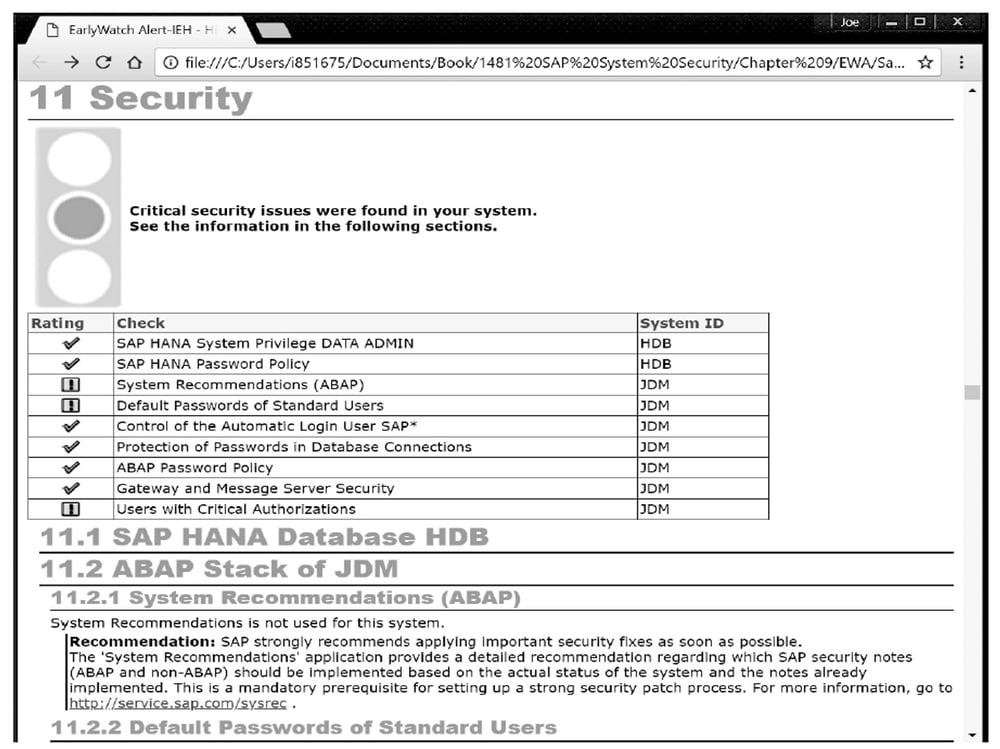
SAP EarlyWatch is a diagnostic tool that provides solution status, health, performance, growth, and security checks. Admins can set up automated SAP EarlyWatch Alert reports to see what needs attention. Additionally, these reports will call out critical SAP Notes and configurations that have yet to be implemented in a system. SAP EarlyWatch is available to any customer with an SAP Solution Manager system.
Another collaborative project with NextLabs, SkyDRM for SAP (formerly known as SAP Enterprise Digital Rights Management) focuses on file protection including encryption, access rights management, and more.
SAP Enterprise Threat Detection is a tool that leverages SAP HANA to process large amounts of security events in real time, such as a cyber attack. It offers insight on how to neutralize attackers and find anomalies or damage in the system landscape following an intrusion.
SAP Governance, Risk, and Compliance (SAP GRC) is a suite of solutions focused on managing multiple aspects of a business. Security components include process and access control for authorizations, audit management tools, and business integrity screening to detect fraud and screen potential business partners.
SAP Identity Management is a tool used to cover the entire identity lifecycle of a person. With this tool, admins can ensure that the people accessing data in a system are who they say they are. Similar to the SAP GRC Access Control functionality, SAP Identity Management provides password self-service capabilities to users and helps in role provisioning.
SAP Information Lifecycle Management (SAP ILM) is a tool that allows the blocking and deletion of data from an SAP system. This is especially important in instances where data privacy laws such as the General Data Protection Regulation (GDPR) and California Consumer Protection Act (CCPA) require businesses to delete customer data upon request.
With SAP ILM, admins can create defined lifecycles for data; for example, how long to keep data (retention) and where to keep it prior to archival (residence). It also allows deletion exceptions for data used in legal proceedings, permanent data destruction, and secure data storage.
Because a majority of security concepts for cloud solutions, such as physical security, hardware, software platform, some applications, and more are the responsibility of SAP and not the customer, SAP has set up a public website that provides content on the ways SAP is securing their cloud products. It is called the SAP Trust Center and while not an SAP solution per se, should be mentioned in relation to SAP security.

SAP Watch List Screening helps vendors vet potential business partners to ensure they are not on watch lists published by governments and international organizations like the United Nations.
With all these tools at its disposal, SAP is confident it is compliant toward multiple financial and security-related privacy laws, including but not limited to:
Here are answers to some of the most common things SAP administrators want to know about SAP security.
What is SAP security?
SAP security refers to the processes, tools, and best practices that protect SAP systems, data, and applications from unauthorized access, cyberattacks, and data breaches.
Why is SAP security important?
SAP systems often store critical financial, operational, and personal data. Securing them helps prevent data loss, fraud, compliance violations, and reputational damage.
What are SAP’s main security tools?
Key solutions include SAP Identity Management, SAP Governance, Risk, and Compliance (GRC), SAP Enterprise Threat Detection, SAP Cloud Identity Access Governance, and SAP Information Lifecycle Management.
How often does SAP release security patches?
SAP releases patches monthly on SAP Patch Day, typically the second Tuesday of each month.
How does SAP handle cloud security?
For cloud products, SAP manages core infrastructure security and provides customers with tools like the SAP Trust Center, encryption options, and access governance controls. Customers are still responsible for some security for cloud products.
Does SAP comply with data protection laws?
Yes. SAP adheres to global compliance frameworks such as GDPR, HIPAA, CCPA, ISO/IEC 27001, and others, depending on the product and region.
What are SAP roles and authorizations?
In SAP, authorizations control which transactions, data, and functions a user can access, and are grouped into roles that are assigned to users. Roles contain authorization objects with specific field values that define the scope of access, for example, which company codes or plant codes a user can work with. Managing roles and authorizations correctly is one of the most fundamental aspects of SAP security.
What is segregation of duties (SoD) in SAP?
Segregation of duties is a security control that prevents any single user from holding conflicting access rights (such as the ability to both create and approve a vendor payment) which could enable fraud or errors to go undetected. In SAP, SoD conflicts are identified through access analysis tools such as SAP GRC Access Control and SAP Cloud Identity Access Governance, and are mitigated by adjusting role assignments or implementing compensating controls.
What is SAP GRC Access Control used for?
SAP GRC Access Control is used to manage and enforce access governance across SAP systems, including identifying and remediating segregation of duties violations, managing emergency access (firefighter access), automating access request and approval workflows, and supporting role management and periodic access certification. It is the primary on-premise access governance tool for SAP environments.
How does SAP handle GDPR compliance?
SAP provides several tools to help organizations meet GDPR requirements, including SAP Information Lifecycle Management for data blocking, retention, and deletion; data anonymization and pseudonymization capabilities; consent management; and read and change logging for audit purposes. SAP also maintains transparency about its own cloud security practices through the SAP Trust Center. Responsibility for GDPR compliance is shared: SAP secures its cloud infrastructure, but customers are responsible for configuring data protection settings and managing personal data within their SAP systems appropriately.
In addition to the information laid out above, there are a handful of important SAP security terms you should also know:
Want to learn more about SAP security? Additional information can be found in the blog posts and books listed below.
General SAP Security Concepts
These posts cover foundational SAP security concepts and emerging threats, including authorization risks, vulnerability monitoring in DevOps pipelines, SAP Patch Day, the limitations of traditional security approaches, the security implications of RISE with SAP, and why logging is essential for securing SAP S/4HANA systems.
Security within SAP Solutions
These posts cover security configuration within specific SAP solutions, including data encryption in SAP HANA, object privilege management, security material configuration in SAP Cloud Integration, and access log monitoring.
SAP's Security Solutions
These posts cover SAP's dedicated security tools and solutions, including SAP GRC Access Control configuration and implementation, business role management, rulesets, emergency access management, continuous control monitoring, SAP Process Control, SAP ILM data deletion, SAP API Management security policies, and SAP Enterprise Threat Detection.
Compliance
These posts cover data privacy and compliance topics in SAP environments, including anonymization and pseudonymization strategies, data masking requirements, and how SAP Fiori app issues can surface GRC-related problems.
Other Key SAP Security Topics
These posts cover additional SAP security topics, including SSL configuration in SAP NetWeaver AS ABAP and best practices for using enabler roles in SAP authorization design.
Learn more SAP from our official Learning Center.
And to continue learning even more about SAP security, sign up for our weekly blog recap here: