My Logos A-Z: SPACE to SPIDER-MAN

Image © unknown

Neil deGrasse Tyson Presents Space Odyssey. Client: Len Wein. Medium: digital. Date: 2016. A video game based on the Tyson TV series Cosmos: A Spacetime Odyssey, which Len Wein was somehow involved in. He commissioned this logo from me, which uses a commercial font, but it was never paid for, and the game is still in limbo as far as I know. I like it, so I’m including it.

Image © DC Comics

Spanner’s Galaxy. Client: DC Comics. Medium: pen and ink. Date: 1984. A science fiction series, I thought the large S at each end was interesting and worth emphasizing. The final logo had a star field inside the letters of Galaxy, probably by artist Tom Mandrake. Appeared on six issues.

Image © Todd McFarlane

Spawn Bible. Client: Todd McFarlane. Medium: digital. Date: 1996. Tom Orzechowski did this fine Spawn logo and most other logo and lettering work for McFarlane, but Todd asked me to do the second line for this one. It uses one of my title fonts with a few tweaks. Appeared on one issue.

Image © Todd McFarlane

Spawn: Blood Feud. Client: Todd McFarlane. Medium: digital. Date: 1995. The other Spawn logo I did used the same title font and a commercial font for the top line. The final logo replaced that with Orzechowski’s logo for the four issue series.

Image © Marvel

The Spectacular Spider-Man. Client: Marvel. Medium: pen and ink. Date: 1994. One of several Spider-Man logo revamps I did at this time. Marvel wanted to update the original by Brodsky and Simek, but not change it too much. A few months later they decided they wanted another, more extreme, revamp, see below. This one was not used as far as I know.

Image © Marvel

The Spectacular Spider-Man. Client: Marvel. Medium: pen and ink. Date: 1994. Their new idea was a design similar to the Sabretooth logo I had done for them two years earlier, so I redid them again on that plan. More on all this HERE. This one was used on most of issues 218 to 256.

Image © DC Comics

The Spectre. Client: DC Comics. Medium: pen and ink. Date: 1986. Pencilled by Ed Hannigan and inked by me, which is probably why I don’t have a copy in my files and don’t recall working on it, but the original in the DC files has our names on it. A unique style that’s somewhat art deco. Appeared on 31 issues.

Image © DC Comics

Speed Buggy! Client: DC Comics. Medium: digital. Date: 1999. One of the Hanna-Barbera character logos I was asked to create or recreate, this was for the cover of CARTOON NETWORK PRESENTS #23. Adobe Illustrator allowed me to make more effective speed lines.

Image © Marvel and DC Comics

Spider-Boy. Client: Amalgam Comics (Marvel and DC). Medium: digital. Date: 1995. Combining my Superboy and Spider-Man logos, so I was the right person for this job. Fun to do, especially the line shading on the S. Appeared on two issues, see below.

Image © Marvel and DC Comics

Spider-Boy Team-Up Featuring The Legion of Galactic Guardians 2099. Client: Amalgam Comics (Marvel and DC). Medium: digital. Date: 1996. Is this the longest cover logo I ever worked on? Probably, though on the actual cover the right side was moved down to the bottom left as if it was cover lettering. The new parts are all my fonts or my designs except that LEGION logo, which is by Ken Lopez. Appeared on one issue.

Image © Marvel
Image © Marvel

Spider-Man. Client: Marvel. Medium: pen and ink. Date: 1994. As seen above, for the Marvel book simply titled Spider-Man, and where all the other versions began. The first was not used, the second appeared on issues 52 to 67 and many other places.

Image © Marvel

Spider-Man Adventures. Client: Marvel. Medium: pen and ink. Date: 1994. Another of these. For titles where the qualifier was below the main word, I felt it wouldn’t work to curve them against all those points, so I did straight block letters in rounded boxes. Appeared on five issues, then someone else did a curved version not in a box.

Image © Marvel

Spider-Man: Dead Man’s Hand. Client: Marvel. Medium: digital. Date: 1996. By this time I’d done a straight-line version of my Spider-Man revamp in digital form so I could squash it a bit vertically to make room for this second line, which is one of my fonts. Appeared on one issue.

Image © Marvel

Spider-Man: Funeral for an Octopus. Client: Marvel. Medium: pen and ink. Date: 1994. This is the design for which I created the straight-line Spider-Man logo, but still by hand. I digitized it later. Not sure that the tombstone is working, but I like the way the subtitle is carved into it. Appeared on three issues.

Image © Marvel

Spider-Man – Punisher Family Plot. Client: Marvel. Medium: digital. Date: 1995. Combo logos like this rarely work well together, but at least the two character logos (by me) are about the same shape. The bottom line is a commercial font. Appeared on two issues.

Image © Marvel

Spider-Man: Redemption. Client: Marvel. Medium: digital. Date: 1996. The second line here started with a commercial font with lots of additions and tweaks. I have no idea why the D is so tall. Appeared on four issues. This straight version of my Spider-Man design replaced the curved one on most titles and stayed on them for a while, as well as appearing many other places. More on that HERE.

Image © Marvel

(Spider-Man) Starring in Marvel Tales. Client: Marvel. Medium: pen and ink. Date: 1994. Another title where the new curved spiky logo was wanted with this below it, in a hexagonal box for a change, but I don’t see any evidence it was used.

Image © Marvel

Spider-Man The Arachnis Project. Client: Marvel. Medium: pen and ink. Date: 1994. A completely different block-letter version of the character’s name for a change. The block serifs at the top helped fill spaces around the A’s. Appeared on six issues.

Image © Marvel
Image © Marvel

Spider-Man Unlimited. Client: Marvel. Medium: pen and ink. Date: 1994. For the top one I went for the matching curve and drop shadow, but that one wasn’t used. The round-ended box appeared on three issues before being replaced by an unboxed curved version by someone else. In retrospect, that’s what I should have done.

Posts in this series are listed on the Logo Links page of my blog.

Rereading: THE CRUISE OF THE MAIDEN CASTLE by David Severn

American Edition illustrated by Manning DeV. Lee

The second Severn book in the Warner series, featuring the three Warner children: Alan, Joan, and Christopher, has them on a holiday cruise on a canal boat. They’re supposed to be with their friend David Grantham and his Uncle Lionel, but that elderly gentleman, owner of the boat Maiden Castle, is called away to an exciting archaeological find that he wants to help excavate. At first he plans to send the children home, but David, who has sailed with him before, convinces him to let the four children crew the narrow canal boat for a week to bring it near where he will be digging. Managing the boat is not as easy as David thinks, leading to various problems and adventures, but the biggest adventure happens when they tie up one night next to an abandoned factory where strange things seem to be going on. Investigating, Alan and David discover it’s crammed with stolen and smuggled goods. Can they escape the pursuit of the criminals using the site?

The idea of kids on a boat on their own was pioneered by Arthur Ransome, and this one is nearly as good. Recommended.

My Logos A-Z: SILVER DEER to SPACE MUSEUM

Image © DC Comics

Silver Deer. Client: DC Comics. Medium: pen and ink or marker. Date: 1986. For Who’s Who #21. The character’s costume included fringe, so I added some.

Image © DC Comics

Silver Ghost. Client: DC Comics. Medium: pen and ink or marker. Date: 1986. For Who’s Who #21. Shine on small letters is hard to pull off, but I think it worked here with help from the color.

Image © DC Comics

Silver Scarab. Client: DC Comics. Medium: pen and ink or marker. Date: 1986. For Who’s Who #21. Also appeared in INFINITY INC. #9. The double S joined by the scarab symbol is a nice touch, I think.

Image © Marvel

Silver Surfer. Client: Marvel. Medium: digital. Date: 1996. It was not until I began working in Adobe Illustrator that I could create more subtle and effective metallic effects. I’m not sure if these letters began as a commercial font, or if I just drew and developed them in Illustrator. The long tails on the S’s were meant to bleed off the covers. Appeared on issues 123 to 146 of the monthly title and I think a few other places.

Image © Marvel

Siren. Client: Malibu Comics. Medium: digital. Date: 1995. I think this began as a sketch and was developed in Illustrator. Pointy and dangerous. Appeared on four issues and a Special.

Image © DC Comics

Sivana. Client: DC Comics. Medium: pen and ink or marker. Date: 1986. For Who’s Who #21. If this 1940s Captain Marvel villain ever had a logo in those stories, we didn’t have access to it at DC. Here I tried to do something villainous but still a bit bouncy and fun.

Image © DC Comics

Sivana. Client: DC Comics. Medium: pen and ink or marker. Date: 1987. For Who’s Who Update #5. And a year later they wanted another one, probably for an updated version of the character being used more recently. I went modern.

Image © Entertainment Weekly

Six Guns & Roses. Client: Entertainment Weekly. Medium: digital. Date: 2016. One of several now puzzling things commissioned for their 2016 Comic-Con Preview issue. I think this had something to do with Stephen King’s Gunslinger character from his Dark Tower series. The letters were sketched, then traced in Illustrator.

Image © Marvel

Skaar, Son of Hulk. Client: Marvel. Medium: marker. Date: 2007. I did lots of marker sketches for this character, first without his name, then with. More on that HERE. I billed for it and got paid, but I kept waiting for them to tell me which sketch was the final choice, and then I would work up a digital version in Illustrator. To my surprise, they simply used one of the marker sketch scans as the final logo. Looks okay on the covers to me, and it saved me some time. Appeared on twelve issues.

Image © Skyshapers Foundation

Skyshapers. Client: Skyshapers Foundation. Medium: pen and ink. Date: 1990. I don’t have a copy of what I did, looking online this seems likely to be it. I’m not clear on what it is or was exactly, looks like animation-style images aimed at kids. There’s also THIS article describing a non-profit that seems to be the same thing, and part of their circular logo is at the top of the image above. I don’t think I did that. Possibly this client was given my contact info by someone at DC Comics.

Image © Marvel

(The Awesome) Slapstick! Client: Marvel. Medium: pen and ink. Date: 1991. Always fun to do something bouncy and humorous for a change, a four-issue series about a character turned into some kind of space clown I think. The word slapstick comes from Vaudeville, it was a pair of sticks that made a loud crack sound when you struck it, used to emphasize a punchline or a gag. The word became synonymous with physical comedy as seen in old films by Laurel and Hardy, the Three Stooges, and others.

Image © Marvel

Sleepwalker. Client: Marvel. Medium: pen and ink. Date: 1991. The conversation with Marvel went something like this: “We want a weird, twisty logo something like the Time Warp one that DC did a while back.” “I did that.” “Great! Do it again.” So, I imitated myself, and they were happy with it. Appeared on 33 issues, a lot more than Time Warp.

Image © DC Comics

Slither. Client: DC Comics. Medium: digital. Date: 1997. Created for SUPERBOY PLUS #2, I used one of the snaky character’s eyes above the I. Probably began as a sketch that I worked up in Illustrator.

Image © DC Comics

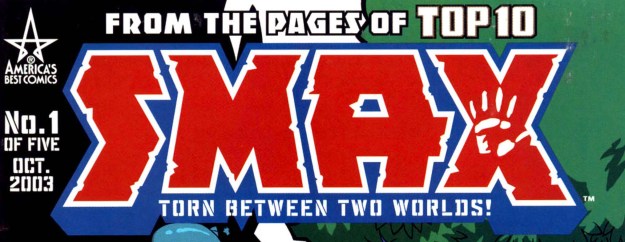
Smax. Client: America’s Best Comics. Medium: digital. Date: 2003. The somewhat surprising (to me) but fun spinoff from Alan Moore’s Top 10. The super-strong character needed a bulky and rugged logo. I added the white hand symbol from his chest to the X. Appeared on five issues.

Image © Neil Gaiman and HarperCollins

Smoke And Mirrors. Client: HarperCollins. Medium: digital. Date: 2020. One of eight Gaiman paperbacks with new painted cover art by the legendary Robert McGinnis. I used commercial fonts, the AND was an extra element in one. More HERE.

Image © Marvel

Solo. Client: Marvel. Medium: pen and ink. Date: 1994. Art deco style sometimes made the top horizontal elements wider, here I did the opposite, thickening the bottom horizontals. Gives it a different look, which is good, since there isn’t much you can do with this name visually. Appeared on four issues.

Image © DC Comics

Sovereign Seven. Client: DC Comics. Medium: pen and ink. Date: 1994. DC had high hopes for this series written by Chris Claremont, which was reasonably successful but not the next X-Men they were hoping for I think. I did lots of marker sketches and received lots of comments on them. This is the version of the name they used with the round O option. My S7 symbol was based on one by artist Dwayne Turner. I like it, but it’s hard to read. The final logo uses a different symbol that’s similar but easier to read. More on this HERE. Appeared on 36 issues, two annuals, and at least one other comic.

Image © Marvel

Soviet Super Soldiers. Client: Marvel. Medium: pen and ink. Date: 1992. For a one-shot. The chance to use one large S for all three words was irresistible, and I went for it.

Image © DC Comics

Space Clusters. Client: DC Comics. Medium: pen and ink. Date: 1986. Most of DC’s graphic novels from this time used type for the logos, this is a rare exception. I enjoyed designing this kind of psychedelic SPACE for the Alex Niño cover art. A silly name, but nothing I could do about that.

Image © DC Comics

Space Museum. Client: DC Comics. Medium: pen and ink or marker. Date: 1986. A favorite series of mine from STRANGE ADVENTURES in the 1960s, I tried to make the logo interesting, and it is to me. The original stories only had a tiny banner, not a real logo.

Posts in this series are listed on the Logo Links page of my blog.

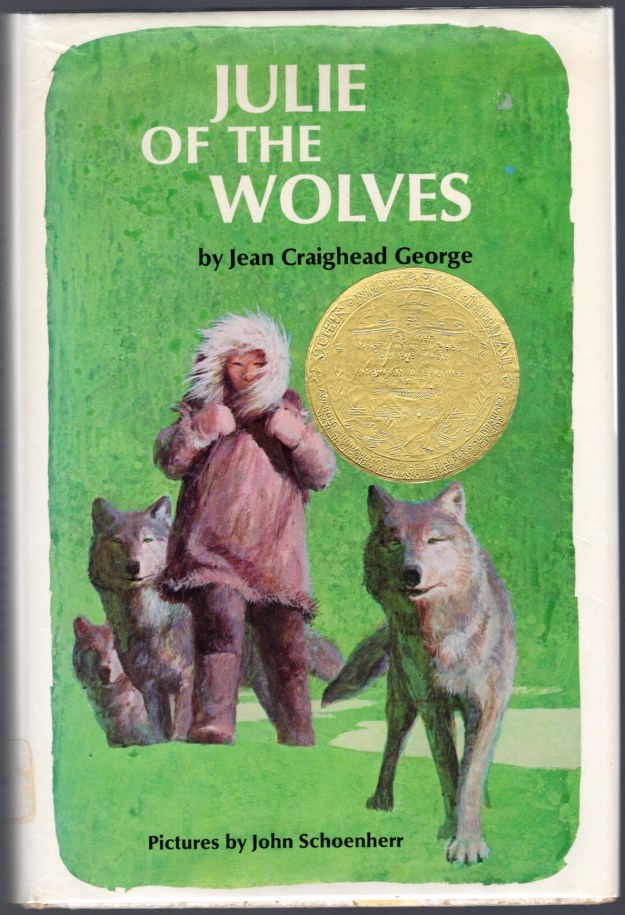
Rereading: JULIE OF THE WOLVES by Jean Craighead George

This Newbery winner published in 1972 has a brave beginning. We are dropped the middle of a story and must figure things out as we go. We’re with Miyax, a young Eskimo girl who is lost in the Alaskan tundra far from civilization. She has made a simple camp near the current home of a pack of wolves. Where is Julie, we wonder. How did this girl get here? How will she survive? The strength of the writing draws us in immediately so we are completely engaged in Miyax’s world and can wait to get those answers.

Miyax has some supplies, but is running out of food. She wants to befriend the wolves, hoping they will help her. She has knowledge from her father that this can be done, but she must learn how by trial and error. It’s a fascinating struggle for survival that Miyax is able to pull off, not without some setbacks. Gradually she learns how to find food for herself after some help from her new friends the wolves, but that leaves a larger problem. How can she get to the coastal town where she hopes to find work on a ship that can bring her to a friend in San Francisco? She has no compass, and the sun is not helpful, being always overhead in the Alaska summer. Soon winter will come and survival will become much harder.

A wonderful story, highly recommended.

Rereading: THE SILVER PRINCESS IN OZ by Ruth Plumly Thompson

Thompson’s eighteenth Oz book features only characters she created, some in previous books, some here, and dips a toe into science fiction, though almost no science is involved.

Randy, King of Regalia, is visited by his friend Kabumpo, the Elegant Elephant, who finds the boy bored with the routines of kingship. They decide to sneak away to visit their friend the Red Jinn of Ev, though they aren’t sure how they’ll be able to cross the Deadly Desert that surrounds Oz. After the usual adventures in previously unknown small kingdoms in Oz, the two find a way across the desert — blown by a fierce storm — into the land of Ix, bordering Ev. There they meet two newly arrived creatures, Planetty, the Silver Princess from Anuther Planet, and her fiery steed Thun the Thunder Colt. Both seem to be made of living metal mesh, and they have come to Ix by accident and don’t know how to return home. If they don’t return in a week or so, they will lose their living metal qualities and become like statues.

Randy and Kabumpo soon agree to help them, with the idea that the Red Jinn’s magic can probably send them home, though Randy is so taken with Planetty he wishes she could stay and return to Oz with him. After more adventures they finally arrive in Ev to discover that the Red Jinn has been deposed by Gludwig, an evil mine worker, and thrown into the Nonestic Ocean. Soon the travelers are captives in the basement prison of the red glass castle. How can they escape from this dire fate?

In addition to silly non-science, this book has some unfortunate racial stereotyping, but aside from that, it’s an entertaining adventure, and the best illustrations by John R. Neill in some years. Recommended.