

A.J. Bauer
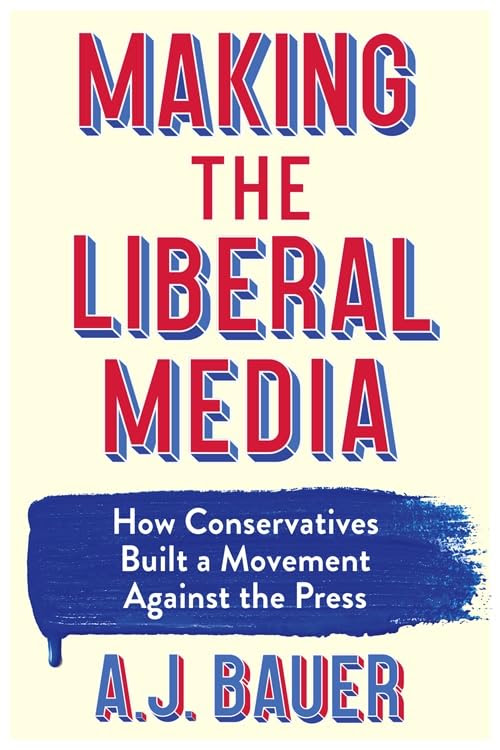
Andrea Lampros spoke with University of Alabama assistant professor, historian, ethnographer, and former journalist A.J. Bauer who researches historical and contemporary right-wing movements in the United States and beyond. He is the author of “Making the Liberal Media: How Conservatives Built a Movement Against the Press,” which delves into the questions of when and how we’ve come to live in a fractured media environment. Bauer looks at various inflection points, including the repeal of the Fairness Doctrine in 1987, but also to events well before and after that enable us to understand something about how we arrived at today.
Q. Most of us have a first memory of reading or watching or maybe clicking on the news. What was yours?
I have a very distinctive memory of the 1992 presidential election when Bill Clinton defeated Bush, and I was a big Bush fan. I went to bed before I knew the results because I was a child, and I went out in the morning to get the newspaper from the lawn. I took it out of its plastic wrapper and I saw the news that Clinton had won, and I started crying and woke my mom up and was like, ‘Oh my god.’
I grew up mostly listening to conservative talk radio and reading our local newspaper.
Part of the reason that I do the research that I do is I grew up in a conservative household, kind of within the conservative media milieu of the 1990s. A lot of the early studies of that kind of a milieu didn’t fully grasp what people got out of that media. [There were] ideas that people were tricked or duped or voting against their self-interest. These kinds of narratives. And I was more interested in what caused folks like those I grew up with to be interested and invested in the news and invested in right-wing commentary as well. It’s approaching it more from an empathy with the audience.
I’m not a conservative anymore, but I still have a certain kind of interest in understanding what appeals to them and why.
What made you leave journalism to start studying right-wing media as a graduate student?
I was interested at that time in nationalism, which was partly resulting from being very critical of the Iraq war. So the Tea Party movement happened in 2009. When I was trying to think of what to do for my master’s thesis, I was like, ‘Well, I’m tired of just reading all the time. I wanna go talk to people.’ And so I did a two-sided ethnography of the Tea Party movement where I went to Massachusetts and Texas and interviewed a bunch of Tea Party people. It was really exhausting because they wanted to try to pull me back….”Oh, he can convert, reconvert.”
I ended up switching and doing more archival history stuff because with archival work, the people are primarily dead and they’re not arguing with you. You can just read what they thought.
So is there a liberal media bias?
I am formally agnostic on that question [of “Is there a liberal media bias?”]. And so by not getting into the ‘is it or isn’t it?’ I was able to say: These people believe it is. Why do they believe it is? What are the conditions that are informing why they believe it is?
After having done this research, I am increasingly really frustrated with bias as a critical lens because I think that it presumes an idea of objectivity in journalism that doesn’t really fully exist. Objectivity is kind of an ideal. It’s a series of practices that you do to try to make your reporting seem as though it’s coming from a place where you don’t have a dog in the fight, that is variously successful or unsuccessful on a case-by-case basis, right?
I think it’s a more useful, critical approach to say, for example: I have some issues with the way that The New York Times covers trans people…and medical care pertaining to trans people. I don’t think that they’re biased against trans people. I think that their coverage of trans people harms the trans community.
Wasn’t there a time when we more or less agreed on facts and isn’t that still important as a society and to our democracy?
In hindsight, it does seem that way, but if you go back into the archive, it doesn’t. For example, one of the first right-wing media initiatives that I looked at is called Facts Forum, and Facts Forum was all about exactly this: We need to get a bunch of people together, talk about the facts, and as long as we have the facts, we’re gonna come to the truth. Right? Right. The facts that they were drawing upon were that the Communists have subverted the State Department, the Communists have supported the Army.
From an objective perspective, it’s not empirically true. But that doesn’t at all change the fact that those people were basing their politics on those non-truths. Right? Right. And basing it on an interpretation of the world that the actual connection to in reality was flawed.
Are we all just destined to live in different realities with different ‘truths’?
What I mean by pointing that out is not to say that there is no possibility of a shared truth. It’s just to say that even during the time periods, let’s say in the 1950s or Sixties, we’ve never had a period where there wasn’t fundamental disagreement over what the facts are, but more importantly, how we narrate those facts. How do we make sense of those facts? Why do those facts matter to me in my life? The vast majority of what we’re talking about here is the interpretation of facts, not about the facticity itself.
Why did conservatives focus their attacks on the media?
Part of what I argue in the book is that belief in liberal media bias was a really important, and, I argue, kind of constitutive factor in the creation of the modern conservative identity and tactical decisions by the modern conservative movement. There’s nothing stopping liberals or the left from borrowing those ideas, but it’s one component of many that allowed the right to succeed.
For example, like when Phyllis Schlafly was opposed to the Equal Rights Amendment in the 1970s. She used critique of the liberal media as one of the tools to get her onto the airwaves using “equal time” provisions. So media criticism was an important part, but ultimately it was uniting against or in favor of traditional values against feminism. And so part of it is you can’t mistake the tactic for the overall vision. And in my perspective, even if the left and liberals borrow tactics from the right, they still lack that coherent vision that they need.
What about the ‘both-sides-ism’ that we’re seeing, where people say both sides have problems; liberals are living in a New York Times bubble and conservatives are living in a Fox News bubble? You can’t really equate those, can you? One is journalism and the other…
I do think that you can meaningfully distinguish between the kinds of reporting you see at The New York Times and the kinds of reporting you see at Fox. But does that distinction matter in terms of how either of those outlets function in the world? And what I mean by that is how audiences interpret their content and then go about acting in the world as a result of their content.
And so I think this is the fundamental challenge that we’re all facing: On the one hand, you can draw very clear distinctions. On the other hand, it all flattens out and functions in basically the same way in terms of audiences and what they decide they believe.
Where do we go from here?
And so it leaves us with this challenge of — and this is something that I’m struggling with in all of my work — how do you level a critique that lands with conservative audiences? If you say, ‘I want to convince conservatives that what they’re getting on Fox News isn’t good for them.’
I can’t simply say, well, The New York Times is better. ‘Look, objectively, look, if I measure these things, The New York Times is better.’ They’re gonna be like, well, but The New York Times is liberal, and I disagree with their coverage of the X, Y, Z issue, right? Again, this has very little to do with facticity. Often it’s about framing.
Is the way that the news is framed fitting within my prior understanding of how the world works?
What you’re saying rings true, but aren’t we to the point of urgency? Aren’t we approaching an authoritarian state?
I think that we’re in a new and scary place. And as a historian, I think it’s important to say we do need to know what happened in the past, to know how we got to this point. But how we got here isn’t going to always tell us what to do now…
I always like to say that we can’t really look backward for ideas on what to do now. All we can do is look backward to understand how we got to this point.
___________________________________
A.J. Bauer speaks at UC Berkeley Journalism on Thursday, March 19 at 6 pm in a talk sponsored by the Center for Right-Wing Studies. In-person or on Zoom. RSVP here.


