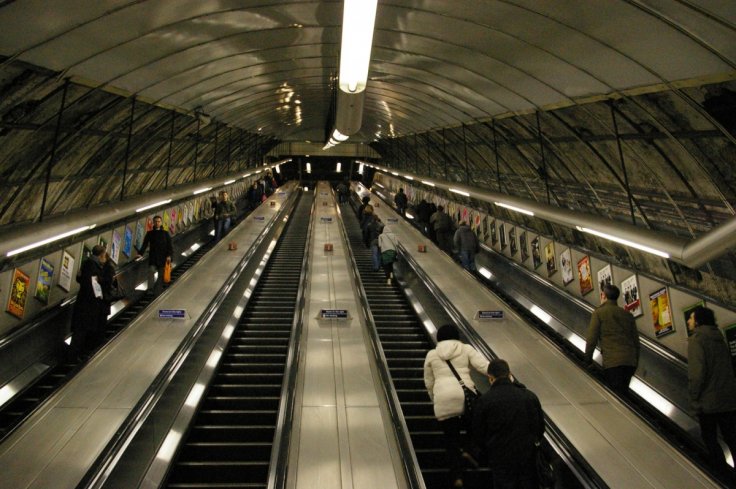
Cycling from King’s Cross to Imperial College London

I've used Santander Cycles to get from King's Cross to Imperial College hundreds of times over the last couple of years, and I'd like to think that I'm pretty close to finding the fastest possible route now. The basic route is to aim for New Cavendish Street and then cross Hyde Park, but I've found… Continue reading Cycling from King’s Cross to Imperial College London

The fastest route between King’s Cross St Pancras and South Kensington

I've commuted via King's Cross St Pancras to Imperial College's South Kensington Campus for about a decade now, but have only recently discovered what I believe to be the fastest possible route between those two London stations. King's Cross St Pancras to South Kensington takes me about 20 minutes, and the return journey takes about… Continue reading The fastest route between King’s Cross St Pancras and South Kensington

Uncovering multicore interference

Dan Iorga's avatarDan's Blog

If I visit an exotic destination, I would surely do some sightseeing. I would cycle to that destination and I would use Google Maps for navigation. At most crossroads, I need to know in which direction I should turn. Other apps running on my phone might delay the indications provided by Google Maps and therefore I can mistakenly make a wrong turn and possibly be eaten by some large animal.

The reason why this is happening is that on all modern multicore processors, applications on different cores of the system are competing for the shared resources. This is not a problem in most applications but it can be in time-sensitive ones. If we design any such time-sensitive programs, we need to know what to expect in terms of interference so that we can accommodate for the delays. The most common approach for evaluating delays in multicore systems is to run…

View original post 406 more words

A plot twist! Drawing better graphs in PL papers

In this post, I'd like to share some thoughts I've accumulated over the past few years about how to draw better graphs. To get straight to the point, I have two concrete recommendations: normalised data should usually be plotted on a logarithmic scale, andscatter plots can be easier to understand than bar charts. I'll now… Continue reading A plot twist! Drawing better graphs in PL papers

Loop invariants – where should we put them?

Many verification-oriented programming languages have built-in support for attaching loop invariants to loops. A loop invariant is a condition that holds in four different places: immediately before the loop, at the start of each iteration (before evaluating the test condition), at the end of each iteration, and immediately after the loop. Usually, the invariants are… Continue reading Loop invariants – where should we put them?

Greatest hits of PLDI 2018

I had a great time at PLDI 2018 last week. Here is my take on a few of the papers that stood out for me. John Vilk presented a tool called BLeak for finding memory leaks in web browsers. One might think that leak detection is not important in a garbage-collected setting, but Vilk explained… Continue reading Greatest hits of PLDI 2018

What is the difference between latency and throughput?

I've been working in an Electrical and Electronic Engineering department for more than three years now, but I admit that it's only quite recently that I find myself properly understanding the difference between latency and throughput. These are terms that are used all the time when talking about an electronic circuit. The distinction between them… Continue reading What is the difference between latency and throughput?