SpyTech: The Underwater Wire Tap

In the 1970s, the USSR had an undersea cable connecting a major naval base at Petropavlovsk to the Pacific Fleet headquarters at Vladivostok. The cable traversed the Sea of Okhotsk, which, at the time, the USSR claimed. It was off limits to foreign vessels, heavily patrolled, and laced with detection devices. How much more secure could it be? Against the US Navy, apparently not very secure at all. For about a decade starting in 1972, the Navy delivered tapes of all the traffic on the cable to the NSA.

Top Secret

You need a few things to make this a success. First, you need a stealthy submarine. The Navy had the USS Halibut, which has a strange history. You also need some sort of undetectable listening device that can operate on the ocean floor. You also need a crew that is sworn to secrecy.

That last part was hard to manage. It takes a lot of people to mount a secret operation to the other side of the globe, so they came up with a cover story: officially, the Halibut was in Okhotsk to recover parts of a Soviet weapon for analysis. Only a few people knew the real mission. The whole operation was known as Operation Ivy Bells.

The Halibut

The Halibut is possibly the strangest submarine ever. It started life destined to be a diesel sub. However, before it launched in 1959, it had been converted to nuclear power. In fact, the sub was the first designed to launch guided missiles and was the first sub to successfully launch a guided missile, although it had to surface to launch.

Oddly enough, the sub carried nuclear cruise missiles and its specific target, should the world go to a nuclear war, was the Soviet naval base at Petropavolvsk.

Continue reading “SpyTech: The Underwater Wire Tap”

Scientific staff members working on the computing machine Setun

The Setun Was A Ternary Computer From The USSR In 1958

[Codeolences] tells us about the FORBIDDEN Soviet Computer That Defied Binary Logic. The Setun, the world’s first ternary computer, was developed at Moscow State University in 1958. Its troubled and short-lived history is covered in the video. The machine itself uses “trits” (ternary digits) instead of “bits” (binary digits).

When your digits have three discrete values there are a multiplicity of ways of assigning meaning to each state, and the Setun uses a system known as balanced ternary where each digit can be either -1, 0, or 1 and otherwise uses a place-value system in the normal way.

An interesting factoid that comes up in the video is that base-3 (also known as radix-3) is the maximally efficient way to represent numbers because three is the closest integer to the natural growth constant, the base of the natural logarithm, e, which is approximately 2.718 ≈ 3.

If you’re interested to know more about ternary computing check out There Are 10 Kinds Of Computers In The World and Building The First Ternary Microprocessor.

Continue reading “The Setun Was A Ternary Computer From The USSR In 1958”

RADUGA: The Retro Computer From Behind The Curtain

When [Kasyan] was six years old, he saw a RADUGA computer, a Russian unit from the 1990s, and it sparked his imagination. He has one now that is a little beat up, but we feel like he sees it through his six-year-old eyes as a shiny new computer. The computer, which you can see in the video below, was a clone of the Spectrum 48K.

The box is somewhat klunky-looking, and inside is also a bit strange. The power supply is a — for the time — state-of-the-art switching power supply. Since it wasn’t in good shape, he decided to replace it with a more modern supply.

The main board was also not in good shape. A Zilog CPU is on a large PCB with suspicious-looking capacitors. The mechanical keyboard is nothing more than a array of buttons, and wouldn’t excite today’s mechanical key enthusiast.

Continue reading “RADUGA: The Retro Computer From Behind The Curtain”

Close up of Zenit 19 camera

Behind The Lens: Tearing Down A Rare Soviet Zenit 19

If you’re into Soviet-era gear with a techy twist, you’ll love this teardown of a rare Zenit 19 camera courtesy of [msylvain59]. Found broken on eBay (for a steal!), this 1982 made-in-USSR single-lens reflex camera isn’t the average Zenit. It features, for example, electronically controlled shutter timing – quite the upgrade from its manual siblings.

The not-so-minor issue that made this Zenit 19 come for cheap was a missing shutter blade. You’d say – one blade gone rogue! Is it lost in the camera’s guts, or snapped clean off? Add to that some oxidized battery contacts and a cracked viewfinder, and you’ve got proper fixer-upper material. But that’s where it gets intriguing: the camera houses a rare hybrid electronic module (PAPO 074), complete with epoxy-covered resistors. The shutter speed dial directly adjusts a set of resistors, sending precise signals to the shutter assembly: a neat blend of old-school mechanics and early electronics.

Now will it shutter, or stutter? With its vertical metal shutter – uncommon in Zenits – and separate light metering circuitry, this teardown offers a rare glimpse into Soviet engineering flair. Hungry for more? We’ve covered a Soviet-era computer and a radio in the past. If you’re more into analog camera teardowns, you might like this analog Pi upgrade attempt, or this bare minimum analog camera project.

Continue reading “Behind The Lens: Tearing Down A Rare Soviet Zenit 19”

Soviet Wired Radio, How It Worked

At the height of the Cold War, those of us on the western side of the wall had plenty of choice over our radio listening, even if we stuck with our country’s monolithic broadcaster. On the other side in the Soviet Union, radio for many came without a choice of source, in the form of wired radio systems built into all apartments. [Railways | Retro Tech | DIY] grew up familiar with these wired radios, and treats us to a fascinating examination of their technology, programming, and ultimate decline.

In a Soviet apartment, usually in the kitchen, there would be a “Radio” socket on the wall. Confusingly the same physical dimension as a mains socket, it carried an audio signal. The box which plugged into it was referred to as a radio, but instead contained only a transformer, loudspeaker, and volume control. These carried the centralised radio station, piped from Moscow to the regions by a higher voltage line, then successively stepped down at regional, local, and apartment block level. A later refinement brought a couple more stations on separate sub-carriers, but it was the single channel speakers which provided the soundtrack for daily life.

The decline of the system came over the decades following the end of communism, and he describes its effect on the mostly older listenership. Now the speaker boxes survive as affectionate curios for those like him who grew up with them.

You probably won’t be surprised to find twisted-wire broadcasting in use in the West, too.

Continue reading “Soviet Wired Radio, How It Worked”

Illustrated Kristina with an IBM Model M keyboard floating between her hands.

Keebin’ With Kristina: The One With All The Espionage

[Ziddy Makes] describes this cute little guy as a biblically-accurate keyboard. For the unfamiliar, that’s a reference to biblically-accurate angels, which have wings (and sometimes eyes) all over the place. They’re usually pretty scary to behold. Don’t say I didn’t warn you.

A cube keyboard with adorably vibrant pastel keycaps.
Image by [Ziddy Makes] via GitHub
But this? This is the opposite of scary. Sure, there are keys everywhere. But it’s just so darn adorable. You know what? It’s those keycaps.

This 16-key macro cube uses a Pro Micro and a system of PH2 5p ribbon cables to connect the four four-key sisterboards to the main board. A 3D-printed base holds all the boards in place. Out of all the switches in the world, [Ziddy] chose Otemu Blues. Clack!

Although it may take some getting used to, this seems like it would be a fun way to input macros. I can see the case for putting some rubber feet on the bottom, otherwise it might scoot around on the desk. That might be cute, but only the first couple of times, you know?

Continue reading “Keebin’ With Kristina: The One With All The Espionage”

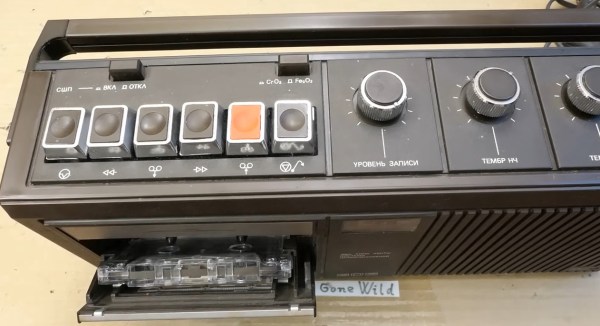
A Soviet Cassette Recorder Receiving Some Love

For those of us who lived in the capitalist west during the Cold War, there remains a fascination to this day about the Other Side. The propaganda we were fed as kids matched theirs in describing the awful things on the other side of the wall, something that wasn’t borne out when a decade or so later in the 1990s we met people from the former communist side and found them unsurprisingly to be just like us. It’s thus still of interest to have a little peek into Eastern Bloc consumer electronics, something we have the chance of courtesy of [DiodeGoneWild], who’s fixing a 1980s Soviet cassette recorder.

The model in question is a Vesna 309, and it has some audio issues and doesn’t turn the tape. It gets a teardown, the motor is cleaned up inside, and a few capacitor and pot cleanups later it’s working again. But the interest lies as much in the machine itself as it does in the repair, as it’s instructive to compare with a Western machine of the same period.

We’re told it would have been an extremely expensive purchase for a Soviet citizen, and in some ways such as the adjustable level control it’s better-specified than many of our equivalents. It’s based upon up-to-date components for its era, but the surprise comes in how comparatively well engineered it is. A Western cassette deck mechanism would have been a much more sketchy affair than the substantial Soviet one, and its motor would have been a DC part with a simple analogue speed controller rather than the brushless 3-phase unit in the Vesna. Either we’re looking at the cassette deck for senior comrades only, or the propaganda was wrong — at least about their cassette decks. The full video is below, and if you’re hungry for more it’s not the first time we’ve peered into electronics from the eastern side of the Iron Curtain.

Continue reading “A Soviet Cassette Recorder Receiving Some Love”