The turntable in question, or at least the same model.

Vintage Turntable Gets Brain Transplant And Home Assistant Integration

When [Marsupial] picked up a vintage Sansusi P-L45 turntable, he figured it would be an easy fix: a few capacitors, a belt or two, and maybe a new cartridge, the usual. But it turned out the electronics were fried, which set the stage for an upgrade that turned it into what may be the world’s only ESP32-driven, Home Assistant integrated, linear tracking turntable.

That last bit, the linear tracking, is why the turntable originally had a microprocessor in the first place: rather than an arm that pivots along the groove naturally, fancy turntables towards the end of the golden era of vinyl slid the needle along a linear track at a variable speed to follow the spiral groove on the record. You can see that in action in the demo video below, though it’s of a working version owned by [BFinks].

The fancy linear mechanism required electronic control to match the speed to the RPM, and in the example of Sansusi’s P-L45, that was provided by an NEC microcontroller on a daughter-board labelled “F4992 CPU”. CPU is a grandiose title, perhaps, but that’s irrelevant since the chip on the board was deader than disco.

That meant [Marsupial] had some reverse engineering to do — figuring out exactly what that chip did to drive this board, in order to replicate its behavior on an ESP32-S3. Luckily the golden era of vinyl correlated with the golden era of service manuals, and the manuals are still available, so [Marsupial] had a big leg up on that. After making the turntable work like stock, what else to do with the extra capability of the ESP32 than plug it into HA and make it really automatic?

Of course it wasn’t quite that easy: a new daughter-board was created that needed to do level shifting to the ESP32’s modern 3.3 V logic as well as hardware debounce on some inputs. The whole saga is very well documented on [Marsupial]’s blog WeAreAllGeeks. The link here takes you to the overview, but he’s got a lot more info on other pages — and of course links to the firmware and PCB design if you happen to have a Sansusi turntable in need of a brain transplant.

Vinyl lovers will appreciate this project much more than the last ESP32 “turntable” we featured, which was anything but. If you want to get into records but don’t have a turntable, you can always make your own.

Continue reading “Vintage Turntable Gets Brain Transplant And Home Assistant Integration”

Swapping Vinyl For Cardboard With This ESP32 Turntable

Cardboard is a surprisingly durable material, especially in its corrugated form. It’s extremely lightweight for its strength, is easy to work, can be folded and formed into almost any shape, is incredibly inexpensive, and when it has done its duty it can be recycled back into more paper. For these reasons, it’s often used in packaging material but it can be used to build all kinds of things outside of ensuring that products arrive at their locations safely. This working cardboard record player is one example.

While the turntable doesn’t have working records in the sense that the music is etched into them like vinyl, each has its own RFID chip embedded that allows the ESP32 in the turntable’s body to identify them. Each record corresponds to a song stored on an SD card that instructs the ESP32 to play the appropriate song. It also takes care of spinning the record itself with a small stepper motor. There are a few other details on this build that tie it together too, including a movable needle arm held on with a magnet and a volume slider.

As far as a building material goes, cardboard is fairly underrated in our opinion. Besides small projects like this turntable, we’ve also seen it work as the foundation for a computer, and it even has the strength and durability to be built into a wall or even used as shelving material. And, of course, it’s a great material to use when prototyping new designs.

Continue reading “Swapping Vinyl For Cardboard With This ESP32 Turntable”

Lamp Becomes Rotating, Illuminated Sign For Festival Table

Two things we love are economical solutions to problems, and clever ways to use things for other than their intended purpose. [CelGenStudios] hits both bases with a simple illuminated and spinning sign made from a lamp and a couple economical pieces of hardware: an LED bulb, and a solar-powered product spinner. Both are readily and cheaply available from your favorite overseas source.

The first step in making a cheap illuminated sign is to not buy one, but instead make do with a standing lamp. Plug a bright LED bulb into the socket, decorate the lampshade with whatever logos or signs one wishes to display, and one has an economical illuminated sign suitable for jazzing up a table at an event. But what really kicks it up a notch is making it rotate, and to do that is where the clever bit comes in.

Mounting the lampshade to the solar turntable body yields a simple, rotating, illuminated sign.

The first attempt used a BBQ rotisserie motor to turn the whole lamp, but it was too loud and not especially stable. The second attempt used a “disco ball effect” LED bulb with a motorized top; it worked but turned too quickly and projected light upward instead of into the lampshade.

The winning combination is LED bulb plus a little solar-powered turntable onto which the lampshade mounts. As a result, the lampshade spins slowly when the lamp is turned on. It might not be the most durable thing to ever come out of a workshop, but as [CelGenStudios] says, it only needs to last for a weekend.

The basic concept is far more simple than it might sound, so check it out in the video (embedded below) to see it in action. Curious about what’s inside those little solar spinners? Skip to 5:55 in the video to see how they work. And if you’re intrigued by the idea of using solar power for motive force but want to get more hands-on with the electrical part, we have just the resource for turning tiny motors with tiny solar cells.

Thanks to [Bike Forever] for the tip!

Continue reading “Lamp Becomes Rotating, Illuminated Sign For Festival Table”

Is That A Record Player In Your Pocket Or…

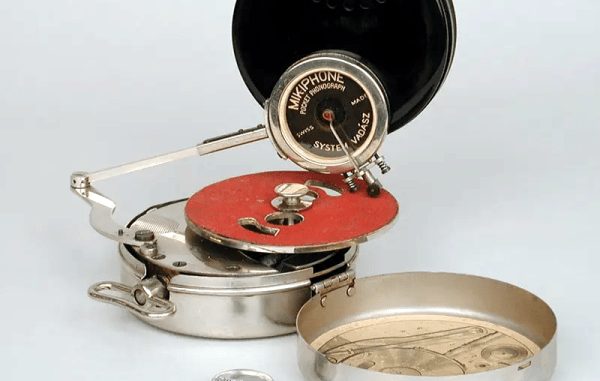
If aliens visited the Earth, they might find our obsession with music hard to fathom. We have music in our homes, our cars, and our elevators. Musical performances draw huge crowds and create enormous fame for a select few musicians. These days, your music player of choice is probably the phone in your pocket. What our grandparents wouldn’t have done to have a pocket-sized music player. Wait…, it turns out they had them. [Rare Historical Photos] has pictures and other material related to the Mikiphone — a “pocket phonograph.” We don’t know how it sounded, but it is a fantastic piece of work visually. Actually, thanks to the [Stanford Archive of Recorded Sound], you can hear one of these rare machines playing in the video below. If only it were playing Toni Basil.

The device was made in the 1920s and had a decidedly strange tonearm. You wind it up with a gigantic key mechanism. There’s no electricity. A bakelite resonator became the speaker attached to the tone arm. The device was made in Switzerland by a company that started in music boxes. However, the design was the work of two brothers named Vadász.

Continue reading “Is That A Record Player In Your Pocket Or…”

A Super-Cheap Turntable Build For Photographic Purposes

When it comes to photographing products or small items, sometimes it’s useful to get vision from all angles. Shooting a video of an item on a turntable is an ideal way to do this. [ROBO HUB] built a super-cheap turntable for just this purpose.

The build relies upon a regular micro servo to handle rotating the turntable. However, it has been modified from stock to rotate 360 degrees instead of its usual 180 degree range of motion. This is a common hack that allows servos to be used for driving wheels or other rotating mechanisms. In this case, though, any positional feedback is ignored. Instead, the servo is just used as a conveniently-geared motor, with its speed controlled via a potentiometer. A CD covered in paper is used as a turntable, with the electronics and motor assembled in a cardboard base.

It’s a simple hack, and one you can probably put together with the contents of your junk drawer. Combined with a lightbox, it could up your photo and video game significantly. Those skills are super useful when it comes to documenting your projects, after all!

How The Turntable Paradox Works

Leave most objects on top of a turntable, and set it spinning, and they’ll fly off in short order. Do the same with a ball, though, and it somehow manages to roll around on top for quite some time without falling off. [Steve Mould] set about unpacking this “Turntable Paradox” in a recent YouTube video.

In the basic case, the fact that the ball rolls is what keeps it on the turntable. As the turntable spins, the ball spins in the opposite direction, as per Newton’s first law of motion. As long as the ball is allowed to roll up to the same speed as the turntable, it will pretty much stay in place in the absence of any other perturbing forces. In the event the ball is nudged along the turntable, though, it quickly ends up in a more complicated circular motion, orbiting in a ratio to the speed of the turntable itself. [Steve] explains the mechanisms at play, and dives into the mathematics behind what’s going on.

Sometimes, demonstrations like these can seem like mere curiosities. However, understanding physical effects like these has been key to the development of all kinds of complicated and fantastical machinery. Video after the break.

Continue reading “How The Turntable Paradox Works”

Glue-on nails with vinyl record pickups pierced through them that are used on a vinyl record

The Sound Of Nails On Black Vinyl Records

[Victoria Shen] modifies glue-on nails to give her the ability to play vinyl records with her fingers. Details are light but from the many glamour pictures, it looks like she pushes record player needles through glue-on nails with thin pickup wire that then presumably goes to an audio jack for amplification.

Photograph of hand with record needs through glue-on nails

[Victoria] experiments with novel musical tools for use in her art and performances. Be sure to check out the videos of the nails in action. The combination of “scratching” and ability to alter the speed of vinyl with the free fingers creates a weird and eerie experience.

Using her “Needle Nails”, [Victoria] has found she’s able to play multiple records simultaneously (Nitter). Thanks to the different diameters of 33, 78 and 45 vinyls, she’s able to stack them up while still keeping her fingers on them.

Glove like musical instruments are nothing new but the novel use of fashion, glamour and technology allow [Victoria Shen] the freedom to create something uniquely weird and cool, so much so that Beyonce used it in a video shoot for Vogue (Nitter).

Continue reading “The Sound Of Nails On Black Vinyl Records”