MyMiniFactory Has Acquired Thingiverse Bringing Anti-AI Focus

One of the best parts of 3D printing is that you can freely download the plans for countless models from sites like Thingiverse, Printables, and others. Yet with the veritable flood of models on these sites you also want to have some level of quality. Here recent news pertaining to Thingiverse is probably rather joyful, as with the acquisition of Thingiverse by MyMiniFactory, it should remain one of the most friendly sites for sharing 3D printing models.

Although Thingiverse as a concept probably doesn’t need much introduction, it’s important here to acknowledge the tumultuous times that it has gone through since its launch in 2008 as part of MakerBot. Both were acquired by Stratasys in 2013, and this has led to ups and downs in the relationship with Thingiverse’s user base.

MyMiniFactory was launched in 2013 as a similar kind of 3D printing object-sharing platform as Thingiverse, while also offering crowdsourcing and paid model options. In the MyMiniFactory blog post it’s stated that these features will not be added to Thingiverse, and that nothing should change for Thingiverse users in this regard.

What does change is its joining of the ‘SoulCrafted‘ initiative, which is an initiative against machine-generated content, including so-called ‘AI slop’. There will be a live Q & A on February 17th during which the community can pitch their questions and ideas, along with a dedicated Thingiverse group.
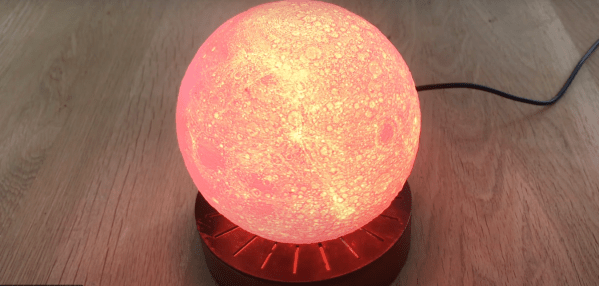
3D printed moon lamp

3D Printed Lithographic Moon Lamp

After years of being a software developer, [Chris] was excited to get back into embedded development and we’re glad he did. His 3D printed lithographic moon lamp combines a number of hacker and maker skills, and is sure to impress.

3D-printed lithographic moons have gotten pretty popular these days, so he was able to find a suitable model on Thingiverse to start with. Gotta love open-source. Of course, he needed to make a few modifications to fit his end design. Namely, he put a hole at the bottom of the moon, so he could slide the LED and heatsink inside. The 3 watt LED is pretty beefy, so he definitely needed a heat sink to make sure everything stayed cool.

Otherwise, the circuit itself is pretty straightforward. He has an ESP32 to drive the RGB LED through a transistor, and fitted the components onto a custom-designed circuit board to ensure everything stayed neat and organized. You don’t want a ton of loose wires and breadboards cluttering this build. Since he used an ESP32, he was able to create a simple web interface to control the color of the LEDs. Gotta make it connected somehow, right?

What’s great is in addition to the project write-up, [Chris] includes video tutorials, walking the readers through each individual step of the build. By doing so he really makes it easy for readers to follow along and reuse his work. If you’re still looking for ideas, one of these could make a really good Christmas present.

Continue reading “3D Printed Lithographic Moon Lamp”

Thingiverse Data Leaked — Check Your Passwords

Every week seems to bring another set of high-profile data leaks, and this time it’s the turn of a service that should be of concern to many in our community. A database backup from the popular 3D model sharing website Thingiverse has leaked online, containing 228,000 email addresses, full names, addresses, and passwords stored as unsalted SHA-1 or bcrypt hashes. If you have an account with Thingiverse it is probably worth your while to head over to Have I Been Pwned to search on your email address, and just to be sure you should also change your password on the site. Our informal testing suggests that not all accounts appear to be contained in the leak, which appears to relate to comments left on the site.

Aside from the seriousness of a leak in itself, the choice of encryption should raise a few eyebrows. Both SHA-1 and bcrypt can be considered broken or at best vulnerable to attack here in 2021, so much so that for any website to have avoided migration to a stronger algorithm indicates a very poor attention to website security on the part of Thingiverse. We’d like to think that it would serve as a salutary warning to other website operators in our field, to review and upgrade their encryption, but we suspect readers will agree that this won’t be the last time we report on such a leak and nervously check our own login details.

Digital Preservation For Old Batteries

The times they are a-changin’. It used to be that no household was complete without a drawer filled with an assortment of different sizes and types of batteries, but today more and more of our gadgets are using integrated rechargeable cells. Whether or not that’s necessarily an improvement is probably up for debate, but the fact of the matter is that some of these old batteries are becoming harder to find as time goes on.

Which is why [Stephen Arsenault] wants to preserve as many of them as possible. Not in some kind of physical battery museum (though that does sound like the sort of place we’d like to visit), but digitally in the form of 3D models and spec sheets. The idea being that if you find yourself in need of an oddball, say the PRAM battery for a Macintosh SE/30, you could devise your own stand-in with a printed shell.

The rather brilliantly named Battery Backups project currently takes the form of a Thingiverse Group, which allows other alkaline aficionados to submit their own digitized cells. The cells that [Stephen] has modeled so far include not only the STL files for 3D printing, but the CAD source files in several different flavors so you can import them into your tool of choice.

Like the efforts to digitally preserve vintage input devices, it’s not immediately clear how many others out there are willing to spend their afternoons modeling up antiquated batteries. But then again, we’ve long since learned not to underestimate the obscure interests of the hacker community.

Hackaday Podcast 083: Soooo Many Custom Peripherals, Leaving Bluetooth Footprints, And A Twirlybird On Mars

Hackaday editors Mike Szczys and Elliot Williams ogle the greatest hacks from the past 168 hours. Did you know that Mars Rover didn’t get launched into space all alone? Nestled in it’s underbelly is a two-prop helicopter that’s a fascinating study in engineering for a different world. Fingerprinting audio files isn’t a special trick reserved for Shazam, you can do it just as easily with an ESP32. A flaw in the way Bluetooth COVID tracing frameworks chirp out their anonymized hashes means they’re not as perfectly anonymized as planned. And you’re going to love these cool ways to misuse items from those massive parts catalogs.

Take a look at the links below if you want to follow along, and as always, tell us what you think about this episode in the comments!

Take a look at the links below if you want to follow along, and as always, tell us what you think about this episode in the comments!

Direct download (60 MB or so.)

Continue reading “Hackaday Podcast 083: Soooo Many Custom Peripherals, Leaving Bluetooth Footprints, And A Twirlybird On Mars”

3D Printed Doggie Braces

[Tye’s] dog Lucifur unfortunately has degenerative arthritis causing her a lot of pain in her feet. The vet suggested orthotic carpal braces to help alleviate the pain, but they come at a price tag of at least $1600. Given her current budgetary limitations, [Tye] decided to try the DIY route.

The first task was to cast Lucifur’s paws in plaster to make a mold of her feet in both the weight-bearing and non-weight-bearing orientations. According to [Tye], the non-weight-bearing orientation is more representative of the shape of a “normal” paw, but she also needed to model the weight-bearing orientation to better design the braces for walking.

Then it was time to print a PLA-based dog splint from a design she found on Thingiverse. Since PLA softens when it’s in boiling water, the splint can be easily molded to Lucifur’s paw. This is where the paw molds [Tye] made earlier come in handy, since nobody would want Lucifur wearing a PLA splint fresh out of boiling water. Finally, she added a bit of super glue to the heel of the splint in hopes that it will hold up better over time.

We certainly can’t recommend DIY solutions to medical problems and [Tye] made sure she stressed the importance of following the recommendations of your vet if you’re ever in her position. Either way, we hope Lucifur finds some momentary reprieve, and that she can eventually receive those $1600 braces she desperately needs.

Printed TS100 Case Beats The Heat With A Bearing

As we’ve said many times in the past, the creation of custom cases and enclosures is one of the best and most obvious applications for desktop 3D printing. When armed with even an entry-level printer, your projects will never again have to suffer through the indignity of getting hot glued into a nondescript plastic box. But if you’re printing with basic PLA, you need to be careful that nothing gets too hot inside.

Which was a problem when [Oleg Vint] started work on this 3D printed case for the popular TS100 soldering iron. But with the addition of a standard 608 bearing, the case provides a safe spot for the iron to cool off before it gets buttoned back up for storage. Of course, you can also use the flip-out perch to hold the iron while you’re working.

The bearing stand that served as inspiration for the case.

As [Oleg] explains on the Thingiverse page for the case, he actually blended a few existing projects together to arrive at the final design. Specifically, the idea of using the 608 bearing came from a printable TS100 stand originally designed in 2017 by [MightyNozzle]. Released under Creative Commons, [Oleg] was able to mash the bearing stand together with elements from several other printable TS100 cases to come up with his unique combined solution.

In a physical sense, this project is a great example of the sort of bespoke creations that are made possible by desktop 3D printing. But it’s also a testament to the incredible community that’s sprung up around this technology. While the logistics of it still could use some work, seeing hackers and makers swap and combine their designs like this is extremely inspiring.

[Thanks Arturo182]