How To Restore Your 19th-Century Lancashire Boiler To Hold 120 PSI

The Industrial Revolution was powered by steam, with boilers being a crucial part of each steam engine, yet also one of the most dangerous elements due to the high pressures involved. The five Lancashire boilers at the Claymills Pumping Station are relatively benign in this regard, as they operate at a mere 80 PSI unlike e.g. high-pressure steam locomotives that can push 200 – 300 PSI. This doesn’t mean that refurbishing one of these boilers is an easy task and doesn’t involve plugging a lot of leaks, as the volunteers at this pumping station found out.

At this Victorian-era pumping station there are a total of five of these twin-flue Lancashire boilers, all about 90 years old after a 1930s-era replacement, with them all gradually being brought back into service. The subject of the video is boiler 1, which was last used in 1971 before the pumping station was decommissioned. Boilers 2 and 3 were known to be in a pretty bad condition, and they needed a replacement for boiler 5 as it was about to go down for maintenance soon.

Although the basic idea behind a Lancashire boiler is still to boil water to create steam, it’s engineered to do this as efficiently as possible to save fuel. This is why it has two flues where the burning coal deposits its thermal energy, which then goes on to heat the surrounding water. The resulting pressure from the steam also means that there are a lot of safeties to ensure that things do not get too spicy.

Continue reading “How To Restore Your 19th-Century Lancashire Boiler To Hold 120 PSI”

How Volunteers Saved A Victorian-Era Pumping Station From Demolition

D-engine of the Claymills Pumping Station. (Credit: John M)

Although infrastructure like a 19th-century pumping station generally tends to be quietly decommissioned and demolished, sometimes you get enough people looking at such an object and wondering whether maybe it’d be worth preserving. Such was the case with the Claymills Pumping Station in Staffordshire, England. After starting operations in the late 19th century, the pumping station was in active use until 1971. In a recent documentary by the Claymills Pumping Station Trust, as the start of their YouTube channel, the derelict state of the station at the time is covered, as well as its long and arduous recovery since they acquired the site in 1993.

After its decommissioning, the station was eventually scheduled for demolition. Many parts had by that time been removed for display elsewhere, discarded, or outright stolen for the copper and brass. Of the four Woolf compounding rotative beam engines, units A and B had been shut down first and used for spare parts to keep the remaining units going. Along with groundwater intrusion and a decaying roof, it was in a sorry state after decades of neglect. Restoring it was a monumental task.

Continue reading “How Volunteers Saved A Victorian-Era Pumping Station From Demolition”

A Steam Machine Clone For An Indeterminate But Possibly Low Cost

For various reasons, crypto mining has fallen to the wayside in recent years. Partially because it was never useful other than as a speculative investment and partially because other speculative investments have been more popular lately, there are all kinds of old mining hardware available at bargain prices. One of those is the Asrock AMD BC250, which is essentially a cut down Playstation 5 but which has almost everything built into it that a gaming PC would need to run Steam, and [ETA PRIME] shows us how to get this system set up.

The first steps are to provide the computer with power, an SSD, and a fan for cooling. It’s meant to be in a server rack so this part at least is pretty straightforward. After getting it powered up there are a few changes to make in the BIOS, mostly related to memory management. [ETA PRIME] is uzing Bazzite as an operating system which helps to get games up and running easily. It plays modern games and even AAA titles at respectable resolutions and framerates almost out-of-the-box, which perhaps shouldn’t be surprising since this APU has a six-core Zen 2 processor with a fairly powerful RDNA2 graphics card, all on one board.

It’s worth noting that this build is a few weeks old now, and the video has gotten popular enough that the BC250 cards that [ETA PRIME] was able to find for $100 are reported to be much more expensive now. Still, though, even at double or triple the price this might still be an attractive price point for a self-contained, fun, small computer that lets you game relatively easily and resembles the Steam Machine in concept. There are plenty of other builds based on old mining hardware as well, so don’t limit yourself to this one popular piece of hardware. This old mining rig, for example, made an excellent media server.

Continue reading “A Steam Machine Clone For An Indeterminate But Possibly Low Cost”

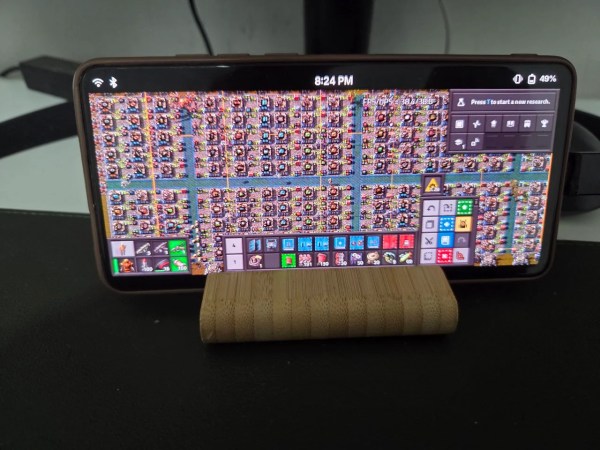
Factorio Running On Mobile

As a video game, DOOM has achieved cult status not just for its legendary gameplay and milestone developments but also because it’s the piece of software that’s likely been ported to the most number of platforms. Almost everything with a processor can run the 1993 shooter, but as it ages, this becomes less of a challenge. More modern games are starting to move into this position, and Factorio may be taking a leading position. [Point Substantial] has gotten this game to run on a mobile phone.

The minimum system requirements for Factorio are enough to make this a challenge, especially compared to vintage title like DOOM. For Linux systems a dual-core processor and 8 GB of memory are needed, as well as something with at least 1 GB of VRAM. [Point_Substantial]’s Xiaomi Mi 9T almost meets these official minimum requirements, with the notable exception of RAM. This problem was solved by adding 6 GB of swap space to make up for the difference.

The real key to getting this running is that this phone doesn’t run Android, it runs the Linux-only postmarketOS. Since it’s a full-fledged Linux distribution rather than Android, it can run any software any other Linux computer can, including Steam. And it can also easily handle inputs for periphreals including a Switch Pro controller, which is important because this game doesn’t have touch inputs programmed natively.

The other tool that [Point_Substantial] needed was box86/box64, a translation layer to run x86 code on ARM. But with all the pieces in place it’s quite possible to run plenty of games semi-natively on a system like this. In fact, we’d argue it’s a shame that more phones don’t have support for Linux distributions like postmarketOS based on the latest news about Android.

Thanks to [Keith] for the tip!

Microsoft Removed WMR Headset Support? No Problem!

In late 2024 Microsoft removed support for WMR (Windows Mixed Reality), and they didn’t just cease development. As of Windows 11 version 24H2, headsets like the HP Reverb and others by Acer, Samsung, Lenovo, and Dell stopped working at all. But the good news is developer [Matthieu Bucchianeri] created the Oasis driver for Windows Mixed Reality which allows WMR headsets (and their controllers) to work again.

Oasis is available as a free download from Steam and involves a few specific setup steps in order to get working, but once the headset and controllers are unlocked and room setup is complete, the hardware will be usable again. Note that while SteamVR is handy, one’s headset and controllers are not actually tied to SteamVR. Any VR application that uses OpenVR or OpenXR should work.

It’s an extremely well-documented project, and anyone willing to read and follow a short list of directions should be off to the races in no time.

Now that there’s a way for folks to dust off their WMR hardware and get back in the game, it’s a good time to mention that if you have ever suffered from VR sickness, we’ve covered ways to help deal with and adapt to it.

A Handheld Gaming PC With Steam Deck Vibes

Since its inception, the Steam Deck has been a bit of a game changer in the PC gaming world. The goal of the handheld console was to make PC gaming as easy and straightforward as a walled-garden proprietary console like a Switch or Playstation but still allow for the more open gaming experience of a PC. At its core, though, it’s essentially a standard PC with the parts reorganized into handheld form, and there’s no reason any other small-form-factor PC can’t be made into a similar system. [CNCDan] has the skills and tools needed to do this and shows us how it’s done.

The build is based around a NUC, a small form factor computer that typically uses the same low-power mobile processors and graphics cards found in laptops but without the built-in battery or screen. This one has an AMD Ryzen 7 processor with Radeon graphics, making it reasonably high-performing for its size. After measuring out the dimensions of the small computer and preparing for other components like the battery, joysticks, buttons, and even a trackpad, it was time to create the case. Instead of turning to a 3D printer, this one is instead milled on a CNC machine. Something tells us that [CNCDan] prefers subtractive manufacturing in general.

With all the parts assembled in the case, the build turns into a faithful Steam Deck replica with a few bonuses, like an exposed Ethernet port and the knowledge that everything can easily be fixed since it was built from the ground up in the first place. The other great thing about builds like these is they don’t need an obscure NUC for the hardware; you can always grab your old Framework mainboard for handheld gaming instead. Reminded us of the NucDeck.

Continue reading “A Handheld Gaming PC With Steam Deck Vibes”

This Tiny Steam Engine Takes A Watchmaker’s Skill To Build

When your steam engine build requires multiple microscopes, including those of the scanning electron variety, you know you’re building something really, really tiny.

All of the usual tiny superlatives and comparisons apply to [Chronova Engineering]’s latest effort — fits on a pencil eraser, don’t sneeze while you’re working on it or you’ll never find it. If we were to put the footprint of this engine into SMD context, we’d say it’s around a 2010 or so. As one would expect, the design is minimalistic, with no room for traditional bearings or valves. The piston and connecting rod are one piece, meaning the cylinder must pivot, which provides a clever way of switching between intake and exhaust. Tiny crankshaft, tiny flywheel. Everything you’d associate with a steam engine is there, but just barely.

The tooling needed to accomplish this feat is pretty impressive too. [Chronova] are no strangers to precision work, but this is a step beyond. Almost everything was done on a watchmaker’s lathe with a milling attachment and a microscope assist. For the main body of the engine, a pantograph engraving machine was enlisted to scale a 3D printed template down tenfold. Drill bits in the 0.3 mm range didn’t fare too well against annealed tool steel, which is where the scanning electron microscope came into play. It revealed brittle fractures in the carbide tool, which prompted a dive down the rabbit hole of micro-machining and a switch to high-speed steel tooling.

It all worked in the end, enough so that the engine managed 42,000 RPM on a test with compressed air. We eagerly await the equally tiny boiler for a live steam test.

Continue reading “This Tiny Steam Engine Takes A Watchmaker’s Skill To Build”