Make Your Ceiling Disappear With ADS-B And Short-Throw Projector

If you’re into airplanes, you’ve probably had the experience of hearing an unusual aircraft and rushing outside to try and catch a glimpse of it, all while fumbling with a smartphone to open a flight-tracking app. If your home was equipped with [cpaczek]’s Skylight project, which combines ADS-B data with a short throw projector, that little dance would have been totally unnecessary.

ADS-B or the “Automatic Dependent Surveillance-Broadcast”, is the standard by which aircraft broadcast their position and other flight information from onboard transponders. In most of the world, every commercial aircraft has an ADS-B transmitter, and they’re slowly creeping into general aviation as well. The signals aren’t hard to pick up with software-defined radio — like perhaps this RP2040 based unit we featured — or the RTL-SDR v4 this project calls for.

Using data from ADS-B, the Skylight software runs on Raspberry Pi 5 and renders icons of the aircraft exactly where they would appear above you, if that pesky ceiling wasn’t in the way. You get the flight’s code, destination and flightplan with a nice icon representing what type of airplane it is. Thanks to specifying a Pi 5, the projection is a smooth 60 FPS at 1080p. Airplanes aren’t the only things plotted, though — this is also a planetarium, giving you a full view of the stars and any satellites passing overhead. That’s obviously via an API, not SDR, and if you like you can configure it to track aircraft that way to — allowing you to set your Skylight for anywhere in the world, if you aren’t near an interesting airport.

ADS-B isn’t just for pilots and plane nerds — if you’re flying drones, you probably should keep an eye on it, too. In that case, though, you probably won’t be looking at your ceiling.

Thanks to [Thinkerer] for the tip!
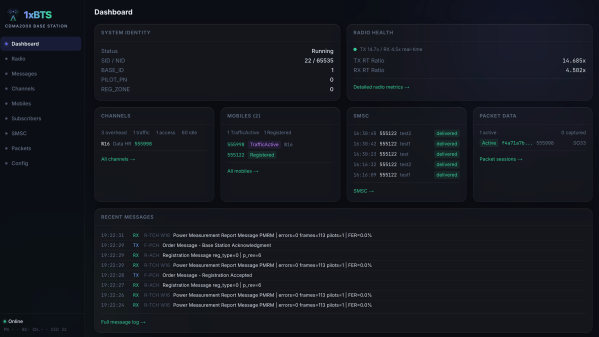
A web interface is shown providing information about a cellular network base station.

Running Your Own 3G Network

CDMA2000 was one of the protocols defined for 3G networks and is now years out of date and being phased out worldwide. Nevertheless, there are still vast numbers of phones that will happily connect to it, creating an opportunity for hackers seeking to run their own cellular networks. [Chrismoos] recently made this endeavour significantly easier by releasing 1xBTS, a Rust implementation of the lower three layers of a CDMA2000 network.

The lowest layer of the stack is an SDR for the actual radio communications. It’s been tested with the USRP B200 and B210, the LimeSDR Mini 2, and the BladeRF Micro 2.0. The code might work with certain other SDRs using the SoapySDR abstraction layer. The SDR is controlled by the base station (BTS) software, which, in turn, is controlled by the base station controller (BSC) over an Abis link. The BSC manages channels and mobile device associations, and exchanges frames with the mobile switching center (MSC), which handles message switching.

Continue reading “Running Your Own 3G Network”

An overlay is shown on a topographical map. High points are highlighted in blue. The letters "A" and "B" are shown in red text at two points.

Using A Scientific Satellite For Passive Radar

The basic principle of radar systems is simple enough: send a radio signal out, and measure the time it takes for a reflection to return. Given the abundant sources of RF signals – television signals, radio stations, cellular carriers, even Wi-Fi – that surround most of us, it’s not even necessary to transmit your own signal. This is the premise of passive radar, which uses passive RF illumination to form an image. The RF signal doesn’t even need to come from a terrestrial source, as [Jean Michel Friedt] demonstrated with a passive radar illuminated by the NISAR radar-imaging satellite (pre-print paper).

NISAR is a synthetic-aperture radar satellite jointly built by NASA and ISRO, and it completes a pass over the world every twelve days. It uses an L-band chirp radar signal, which can be picked up with GNSS antennas. One antenna points up towards the satellite, and has a ground plane blocking the signal from directly reaching the second antenna, which picks up reflections from the landscape under observation. Since the satellite would illuminate the scene for less than a minute, [Jean-Michel] had to predict the moment of peak intensity, and achieved an accuracy of about three seconds.

The signals themselves were recorded with an SDR and a Raspberry Pi. High-end, high-resolution SDRs such as the Ettus B210 gave the best results, but an inexpensive homebuilt MAX2771-based SDR also produced recognizable images. This setup won’t be providing any particularly detailed images, but it did accurately show the contours of the local geography – quite a good result for such a simple setup.

If you’re more interested in tracking aircraft than surveying landscapes, check out this ADS-B-synchronized passive radar system. Although passive radar doesn’t require a transmitter license, that doesn’t mean it’s free from legal issues, as the KrakenSDR team can testify.

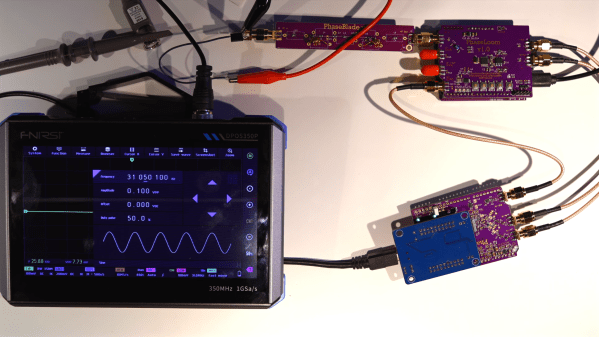
An oscilloscope display is seen in lower left corner. In the rest of the image, two purple circuit boards are connected by SMA RF cables. A wire antenna is connected to one board.

Building A $50 SDR With 20 MHz Bandwidth

Although the RTL-SDR is cheap, accessible, and capable enough for many projects, it does have some important limitations. In particular, its bandwidth is limited to about 3.2 MHz, and the price of SDRs tends to scale rapidly with bandwidth. [Anders Nielsen], however, is building a modular SDR with a target price of $50 USD, and has already reached a bandwidth of almost 20 MHz.

If this project looks familiar, it’s because we’ve covered an earlier iteration. At the time, [Anders] had built the PhaseLoom, which filters an incoming signal, mixes it down to baseband, and converts it to I/Q signals. The next stage is the PhaseLatch, a board housing a 20-MHz, 10-bit ADC, which samples the in-phase and quadrature signals and passes them on to a Cypress FX2LP microcontroller development board. [Anders] had previously connected the ADC to a 6502 microprocessor instead of the FX2LP, but this makes it a practical SDR. The FX2LP was a particularly good choice for this project because of its USB 2.0 interface, large buffers for streaming data, and parallel interface. It simply reads the data from the SDR and dumps it to the computer.

Continue reading “Building A $50 SDR With 20 MHz Bandwidth”

Adding A Panadapter To A Classic Receiver

There was a time when only the richest ham radio operators could have a radio with a panadapter. Back in the day, this was basically a spectrum analyzer that monitored a broad slice of the receiver’s intermediate frequency so you could see signals on either side of the receiver’s actual frequency. Today, with SDR technology and computers, this is an easy thing for receivers to implement. But what if you want to refit a classic radio? It isn’t that hard, and [Mirko Pavleski] shares his notes on how he tackled the project. You can also check it out in the video below.

The plan is simple. A FET amplifier taps the radio’s IF stage before the first IF filter. This provides good isolation and buffering. Then, an emitter follower stage provides a matched output to the SDR through a low-pass filter. The SDR remains tuned to the IF frequency, of course. The rest is essentially software and procedures.

Continue reading “Adding A Panadapter To A Classic Receiver”

off grid weather station

915 MHz Forecast: Rolling Your Own Offline Weather Station

There are a lot of options for local weather stations; most of them, however, are sensors tied to a base station, often requiring an internet connection to access all features. [Vinnie] over at vinthewrench has published his exploration into an off-grid weather station revolving around a Raspberry Pi and an RTL-SDR for communications.

The weather station has several aspects to it. The main sensor package [Vinnie] settled on was the Ecowitt WS90, capable of measuring wind speed, wind direction, temperature, humidity, light, UVI, and rain amount. The WS90 communicates at 915 MHz, which can be read using the rtl_433 project. The WS90 is also available for purchase as a standalone sensor, allowing [Vinnie] to implement his own base station.

For the base station, [Vinnie] uses a weatherproof enclosure that houses a 12V battery with charger to act as a local UPS. This powers the brains of the operation: a Raspberry Pi. Hooked to the Pi is an RTL-SDR with a 915 MHz antenna. The Pi receives an update from the WS90 roughly every 5 seconds, which it can decode using the rtl_433 library. The Pi then turns that packet into structured JSON.

The JSON is fed into a weather model backend that handles keeping track of trends in the sensor data, as well as the health of the sensor station. The backend has an API that allows for a dashboard weather site for [Vinnie], no internet required.

Thanks, [Vinnie], for sending in your off-grid weather station project. Check out his site to read more about his process, and head over to the GitHub page to check out the technical details of his implementation. This is a great addition to some of the other DIY weather stations we’ve featured here.

2G Gone? Bring It Back Yourself!

Some parts of the world still have ample 2G coverage; for those of in North America, 2G is long gone and 3G has either faded into dusk or beginning its sunset. The legendary [dosdude1] shows us it need not be so, however: Building a Custom 2G GSM Cellular Base Station is not out of reach, if you are willing to pay for it. His latest videos show us how.

Before you start worrying about the FCC or its equivalents, the power here is low enough not to penetrate [dosdude]’s walls, but technically this does rely in flying under the radar. The key component is a Nuand BladeRF x40 full-duplex Software Defined Radio, which is a lovely bit of open-source hardware, but not exactly cheap. Aside from that, all you need is a half-decent PC (it at least needs USB-3.0 to communicate with the SDR, the “YateBTS”  software (which [dosdude1] promises to provide a setup guide for in a subsequent video) and a sim card reader. Plus some old phones, of course, which is rather the whole point of this exercise.

The 2G sunset, especially when followed by 3G, wiped out whole generations of handhelds — devices with unique industrial design and forgotten internet protocols that are worth remembering and keeping alive. By the end of the video, he has his own little network, with the phones able to call and text one another on the numbers he set up, and even (slowly) access the internet through the miniPC’s network connection.

Unlike most of the hacks we’ve featured from [dosdude1], you won’t even need a soldering iron, never mind a reflow oven for BGA. 

Continue reading “2G Gone? Bring It Back Yourself!”