The turntable in question, or at least the same model.

Vintage Turntable Gets Brain Transplant And Home Assistant Integration

When [Marsupial] picked up a vintage Sansusi P-L45 turntable, he figured it would be an easy fix: a few capacitors, a belt or two, and maybe a new cartridge, the usual. But it turned out the electronics were fried, which set the stage for an upgrade that turned it into what may be the world’s only ESP32-driven, Home Assistant integrated, linear tracking turntable.

That last bit, the linear tracking, is why the turntable originally had a microprocessor in the first place: rather than an arm that pivots along the groove naturally, fancy turntables towards the end of the golden era of vinyl slid the needle along a linear track at a variable speed to follow the spiral groove on the record. You can see that in action in the demo video below, though it’s of a working version owned by [BFinks].

The fancy linear mechanism required electronic control to match the speed to the RPM, and in the example of Sansusi’s P-L45, that was provided by an NEC microcontroller on a daughter-board labelled “F4992 CPU”. CPU is a grandiose title, perhaps, but that’s irrelevant since the chip on the board was deader than disco.

That meant [Marsupial] had some reverse engineering to do — figuring out exactly what that chip did to drive this board, in order to replicate its behavior on an ESP32-S3. Luckily the golden era of vinyl correlated with the golden era of service manuals, and the manuals are still available, so [Marsupial] had a big leg up on that. After making the turntable work like stock, what else to do with the extra capability of the ESP32 than plug it into HA and make it really automatic?

Of course it wasn’t quite that easy: a new daughter-board was created that needed to do level shifting to the ESP32’s modern 3.3 V logic as well as hardware debounce on some inputs. The whole saga is very well documented on [Marsupial]’s blog WeAreAllGeeks. The link here takes you to the overview, but he’s got a lot more info on other pages — and of course links to the firmware and PCB design if you happen to have a Sansusi turntable in need of a brain transplant.

Vinyl lovers will appreciate this project much more than the last ESP32 “turntable” we featured, which was anything but. If you want to get into records but don’t have a turntable, you can always make your own.

Continue reading “Vintage Turntable Gets Brain Transplant And Home Assistant Integration”

When A Record Player Doesn’t Work Due To Solid State Grease

Normally, mechanical devices like record players move smoothly, with well-greased contact surfaces enabling the tone arm to automatically move, the multi-record mechanism to drop down a fresh disc, and the listener to have a generally good time. Unfortunately, the 1972-era ITT KP821 record player that [Mark] got recently handed by a friend wasn’t doing a lot of moving, with every part of the mechanism seemingly frozen in place, though the current owner wasn’t certain that they were doing something wrong.

Fortunately, this record player was in exceptionally good condition.. The primary failure was that the BSR record player mechanism, with its many touching metal surfaces, was suffering from a bad case of solidified grease. Although this is easily fixed with some IPA and a lot of elbow grease, the biggest trick with these mechanisms is putting it back together after cleaning, with many seemingly randomly shaped parts and every single E-clip that the manufacturer could design for and source at the time.

With that complete, this just left some pot cleaning and replacing a busted fuse in the amplifier section. The selenium rectifier was still functional, as were the SGS TAA621AX1 audio amplifier ICs. Despite the age of this ‘portable’ record player, both its BSR mechanism and the twin speakers that are part of the record player are in remarkably good condition. Much like with a car, it seems that you just have to swap out the liquid-y elements before they turn into a solid.

Continue reading “When A Record Player Doesn’t Work Due To Solid State Grease”

Record Changer Spins Round And Round

There was a time when all the cool kids had a 45 RPM record player. [RF Burns] picked up a 1950s-era player from  RCA. However, it needed a lot of work. The good news? We get to see the teardown and the result in a two-part video series, which you can see below. If you are looking for the schematic, you’ll have to wait for the second video.

These were made to be cheap, so there were many parts that needed replacement or, at least TLC. The automation of the record changer was all done with an eccentric wheel, which is satisfyingly low-tech. We were surprised that it still seemed to work after everything was cleaned up.

Inside were two active tubes and a rectifier tube to amplify the signal from the needle. A coat of paint made it look great, and a polarized power cord made it safer.

There was also an unamplified version of the player you can see at the end of the second video. All the same things except for the tube amplifier, of course.

If you are too young to have fond memories of 45s, here’s a primer on how records work. The record player we really want is mobile.

Swapping Vinyl For Cardboard With This ESP32 Turntable

Cardboard is a surprisingly durable material, especially in its corrugated form. It’s extremely lightweight for its strength, is easy to work, can be folded and formed into almost any shape, is incredibly inexpensive, and when it has done its duty it can be recycled back into more paper. For these reasons, it’s often used in packaging material but it can be used to build all kinds of things outside of ensuring that products arrive at their locations safely. This working cardboard record player is one example.

While the turntable doesn’t have working records in the sense that the music is etched into them like vinyl, each has its own RFID chip embedded that allows the ESP32 in the turntable’s body to identify them. Each record corresponds to a song stored on an SD card that instructs the ESP32 to play the appropriate song. It also takes care of spinning the record itself with a small stepper motor. There are a few other details on this build that tie it together too, including a movable needle arm held on with a magnet and a volume slider.

As far as a building material goes, cardboard is fairly underrated in our opinion. Besides small projects like this turntable, we’ve also seen it work as the foundation for a computer, and it even has the strength and durability to be built into a wall or even used as shelving material. And, of course, it’s a great material to use when prototyping new designs.

Continue reading “Swapping Vinyl For Cardboard With This ESP32 Turntable”

Is That A Record Player In Your Pocket Or…

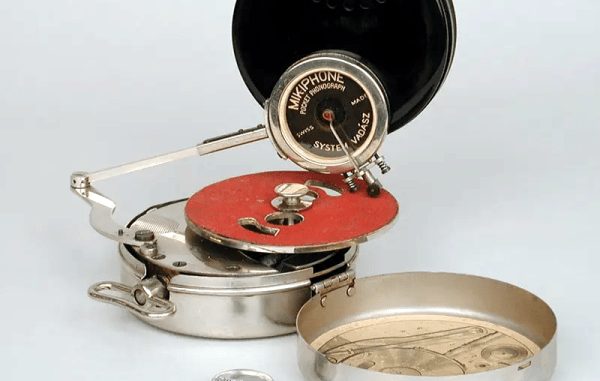
If aliens visited the Earth, they might find our obsession with music hard to fathom. We have music in our homes, our cars, and our elevators. Musical performances draw huge crowds and create enormous fame for a select few musicians. These days, your music player of choice is probably the phone in your pocket. What our grandparents wouldn’t have done to have a pocket-sized music player. Wait…, it turns out they had them. [Rare Historical Photos] has pictures and other material related to the Mikiphone — a “pocket phonograph.” We don’t know how it sounded, but it is a fantastic piece of work visually. Actually, thanks to the [Stanford Archive of Recorded Sound], you can hear one of these rare machines playing in the video below. If only it were playing Toni Basil.

The device was made in the 1920s and had a decidedly strange tonearm. You wind it up with a gigantic key mechanism. There’s no electricity. A bakelite resonator became the speaker attached to the tone arm. The device was made in Switzerland by a company that started in music boxes. However, the design was the work of two brothers named Vadász.

Continue reading “Is That A Record Player In Your Pocket Or…”

2023 Cyberdeck Challenge: Crosberry Pi Loves Lo-Fi Hip Hop

As far as we can tell, the only real selling point that any portable record player offered was, well, its portability. To be clear, the sound is never that great. But perhaps a selling point for this crowd is that they usually come in hinged cases with handles, and you know what that means — cyberdeck that thing!

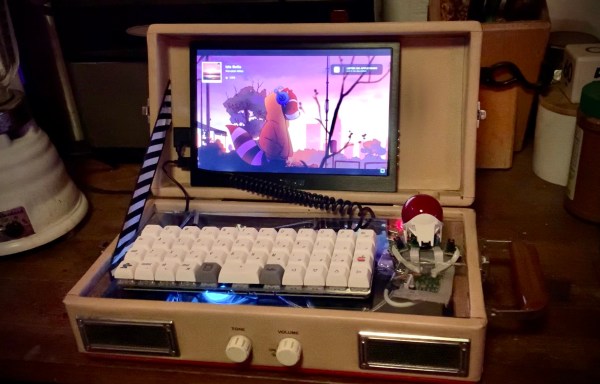
[Mx. Jack Nelson] started gutting this Crosley CR40 record player to make a Raspberry Pi housing, but it quickly turned into a cyberdeck project with the addition of a 10.1″ portable monitor, a Planck ortholinear keyboard, and a gutted trackball mouse.

We love that [Mx. Jack Nelson] made use of the Crosley’s original speakers — this was the wife’s idea! — as well as the volume and tone knobs. But our favorite part has to be the clear acrylic top that both protects the electronics and provides a platform for the keyboard and mouse buttons. Be sure to check out the demo video after the break.

Continue reading “2023 Cyberdeck Challenge: Crosberry Pi Loves Lo-Fi Hip Hop”

Retro Gadgets: I Swear Officer, I Was Listening To 45

Audio in cars has a long history. Car radios in the 1920s were bulky and expensive. In the 1930s, there was the Motorola radio. They were still expensive — a $540 car with a $130 radio — but much more compact and usable.  There were also 8-tracks, cassettes, CDs, and lately digital audio on storage media or streamed over the phone network. There were also record players. For a brief period between 1955 and 1961, you could get a car with a record player. As you might expect, though, they weren’t just any record players. After all, the first thing to break on a car from that era was the mechanical clock. Record players would need to be rugged to work and continue to work in a moving vehicle. As you might also expect, it didn’t work out very well.

It all started with Peter Goldmark, the head of CBS Laboratories. He knew a lot about record players and had been behind the LP — microgroove records that played for 22 minutes on a side at 33.3 RPM instead of 5 minutes on a side at 78 RPM. He knew that a car record player needed to be smaller and shock-resistant. Of course, in those days, it would have tubes, but that could hardly be helped.

The problem turned into one of size. A standard 10- or 12-inch disk is too big to easily fit in the car. A 45 RPM record would be more manageable, but who wants to change the record every three or four minutes while driving?

Continue reading “Retro Gadgets: I Swear Officer, I Was Listening To 45”