A diagram of a neutron generator is shown in the top portion of the image, with the physical version below.

A Benchtop Neutron Generator For The Home Reactor

There are a surprising number of experiments an amateur nuclear physicist can perform, from making a Geiger counter to fusing hydrogen atoms in a fusor. One project which we haven’t seen before is a neutron generator, such as the benchtop neutron generator made by [Rapp Instruments] (translated).

This particular generator takes a feedstock of pure deuterium, which it ionizes and accelerates into a titanium target. The first deuterium nuclei to hit the target react with it to form titanium deuteride, immobilizing them until more ions strike them and they undergo nuclear fusion. The fusion reaction mostly forms helium-4, but sometimes forms helium-3 and a free neutron, which is radiated away. The radiated neutrons are slowed down by a block of high-density polyethylene, and a portion of them strike a silver or indium foil wrapped around a Geiger counter tube. The neutrons activate the silver or indium, and the Geiger counter detects the resultant increase in radioactivity.

The design is a linear particle accelerator built inside an evacuated glass tube. It uses two high-voltage power supplies: a 20 kV supply which ionizes the deuterium gas fed into the tube, and a 100 kV supply which accelerates ions emitted from the source into the target. The target itself is surrounded by a cup-shaped electrode to capture secondary electrons emitted during impact. To prevent arcing, the tube needs to be at a very low pressure, reached by extensive use of an oil diffusion pump.

Radioactivity measurements of the silver and indium foils showed that the generator did work; when irradiating the silver foil for five minutes, it generated 175 counts per second after the neutron source was turned off. Plotting the count rate versus time suggested that a mixture of two silver isotopes was being generated, Ag-110 and Ag-108, based on their half-lives. Irradiation of indium produced a similar exponential decay in radiation.

We recommend checking out the rest of the site; it’s a gold mine of projects, such as this mass spectrometer. For more background on neutron generators, we’ve covered their theory and some of the more common varieties.

Venus Flytrap Takes Ride Through A Particle Accelerator

In the blue corner, we have the VENUS FLYTRAP! In the red corner, we have the underdog of the century, AN ENTIRE PARTICLE ACCELERATOR. Yes, you read that right. When you have a particle accelerator, it’s only second nature to throw anything you can into it. That’s why [Electron Impressions] put a poor fly-eating trap into their accelerator.

Chloride and potassium ions leaving cause osmotic pressure in neighboring cells

The match-up isn’t quite as arbitrary as it might seem at first. The flytrap’s main mechanism of trapping and digesting insects relies heavily on intracellular ion movement. Many cells along the inside of the trap have hair-activated calcium channels that respond to a fly landing on its surface. This ion movement then creates an action potential, which propagates along the entire surface, triggering closing. As the potential moves across different cells, other ions leave and create osmotic pressure. This pressure is what creates the mechanical movement.

Of course, this makes it no surprise when the plant finds itself under the ionizing radiation that every single head closes at once. While this is a cool demonstration, there is a slight side effect of killing every single cell by ripping apart the trap’s DNA.

Well, who would have guessed that the underdog accelerator would have won… Anyways, the DNA being ripped apart is far from ideal for repeatability. If you want to learn more about genetic features that SHOULD be repeated, then make sure to check out the development of open-source insulin!

Continue reading “Venus Flytrap Takes Ride Through A Particle Accelerator”

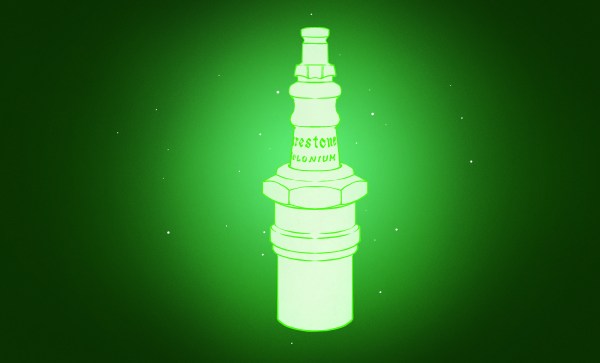
The Hottest Spark Plugs Were Actually Radioactive

In the middle of the 20th century, the atom was all the rage. Radiation was the shiny new solution to everything while being similarly poorly understood by the general public and a great deal of those working with it.

Against this backdrop, Firestone Tire and Rubber Company decided to sprinkle some radioactive magic into spark plugs. There was some science behind the silliness, but it turns out there are a number of good reasons we’re not using nuke plugs under the hood of cars to this day.

Continue reading “The Hottest Spark Plugs Were Actually Radioactive”

Meter Mods Make Radioactive Prospecting More Enjoyable

While we often get a detailed backstory of the projects we cover here at Hackaday, sometimes the genesis of a build is a bit of a mystery. Take [maurycyz]’s radiation survey meter modifications, for instance; we’re not sure why such a thing is needed, but we’re pretty glad we stumbled across it.

To be fair, [maurycyz] does give us a hint of what’s going on here by choosing the classic Ludlum Model 3 to modify. Built like a battleship, these meters would be great for field prospecting except that the standard G-M tube isn’t sensitive to gamma rays, the only kind of radiation likely not to be attenuated by soil. A better choice is a scintillation tube, but those greatly increase the background readings, making it hard to tease a signal from the noise.

To get around this problem and make rockhounding a little more enjoyable, [maurycyz] added a little digital magic to the mostly analog Ludlum. An AVR128 microcontroller taps into the stream of events the meter measures via the scintillation tube, and a little code subtracts the background radiation from the current count rate, translating the difference into an audible tone. This keeps [maurycyz]’s eyes on the rocks rather than on the meter needle, and makes it easier to find weakly radioactive or deeply buried specimens.

If you’re not ready to make the leap to a commercial survey meter, or if you just want to roll your own, we’ve got plenty of examples to choose from, from minimalist to cyberpunkish.

A piece of perovskite crystal

Perovskite Solar Cell Crystals See The Invisible

A new kind of ‘camera’ is poking at the invisible world of the human body – and it’s made from the same weird crystals that once shook up solar energy. Researchers at Northwestern University and Soochow University have built the first perovskite-based gamma-ray detector that actually works for nuclear medicine imaging, like SPECT scans. This hack is unusual because it takes a once-experimental lab material and shows it can replace multimillion-dollar detectors in real-world hospitals.

Current medical scanners rely on CZT or NaI detectors. CZT is pricey and cracks like ice on a frozen lake. NaI is cheaper, but fuzzy – like photographing a cat through steamed-up glass. Perovskites, however, are easier to grow, cheaper to process, and now proven to detect single photons with record-breaking precision. The team pixelated their crystal like a smartphone camera sensor and pulled crisp 3D images out of faint radiation traces. The payoff: sharper scans, lower radiation doses, and tech that could spread beyond rich clinics.

Perovskite was once typecast as a ‘solar cell wonder,’ but now it’s mutating into a disruptive medical eye. A hack in the truest sense: re-purposing physics for life-saving clarity.

Food Irradiation Is Not As Bad As It Sounds

Radiation is a bad thing that we don’t want to be exposed to, or so the conventional wisdom goes. We’re most familiar with it in the context of industrial risks and the stories of nuclear disasters that threaten entire cities and contaminate local food chains. It’s certainly not something you’d want anywhere near your dinner, right?

You might then be surprised to find that a great deal of research has been conducted into the process of food irradiation. It’s actually intended to ensure food is safer for human consumption, and has become widely used around the world.

Continue reading “Food Irradiation Is Not As Bad As It Sounds”

Desk Top Peltier-Powered Cloud Chamber Uses Desktop Parts

There was a time when making a cloud chamber with dry ice and alcohol was one of those ‘rite of passage’ type science projects every nerdy child did. That time may or may not be passed, but we doubt many children are making cloud chambers quite like [Curious Scientist]’s 20 cm x 20 cm Peltier-powered desktop unit.

The dimensions were dictated by the size of the off-the-shelf display case which serves as the chamber, but conveniently enough also allows emplacement of four TEC2-19006 Peltier cooling modules. These are actually “stacked” modules, containing two thermoelectric elements in series — a good thing, since the heat delta required to make a cloud chamber is too great for a single element. Using a single-piece two stage module simplifies the build considerably compared to stacking elements manually.

To carry away all that heat, [Curious Scientist] first tried heatpipe-based CPU coolers, but moved on to CPU water blocks for a quieter, more efficient solution. Using desktop coolers means almost every part here is off the shelf, and it all combines to work as well as we remember the dry-ice version. Like that childhood experiment, there doesn’t seem to be any provision for recycling the condensed alcohol, so eventually the machine will peter out after enough vapor is condensed.

This style of detector isn’t terribly sensitive and so needs to be “seeded” with spicy rocks to see anything interesting, unless an external electric field is applied to encourage nucleation around weaker ion trails. Right now [Curious Scientist] is doing that by rubbing the glass with microfiber to add some static electricity, but if there’s another version, it will have a more hands-off solution.

We’ve seen Peltier-Powered cloud chambers before (albeit without PC parts), but the “dry ice and alcohol” hack is still a going concern. If even that’s too much effort, you could just go make a cup of tea, and watch very, very carefully.

Continue reading “Desk Top Peltier-Powered Cloud Chamber Uses Desktop Parts”