Low Head Turbine Generates Plenty Of Power

Engineering design makes all kinds of tradeoffs. Power trades off with torque, strength trades off with weight, and cost can trade off with quality. For designing a hydroelectric turbine, one of the main tradeoffs is hydraulic head with flow rate. Many large dams meant for bulk power generation will go with high head (or medium) designs, and for small dams with low head it’s usually not cost effective to build any generation. But if you’re really determined, you’ll want to build a low head water turbine like this one.

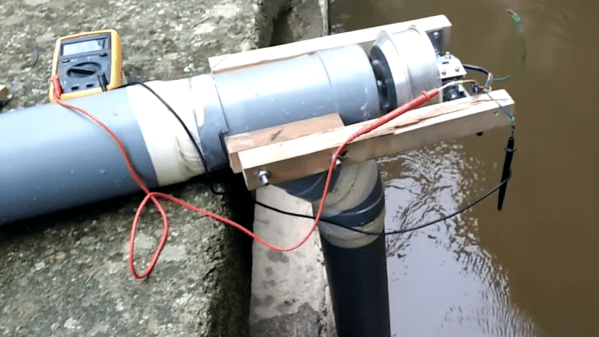
The build aims to use easy-to-find materials and simple tools. It uses 110mm and 160mm PVC pipe to not only siphon water up and over a dam, but to house the turbine as well. The turbine is built from a computer fan and sits inside the pipe with a shaft running through a Y-type fitting to the generator. The generator is built from a scavenged hoverboard wheel, and outputs a reported 3.3A DC at 60V for around 200 watts of power with only around 3m of head. The design allows the turbine to be placed at the point in the pipe that best suits the environment.

[OpenSourceLowTech], the creators of this project, make a compelling case that this build is cheaper than a 150W solar panel and it might even be able to produce more energy as well over certain timeframes, provided there’s a reliable source of water available and the owners of the dam don’t mind someone siphoning water over it continuously. The build video is worth a watch as well if for nothing else than the animation, which documents the build in excellent detail. Generating usable energy from hydropower doesn’t even need this big of a dam; if all you need is to charge your phone this tiny waterwheel will get the job done.

Thanks to [Keith] for the tip!

Continue reading “Low Head Turbine Generates Plenty Of Power”

Magnetic-Suspension Hoverboard Is Only 11 Years Late

Anyone who saw Back to the Future II was disappointed when 2015 rolled around with nary a hoverboard in sight. There have been various attempts to fake it, but none of them quite have the feel of floating about wherever you’d like to go that the movie conveys. The little-known YouTuber [Colin Furze] has a new take on the idea: use magnets. Really big magnets.

If you’re one of [Colin]’s handful of subscribers, then you probably saw his magnetic-suspension bike. We passed on that one, but we couldn’t resist the urge to cover the hoverboard version, regardless of how popular [Colin] might be on YouTube. It’s actually stupidly simple: the suspension is provided by the repulsive force between alarmingly large neodymium magnets. In this case, two are on the base plate that holds the skateboard ‘trucks’, and two are on the wooden ‘deck’ that [Colin] rides upon.

Of course magnetic repulsion is a very unstable equilibrium, so [Colin] had to reduce the degrees of freedom. In his first test, that was with a pair of rods and linear bearings. That way the deck could only move in the z-axis, providing the sensation of hovering without allowing the deck to slide off its magnetic perch. Unfortunately those pins transferred too much vibration from the ground into the deck, ruining the illusion of floating on air.

Continue reading “Magnetic-Suspension Hoverboard Is Only 11 Years Late”

Has Steampunk Delivered The Hoverboard?

The hoverboard, one of the teen crazes of the last decade, is both a marvel of technology and a source of hacker parts that have appeared in so many projects on these pages. It contains an accelerometer or similar, along with a microcontroller and a pair of motor controllers to drive its in-wheel motors. That recipe is open to interpretation of course and we’ve seen a few in our time, but perhaps not quite like this steampunk design from [Skrubis]. It claims a hoverboard design with no modern electronics, only relays, mercury switches, and neon bulbs.

The idea is that it’s a hoverboard from 1884 using parts available in that era, hence there’s talk of telegraph relays and galvanomic piles. The write-up is presented in steampunk-style language which if we’re honest makes our brain hurt, but the premise is intriguing enough to persevere. As far as we can see it uses a pair of relays and a transformer to make an oscillator, from which can be derived the drive for a 3-phase motor. This drive is sent to the motors by further relays operating under the influence of mercury tilt switches.

There are a full set of hardware designs once you wade past the language, but as yet it has no evidence of a prototype. We admit we kinda want it to work because the idea is preposterous enough to be cool if it ran, but we’d be lying if we said we didn’t harbor some doubts. Perhaps you our readers can deliver a verdict, after all presenting you with entertainment is what it’s all about. If a working prototype surfaces we’ll definitely be featuring it, after all it would be cool as heck.

Oddly this isn’t the first non-computerized balance transport we’ve seen.

Featured image: Simakovarik, CC BY-SA 4.0.

Walking Desk Is More Annoying Than A Standing Desk

We’re often told that sitting is bad for our backs, for our necks, and even our general health. The standing desk aims to solve this by keeping us in a more vertical position while we work. [Joel Creates] took this a step further by creating a walking desk that’s motorized and keeps him on the move.

[Joel’s] build started with a standing desk. He then pulled off the desk’s standard wheels, and replaced them with motors sourced from cheap second-hand hoverboards and a couple of casters. The hoverboard wheels and casters were upgraded with pneumatic tires for the sake of a smoother ride, and control is via a thumbstick mounted on a mouse. Power is via a large bank of lithium-polymer batteries which are responsible for running the motors and the computer hardware which [Joel] uses to work on the go. A solar panel canopy helps top off the batteries when he’s out and about.

As you might imagine, a guy walking around trails with an entire computer desk draws a lot of attention. It’s probably not the best way to be productive, but it’s a neat way to integrate exercise into your routine if you’re always working at a computer. Somehow we suspect these might not catch on. Video after the break.

Continue reading “Walking Desk Is More Annoying Than A Standing Desk”

Hoverboard Turned Into Bonkers Omniwheeled Bike

Segways stunned the world when they first hit the market in 2001. Hoverboards then terrified the world with nasty accidents and surprise fires. [James Bruton] loves hoverboards regardless, and set out on a mighty upgrade regime turning the ride-on toy into a giant omniwheeled bicycle.

The build relies on two giant omniwheels of [James’s] own creation, using lasercut and 3D-printed parts. The wheels are mounted perpendicularly on either end of a boxy plywood “bike frame” built in two sections, with a split in the middle. The two halves can rotate relative to each other, much like the two halves of a stock hoverboard.

Amazingly, the build relies on the stock hoverboard motors and electronics. The hoverboard wheel motors are responsible for driving the omniwheels at either end via a toothed belt drive. The gear ratio of the belt reduction is set up to cancel out the greater diameter of the omniwheels, such that the hoverboard’s tuning isn’t disrupted. Wisely, [James] also fitted a safety power cutout, too.

The result is a self-balancing “bike” the likes of which you’ve never seen before. At present, it can balance upright and rotate relatively well. However, control is difficult, requiring the use of the rider’s body weight and the twisting of the bike’s sections. [James] has instead contemplated using servos to tilt the hoverboard sensors instead for an easier control method than the current setup.

It’s a truly bonkers build which is a testament to [James’s] creativity and prowess. We’ve seen some other great hoverboard hacks before, but nothing quite like this. Video after the break.

Continue reading “Hoverboard Turned Into Bonkers Omniwheeled Bike”

A man in a dark shirt stands at a podium in front of a projector screen with the text "50% OF US CAR TRIPS" in white above yellow text saying "1 HUMAN < 3 MILES". The screen is flanked by decor saying "Supercon" in white on a black background.

Supercon 2022: Bradley Gawthrop Wants You To Join The PEV Revolution

During the 20th Century, much of the western world decided that motor vehicles were the only desirable form of transportation. We built our cities to accommodate cars through parking, stop lights, and any number of other infrastructure investments so that you could go get milk and bread in style. In the US, 50% of automobile trips are less than three miles and have only one occupant. [Bradley Gawthrop] asked if there might be a more efficient way to do all this? Enter the Personal Electric Vehicle (PEV).

What Are PEVs?

PEVs are a nascent part of the transportation mix that fall under the wider umbrella of “micromobility,” including scooters, bikes, skateboards, and the like. The key differentiator here is that they are at least partially electrically-driven. [Gawthrop] walks us through several of the different types during his Supercon 2022 talk, but since they are all small, electric powered devices for transporting one or two people, they can trace their lineage back to the infamous Segway Human Transporter.

Using an electric motor or two connected to a controller and batteries, the overall system complexity for any of these devices is quite low and ripe for the hacking. Given the right tools and safety precautions, anyone should be able to crack a PEV open and repair or tinker with it. As with many things in life, the real story is more complicated.

As [Gawthrop] notes, many a hacker has said, “I wish I’d been able to be involved in X before…” where X equals some technology like home automation and it’s before it got creepy or dystopian in some manner. He exhorts us that the time to be in on the ground floor with PEVs is now. Continue reading “Supercon 2022: Bradley Gawthrop Wants You To Join The PEV Revolution”

Hoverboard Rides On Eddy Currents

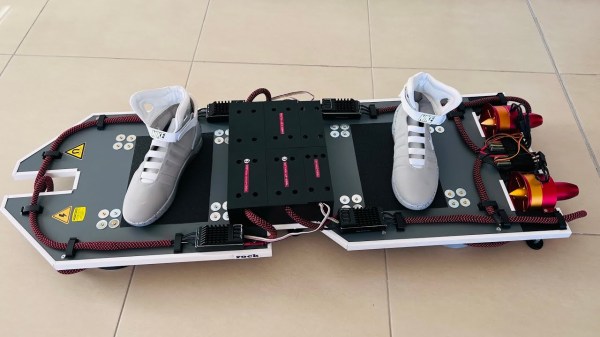
The famous hoverboards of Back to the Future haven’t quite gotten here yet, but that hasn’t stopped anyone with a unique personal vehicle from using the name any time they need some quick marketing. The self-balancing scooter trend of the mid-2010s was the best example of this in recent memory, but there are also water-propelled platforms that use the popular name as well as a myriad of other more skateboard-like devices that never got off the ground at all. This project from [Damien Dolata], on the other hand, might be the most authentic prototype we’ve seen compared against the fictional version presented in the movie.

The hoverboard uses a set of rotating magnets, referred to in this build as magneto-rotational repulsors, which spin up to an extremely high rotational speed underneath the board. When above a metal surface, the spinning magnets generate eddy currents in the metal beneath them which create the strong magnetic field needed to levitate the board. Unlike the Lexus hoverboard system which used supercooling magnets, this is a much more affordable way of producing magnetic fields but is a little bit more complicated due to the extra moving parts.

As this is still in the prototyping stages, it has only been able to lift around 30 kg and hasn’t been tested in motion yet, but there are two small turbines built into the hoverboard to generate thrust whenever [Damien] gets to that point. It would require a larger metal surface to move across as well, which might be the main reason why it hasn’t been tested this way yet. For any native French speakers taking a look at this project, be sure to fill in any of our gaps in the comments below, and for other ways that eddy currents have been used in transportation take a look at this bicycle that uses them in its drivetrain.

Continue reading “Hoverboard Rides On Eddy Currents”