Ebike Display Uses Reflective LCD

Although LCD displays have been used in almost every type of consumer electronics display over the last two decades, many of these screens have a few downsides that limit their usefulness in certain situations. As any owner of an early digital watch, an early laptop, or an early digital camera will testify, these displays often completely fail in direct sunlight. And, a currently new technology often using inexpensive displays in full sunlight conditions is ebikes, so [Volos Projects] decided to use a unique LCD display to solve this issue.

The display is called a reflective LCD (RLCD) and is actually a fairly old but overlooked piece of technology. Displays like these have a reflective layer that bounces ambient light back to the user, increasing contrast and readability in high light, especially when compared to more common transmissive displays. This build is based on a board from Waveshare, which includes the screen and its driver components, and [Volos Projects] integrated this into a test stand that mimics an ebike’s speed sensor and other hardware like turn signals. The display shows the bike’s speed and a few other indicators, and thanks to the screen, this information can be easily seen in full sun.

Although he doesn’t have it on an actual e-bike yet, he hopes it will be useful for those who want to try out something like this with their substandard e-bike displays. The code he’s used is available on a GitHub page for anyone interested. We’d imagine that a low-cost display like this would pair well with an open-source ebike like this one.

Continue reading “Ebike Display Uses Reflective LCD”

Ebike Charges At Car Charging Stations

Electric vehicles are everywhere these days, and with them comes along a whole slew of charging infrastructure. The fastest of these are high-power machines that can deliver enough energy to charge a car in well under an hour, but there are plenty of slower chargers available that take much longer. These don’t tend to require any specialized equipment which makes them easier to install in homes and other places where there isn’t as much power available. In fact, these chargers generally amount to fancy extension cords, and [Matt Gray] realized he could use these to do other things like charge his electric bicycle.

To begin the build, [Matt] started with an electric car charging socket and designed a housing for it with CAD software. The housing also holds the actual battery charger for his VanMoof bicycle, connected internally directly to the car charging socket. These lower powered chargers don’t require any communication from the vehicle either, which simplifies the process considerably. They do still need to be turned on via a smartphone app so the energy can be metered and billed, but with all that out of the way [Matt] was able to take his test rig out to a lamppost charger and boil a kettle of water.

After the kettle experiment, he worked on miniaturizing his project so it fits more conveniently inside the 3D-printed enclosure on the rear rack of his bicycle. The only real inconvenience of this project, though, is that since these chargers are meant for passenger vehicles they’re a bit bulky for smaller vehicles like e-bikes. But this will greatly expand [Matt]’s ability to use his ebike for longer trips, and car charging infrastructure like this has started being used in all kinds of other novel ways as well.

Continue reading “Ebike Charges At Car Charging Stations”

Elongating A BMX For Drag Racing

BMX bikes are a unique frame geometry, essentially forgoing all travel efficiency for maneuverability and sturdiness. For how much abuse these bikes are designed to take, these are all good tradeoffs. But it turns out that these bikes also have an exceptionally low center of gravity, which could make them useful for drag racing, provided they’re given a suitably large electric motor and a few minor frame modifications.

The project began as a fun weekend project for friends [Sam Barker] and [Tom Stanton]. They had a 20″ BMX wheel with a massive integrated hub motor that seemed to be begging to be put onto a BMX bike that they had on hand. After hooking up a 72V, 20Ah battery to it they were quickly zipping around the driveway, but the short wheelbase on the bike was bottlenecking its maximum performace because the bike would wheelie under high throttle. To solve that, they broke out the welder and extended frame, which kept the wheelies to a minimum and allowed them to take it out and drag race.

Another benefit to the extended frame is that the bike has room to store its battery now as well; before the frame extension it was strapped to the side of the frame under the rider in a non-ergonomic fashion. The duo also had to figure out a braking solution since the BMX didn’t come with its own brakes, but a loaner caliper from a penny farthing was found for some basic stopping abilities. We might assume this bike is not street legal on many public roads, but not every ebike operates in the same legal jurisdictions you might be the most familiar with.

Continue reading “Elongating A BMX For Drag Racing”

AC Motor Converted Into DC EBike Powerplant

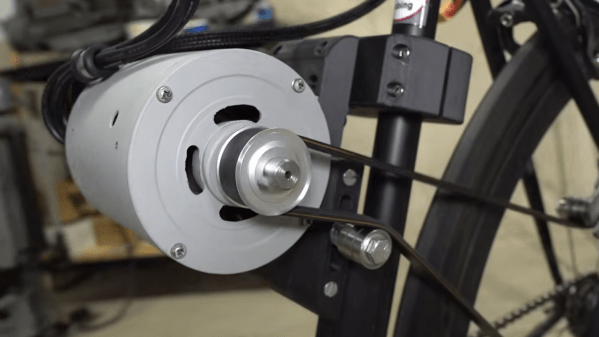
AC induction motors are everywhere, from ceiling fans to vehicles. They’re reliable, simple, and rugged — but there are some disadvantages. It’s difficult to control the speed without complex electronics, and precisely placing the shaft at a given angle is next to impossible. But the core of these common induction machines can be modified and rewired into brushless DC (BLDC) motors, provided you have a few tools on hand as [Austin] demonstrates.

To convert an AC induction motor to a brushless DC electric motor (BLDC), the stator needs to be completely rewired. It also needs a number of poles proportional to the number of phases of the BLDC controller, and in this case the 24-pole motor could accommodate the three phases. [Austin] removed the original stator windings and hand-wound his own in a 16-pole configuration. The rotor needs modification as well, so he turned the rotor on a lathe and then added a set of permanent magnets secured to the rotor with JB Weld. From there it just needs some hall effect sensors, a motor controller and power to get spinning.

At this point the motor could be used for anything a BLDC motor would be used. For this project, [Austin] is putting it on a bicycle. A 3D printed pulley mounts to the fixed gear on the rear wheel, and a motor controller, battery, and some tensioners are all that is left to get this bike under power. His tests show it comfortably drawing around 1.3 kW so you may want to limit this if you’re in Europe but other than that it works extremely well and reminds us of one of our favorite ebike conversions based on a washing machine motor instead of a drill press.

Continue reading “AC Motor Converted Into DC EBike Powerplant”

Saving A Rental Ebike From The Landfill

One of the hardest things about owning a classic car is finding replacement parts. Especially if the car is particularly old or rare, or if the parent company is now out of business, sometimes this can be literally impossible and a new part will have to be manufactured from scratch. The same is true of bicycles as well, and there are plenty of defunct bicycle manufacturers to choose from. [Berm Peak] found a couple old rental ebikes from a company that’s not in business anymore and set about trying to get them working again. (Video, embedded below.)

Of course, unlike many classic cars, ebikes are encumbered by proprietary electronics and software that are much harder to replace than most physical components. As a result, these bikes get most of their electronics pulled out and directly replaced. This bike also had a seized motor, so [Berm Peak] replaced it with another hub motor he had in his shop. Some of the other highlights in the build include a custom 3D-printed latching mechanism for the battery’s attachment point at the frame, a 3D printed bezel for the new display and control unit, and the reuse of some of the other fun parts of the bike like the front basket and integrated headlight.

There are a few reasons for putting so much work into a bike like this. For this specific bike at least, the underlying components are worth saving; the sturdy metal frame and belt drivetrain are robust and won’t need much maintenance in the long term. It also only cost around $500 in parts to build a bike that would take around $2,000 to purchase new, so there’s some economic incentive as well. And in general it’s more fun and better for the world to fix things like this up and get them running again rather than buying something new off the shelf. And while proprietary electronics like those found on this bike are ubiquitous in the ebike world, they’re not all completely closed-source.

Continue reading “Saving A Rental Ebike From The Landfill”

Making The World’s Smallest E-Bike Battery

Often times, e-bikes seek to build the biggest battery with the most range. But what if you want to take a couple lunch loops on your bike and only need 20 minutes of charge? That’s [Seth] from Berm Peak set out to find out with his minuscule Bermacell battery.

The battery is made from only 14 18650s, this tiny 52V batty is nearly as small an e-bike battery as can be made. Each cell is 3000 mAh making a total battery capacity of 156 Wh. All the cells were welded in series with an off the shelf BMS and everything was neatly packaged in an over-sized 3D printed 9V battery case. [Seth] plans to make another smaller battery with less then 100 Wh of capacity so he can take it on a plane, so stay tuned for more coverage!

Continue reading “Making The World’s Smallest E-Bike Battery”

The Nightmare Of Jailbreaking A ‘Pay-To-Ride’ Gotcha Ebike

Theoretically bicycle rental services are a great thing, as they give anyone the means to travel around comfortably without immediately having to rent a car, hail a taxi or brave whatever the local public transport options may be. That is until said services go out of business and suddenly thousands of increasingly more proprietary and locked-down e-bikes suddenly are at risk of becoming e-waste. So too with a recent acquisition by [Berm Peak] over at YouTube, featuring a ‘Gotcha’ e-bike by Bolt Mobility, which went AWOL back in 2022, leaving behind thousands of these e-bikes.

So how hard could it be to take one of these proprietary e-bikes and turn it into a run-off-the-mill e-bike for daily use? As it turns out, very hard. While getting the (36V) battery released and recharged was easy enough, the challenge came with the rest of the electronics, with a veritable explosion of wiring, the Tongsheng controller module and the ‘Gotcha’ computer module that locks it all down. While one could rip this all out and replace it, that would make the cost-effectiveness of getting one of these go down the drain.

Sadly, reverse-engineering the existing system proved to be too much of a hassle, so a new controller was installed along with a bunch of hacks to make the lights and new controller work. Still, for $75 for the bike, installing new electronics may be worth it, assuming you can find replacement parts and got some spare hours (or weeks) to spend on rebuilding it. The bike in the video costed less than $200 in total with new parts, albeit with the cheapest controller, but maybe jailbreaking the original controller could knock that down.

Continue reading “The Nightmare Of Jailbreaking A ‘Pay-To-Ride’ Gotcha Ebike”