Honor Thy Error

Musician Brian Eno’s Oblique Strategies are like a Tarot card deck full of whimsical ideas meant to break up a creative-block situation, particularly in the recording studio. They’re loads of fun to pick one at random and actually try to follow the advice, as intended, but some of them are just plain good advice for creatives.

One that keeps haunting me is “Honor thy error as a hidden intention”, which basically boils down to taking a “mistake” and seeing where it leads you if you had meant to do it. I was just now putting the finishing touches on this week’s Hackaday Podcast, and noticed that we have been honoring a mistake for the past 350-something shows. Here’s how it happened.

When Mike and I recorded the first-ever podcast, I had no idea how to go about doing it. But I grew up in Nashville, and know my way around the inside of a music studio, and I’ve also got more 1990s-era music equipment than I probably need. So rather than do the reasonable thing, like edit the recording on the computer, we recorded to an archaic Roland VS-880 “Digital Studio” which is basically the glorified descendant of those old four-track cassette Portastudios.

If you edit audio in hardware, you can’t really see what you’re doing – you have to listen to it. And so, when I failed to notice that Mike and I were saying “OK, are you ready?” and “Sure, let’s go!”, it got mixed in with the lead-in music before we started the show off for real. But somehow, we said it exactly in time with the music, and it actually sounded good. So we had a short laugh about it and kept it.

And that’s why, eight years later, we toss random snippets of conversations into the intro music to spice it up. It was a mistake that worked. Had we been editing on the computer, we would have noticed the extra audio and erased it with a swift click of the mouse, but because we had to go back and listen to it, we invented a new tradition. Honor thy error indeed.

Building A Light That Reacts To Radio Waves

When it comes to electromagnetic waves, humans can really only directly perceive a very small part of the overall spectrum, which we call “visible light.” [rootkid] recently built an art piece that has perception far outside this range, turning invisible waves into a visible light sculpture.

The core of the device is the HackRF One. It’s a software defined radio (SDR) which can tune signals over a wide range, from 10 MHz all the way up to 6 GHz. [rootkid] decided to use the HackRF to listen in on transmissions on the 2.4 GHz and 5 GHz bands. This frequency range was chosen as this is where a lot of devices in the home tend to communicate—whether over WiFi, Bluetooth, or various other short-range radio standards.

The SDR is hooked up to a Raspberry Pi Zero, which is responsible for parsing the radio data and using it to drive the light show. As for the lights themselves, they consist of 64 filament LEDs bent into U-shapes over a custom machined metal backing plate. They’re controlled over I2C with custom driver PCBs designed by [rootkid]. The result is something that looks like a prop from some high-budget Hollywood sci-fi. It looks even better when the radio waves are popping and the lights are in action.

It’s easy to forget about the rich soup of radio waves that we swim through every day.

Continue reading “Building A Light That Reacts To Radio Waves”

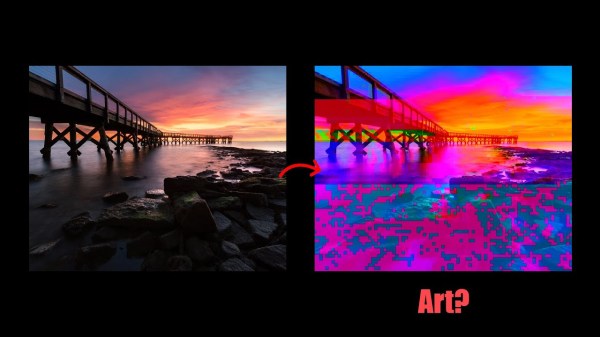
Messing With JPEGs In A Text Editor Is Fun And Glitchy

If you’re looking to edit an image, you might open it in Photoshop, GIMP, or even Paint Shop Pro if you’re stuck in 2005. But who needs it — [Patrick Gillespie] explores what can be done when editing a JPEG on a raw, textual level instead.

As the video explains, you generally can’t simply throw a JPEG into Notepad and start making changes all willy nilly. That’s because it’s very easy to wreck key pieces of the image format that are required to render it as an image. Particularly because Notepad likes to sanitize things like line endings which completely mess up the structure of the file. Instead, you’re best off using a binary editor that will only change specific bytes in the image when you tell it to. Do this, and you can glitch out an image in all kinds of fun digital ways… or ruin it completely. Your choice!

If you’d like to tinker around with this practice, [Patrick] has made a tool for just that purpose. Jump over to the website, load the image of your choice, and play with it to your heart’s content.

This practice is often referred to as “datamoshing,” which is a very cool word, or “databending,” which isn’t nearly as good. We’ve explored other file-format hacks before, too, like a single file that can be opened six different ways. Video after the break.

Continue reading “Messing With JPEGs In A Text Editor Is Fun And Glitchy”

Neat Techniques To Make Interactive Light Sculptures

[Voria Labs] has created a whole bunch of artworks referred to as Lumanoi Interactive Light Sculptures. A new video explains the hardware behind these beautiful glowing pieces, as well as the magic that makes their interactivity work.

The basic architecture of the Lumanoi pieces starts with a custom main control board, based around the ESP-32-S3-WROOM-2. It’s got two I2C buses onboard, as well as an extension port with some GPIO breakouts. The controller also has lots of protection features and can shut down the whole sculpture if needed. The main control board works in turn with a series of daisy-chained “cell” boards attached via a 20-pin ribbon cable. The cable carries 24-volt power, a bunch of grounds, and LED and UART data that can be passed from cell to cell. The cells are responsible for spitting out data to addressable LEDs that light the sculpture, and also have their own microcontrollers and photodiodes, allowing them to do all kinds of neat tricks.

Continue reading “Neat Techniques To Make Interactive Light Sculptures”

Instant Sketch Camera Is Like A Polaroid That Draws

These days, everyone’s got a million different devices that can take a passable photo. That’s not special anymore. A camera that draws what it sees, though? That’s kind of fun. That’s precisely what [Jens] has built—an instant sketch camera!

The sketch camera looks like a miniature drawing easel, holding a rectangular slip of paper not dissimilar in size to the Polaroid film of old. The 3D-printed frame rocks a Raspberry Pi controlling a simple pen plotter, using SG90 servos to position the drawing implement and trace out a drawing. So far, so simple. The real magic is in the image processing, which takes any old photo with the Pi camera and turns it into a sketch in the first place. This is achieved with the OpenCV image processing library, using an edge detection algorithm along with some additional filtering to do the job.

If you’ve ever wanted to take Polaroids that looked like sketches when you’re out on the go, this is a great way to do it. We’ve featured some other great plotter builds before, too, just few that are as compact and portable as this one. Video after the break.

Continue reading “Instant Sketch Camera Is Like A Polaroid That Draws”

The Zen Must Flow From Arrakis Sand Table

In Dune, the Fremen people of Arrakis practice an odd future hybrid religion called “zensunni.” This adds an extra layer of meaning to the title of [Mark Rehorst]’s Arrakis 3.0 sand table, given that the inspiration for the robotic sand table seems to be Zen gardens from Japan.

The dunes on the tabletop version of Arrakis owe nothing to sand worms, but are instead created a rolling metal ball. With all workings happening below, it looks quite magical to the uninitiated, but of course it’s not magic: it’s magnets. Just beneath the tabletop and its sands, the steel ball is being dragged along by the magnetic field of a powerful neodynium magnet.

That magnet is mounted in a CoreXY motion system that owes more than a little bit to modern 3D printers. Aside from the geometry, it’s using the standard G6 belt we see so often, along with a Duet3D mainboard, NEMA 17 steppers, and many 3D printed parts to hold its aluminum extrusions together. Thanks to that printer-inspired motion system, the ball can whirl around at 2000 mm/s, though [Mark] prefers to run slower: the demo video below shows operation at 1000 mm/s before the sand has been added.

This build was designed for ease of construction and movement: sized at 2’x4′ (about 61 cm x 122 cm), it fits through doors and fits an off-the-shelf slab of coffee table glass, something that [Mark] wishes he’d considered when building version two. That’s the nice thing about jumping in on a project someone’s been iterating for a while: you’ve got the benefit of learning from their mistakes. You can see the roots of this design, and what has changed, from the one he showed us in 2020. 

Naturally you’re not limited to CoreXY for a sand table, though it is increasingly popular — we’ve seen examples with polar mechanisms and even a SCARA arm.

Continue reading “The Zen Must Flow From Arrakis Sand Table”

DIY Pinball Machine Uses Every Skill

Pinball machines have something for everyone. They’re engaging, fast-paced games available in a variety of sizes and difficulties, and legend has it that they can be played even while deaf and blind. Wizardry aside, pinball machines have a lot to offer those of us around here as well, as they’re a complex mix of analog and digital components, games, computers, and artistry. [Daniele Tartaglia] is showing off every one of his skills to build a tabletop pinball machine completely from the ground up.

Continue reading “DIY Pinball Machine Uses Every Skill”