Hunting Submarines Via Gravity Is A Tough Errand

Among so many other technological advances, the Cold War saw the advent of the ballistic missile submarine. The concept was simple—pack enough nuclear warheads to destroy a small civilization into a compact metal tube, and then hide it underwater. The oceans would act as a cloak for your fleet of world-enders, and keep your enemies forever on their toes. A terrifying machine that could both start and end a war with the push of a button.

Most nation states are populated by humans with the will to live. Thus, there has been a great incentive to find ways to keep tabs on these sunken doombringers. Great efforts have gone into improving sonar and magnetic detection methods over the decades, which are the bread and butter of sub hunting to this day. However, military researchers have also explored the prospect of whether submarines could be detected via their effect on the gravitational field alone.

Continue reading “Hunting Submarines Via Gravity Is A Tough Errand”

Remember When Flash Drives Were Going To Make Your PC Faster?

The 2000s was a decade of great change in the computer industry. The world had grown accustomed to corruptible floppy disks, blue screens of death, and achingly slow load times. In a few short years, all of that would change, as USB drives, better operating systems, and faster processors brought forth a new age of stability and speed.

Amidst this era of upheaval, Microsoft introduced a new technology. It was intended to increase performance on the cheap to a new generation of machines, but it would turn out to be little more than a gimmick that never really caught on. Let’s explore the easily-forgotten legacy of ReadyBoost.

Continue reading “Remember When Flash Drives Were Going To Make Your PC Faster?”

NoiseCloud: Storing Data On YouTube

Storage is expensive these days, whether you’re looking at the prices of spinning rust or magic little sticks of silicon. But what if there was some benevolent overlord that you could trick into giving you unlimited storage? That’s where Noisecloud comes in.

Created by [Lucas], Noisecloud is a tool that lets you use YouTube as a form of effectively-unlimited file storage. It works by taking whatever file data you have on hand, and turns it into frames of digital noise that can be stored and transported as an MP4 file and uploaded to YouTube. The encoding process involves first compressing the data with gzip, then packaging it into a high-constrast series of video frames that are then encoded with FFmpeg. Video containers can be produced in various resolutions, all the way down to 640×360 @ 30 fps. There’s also a special “TikTok mode” which is optimised to best preserve data on short form sites that use vertical orientation as default. More commentary from the creator is available via the supporting article on Github.

It’s probably not a practical way to store your files, given the fussy encoding and decoding required to actually use the data. However, it’s an interesting proof of concept that explores how data can be stashed in unexpected places via publicly-accessible services. We’ve explored similar work before, too.

PCB Map Display Keeps An Eye On Family

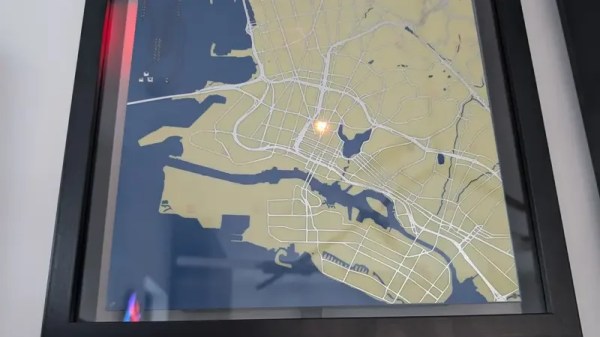
PCBs are traditionally designed with traces laid out to support a circuit full of electronic components. However, they’ve become increasingly popular as a way to produce functional visual artworks. This PCB map from [Jonathan] is a great example.

The PCB was designed as a map of the California East Bay area. The roads are laid out as the top-side copper layer, while the land and roads are used for the top solder mask layer, with the flipped land and roads area making up the solder mask on the bottom side. The map data itself was cribbed from Snazzy Maps. Behind the PCB, [Jonathan] mounted a 64 x 32 RGB LED array, which can be seen glowing through from behind the material. The LEDs are controlled by an ESP32, which grabs location data from [Jonathan’s] family member’s mobile devices over MQTT, and uses it to light their positions on the map. Files are on Github for the curious.

If you’ve got a family that is open to location tracking, and the money to pay for a custom PCB, you could probably recreate this project yourself. We’ve seen some other great PCB maps before, too, like this amazing metro tracker. Video after the break.
Continue reading “PCB Map Display Keeps An Eye On Family”

Touchable POV Display Blooms In Mid Air

Typically, when we think of touch screens, we think of LCDs or OLEDs with a resistive or capacitive sensing layer laid over the top. However, a team from the University of Chicago has developed an entirely different type of touch-sensitive display that uses persistence-of-vision techniques.

The project is called BloomBeacon. It consists of a pair of spinning arms to create a stable round display in mid-air. One arm is covered in LEDs, while the other is covered with capacitive pads for touch sensing purposes.  The trick behind this device is evident in the name—the device uses soft, flexible arms which are hinged and “bloom” upwards as the device spins up to speed. This makes it safe to physically interact with the spinning blades while they’re in motion to create a touch-interactive display. The device can thus display user interface elements like buttons that the viewer can interact with by reaching out and touching them directly.

Normally we’d advise not sticking your fingers in a rotating piece of machinery, but in this case, BloomBeacon was designed specifically to make this safe. Even sticking your fingers or hand right through the spinning arms won’t cause injury.

We’ve featured some other cool POV projects over the years, like this neat volumetric display. Video after the break.

Continue reading “Touchable POV Display Blooms In Mid Air”

Building An Analog Meter Watch

Most conventional analog watches have two or three hands, covering hours, minutes, and seconds (where present). [Sahko] has built a different kind of analog watch that creatively displays the time with just one. 

The build is based around a simple analog coil meter, which, at its heart, just sweeps its needle across a scale based on the voltage input to the device. A Raspberry Pi Pico is employed to drive the meter through a digital-to-analog converter. Pressing the buttons on the outside of the device tells the watch to display hours, minutes/seconds, or the current month or day of the week. With a single needle, only one parameter can be displayed at a time, but that’s just a compromise you accept for having a cool unique analog dial watch.

Another cool touch in the design is that the dial backer isn’t just a printed piece of paper—it’s a custom PCB, which has a much nicer, hardier finish. The case of the watch is also CNC milled out of aluminum and bead blasted for a quality surface finish, adding a nice industrial touch to the build.

This is a great example of a custom watch with quality fit and finish. The attention to detail really pays off in terms of feel. We’ve seen other watch projects use similar construction techniques before, too.

Continue reading “Building An Analog Meter Watch”

Water-cooling A 3D Printed Rocket Isn’t Quite Practical

Consumer-grade 3D printers are useful for lots of things, but they kind of fall down when it comes to making stuff that survives high temperatures. [Mr. More Gooder] wasn’t deterred from a rocket build using FDM printed parts though, instead relying on water cooling to try and beat this practical limit.

The concept is simple enough—[Mr. More Gooder] printed a propane-burning combustion chamber and nozzle out of plastic that you’d totally expect to melt when the flames started. Thus, the nozzle was given fittings to allow water to be continually pumped through to try and drag away enough heat to let the rocket survive more than a few seconds. Unfortunately, during testing the uncooled combustion chamber quickly melted. A redesign with water cooling throughout performed a little better, until the water jacket began to leak into the main chamber and extinguished the flames. Melted plastic could be seen dripping out of the nozzle shortly after ignition, too.

Even if the nozzle did hold up for a longer period of time, it’s worth noting this is probably not a viable route towards a flight-ready engine. Mostly because you would need a huge supply of water to keep the components cool which would add a great deal of weight to any such build. There’s a reason NASA doesn’t recycle old drink bottles to make rocket engines, after all.

In any case, we love to see all sorts of rocket experiments, even the unsuccessful ones.

Continue reading “Water-cooling A 3D Printed Rocket Isn’t Quite Practical”