Repository navigation
Studio: update in the background and restart when ready - #9890
Conversation


This comment was marked as resolved.
This comment was marked as resolved.
Sorry, something went wrong.


Review, GitHub Actions A/B, and UI evidenceReviewed at Fixed
Deferred — the native helpers ( Also fixed here — the four new GitHub Actions A/B — all six jobs greenSame runner, same probe, same command in each pair; only the tree under test changes.
The three remaining reds are already red on
|

This comment was marked as resolved.
This comment was marked as resolved.
Sorry, something went wrong.
This comment was marked as resolved.
This comment was marked as resolved.
Sorry, something went wrong.
This comment was marked as resolved.
This comment was marked as resolved.
Sorry, something went wrong.
…the bundle after single-instance
This comment was marked as resolved.
This comment was marked as resolved.
Sorry, something went wrong.
…staged backend version

|
@codex review |

Codex Review SummaryThis comment shows the latest Codex review activity on this pull request.
ℹ️ About Codex in GitHubYour team has set up Codex to review pull requests in this repo. Reviews are triggered when you
Codex reacts with 👀 while any review is running, comments if it has suggestions, and reacts with 👍 once all reviews finish with no findings. |
|
Codex Review: Didn't find any major issues. Chef's kiss. Reviewed commit: ℹ️ About Codex in GitHubYour team has set up Codex to review pull requests in this repo. Reviews are triggered when you
If Codex has suggestions, it will comment; otherwise it will react with 👍. Codex can also answer questions or update the PR. Try commenting "@codex address that feedback". |

Review and repair resultsThe PR solves a real updater problem. The old desktop flow stopped the managed backend and held the UI on the update screen. The staged flow copies the managed runtime, updates that copy, and downloads the signed desktop bundle while the live backend remains available. Confirmed findings and fixes
Testing performed
Playwright UI evidenceAll affected states were exercised through Playwright. The checks covered discovery, Update, background progress, progress text, log toggle, fast restart-ready state, failure, retry, duplicate-click suppression, retained download recovery, and classic fallback.
|


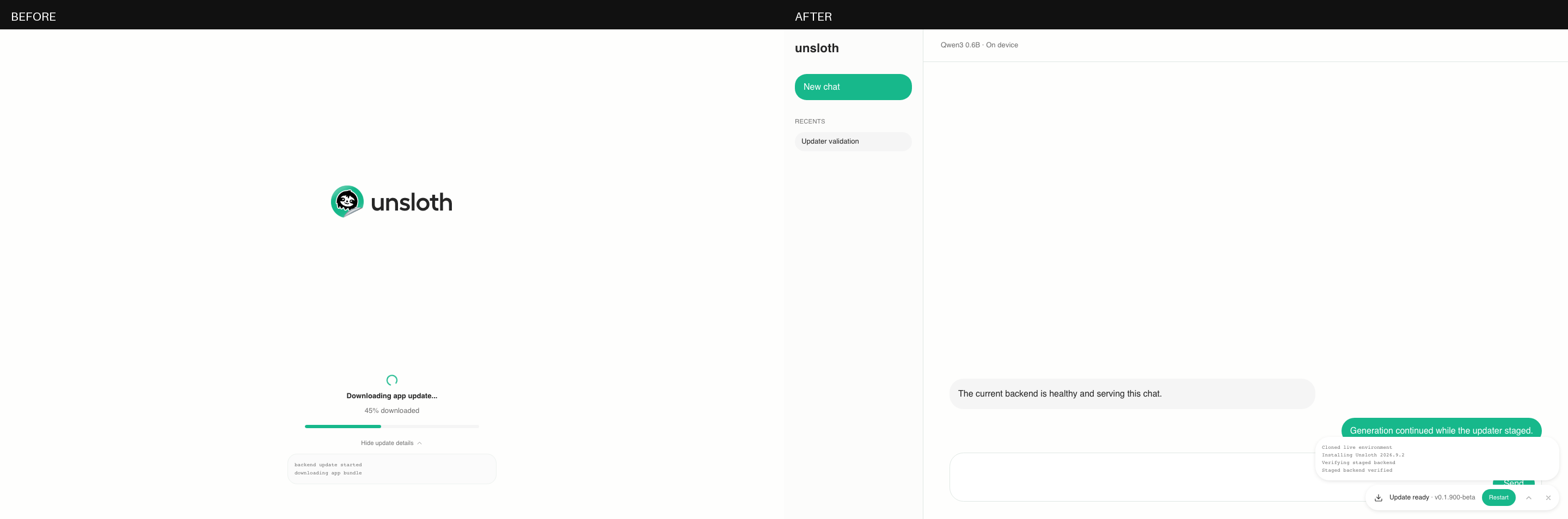

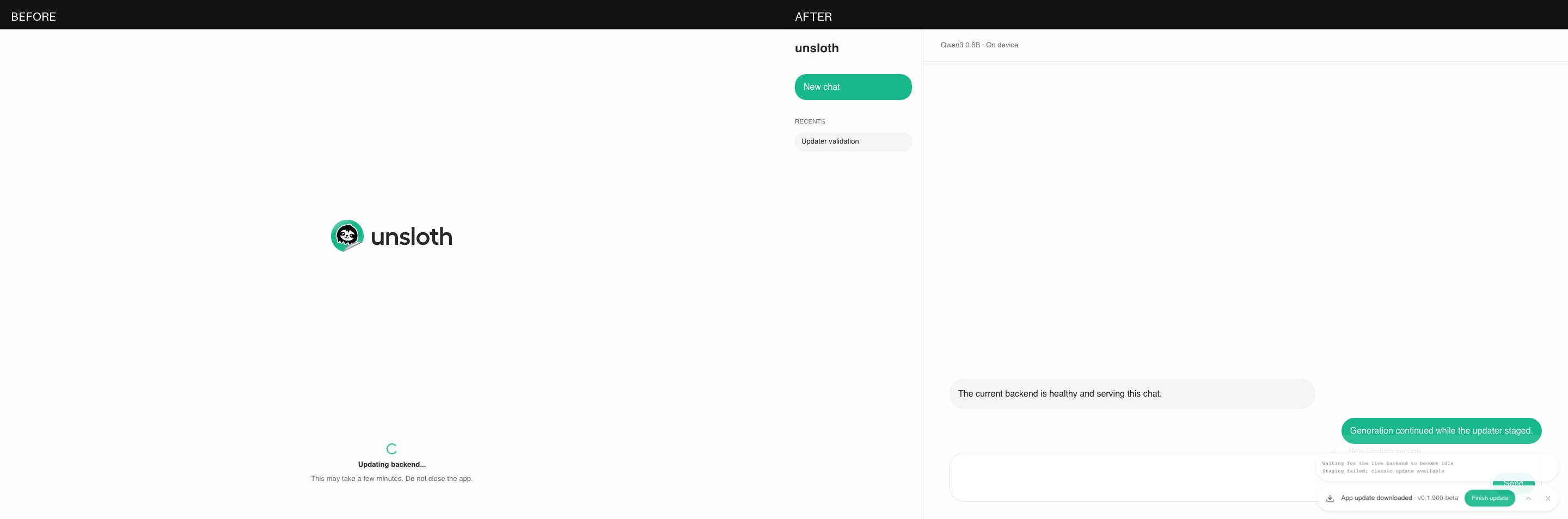
|
@codex review |
|
Codex Review: Didn't find any major issues. More of your lovely PRs please. Reviewed commit: ℹ️ About Codex in GitHubYour team has set up Codex to review pull requests in this repo. Reviews are triggered when you
If Codex has suggestions, it will comment; otherwise it will react with 👍. Codex can also answer questions or update the PR. Try commenting "@codex address that feedback". |
|
@codex review |

There was a problem hiding this comment.
💡 Codex Review
Here are some automated review suggestions for this pull request.
Reviewed commit: 4b3ba93439
ℹ️ About Codex in GitHub
Your team has set up Codex to review pull requests in this repo. Reviews are triggered when you
- Open a pull request for review
- Mark a draft as ready
- Comment "@codex review".
If Codex has suggestions, it will comment; otherwise it will react with 👍.
Codex can also answer questions or update the PR. Try commenting "@codex address that feedback".
| fn live_entry(home: &Path, name: &str) -> PathBuf { | ||
| if HELPER_RUNTIME_ENTRIES.contains(&name) { | ||
| home.parent().unwrap_or(home).join(name) | ||
| } else { |
There was a problem hiding this comment.

When staging is run for a custom UNSLOTH_STUDIO_HOME, _studio_stage.managed_helper_root() and both setup scripts place node, llama.cpp, and whisper.cpp directly under that custom home, but this function always treats them as siblings under home.parent(). Activation and rollback therefore replace unrelated sibling directories while leaving the custom installation's helpers untouched, producing a mixed old/new runtime; derive the live helper root using the same default-versus-custom layout rule used while staging.
Useful? React with 👍 / 👎.

There was a problem hiding this comment.
This path is not reachable in the desktop updater. configure_tauri_update_environment removes both UNSLOTH_STUDIO_HOME and STUDIO_HOME, every production activation/reconcile caller passes diagnostics::studio_dir(), and that function is fixed to ~/.unsloth/studio. The hidden CLI --stage can create a custom stage, but no activation caller reads that custom root. live_entry therefore only receives the legacy root in production, where home.parent() matches _studio_stage.managed_helper_root. No code change needed.
|
@codex review |
|
Codex Review: Didn't find any major issues. Another round soon, please! Reviewed commit: ℹ️ About Codex in GitHubYour team has set up Codex to review pull requests in this repo. Reviews are triggered when you
If Codex has suggestions, it will comment; otherwise it will react with 👍. Codex can also answer questions or update the PR. Try commenting "@codex address that feedback". |

|
All reviewed and fixed, LGTM. CI results |


#9890 added staging support to studio/setup.ps1 and put an early
`if ($StageRoot)` return inside Get-ManagedLlamaCppDir, which sits in the block
install.ps1 holds a byte-identical copy of. The copy never got it, so
test_denied_llama_cpp_preflight.py failed on exactly the drift it exists to
catch, taking Repo tests (CPU) down with it.

install.ps1 never assigns $StageRoot, and it runs under Set-StrictMode -Off from
line 25 onwards, so the read is $null there and the branch is inert. Parity is
what the block is for: the copies have to match or the next person edits one of
them and only finds out in production.


…ordless pip install (#9959)

* Fix three CI regressions: code-span anchor, load-dispatch anchor, recordless pip install

Three unrelated failures, all reproduced locally first.

1. tests/studio/test_update_release_notes.py::test_code_span_closers_ignore_backslashes

   #9796 moved the code-span scanner into scanCodeSpans, which is defined ABOVE
   `export function codeSpans`. The test sliced the file from that export and
   counted `escaped(text` in the remainder, so the count went from 1 to 0 and
   the assertion "only an opener can be escaped" fired on a file where exactly
   one opener is still the only escaped thing. Count over the whole module and
   check the surviving call guards the opening run, so a wrapper moving again
   cannot read as "no opener is escaped either".

2. studio/backend/tests/test_parallel_slots_per_load.py::test_route_resolves_slots_once_before_dedupe_guard_and_load

   The GGUF load moved into _run_gguf_load_attempt, a health-wait helper defined
   above _load_model_impl, so `llama_backend.load_model` left the function body
   and .index() raised ValueError. Every ordering the test guards still holds.
   Anchor on whichever call the body dispatches a load through instead of on one
   backend's method name.

3. startup windows-latest

   pip will not replace a distribution whose .dist-info carries no RECORD, and an
   interrupted install leaves exactly that. The job reuses its venv, so the stub
   is not transient: once written, every later run dies the same way on
   "Cannot uninstall pydantic-core / no RECORD file was found". pip_install now
   retries once after clearing only the distributions pip named as unremovable,
   and only when it named one. pip's own hint is --ignore-installed, which would
   apply to every package in the command and skip real upgrades with it.

run() grows check=False so pip_install can inspect a failure instead of exiting
inside it; every existing caller keeps the old exit-on-failure behaviour.

* [pre-commit.ci] auto fixes from pre-commit.com hooks

for more information, see https://pre-commit.ci

* Mirror the StageRoot branch into install.ps1's shared copy

#9890 added staging support to studio/setup.ps1 and put an early
`if ($StageRoot)` return inside Get-ManagedLlamaCppDir, which sits in the block
install.ps1 holds a byte-identical copy of. The copy never got it, so
test_denied_llama_cpp_preflight.py failed on exactly the drift it exists to
catch, taking Repo tests (CPU) down with it.

install.ps1 never assigns $StageRoot, and it runs under Set-StrictMode -Off from
line 25 onwards, so the read is $null there and the branch is inert. Parity is
what the block is for: the copies have to match or the next person edits one of
them and only finds out in production.

---------

Co-authored-by: danielhanchen <[email protected]>
Co-authored-by: pre-commit-ci[bot] <66853113+pre-commit-ci[bot]@users.noreply.github.com>

Second failure in the same job, from the same pull request, and it only became
visible once the pytest step above stopped failing first.

tests/sh/test_studio_home_node_dir.sh lifts the real STUDIO_HOME and NODE_DIR
logic out of studio/setup.sh by content anchor and runs it against a fake HOME.
Block B started grabbing at:

    ^if \[ "\$_STUDIO_HOME_IS_CUSTOM" = true \]; then

#9890 added a staging branch above that one:

    if [ -n "$STAGE_ROOT" ]; then
        _NODE_PARENT="$RUNTIME_ROOT"
    elif [ "$_STUDIO_HOME_IS_CUSTOM" = true ]; then

which demoted the anchored line to an elif. The anchor then matched nothing,
block B came out empty, and the file's own extraction guard fired:

    FAIL: blockB extraction broke

setup.sh is right here. A background update has to put its Node under the
staging root, not into the home the running Studio is serving from. The anchor
was the problem: it pinned one branch's text in a conditional that was always
going to grow branches.

Block B is now anchored on the NODE_DIR assignment, the line that actually
matters, and walks back to the top-level `if` feeding it. Branches can be added,
reordered or removed without touching this file. Walking back could in principle
land on an unrelated `if`, so the extraction guard now also requires both
_STUDIO_HOME_IS_CUSTOM and STAGE_ROOT to appear in what it captured.

The staging branch was untested, which is why nothing caught this at the time,
so it gets two checks: a stage root sends Node under it, and it outranks a
custom studio home. Both drive UNSLOTH_STUDIO_STAGE_ROOT, the public knob, since
block A derives STAGE_ROOT and RUNTIME_ROOT from it.

7 checks, all passing. Deleting the staging branch from setup.sh fails the file.
Eleven tests in unsloth_cli/tests have been failing on main, taking Repo tests
(CPU) down with them on every pull request:

  Error: could not coordinate the Unsloth launch:
  [Errno 13] Permission denied: '/fake'

These tests pin STUDIO_HOME to /fake/studio so sys.prefix.startswith() picks the
in-venv branch. /fake was fine while nothing on the path touched the disk. #9890
put _studio_runtime_launch_guard in front of the launch, and
studio_runtime_launch_guard does studio_home.mkdir(parents = True) and then locks
a file inside it, so an unwritable home now aborts the run before run_server is
ever reached. Every one of these failures is the same shape underneath: an empty
captured dict, because the flag under test never got as far as being forwarded.

The guard is right to create the directory it locks in, and right to refuse the
launch when it cannot. What was wrong was a fixture using an unwritable sentinel
path for somewhere that is now genuinely written to, so the tests move to
tmp_path. The tree keeps its shape, so sys.prefix still sits under STUDIO_HOME
and the in-venv branch is still the one exercised: removing the sys.prefix pin
still fails these tests.

unsloth_cli/tests: 1113 passed, 6 skipped.
Second failure in the same job, from the same pull request, and it only became
visible once the pytest step above stopped failing first.

tests/sh/test_studio_home_node_dir.sh lifts the real STUDIO_HOME and NODE_DIR
logic out of studio/setup.sh by content anchor and runs it against a fake HOME.
Block B started grabbing at:

    ^if \[ "\$_STUDIO_HOME_IS_CUSTOM" = true \]; then

#9890 added a staging branch above that one:

    if [ -n "$STAGE_ROOT" ]; then
        _NODE_PARENT="$RUNTIME_ROOT"
    elif [ "$_STUDIO_HOME_IS_CUSTOM" = true ]; then

which demoted the anchored line to an elif. The anchor then matched nothing,
block B came out empty, and the file's own extraction guard fired:

    FAIL: blockB extraction broke

setup.sh is right here. A background update has to put its Node under the
staging root, not into the home the running Studio is serving from. The anchor
was the problem: it pinned one branch's text in a conditional that was always
going to grow branches.

Block B is now anchored on the NODE_DIR assignment, the line that actually
matters, and walks back to the top-level `if` feeding it. Branches can be added,
reordered or removed without touching this file. Walking back could in principle
land on an unrelated `if`, so the extraction guard now also requires both
_STUDIO_HOME_IS_CUSTOM and STAGE_ROOT to appear in what it captured.

The staging branch was untested, which is why nothing caught this at the time,
so it gets two checks: a stage root sends Node under it, and it outranks a
custom studio home. Both drive UNSLOTH_STUDIO_STAGE_ROOT, the public knob, since
block A derives STAGE_ROOT and RUNTIME_ROOT from it.

7 checks, all passing. Deleting the staging branch from setup.sh fails the file.
* Give the in-venv CLI tests a writable STUDIO_HOME

Eleven tests in unsloth_cli/tests have been failing on main, taking Repo tests
(CPU) down with them on every pull request:

  Error: could not coordinate the Unsloth launch:
  [Errno 13] Permission denied: '/fake'

These tests pin STUDIO_HOME to /fake/studio so sys.prefix.startswith() picks the
in-venv branch. /fake was fine while nothing on the path touched the disk. #9890
put _studio_runtime_launch_guard in front of the launch, and
studio_runtime_launch_guard does studio_home.mkdir(parents = True) and then locks
a file inside it, so an unwritable home now aborts the run before run_server is
ever reached. Every one of these failures is the same shape underneath: an empty
captured dict, because the flag under test never got as far as being forwarded.

The guard is right to create the directory it locks in, and right to refuse the
launch when it cannot. What was wrong was a fixture using an unwritable sentinel
path for somewhere that is now genuinely written to, so the tests move to
tmp_path. The tree keeps its shape, so sys.prefix still sits under STUDIO_HOME
and the in-venv branch is still the one exercised: removing the sys.prefix pin
still fails these tests.

unsloth_cli/tests: 1113 passed, 6 skipped.

* [pre-commit.ci] auto fixes from pre-commit.com hooks

for more information, see https://pre-commit.ci

* Anchor the node-dir extraction on NODE_DIR, and cover the staging branch

Second failure in the same job, from the same pull request, and it only became
visible once the pytest step above stopped failing first.

tests/sh/test_studio_home_node_dir.sh lifts the real STUDIO_HOME and NODE_DIR
logic out of studio/setup.sh by content anchor and runs it against a fake HOME.
Block B started grabbing at:

    ^if \[ "\$_STUDIO_HOME_IS_CUSTOM" = true \]; then

#9890 added a staging branch above that one:

    if [ -n "$STAGE_ROOT" ]; then
        _NODE_PARENT="$RUNTIME_ROOT"
    elif [ "$_STUDIO_HOME_IS_CUSTOM" = true ]; then

which demoted the anchored line to an elif. The anchor then matched nothing,
block B came out empty, and the file's own extraction guard fired:

    FAIL: blockB extraction broke

setup.sh is right here. A background update has to put its Node under the
staging root, not into the home the running Studio is serving from. The anchor
was the problem: it pinned one branch's text in a conditional that was always
going to grow branches.

Block B is now anchored on the NODE_DIR assignment, the line that actually
matters, and walks back to the top-level `if` feeding it. Branches can be added,
reordered or removed without touching this file. Walking back could in principle
land on an unrelated `if`, so the extraction guard now also requires both
_STUDIO_HOME_IS_CUSTOM and STAGE_ROOT to appear in what it captured.

The staging branch was untested, which is why nothing caught this at the time,
so it gets two checks: a stage root sends Node under it, and it outranks a
custom studio home. Both drive UNSLOTH_STUDIO_STAGE_ROOT, the public knob, since
block A derives STAGE_ROOT and RUNTIME_ROOT from it.

7 checks, all passing. Deleting the staging branch from setup.sh fails the file.

* Pin UNSLOTH_ALLOW_CPU for the child that imports unsloth

Third failure in Repo tests (CPU), and it now runs before the other two, so it
is what the job reports on main today while the eleven unsloth_cli failures and
the setup.sh anchor wait behind it.

test_a_hostile_dtype_field_cannot_reach_an_eval, added by #9777, spawns a fresh
interpreter that imports unsloth. On a host with no torch accelerator that dies
inside unsloth_zoo:

  File "unsloth_zoo/device_type.py", line 389, in get_device_type
    raise NotImplementedError("Unsloth cannot find any torch accelerator? You need a GPU.")

so the child never reaches the module under test and the returncode assertion
fires. The FutureWarning about HF_HUB_ENABLE_HF_TRANSFER that heads the failure
message is unrelated noise from the same stderr.

UNSLOTH_ALLOW_CPU=1 is the documented way to import on such a host, and the test
was getting it by accident: studio/backend/tests/conftest.py sets it with
setdefault at import, so whether the child inherited it depended on whether that
conftest had been loaded, which depends on what else the run collected. In this
job it had not been.

The test copies os.environ and now pins the variable in the copy. It is a test
about the dtype field, and it should read the same on a runner with a card and
on one without.

With no accelerator visible and the variable unset in the parent: 1 failed, 11
passed before, 12 passed after. Unchanged with a card present.

---------

Co-authored-by: danielhanchen <[email protected]>
Co-authored-by: pre-commit-ci[bot] <66853113+pre-commit-ci[bot]@users.noreply.github.com>
… classic update (#10604)

* Studio: stop the desktop shell staging updates in the background

Removes the staged-update path #9890 added to the Tauri shell: the staged
UpdateKind and its stage-progress/stage-complete/stage-failed events, the four
staged Tauri commands, the pending-version branches in port validation, the
staged rollback restart and the macOS relaunch helper. The update child now
always runs under the runtime launch guard and always inherits the gate through
STUDIO_RUNTIME_GATE_HANDOFF, which POSIX needs because the shell holds the flock
around the whole child.

staged_update.rs stays as a legacy cleanup module: reconcile_legacy_at_launch
deletes stale rollback trash, the compatibility failure marker and any stage
directory, then restores a runtime an unconfirmed 805-807 activation replaced.
Every step is a rename or a delete, so a second launch is a no-op.

Keeps the independent fixes that shipped in #9890: the POSIX runtime gate and
its ACQUIRE protocol, the stop_update process-group hardening, the unconditional
PYTHONHOME/PYTHONPATH scrub, and the desktop update bundle download with its
three commands.

* Studio: refuse a staged update instead of cloning the environment

An 805-807 desktop shell still spawns `unsloth studio update --stage`. The
hidden flag stays, but it now fails fast: no clone, no gate, no idle scan, no
launcher transaction. It writes the .update-failed.json those shells read, so a
later recheck of the same version returns skip rather than offering to prepare
again, prints the [TAURI:ERROR] line update.rs promotes off stdout, and exits 1,
which drops the shell onto the classic update.

_studio_stage.py keeps only the half an old CLI still calls into: the stage root
helpers, the shebang relocation and finalize_for_activation, stdlib only and
importable under python -I. The cloning, ready marker and uv marker promotion go
with the feature.

* Studio: put the desktop update banner back on the classic flow

The frontend no longer prepares an update in the background: the preparing and
ready statuses, the compact pill, the preparation state and the five staged
wrappers all go, together with lib/update-preparation.ts. Update now runs the
backend update, downloads the shell bundle if an earlier attempt did not leave
one, installs it and relaunches, which is what the classic path always did.

Kept: the periodic check from #9505 with its status ref and focus/visibility
wake-ups, the retained bundle download and install commands, the release notes
panel, and the banner card shapes the Python contract tests pin. The locale keys
the background flow added are removed and desktopAvailableDescription goes back
to describing a restart on completion.

* Apply the repo-pinned ruff formatting to the files this branch touched

* Studio: pin that the legacy cleanup leaves a retained update bundle alone

* Use the shared shell version constant in the staged update refusal

* Studio: wait out a desktop bundle download the update did not start

download_desktop_update refuses a second concurrent download, so a webview
reload during the shell download left the next Update now failing with
"Desktop update download is already running" instead of finishing. Poll the
bundle status until the running one settles, then reuse it or download.

* Studio: keep the legacy update cleanup off the launch path

Both leftovers this reconciler removes are whole runtime trees: .update-stage is
a clone of the managed venv and every native helper, and a confirmed
.update-prev is the runtime it replaced. Unlinking either one inside the Tauri
setup hook holds the runtime gate before the window exists, which on Windows is
minutes for a torch venv, and a complete stage is the common case for exactly
the installs this cleanup targets.

The stage is renamed into the rollback trash namespace, which a later launch
sweeps anyway, and unlinked on a background thread; a confirmed previous runtime
is dropped on one too, keeping its marker-last ordering so an interrupted delete
just repeats.

* Studio: clear a stage an old shell left before refusing to make one

A 805-807 shell reports `partial` for any `.update-stage` directory before it
reads `.update-failed.json`, and its `stagingDecision` maps `partial` straight
back to `stage`. An orphaned stage from an earlier attempt therefore had that
shell re-spawning `studio update --stage` at every periodic recheck, whatever the
refusal marker said. Take the directory out of the way first: renamed into the
`.update-rollback-` namespace the desktop already sweeps at launch, then unlinked
off that path, so the name the shell reads is gone the instant the rename lands
and a delete that fails leaves only trash somebody else collects.

Also spell out two things the marker relies on: `shell_version` is an
`Option<String>` on the other side, so null parses and a placeholder would fail
the version comparison exactly as null does, and the marker lands under the
Python STUDIO_HOME, which matches the shell's studio directory except for a
desktop-configured custom home.

* Studio: pad a relocated launcher back to the size the installer recorded

`make_relocatable` replaces a console script's `#!<venv>/bin/python` line with
the 82-byte relocatable shebang, so every venv path past about 68 characters
leaves the file SHORTER than the size RECORD holds for it. `install_manifest`
reads anything smaller than its recorded size as damage, which makes `setup.sh`
force the full dependency pass at every update and keeps a deep verification from
ever passing, so the whole cost of that check landed on exactly the installs
whose Studio path is long. This is the rewrite an old shell reaches through
`finalize_for_activation`, and `bin/unsloth` is the one launcher it rewrites, so
the deficit is paid back here: a comment line between the shebang and the body,
which `/bin/sh` never reads past the exec on line 2 and Python treats as a
comment, leaving the script still ending in whatever the installer wrote.

Tests cover a rewrite never shrinking a script, a stage finalised under a
100-character path clearing the same size comparison `install_manifest` runs, and
the shell version recorded in the refusal marker for a missing, blank or real
value. `managed_helper_root` goes with its test: the clone step was its only
caller and that step is gone.

* Studio: settle every legacy update leftover before something acts on it

Five things the cleanup module got wrong once a launch was not the only caller.

A rollback the launch deferred outlives the update that follows it. When a
backend still holds the tree, `reconcile_legacy_at_launch` leaves the PENDING
journal for the next launch, which is right at launch and wrong afterwards: a
classic update then installs into a runtime a journal still names as something to
undo, and the next idle launch restores the pre-update trees over all of it.
`reconcile_before_update` settles it inside the runtime guard, after the idle
scan and before the child spawns, and refuses with the one instruction that fixes
it when a backend is holding the tree.

The confirmed backup is quarantined rather than emptied. Deleting in place took
entries out from under the marker that vouches for the live runtime, so an
interrupted delete left a backup with no confirmation, which the next launch
reads as an activation nobody confirmed and rolls back to. The rename is the
whole decision and it is atomic.

The stage discard puts its fallback on a thread too. On Windows the rename fails
exactly when a file inside is still open, which is the multi-gigabyte tree the
background delete exists for, so the in-place unlink held the setup hook for as
long as the clone took.

`roll_back_unconfirmed` stops probing the process table at every launch: an
install with no `.update-prev` has nothing to decide. And a trash name carries a
counter as well as nanos and a pid, so two names in one launch cannot collide.

Tests: a READY stage discarded ahead of a mid-swap PENDING journal, a stage whose
rename fails still swept, distinct trash names, a confirmed backup gone from the
directory on return, and a deferred journal settled or the update refused.

* Studio: report progress while the update waits out a bundle download

A webview reload leaves the native bundle download running with nothing listening
to it, and `download_desktop_update` refuses a second one, so `installUpdate`
waits that download out. It did so silently and forever: the progress bar sat at
zero for the whole of it, and a download that stalled without ever clearing the
flag held the update there with nothing on screen to say why.

`listenDesktopUpdateDownload` comes out of `downloadDesktopUpdate` so the wait can
attach to the same `desktop-update-download` events, once a download really is in
flight and released whichever way the wait ends. The wait is bounded at ten
minutes, after which the attempt falls through to `downloadDesktopUpdate`, which
either takes the download over or reports why it cannot.

The schedule tests grow an event bus and a scripted bundle status so both shapes
are covered, and the failed-install case now pins a rejected
`invoke("start_backend_update")` rather than leaning on a `listen` stub that
happened to throw somewhere earlier in the same path.

* Studio: keep the install test id on the update card action

The revert took `data-testid="tauri-update-install"` off with the compact pill it
also belonged to. The card button is the one an end-to-end test drives, and the
background prefetch built on this branch selects it by that id.

* Studio: tighten the comments in the update path

* Studio: drop the now unused time import from the runtime gate tests

* Studio: align the update module comments with the code they describe
Three dependencies in `studio/frontend/package.json` are not used by
anything: not by the app, tests, configs, npm scripts, CSS, CI workflows
or the Tauri build.

## What changes

`npm uninstall` of:

- `@tauri-apps/plugin-updater`: nothing in the repo references it. The
last import went away in #9890; the frontend calls the app's own Rust
commands now. The Rust crate is separate and untouched.
- `@radix-ui/[email protected]` and `@radix-ui/[email protected]`:
nothing imports them. The bundle only uses the copies nested under
`radix-ui`, never these top-level ones.

The lockfile loses exactly these 3 entries; nothing is added or changed.

## How it was checked

- Module graph from the repo's own `vite.config.ts` production build,
plus a TypeScript AST pass over every source, test, config file, script
and CSS `@import`, `tsconfig` paths, npm script commands, peer
requirements, and files outside the frontend (workflows, Tauri config).
Transitive dependencies expanded with `npm ls --all`, so packages used
only as peers, config plugins, type-only imports or CLIs in scripts were
not flagged.
- `npm ci` passes and leaves a clean tree. The production `dist/` (871
files) is byte identical to main. `bundle:check`: 6,802.0 KB raw /
2,053.2 KB transfer / 110 chunks on both sides. Typecheck passes on
both; lint gives the identical set of findings on both (main already has
them). Frontend tests: 14,249 passed, 0 failed on both.
`tests/studio/test_frontend_dep_removal.py` and the lockfile audit pass.

This is tidying, not a speed change: none of the three was in the
bundle, and they are 39 KB of `node_modules`.


Right now, updating the desktop app stops the backend and shows a "do not close" screen for a few minutes. With new versions shipping every day or two, that gets old fast.
This change makes updates happen in the background. When a new version is found, the banner shows an Update button. Clicking it downloads the new app and sets up the new backend in a separate copy, while the current one keeps running. You can keep chatting or training in the meantime. A small pill in the corner shows progress, with a toggle to see the log. When everything is ready, the pill says Restart. Restarting takes a few seconds instead of a few minutes.
On the next launch the app switches to the new copy. If the new backend fails to start, the app goes back to the previous copy on its own and will not try that version again. If preparing the update fails for any reason, the old full update still works as before.
What changed: