Repository navigation
sphinx.ext.autodoc: Typehints, aliases, and (internal/external) cross-references #10794
Description

Describe the bug
For this issue, the code for the project is found here with conf.py and documentation rendered here.
In the code, we have lines like this for our typehints:
T = TypeVar("T", bound=NBitBase)

Tensor = Union["NDArray[np.number[T]]", "NDArray[np.bool_]"]
FloatIntOrBool = Literal["float", "int", "bool"]
...
...
    def astensor(
        self, tensor_in: ArrayLike, dtype: FloatIntOrBool = 'float'
    ) -> ArrayLike:
        """
        Convert to a NumPy array.
        Example:
            >>> import pyhf
            >>> pyhf.set_backend("numpy")
            >>> tensor = pyhf.tensorlib.astensor([[1.0, 2.0, 3.0], [4.0, 5.0, 6.0]])
            >>> tensor
            array([[1., 2., 3.],
                   [4., 5., 6.]])
            >>> type(tensor)
            <class 'numpy.ndarray'>
        Args:
            tensor_in (Number or Tensor): Tensor object
        Returns:
            `numpy.ndarray`: A multi-dimensional, fixed-size homogeneous array.
        """
which renders as
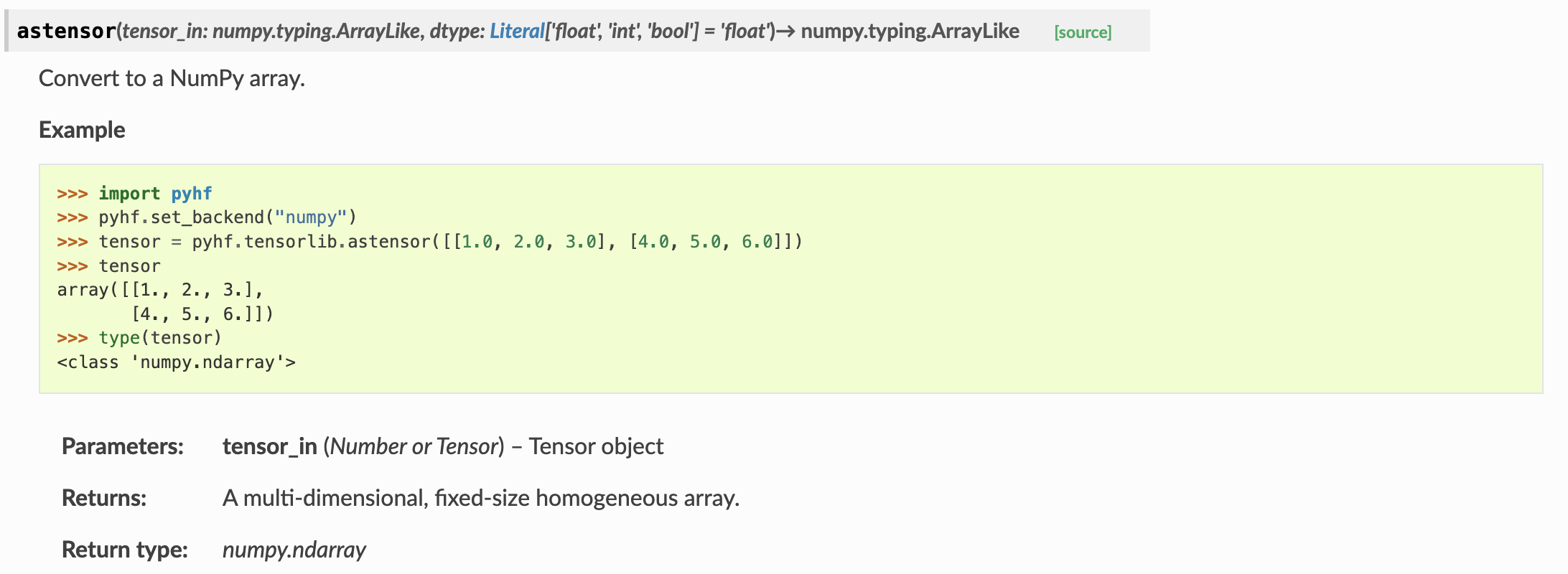
and
    def percentile(
        self,
        tensor_in: Tensor[T],
        q: Tensor[T],
        axis: None | Shape = None,
        interpolation: Literal[
            "linear", "lower", "higher", "midpoint", "nearest"
        ] = "linear",
    ) -> ArrayLike:
        r"""
        Compute the :math:`q`-th percentile of the tensor along the specified axis.
        Example:
            >>> import pyhf
            >>> pyhf.set_backend("numpy")
            >>> a = pyhf.tensorlib.astensor([[10, 7, 4], [3, 2, 1]])
            >>> pyhf.tensorlib.percentile(a, 50)
            3.5
            >>> pyhf.tensorlib.percentile(a, 50, axis=1)
            array([7., 2.])
        Args:
            tensor_in (`tensor`): The tensor containing the data
            q (:obj:`float` or `tensor`): The :math:`q`-th percentile to compute
            axis (`number` or `tensor`): The dimensions along which to compute
            interpolation (:obj:`str`): The interpolation method to use when the
             desired percentile lies between two data points ``i < j``:
                - ``'linear'``: ``i + (j - i) * fraction``, where ``fraction`` is the
                  fractional part of the index surrounded by ``i`` and ``j``.
                - ``'lower'``: ``i``.
                - ``'higher'``: ``j``.
                - ``'midpoint'``: ``(i + j) / 2``.
                - ``'nearest'``: ``i`` or ``j``, whichever is nearest.
        Returns:
            NumPy ndarray: The value of the :math:`q`-th percentile of the tensor along the specified axis.
        """
which renders as
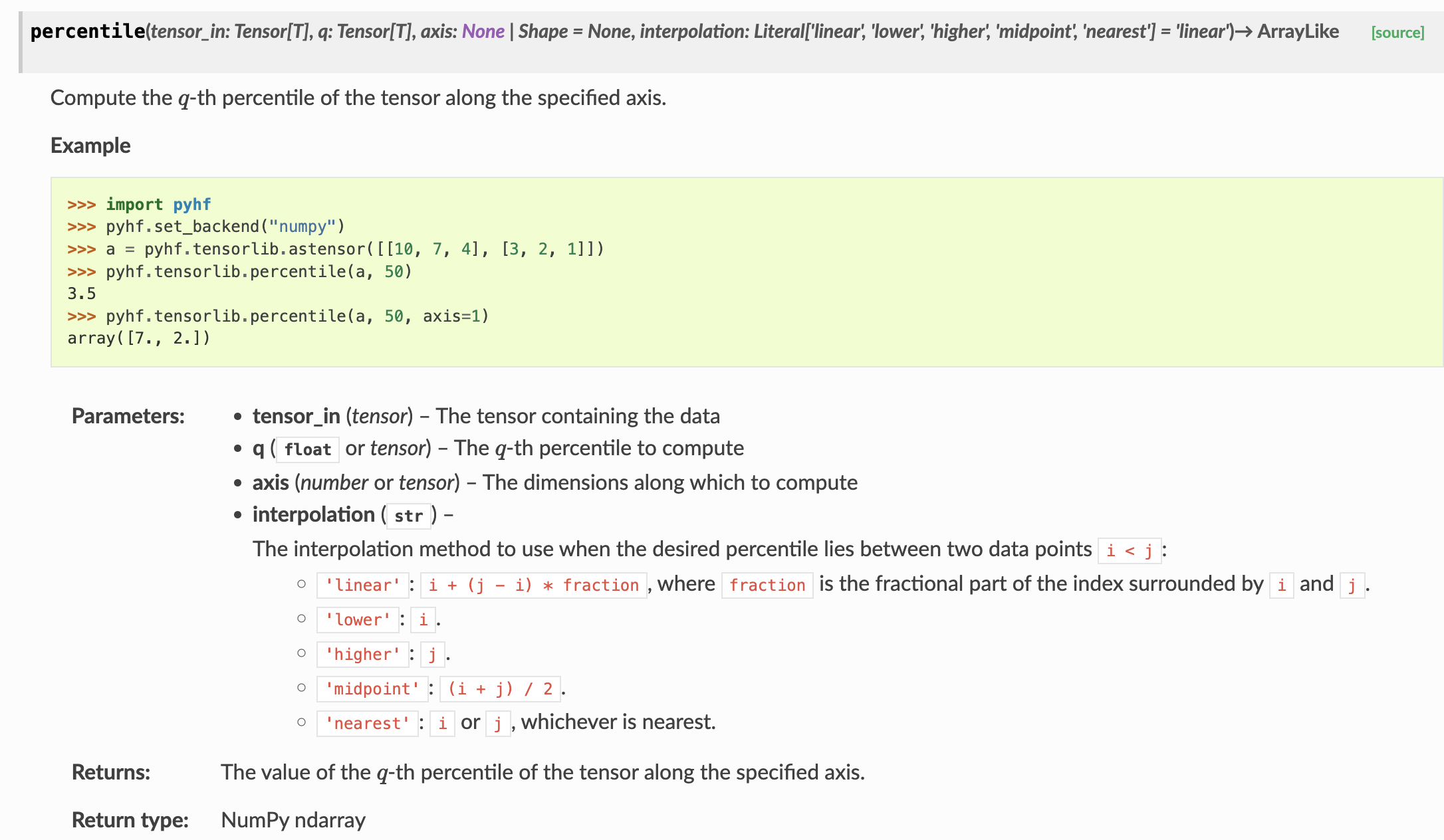
And finally, in conf.py, we have the aliases defined such as 'ArrayLike': 'numpy.typing.ArrayLike'
_type_aliases_inverted = {
    'pyhf.typing': [
        'PathOrStr',
        'ParameterBase',
        'Parameter',
        'Measurement',
        'ModifierBase',
        'NormSys',
        'NormFactor',
        'HistoSys',
        'StatError',
        'ShapeSys',
        'ShapeFactor',
        'LumiSys',
        'Modifier',
        'Sample',
        'Channel',
        'Observation',
        'Workspace',
        'Literal',
    ],
    'numpy.typing': ['ArrayLike', 'DTypeLike', 'NBitBase', 'NDArray'],
}
autodoc_type_aliases = {
    item: f'{k}.{item}' for k, v in _type_aliases_inverted.items() for item in v
}

autodoc_typehints_format = 'fully-qualified'
Here are the issues
- In
astensor,Literalgets linked totyping.Literalinstead ofpyhf.typing.Literal(which is fine! but in other python versions, this comes fromtyping_extensionswhich is why we import frompyhf.typingwhich has the code for switching where it comes from) since the docs are rendered using python 3.10. Inpercentile,Literaldoes not get cross-referenced, but why? - In
astensor,numpy.typing.ArrayLikeis not getting cross-referenced at all, but it exists in thenumpyintersphinx. - In
percentile,Tensoris not getting cross-referenced (from the same module) andShapeis not getting cross-referenced (frompyhf.typingin the same package).
How to Reproduce
Recommend python 3.10+ (Sphinx does not correctly process UnionType in older python versions).
$ git clone https://github.com/scikit-hep/pyhf
$ cd pyhf
$ python -m pip install --upgrade pip setuptools wheel
$ python -m pip --quiet install --upgrade .[docs,test]
$ cd docs
$ make html
$ open _build/html/index.html
Expected behavior
Expected type aliases to be processed with intersphinx (but also internal cross-referencing working too).
Your project
Screenshots
No response
OS
Mac 10.14.6 (18G9323)
Python version
Python 3.8.6
Sphinx version
5.1.1
Sphinx extensions
'sphinx.ext.autodoc', 'sphinx.ext.autosummary', 'sphinx.ext.coverage', 'sphinx.ext.mathjax', 'sphinx.ext.ifconfig', 'sphinx.ext.viewcode', 'sphinx.ext.githubpages', 'sphinx.ext.intersphinx', 'sphinxcontrib.bibtex', 'sphinx.ext.napoleon', 'sphinx_click.ext', 'nbsphinx', 'sphinx_issues', 'sphinx_copybutton', 'sphinx_togglebutton', 'xref',
Extra tools
No response
Additional context
Related:
Activity
mscuthbert commentedon Oct 8, 2022
Agreed on the importance of this request.
Also it would be good if argument annotations were not typed with the same class as the argument name itself. It would mkae it much easier to give a different style to type declarations or to use a callback to fi the problems that @kratsg mentions abouve.
cjw296 commentedon Dec 2, 2022
Seems like there might be overlap between this issue and #10785
Add type annotations to `ribs.schedulers` (#610)
jdillard commentedon Aug 18, 2026
After investigating the three reported behaviors, they appear to have separate causes:
Literallinking is still reproducible and appears to be tracked more specifically byautodoc_type_aliasesnot working withtyping.Literaltype aliases... #10525.numpy.typing.ArrayLikeis an intersphinxpy:class-to-py:datamismatch. The equivalent local mismatch is fixed by Add py:class to py:data fallback for type alias cross-references (#10785) #13808, but the intersphinx fallback remains unresolved. I added a detailed reproduction and proposed fix to Use of TypeVar results in "reference target not found" error #10974, which also has reports of this external behavior.TensorandShapecases do not appear to be reference-resolution failures. In the linked pyhf revision, neither alias is included inautodoc_type_aliases, and the generated API documentation does not register either as an indexed object. Sphinx therefore has no target to resolve. The local fallback in Add py:class to py:data fallback for type alias cross-references (#10785) #13808 only helps when an alias is already documented aspy:dataorpy:attr.I do not think a single fix covers all three reports. I suggest tracking the
Literalbehavior in #10525 and the intersphinx fallback in #10974.