Suggest a new persistence method from Redis.#6584
Suggest a new persistence method from Redis.#6584
Conversation


|
Hello @hshs1103
Nothing wrong making the PR in my opinion - thanks for sharing this. |

|
@itamarhaber |

|
Hello @itamarhaber . Can you tell if the review process is going on now? |

|
@hshs1103 @addb-swstarlab can you please outline the differences and advantages here? p.s. we can't obviously merge a PR for redis 4. but we can review the diff, provide feedback, and then make a new one for the |
|
Compared to the existing persistence method, AOF-Preamble, there are two differences. First, LESS method can guarantee data persistence without using a Rewrite buffer for newly requested commands during the operation of the child process. The advantages of these differences are as follows. First, since the LESS method does not use the Rewrite buffer, the memory usage of LESS method is less than that of the AOF-Preamble method. During the AOF-Preamble operation, Redis store the generated log record redundantly in two buffers(AOF buffer & Rewrite buffer), which leads to surge in memory usage. However, in LESS method, the generated log record is stored in only AOF buffer, so memory usage does not increase sharply. For the same memory capacity, LESS method increases the available memory space to store data when compared to the AOF-Preamble. Second, our method improves throughput over the original method. This is because LESS method does not perform excessive disk I/O. In the AOF-Preamble method, the main process incurs heavy disk I/O owing to the merging of the RDB and AOF files. LESS solves the heavy disk I/O problem by storing the log files separately rather than merging the AOF and RDB files. As the paper on the LESS module has been published, I will give you another link to the paper for your understanding. Please review it. I would appreciate if you could review the diff and provide feedback. |
|
Ohh, IIUC, this idea is was around for a while (we called it multipart-aof, not as fancy as LESS), IIRC it was proposed by @inbareyal several years ago and rejected by Salvatore due to introducing complexity for the operator needing to move several files around. Just to make sure i understand (didn't fully read it), it boils down to this:
Let me know if i'm right, or did i miss anything. |

|
Thank you for your reply. As a result of checking the comments you left, I think you understood them correctly. To help you understand more in detail, I attach some pictures of motivation for developing the LESS method, the operation process of LESS method, and the data recovery method if an error occurs during LESS operation. Motivation
LESS logging operation
LESS recovery mechanism
If you have additional questions, please leave a comment. |


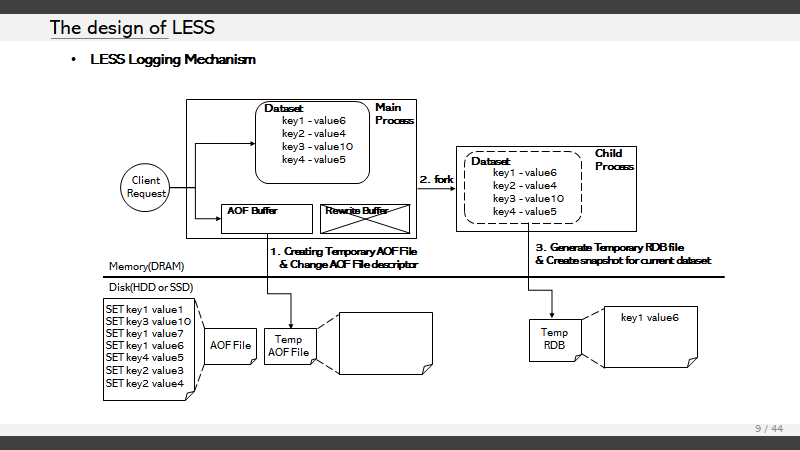


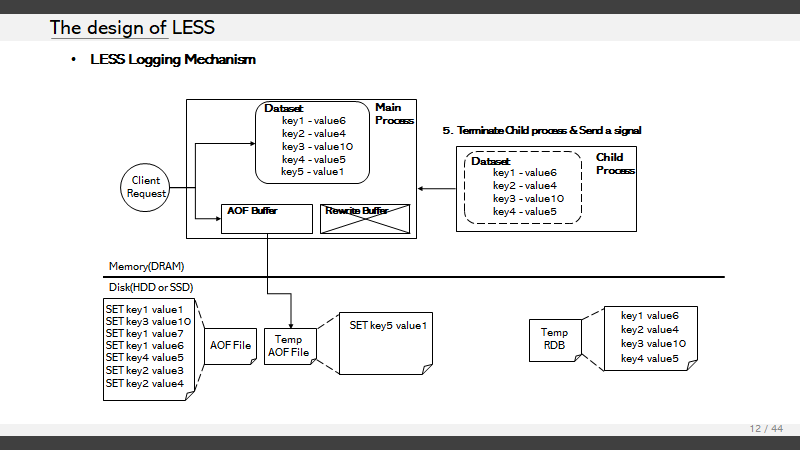

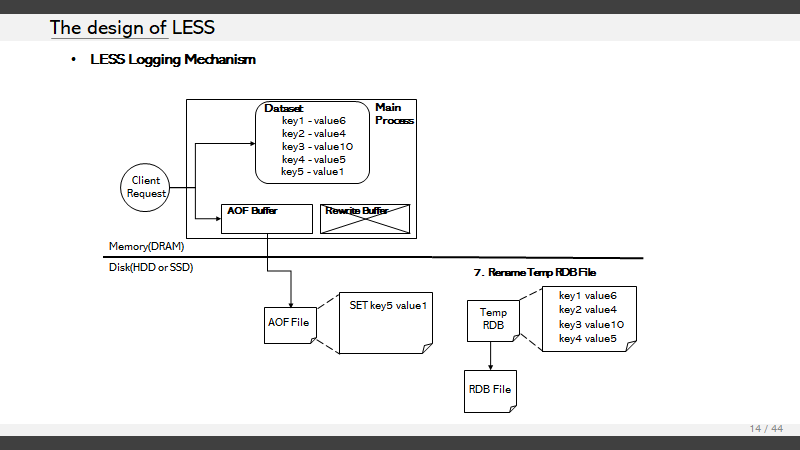

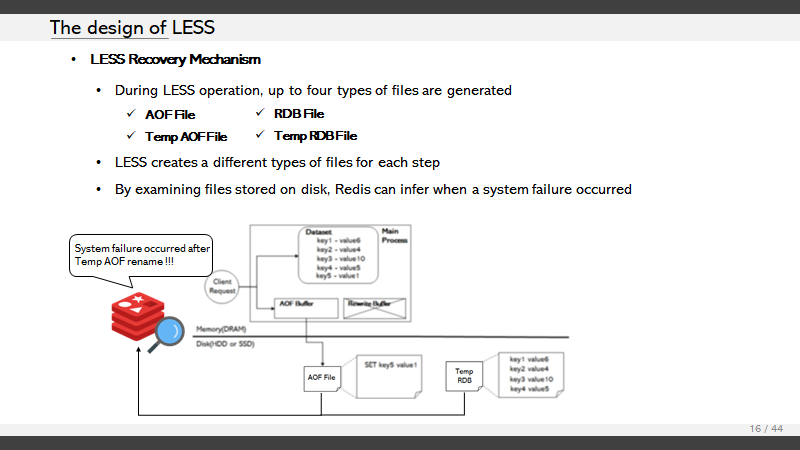
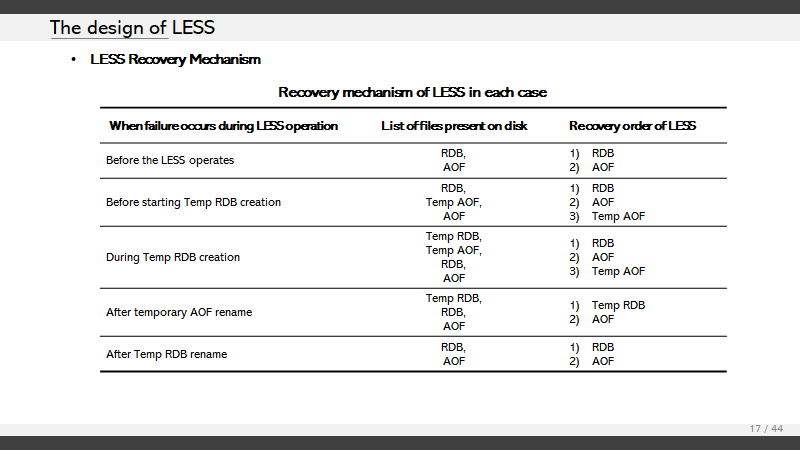

|
Interesting idea, it seems we need two Actually we have a similar implementation, we call it |

|
Hello. May I know what the future progress will be about the pull request(#6584 ) I posted? Is there anything I can do to help? |
|
@hshs1103 as i stated in the past, this PR is not mergable because it was done against redis 4.0 rather than the unstable branch (but also redis changed quite a lot since when so it'll have many conflicts and need to be re-done). back when you submitted this paper and PR, the idea of multi-part AOF already existed in our future roadmap (at least in RedisLabs), but we weren't ready to go there just yet (there was a different maintainer back then, a different development cadence, and different priorities). Recently the new redis-core-team decided to pick this up for redis 7.0, and and the Alibaba team stepped up to do the detailed design and implementation (hence #9539). |
|
@oranagra Thanks for your reply. In Less, file name change is not handled atomically for the operation of multiple files. Instead, we designed each file to be renamed sequentially, one by one, so we know when the error occurred. If there is anything I can help with later, please feel free to comment. :-) |

6 participants


Hello. I do research on Redis, and I recently developed a new persistence method that improves AOF-PREAMBLE.
The proposed method was designed to reduce memory usage and improve the performance of Redis. This persistence method is called LESS, uses a mixture of AOF and RDB. It seems to similar to AOF-PREAMBLE but detailed behavior is different from AOF-PREAMBLE.
I worked on the Redis 4 version of the module. So I asked for a PR from 4.0.
As the paper on the LESS module has been published, I will give you a link to the paper for your understanding. Please review it.
https://ieeexplore.ieee.org/document/8679377
*I'm not used to open-source activities. Please tell me if the method of PR is wrong.