Update documentation for CTCLoss #18415
Conversation


torch/nn/modules/loss.py
Outdated
| targets: Tensor of size :math:`(N, S)` or `(sum(target_lengths))`. | ||
| Targets (cannot be blank). In the second form, the targets are assumed to be concatenated. | ||
| targets: Tensor of size :math:`(N, S)` or `(sum(target_lengths))`, where `N = batch size`, and | ||
| `S = maximum target length`. |
There was a problem hiding this comment.
What's the effect of changing the indent here?
There was a problem hiding this comment.
Did you mean on line 1238?
The indent means that the remaining words in that sentence will belong to the header block when rendered. I noticed that some of the other docs don't do this, so I have actually changed it again to something else.
torch/nn/modules/loss.py
Outdated
| such that :math: `target_n = targets[n,:s_n]` for each target in a batch. | ||
| target_lengths: Tuple or tensor of size :math:`(N)`. | ||
| Lengths of the targets | ||
| Lengths of the targets (may be :math: < S) |
There was a problem hiding this comment.
Maybe should be <= S if targets is a two-dimensional tensor (but with :math:) would be clearer.
torch/nn/modules/loss.py
Outdated
| >>> | ||
| >>> min_target_length = 10 | ||
| >>> max_target_length = S | ||
| >>> |
There was a problem hiding this comment.
I must admit that the blank lines are just too much. Also, I wonder, if we need to introduce a second name for S.
There was a problem hiding this comment.
I redid the naming it in the latest update. Also removed some of the self explanatory comments, and removed some spaces.

|
Thank you for your patch! It will be nice to have the improved documentation. |

torch/nn/modules/loss.py
Outdated
| targets: Tensor of size :math:`(N, S)` or `(sum(target_lengths))`, where `N = batch size`, and | ||
| `S = maximum target length`. | ||
| Each element in the target sequence is a class index. Target index cannot be blank (default=0). | ||
| In the second form, the targets are assumed to be concatenated. |

There was a problem hiding this comment.
Are the targets concatenated with or without the padding to make it a fixed (N, S)?
Maybe it would be useful to explicitly comment on that.
There was a problem hiding this comment.
I think the answer is "with padding". I actually still don't understand how the (sum(target_lengths)) form works... it doesn't seem like that actually describes a shape. Can @t-vi comment on this?
There was a problem hiding this comment.
That's a 1-d shape. (sum(target_lengths),) would probably be more pythonesque.
There was a problem hiding this comment.
Ah no I see now. Not sure why I was confused before. The comma is probably not necessary.
|
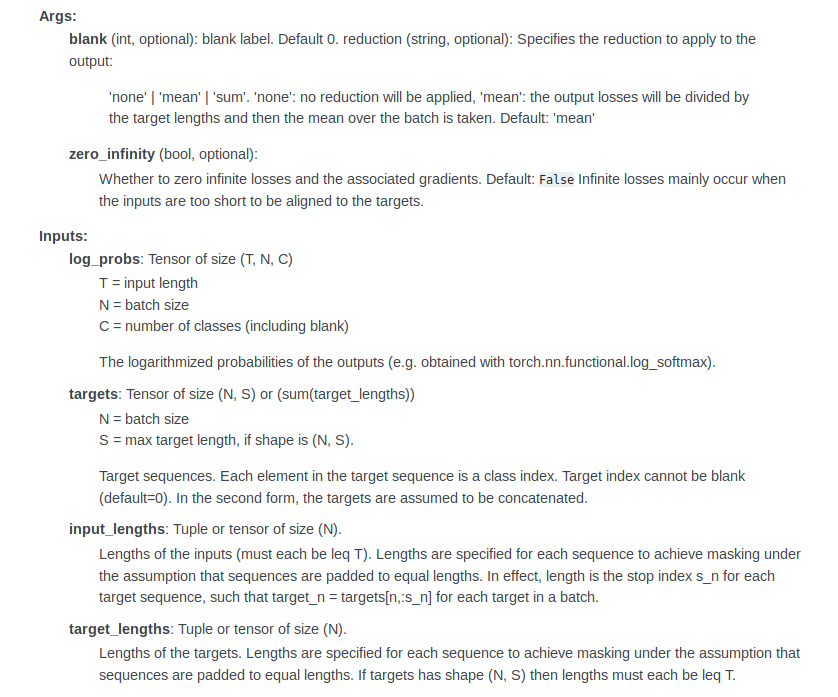
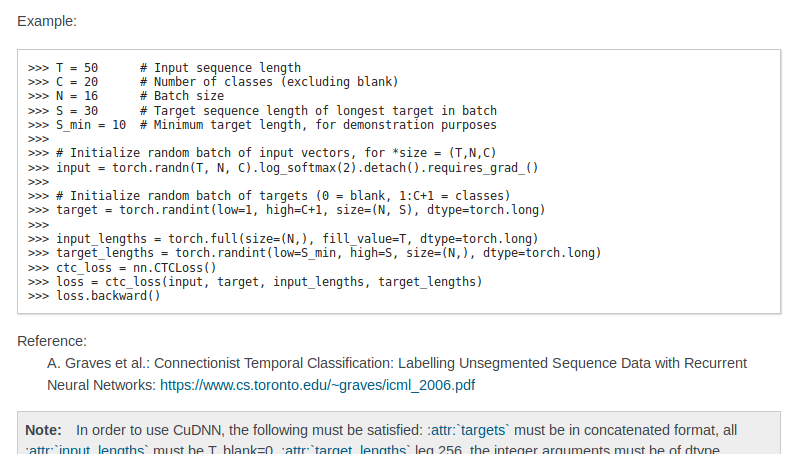
Ok I made some changes, hopefully for the better. Since you asked about rendering, I didn't want to try to build this because of the dependencies and errors I got when I tried, but i did find a cheap renderer online (missing the math plugin) to give a sense of the appearance
and the example now looks like this: |
 t-vi
left a comment
t-vi
left a comment
t-vi
left a comment
There was a problem hiding this comment.
Thank you for checking the rendering! (I had half-hoped that you'd go through the trouble of installing the doc dependencies and make a habit of improving those things you find imperfect. 😉)
From my point of view, this can go in, unless you want to do something about the less than perfect explanation of concatenated targets.
|
No problem. I will make one more edit tomorrow to address the lengths/concatenation, since there is no rush. Also, does the alternative concatenated form not also apply to inputs? |
|

|
OK, I'll wait for the last change before landing this |
|
Ok here is the final edit. It is still less than perfect, but a lot less less than perfect than it was before. I decided to just explicitly break out the explanations for both forms of input. I used the term "stacked" vs "concatenated" because it kind of makes sense considering the difference between these 2 operations in torch. This is how it renders (roughly): Looks like it says there is now a conflict in |

|
Thanks! Two quick comments:
|
|
Ah sorry about that, I will fix it, and use your wording for target_lengths |
|
Looks good! Thanks! But there is a merge conflict for the formatting of the reduction strings. |


|
I fixed the merge conflict. Thanks a lot @rlorigro ! |

 facebook-github-bot
left a comment
facebook-github-bot
left a comment
facebook-github-bot
left a comment
There was a problem hiding this comment.
@soumith is landing this pull request. If you are a Facebook employee, you can view this diff on Phabricator.


|
Thanks @soumith for fixing the conflict. Does this page get updated whenever the next version of pytorch is officially released: https://pytorch.org/docs/stable/nn.html#ctcloss ? |
|
@rlorigro yes. right now master docs are already updated: https://pytorch.org/docs/master/nn.html#ctcloss |
|
Awesome, thanks. Ah it looks like the kerning on the "math" font is making it almost unreadable in some places. That was unfortunately not rendered in the renderer I used for testing. Also the underscore is being parsed as a subscript in |

|
why is the input size for class is C = 20 which excluding blank? If the network does not predict the blank in the output, why would this loss make sense...
instead of
|
|
I think you are right, it should actually be |

7 participants


This is meant to resolve #18249, where I pointed out a few things that could improve the CTCLoss docs.
My main goal was to clarify:
targetandinputare needed for masking unequal length sequences, and do not necessarily = S, which is the length of the longest sequence in the batch.I thought about Thomas's suggestion to link the distill.pub article, but I'm not sure about it. I think that should be up to y'all to decide.
I have no experience with .rst, so it might not render as expected :)
@t-vi @ezyang