Repository navigation
Convolution Notes #1
Description

References:
Astropy:
- astropy.convolution.convolve docs
- astropy.convolution.convolve_fft docs
- WIP: convolve_fft memory & execution time profiling
- DASK conv prof by rabernat
- Releasing the global interpreter lock (GIL)
SciPy:
- scipy.ndimage.filters.convolve docs
- scipy.signal.fftconvolve
- ndimage convolution with large mask uses too much memory (Trac #1649)
Other:
- galario: a GPU Accelerated Library for Analysing Radio
Interferometer Observations - https://github.com/maweigert/gputools
- http://www.astrodeep.eu/t-phot/
- http://www.astrodeep.eu/t-phot-v2-0-public-release/
- https://aeon.stsci.edu/ssb/trac/astrolib/wiki/tfit
- wiki - Richardson-Lucy deconvolution gputools has this implemented (src).
- http://dask.pydata.org/en/latest/index.html
Perf:
Driver:
mprof run --include-children ../convolve.py
import astropy
print(astropy.version.version)

import astropy.convolution as astroconv
import scipy.ndimage.filters as sciconv1
import scipy.signal as scisig
#from scipy.ndimage.filters import convolve
import numpy as np
import gputools

iLength = 10000
jLength = iLength
image = np.random.random((iLength, jLength))

size = 111
ker = astroconv.Gaussian2DKernel(20,x_size=size,y_size=size)
#for 10k+1 x 10k+1 tests
#ker = np.random.random((iLength+1, jLength+1))

#smoothed = scisig.fftconvolve(image, ker.array)
#smoothed = astroconv.convolve_fft(image, ker, allow_huge=True)

#smoothed = sciconv.convolve(image, ker.array, mode='wrap')
smoothed = astroconv.convolve(image, ker, boundary='wrap')
#smoothed = gputools.convolve(image, ker.array)
Benchmark
Env
- python 3.5.4-he720263_23
- numpy 1.13.3-py35hfd7066c_0
- scipy 1.0.0-py35h8b35106_0
- astropy 2.0.3 (built on the box below w/clang &
-O3) v3.0rc2 has no significant code changes. - libcxx 4.0.1-h579ed51_0
- libcxxabi 4.0.1-hebd6815_0
- clang Apple LLVM version 7.3.0 (clang-703.0.31)
- memory-profiler 0.50.0-pip
Box
- Model Name: Mac Pro
- Model Identifier: MacPro6,1
- Processor Name: 6-Core Intel Xeon E5
- Processor Speed: 3.5 GHz
- Number of Processors: 1
- Total Number of Cores: 6 (12w/hyperthreading ON - default)
- L2 Cache (per Core): 256 KB
- L3 Cache: 12 MB
- Memory: 32 GB
- Boot ROM Version: MP61.0116.B25
- SMC Version (system): 2.20f18
- Illumination Version: 1.4a6
- Serial Number (system): F5KS302VF9VN
- Hardware UUID: 549FB335-E005-524B-85C3-B582CA595478
- Disk: APPLE SSD SM1024G
- GPU: Dual AMD FirePro D300
- 2GB of GDDR5 VRAM (each)
- 1280 stream processors
- 256-bit-wide memory bus
- 160GB/s memory bandwidth
- 2 teraflops performance
Direct
astropy.convolution.convolve(array, kernel,
                                                 boundary='fill',
                                                  fill_value=0.0,
                                                  nan_treatment='interpolate',
                                                  normalize_kernel=True,
                                                  mask=None,
                                                  preserve_nan=False,
normalization_zero_tol=1e-08)scipy.ndimage.filters.convolve(input, weights, output=None, mode='reflect', cval=0.0, origin=0)NOTE: the above two functions and their tests utilize only a single thread.
- gputools.convolve. This routine is very unstable, binding my machine on more runs than not. Only 2/12 runs did not do this. #061fa99 (master) & v0.2.2 (latest release)
gputools.convolve(data, h, res_g=None, sub_blocks=None)

FFT
astropy.convolution.convolve_fft(array, kernel, boundary='fill', fill_value=0.0,
                                                 nan_treatment='interpolate', normalize_kernel=True,
                                                 normalization_zero_tol=1e-08,
                                                 preserve_nan=False, mask=None, crop=True, return_fft=False,
                                                 fft_pad=None, psf_pad=None,
                                                 quiet=False, min_wt=0.0, allow_huge=False, fftn=<function fftn>,
ifftn<function ifftn>, complex_dtype=<class 'complex'>)scipy.signal.fftconvolve(in1, in2, mode='full')NOTE: the above two functions and their tests utilize only a single thread.
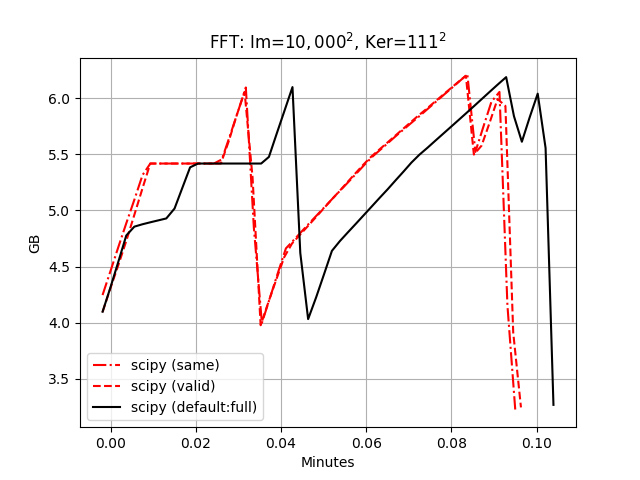
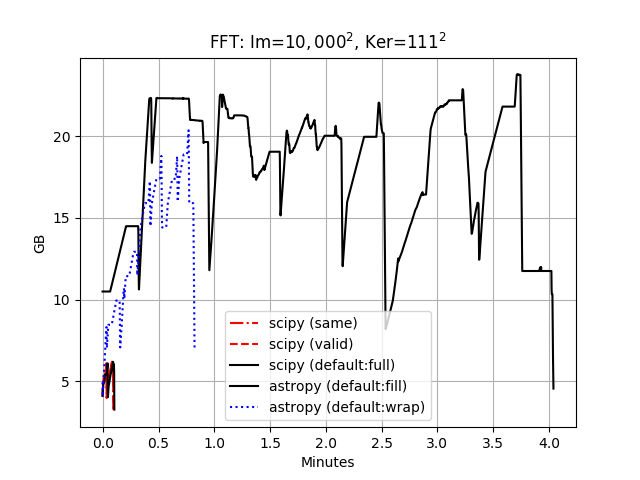
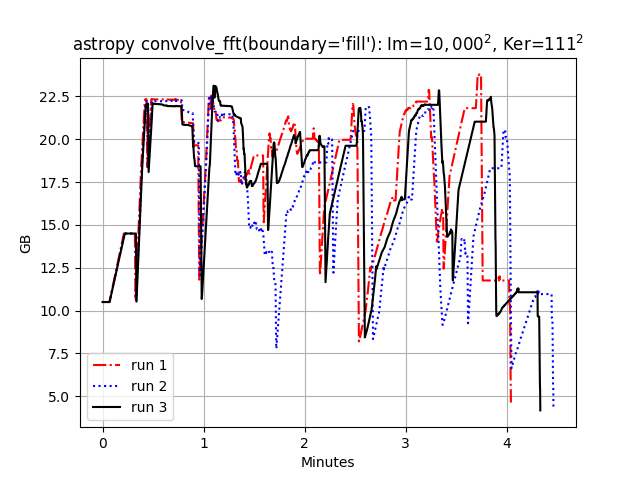
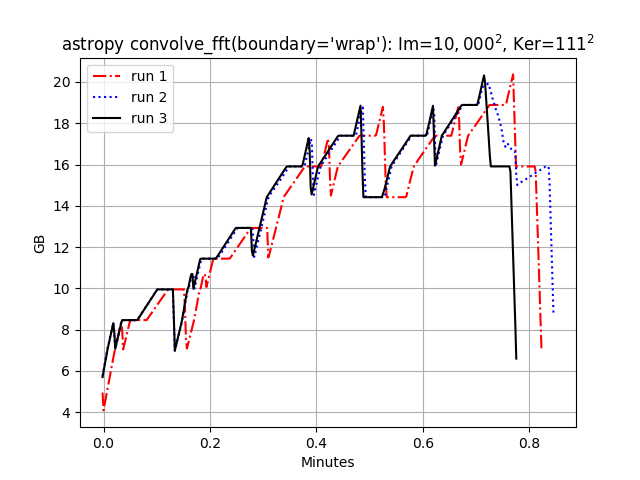
NOTE: There appears to be a memory ceiling at ~25GB that mprof is unable to observe beyond. E.g. when running astropy.convolution.convolve_fft(image, kernel, allow_huge=True), the OSX activity monitor records a peak usage of ~47GB with ~22GB compressed, equating to ~25 "uncompressed". ~6GB is the background usage by other apps that are open during testing, yielding the 25GB out of the total 32GB available. It appears that mprof is oblivious to this compressed memory.
Results (10k x 10k with 111 x 111)
Memory Deck
The minimum memory required for both arrays to be stored in memory:
- 0.8GB (float64)
Direct
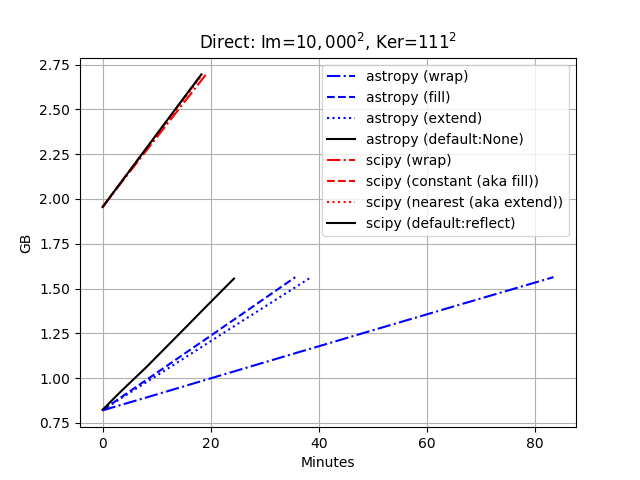
The above linear increase in memory, as a function of time, is indicative of it "leaking" (may not be a literal leak).
FFT
Results (10k x 10k with 10k+1 x 10k+1)
NOTE: The below plot titles are incorrect for kernel size in that they are missing the +1 in both dims
Memory Deck
The minimum memory required for both arrays to be stored in memory:
- 1.6GB (float64)
Direct
Estimates assuming linear scaling:
- Astropy default (
None) : ~141 days. Actual memory used ~2.3GB (incomplete run). - Scipy default (reflect) : ~101.5 days. Immediately fails with
MemoryError. ~3GB reached at fail-time.
FFT
NOTE: effectively the PSF deconvolution benchmark.
- Scipy default (full) :

- Astropy default (fill) : Aborted by OS with signal 9. OSX activity monitor indicated significantly higher mem consumption than
mprofhas. This was true when not profiled so cannot be attributed tomprofoverhead. Approx 70GB of memory was recorded, with ~50GB compressed.

Activity