
Project Members:
- Maxwell Blevins
- Jason Sun
- Ethan Tiller
In today's attention economy, the news industry is increasingly driven by clicks rather than context. Across the board, organizations are financially incentivized to use provocative, sensationalized language to capture eyeballs instead of focusing on objective, level-headed reporting. We built Bad Faith to help readers cut through the noise, recognize manipulative rhetoric, and instantly verify claims so they can navigate the modern web with confidence.
Bad Faith is an automated news auditor wrapped in a Chrome extension. When you read an article, the extension scans the text to highlight manipulative techniques like loaded language, false dilemmas, or misleading statistics right on the page. Readers can then choose to have those biased sections rewritten into neutral language for a more objective perspective. It also extracts testable claims from the text, allowing users to instantly verify them against a live consensus of other news outlets to see if a claim is supported, contradicted, or missing crucial context. Finally, the tool verifies the quotes used in the article and provides immediate background information on the speakers and organizations, giving readers full context on exactly who is shaping the narrative.
Flagged phrases and manipulative rhetoric highlighted directly on the page:

Testable claims extracted from the article for one-click verification:

Live coverage lookup showing what other outlets are reporting on a claim:

Biased passages rewritten into neutral, objective language:

Opinion pieces automatically recognized and labeled as such:

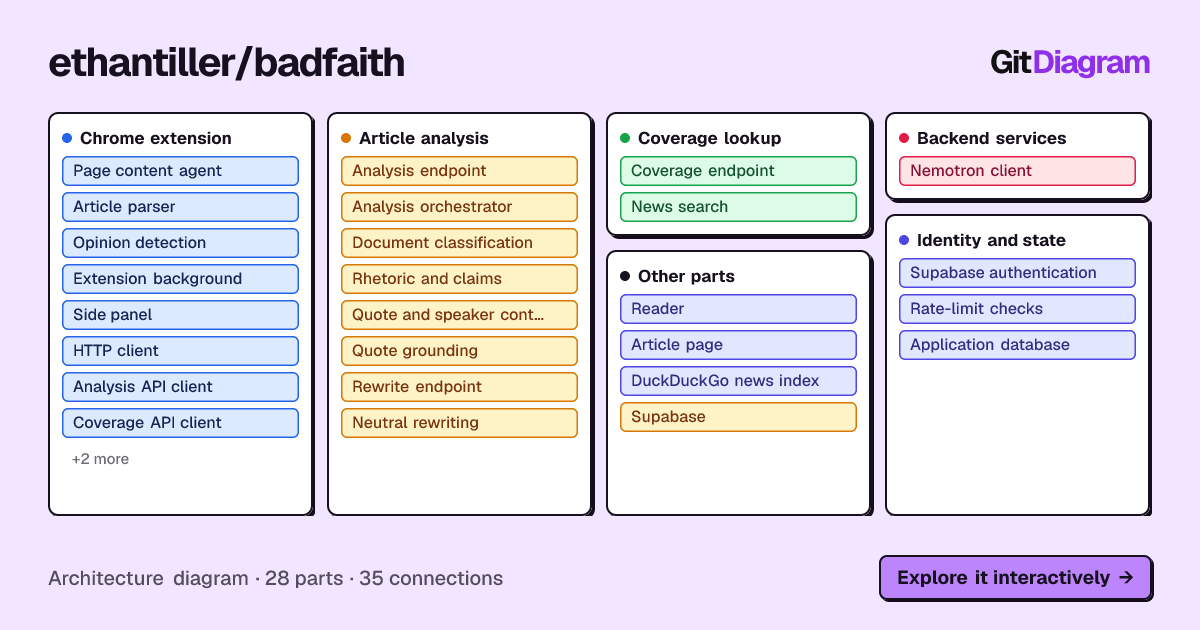
We structured Bad Faith as a monorepo containing a TypeScript Chrome extension, a Python 3.12 FastAPI backend, and a standalone CLI evaluation harness. We utilized the Nemotron LLM to classify rhetoric and extract entities. To power our real-time coverage verification, we built a highly concurrent async pipeline using DuckDuckGo's news index, pulling live reporting snippets to feed the LLM as evidence. We tied it all together with Supabase for authentication and intelligent caching.
Building a fast, reliable coverage pipeline was our biggest hurdle. We initially tried using the public GDELT API but were immediately bottlenecked by 429 rate limits. We also realized that attempting to scrape full HTML from external news sites introduced massive latency and bot-blocking issues. We successfully pivoted to a streamlined async search pipeline that relies entirely on search engine snippets, cutting our verification latency down to our strict ~3-second target.
We are proud of our robust evaluation and anti-hallucination safeguards. We rigorously benchmarked the Nemotron model's performance using the SemEval dataset to ensure high-quality, standardized rhetorical classification. To prevent the model from inventing evidence, we built a strict grounding gate that verifies every single quote it references exists verbatim in the original article. We also pushed beyond our initial scope by engineering an entity-context feature that automatically surfaces background information on the people and organizations quoted, giving readers immediate insight into exactly who is speaking.
We learned that when building complex LLM tools, standardizing the data contract is everything. We also learned the hard way that fetching live news data requires building highly defensive, fail-open search clients. You don't always need to scrape the whole web to fact-check; sometimes a clean, targeted search engine snippet provides the exact context the model needs to make an accurate judgment.
We plan to expand our pipeline to support multi-language auditing, allowing users to cross-reference claims against international reporting. Ultimately, we want to build a public macro-dashboard that aggregates our data to track the long-term credibility and rhetorical habits of major news outlets, holding the industry accountable at scale.
make install— installs backend dependencies (uv sync).make dev— starts the FastAPI backend with auto-reload.cd extensionthenmake build— builds the Chrome extension bundle, then loadextension/distas an unpacked extension in Chrome.- Set the required environment variables in a
.envfile at the repo root (seebackend/app/config.py/ runmake env-examplefor a template):DATABASE_URL,SUPABASE_URL,SUPABASE_ANON_KEY,NVIDIA_API_KEY,EXTENSION_ORIGIN.
Bad Faith is a monorepo for a news article auditing product. The backend is a Python 3.12 FastAPI server, the frontend is a Chrome extension, and the eval harness is a standalone Python CLI.
Use badfaith as the package/product slug unless a more specific deploy-time identifier
is intentionally chosen. The slug can affect the Python package name, extension ID, and
Firestore collection prefix, so keep it consistent across the stack.
badfaith/
├── extension/
├── backend/
├── eval/
├── docs/
├── .github/workflows/
└── README.md