
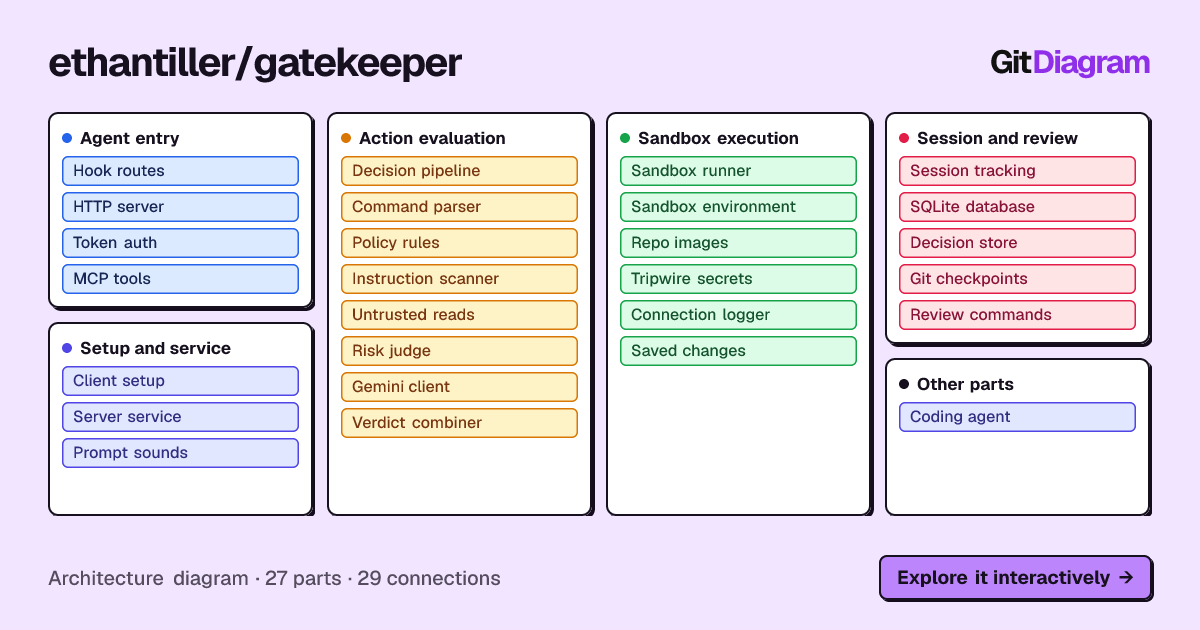
Gatekeeper sandboxes and checks risky actions from AI coding agents (Claude Code, VS Code, Codex) before they run.
Files are created by the ticket that owns them. This is the target layout.
gatekeeper/
├── pyproject.toml
├── README.md
├── .github/workflows/ci.yml        # lint + tests on every push (GK-1)
├── src/gatekeeper/
│   ├── config.py                   # reads ~/.gatekeeper/config.toml (GK-1)
│   ├── database.py                 # SQLite connection, WAL mode, runs migrations (GK-1)
│   ├── migrations/
│   │   ├── 0001_initial.sql        # the five tables: sessions, prompts, untrusted_reads, decisions, checkpoints (GK-1)
│   │   ├── 0004_untrusted_snippets.sql  # sequence, score and snippet on untrusted_reads (GK-8)
│   │   ├── 0005_useless_questions.sql   # questions useless mode asked and the answers (GK-10)
│   │   └── 0006_drop_pending_question.sql  # drops the columns 0005 replaced (GK-10)
│   ├── server/
│   │   ├── types.py                # shared Pydantic types (GK-1)
│   │   ├── main.py                 # server startup and route mounting (GK-1)
│   │   ├── auth.py                 # X-Gatekeeper-Token check (GK-1)
│   │   ├── hooks/                  # /hooks/{client}/<event>, one folder per event: session_start, prompt, before_tool, after_tool, stop (GK-6, GK-10)
│   │   ├── mcp_tools.py            # run_command, write_file, read_file, fetch_url (GK-7)
│   │   ├── review_routes.py        # GET /decisions, POST /rollback (GK-11)
│   │   └── approval_socket.py      # WebSocket /approvals (GK-7)
│   ├── core/
│   │   ├── sessions.py             # session records, action counter, source handling (GK-6)
│   │   ├── actions.py              # tool call to StandardAction (GK-6)
│   │   ├── executor.py             # runs approved commands on the host (GK-7)
│   │   ├── approvals.py            # waits for user approval (GK-7)
│   │   ├── sounds.py               # picks and plays a brain rot sound for each prompt and reply (GK-10)
│   │   ├── decision_store.py       # saves decisions, writes summaries (GK-5)
│   │   └── checkpoints.py          # git checkpoints and rollback (GK-5, GK-11)
│   ├── pipeline/
│   │   ├── decide.py               # runs the pipeline steps (GK-5)
│   │   ├── parser.py               # bashlex command parsing (GK-5)
│   │   ├── rules.py                # loads rules files, tags actions (GK-5)
│   │   ├── untrusted.py            # records and looks up untrusted reads (GK-8)
│   │   ├── scanner.py              # finds hidden instructions in text (GK-8)
│   │   ├── scanner_llm_review.py   # LLM second look at ambiguous scanner scores (GK-8)
│   │   ├── judge.py                # builds the judge input and catches judge failures (GK-5)
│   │   ├── rate_action_risk.py     # LLM risk rating request (GK-5)
│   │   ├── combine.py              # if/else that produces the final verdict (GK-5)
│   │   └── useless_mode.py         # sarcastic question generation (GK-10)
│   ├── assets/brainrot/            # brain rot sound files for useless mode, with CREDITS.md (GK-10)
│   ├── sandbox/
│   │   ├── repo_images.py          # builds and caches repo images (GK-4)
│   │   ├── runner.py               # runs a command in a container (GK-4)
│   │   ├── saved_changes.py        # keeps and applies the files a run changed (GK-4)
│   │   ├── environment.py          # builds/manages base image, network, logger (GK-2)
│   │   └── tripwires.py            # per-session fake secret values (GK-2)
│   └── cli/
│       ├── main.py                 # gatekeeper command entry point (GK-1)
│       ├── init.py                 # gatekeeper init (GK-12)
│       ├── approve.py              # gatekeeper approve (GK-7)
│       ├── review.py               # gatekeeper log, show, rollback (GK-11)
│       ├── dev.py                  # gatekeeper sandbox-test (GK-4)
│       └── fun.py                  # gatekeeper fun on|off|toggle|status (GK-10)
├── docker/
│   ├── base.Dockerfile             # base sandbox image (GK-2)
│   ├── tripwire_templates/         # fake secret file layouts (GK-2)
│   │   ├── env.template
│   │   └── aws_credentials.template
│   └── connection_logger/          # proxy that logs attempted hosts (GK-2)
│       ├── Dockerfile
│       ├── logger.py               # mitmproxy addon
│       └── tripwire_match.py       # tripwire matching helpers
├── rules/rules.yaml                # default rules file (GK-1)
├── plugin/
│   ├── .claude-plugin/plugin.json  # Claude Code plugin manifest (GK-6)
│   └── hooks/hooks.json            # the four curl hook commands (GK-6)
├── eval/
│   ├── scenarios/                  # one YAML per attack or benign case (GK-9)
│   ├── fixture_repos/poisoned_readme/  # also the demo repo (GK-9)
│   ├── run_eval.py                 # hooks on vs. off runner (GK-9)
│   ├── red_team.py                 # attacker LLM loop (GK-9)
│   └── results/                    # results.json + summary.md (GK-9)
└── tests/
    ├── test_tripwires.py           # tripwire values, archive, matching (GK-2)
    ├── test_sandbox_network.py     # needs Docker (GK-2)
    ├── fixtures/claude_hooks/      # real hook payloads (GK-3)
    └── fixtures/mcp/               # real MCP payloads (GK-3)
- Base image:
docker/base.Dockerfile, Node 22 on Debian bookworm-slim with git, python3, uv, corepack, strace and a non-rootsandboxuser (uid 1000). Tripwire files are not baked in; they are planted per session at run time. - Network
gk-sandbox: a Docker bridge network withinternal=True, so containers on it have no route to the internet. Created bysandbox/environment.pythrough the Docker Python SDK, which also starts the logger. - Connection logger
gk-connection-logger: a mitmproxy container on that network. Sandbox containers send web traffic to it throughhttp_proxy/https_proxy(seeproxy_environment()). It logs every host, scans URLs, headers and bodies for tripwire values (raw, URL, hex, base64), answers 403 and never forwards anything.
Build and start everything (idempotent; status and down work the same way; add --rebuild after up to rebuild the images):
uv run python -m gatekeeper.sandbox.environment up
Each request produces one stdout line in the logger:
GK_CONN {"time": "<UTC ISO 8601>", "client_ip": "...", "scheme": "http|https", "method": "...", "host": "...", "port": 80, "path": "<first 200 chars>", "body_bytes": 0, "tripwire_hits": [{"session_id": "...", "name": "...", "form": "raw|url|hex|base64|base64url", "location": "url|header|body"}], "blocked": true}
TLS handshakes the client rejects are logged with "tls_failed": true. GK_READY is printed once the proxy listens.
Tests: uv run pytest. tests/test_sandbox_network.py needs a running Docker daemon and is skipped with a reason otherwise.
HTTPS interception works. Sandbox containers trust the logger's CA (copied in with ca_certificate_archive()), so decrypted HTTPS requests are logged and scanned like HTTP. The CA is regenerated if the logger container is recreated, so copy it into each new sandbox container.
Running a command (GK-4): sandbox.runner.run(action, session) copies the repo (minus gitignored files), the fake secrets and the logger CA into a throwaway container on gk-sandbox, runs action.command under strace with a 30 s timeout, and returns a SandboxReport. Try it with uv run python -m gatekeeper.cli.dev "<command>" (to be gatekeeper sandbox-test).
Repo image (sandbox/repo_images.py): start_repo_image_build(repo_root) builds gatekeeper-repo:<hash> in the background from git archive HEAD, with dependencies installed from package-lock.json, pnpm-lock.yaml or uv.lock (npm and pnpm with --ignore-scripts, because the build has network access). The tag is a hash of the repo path and the lockfile at HEAD; an existing image is reused. When it is ready, run() starts from it and copies in only the files that differ from the image's commit (git diff plus untracked files). .devcontainer is not used: its commands would run repo-controlled code with network access outside the sandbox.
Saved changes (sandbox/saved_changes.py): after a run, the created and modified files are archived from the container and SandboxReport.saved_changes_id names them (stored under ~/.gatekeeper/saved_changes/, or GATEKEEPER_SAVED_CHANGES). apply_saved_changes(id, repo_root) applies exactly those files and deletions, but refuses if any host file changed since the run (SavedChangesDriftError; check_drift is the read-only check). The tar comes from an untrusted command, so only files, folders and symlinks inside the repo are accepted, and never anything under .git. Call discard_saved_changes(id) after a denial. Changes over 200 MB are not saved.
strace works as user sandbox with cap_drop=["ALL"] and no extra capabilities (tested on Docker 29.4.1).
All shared Pydantic types live in src/gatekeeper/server/types.py. Every pipeline stage passes these around instead of raw dicts.
| Type | What it holds |
|---|---|
StandardAction |
One tool call from an agent, normalized. The rest of the system never sees raw hook or MCP payloads. |
ParsedCommand |
A shell command broken into programs, arguments, pipes, and redirects (bashlex). |
RuleResult |
Which rules matched, their tags, and an optional forced verdict. |
UntrustedRead |
Content the agent read but did not write (a URL, a cloned file). Used to catch prompt injection. |
JudgeResult |
The LLM's risk rating and reasoning. |
SandboxSession |
What sandbox.run(action, session) needs from a session: session_id (the agent's own id or a generated one, not guaranteed to be a UUID), repo_root (the repo's top folder, not action.cwd, which can be a subfolder) and tripwire_seed (a random secret the fake secret values come from; never the session id, which the agent can read). GK-5 builds one from the full session record (GK-6). |
SandboxReport |
What a command did in the container: files changed, hosts contacted, tripwires triggered. |
Decision |
The final verdict for one action, embedding every stage's output above. |
Conventions:
- Unknown fields are errors. All types inherit
GatekeeperModel(extra="forbid"), so a typo likecomand=fails instead of being silently dropped. - Stages fail softly.
JudgeResultandSandboxReporthave anerrorfield, andDecisionallows any stage to beNone, so a failed stage can still be recorded. - IDs are UUID strings with dashes, for example
4f28bfba-6756-418b-88d6-19cc02569654(str(uuid4())). - Timestamps are timezone-aware US Eastern (
America/New_York). They follow daylight saving: UTC-5 in winter (EST), UTC-4 in summer (EDT). - Enums (
ActionSource,ActionKind,Verdict,RiskLevel) serialize as plain lowercase strings. - Action sources are
claude_hook,codex_hook, andmcp_vscode.
Gatekeeper stores sessions, prompts, untrusted reads, decisions, and checkpoints in SQLite. connect() in src/gatekeeper/database.py opens it and sets everything up.
- Location:
~/.gatekeeper/gatekeeper.dbby default. Set theGATEKEEPER_DBenvironment variable to use a different file (useful for testing without touching your real data). - WAL mode, so the server can write decisions while
gatekeeper logreads them. Foreign keys are on, and a busy database is waited on for up to 5 seconds. - Nested objects are stored as JSON text (for example
decisions.decision_jsonholds a wholeDecision). Only the columns used for sorting and filtering get their own column.
The table definitions live in numbered SQL files in src/gatekeeper/migrations/, not in Python code.
- On every
connect(), Gatekeeper reads the database'suser_versionnumber and runs any migration file with a higher number, in order. A new database starts at 0 and runs them all. - Each migration and its version bump run in one transaction. If the SQL fails partway, nothing is applied.
- Files are named
NNNN_description.sql, for example0001_initial.sql.
To change the schema, add a new file such as 0002_add_something.sql. Never edit a migration that has already been merged, because databases that already ran it won't run it again. If two branches add the same number, rename one before merging.
Teammates don't share a database file. Everyone builds their own from the same migration files when they first run Gatekeeper.