More readable stack traces (StackTrace method opt-out)#14608
More readable stack traces (StackTrace method opt-out)#14608benaadams wants to merge 15 commits intodotnet:masterfrom
Conversation


|
Using settings StackTraceFormattingOptions.ExcludeStackTraceHiddenAttribute |
StackTraceFormattingOptions.ExcludeDispatchBoundaries |
StackTraceFormattingOptions.ExcludeInnerExceptionBoundaries |
StackTraceFormattingOptions.ResolveAsyncMethods |
StackTraceFormattingOptions.ResolveIteratorMethodsThe output is System.Exception: Inner1 ---> System.Exception: Inner2 ---> System.Exception: Inner3 ---> System.InvalidOperationException: Collection was modified; enumeration operation may not execute.
at System.Collections.Generic.List`1.Enumerator.MoveNextRare()
at System.Collections.Generic.List`1.Enumerator.MoveNext()
at Program.FirstException(Int32 value, Int32 index)
at Program.<>c.<LinqIteration>b__3_0(Int32 x, Int32 i)
at System.Linq.Enumerable.SkipWhileIterator[TSource](IEnumerable`1 source, Func`3 predicate)
at System.Collections.Generic.LargeArrayBuilder`1.AddRange(IEnumerable`1 items)
at System.Collections.Generic.EnumerableHelpers.ToArray[T](IEnumerable`1 source)
at Program.LinqIteration(Int32 count)
at Program.Iterator(Int64 count, Int32 value)
at Program.InnerException3()
at Program.InnerException3()
at Program.InnerType`1.InnerException2(Int32 count)
at Program.InnerType`1.InnerException2(Int32 count)
at Program.InnerException1[T](Int32 count)
at Program.InnerException1[T](Int32 count)
at Program.NonAsyncValueTask(Int32 count, String name)
at Program.ValueTaskAsync(String name)
at Program.TaskTAsync(Int32 count)
at Program.MethodAsync(Int32 count)
at Program.ConfiguredAsync(Int32 count)
at Program.MethodAsync(Int32 count)
at Program.ConfiguredAsync(Int32 count)
at Program.MethodAsync(Int32 count)
at Program.Main(String[] args) Rather than System.Exception: Inner1 ---> System.Exception: Inner2 ---> System.Exception: Inner3 ---> System.InvalidOperationException: Collection was modified; enumeration operation may not execute.
at System.ThrowHelper.ThrowInvalidOperationException_InvalidOperation_EnumFailedVersion()
at System.Collections.Generic.List`1.Enumerator.MoveNextRare()
at System.Collections.Generic.List`1.Enumerator.MoveNext()
at Program.FirstException(Int32 value, Int32 index)
at Program.<>c.<LinqIteration>b__3_0(Int32 x, Int32 i)
at System.Linq.Enumerable.<SkipWhileIterator>d__179`1.MoveNext()
at System.Collections.Generic.LargeArrayBuilder`1.AddRange(IEnumerable`1 items)
at System.Collections.Generic.EnumerableHelpers.ToArray[T](IEnumerable`1 source)
at Program.LinqIteration(Int32 count)
at Program.<Iterator>d__4.MoveNext()
at Program.InnerException3()
--- End of inner exception stack trace ---
at Program.InnerException3()
at Program.InnerType`1.InnerException2(Int32 count)
--- End of inner exception stack trace ---
at Program.InnerType`1.InnerException2(Int32 count)
at Program.InnerException1[T](Int32 count)
--- End of inner exception stack trace ---
at Program.InnerException1[T](Int32 count)
at Program.NonAsyncValueTask(Int32 count, String name)
at Program.<ValueTaskAsync>d__9.MoveNext()
--- End of stack trace from previous location where exception was thrown ---
at System.Runtime.ExceptionServices.ExceptionDispatchInfo.Throw()
at System.Runtime.CompilerServices.TaskAwaiter.ThrowForNonSuccess(Task task)
at System.Runtime.CompilerServices.TaskAwaiter.HandleNonSuccessAndDebuggerNotification(Task task)
at System.Runtime.CompilerServices.TaskAwaiter.ValidateEnd(Task task)
at System.Runtime.CompilerServices.TaskAwaiter`1.GetResult()
at System.Runtime.CompilerServices.ValueTaskAwaiter`1.GetResult()
at Program.<TaskTAsync>d__11.MoveNext()
--- End of stack trace from previous location where exception was thrown ---
at System.Runtime.ExceptionServices.ExceptionDispatchInfo.Throw()
at System.Runtime.CompilerServices.TaskAwaiter.ThrowForNonSuccess(Task task)
at System.Runtime.CompilerServices.TaskAwaiter.HandleNonSuccessAndDebuggerNotification(Task task)
at System.Runtime.CompilerServices.TaskAwaiter.ValidateEnd(Task task)
at System.Runtime.CompilerServices.TaskAwaiter`1.GetResult()
at Program.<MethodAsync>d__14.MoveNext()
--- End of stack trace from previous location where exception was thrown ---
at System.Runtime.ExceptionServices.ExceptionDispatchInfo.Throw()
at System.Runtime.CompilerServices.TaskAwaiter.ThrowForNonSuccess(Task task)
at System.Runtime.CompilerServices.TaskAwaiter.HandleNonSuccessAndDebuggerNotification(Task task)
at System.Runtime.CompilerServices.TaskAwaiter.ValidateEnd(Task task)
at System.Runtime.CompilerServices.ConfiguredTaskAwaitable.ConfiguredTaskAwaiter.GetResult()
at Program.<ConfiguredAsync>d__13.MoveNext()
--- End of stack trace from previous location where exception was thrown ---
at System.Runtime.ExceptionServices.ExceptionDispatchInfo.Throw()
at System.Runtime.CompilerServices.TaskAwaiter.ThrowForNonSuccess(Task task)
at System.Runtime.CompilerServices.TaskAwaiter.HandleNonSuccessAndDebuggerNotification(Task task)
at System.Runtime.CompilerServices.TaskAwaiter.ValidateEnd(Task task)
at System.Runtime.CompilerServices.TaskAwaiter.GetResult()
at Program.<MethodAsync>d__14.MoveNext()
--- End of stack trace from previous location where exception was thrown ---
at System.Runtime.ExceptionServices.ExceptionDispatchInfo.Throw()
at System.Runtime.CompilerServices.TaskAwaiter.ThrowForNonSuccess(Task task)
at System.Runtime.CompilerServices.TaskAwaiter.HandleNonSuccessAndDebuggerNotification(Task task)
at System.Runtime.CompilerServices.TaskAwaiter.ValidateEnd(Task task)
at System.Runtime.CompilerServices.ConfiguredTaskAwaitable.ConfiguredTaskAwaiter.GetResult()
at Program.<ConfiguredAsync>d__13.MoveNext()
--- End of stack trace from previous location where exception was thrown ---
at System.Runtime.ExceptionServices.ExceptionDispatchInfo.Throw()
at System.Runtime.CompilerServices.TaskAwaiter.ThrowForNonSuccess(Task task)
at System.Runtime.CompilerServices.TaskAwaiter.HandleNonSuccessAndDebuggerNotification(Task task)
at System.Runtime.CompilerServices.TaskAwaiter.ValidateEnd(Task task)
at System.Runtime.CompilerServices.TaskAwaiter.GetResult()
at Program.<MethodAsync>d__14.MoveNext()
--- End of stack trace from previous location where exception was thrown ---
at System.Runtime.ExceptionServices.ExceptionDispatchInfo.Throw()
at System.Runtime.CompilerServices.TaskAwaiter.ThrowForNonSuccess(Task task)
at System.Runtime.CompilerServices.TaskAwaiter.HandleNonSuccessAndDebuggerNotification(Task task)
at System.Runtime.CompilerServices.TaskAwaiter.ValidateEnd(Task task)
at System.Runtime.CompilerServices.TaskAwaiter.GetResult()
at Program.<Main>d__0.MoveNext()For program in #14608 (comment) |

| /// <exception cref="System.NullReferenceException">The awaiter was not properly initialized.</exception> | ||
| /// <exception cref="System.Threading.Tasks.TaskCanceledException">The task was canceled.</exception> | ||
| /// <exception cref="System.Exception">The task completed in a Faulted state.</exception> | ||
| [StackTraceHidden] |

There was a problem hiding this comment.
You'd want these on the corresponding methods in ValueTask's awaiters, too, right?
https://github.com/dotnet/coreclr/blob/master/src/mscorlib/shared/System/Runtime/CompilerServices/ValueTaskAwaiter.cs
https://github.com/dotnet/coreclr/blob/master/src/mscorlib/shared/System/Runtime/CompilerServices/ConfiguredValueTaskAwaitable.cs
There was a problem hiding this comment.
Added and moved Attribute to shared partition

|
If @noahfalk is ok with this approach and there aren't other unexpected consequences of leaving things out of the StackTrace (does this only affect the string-rendered stack trace, or would it also affect what the VS debugger shows or anything like that?), then I'm fine with it, too, and prefer it over the more invasive changes in the previous attempt. |
It only effects the |
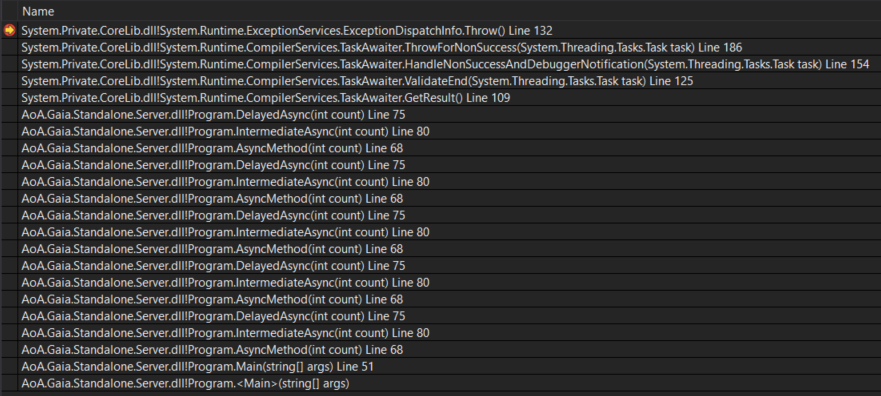
 benaadams
force-pushed
the
stacktracehidden
branch
from
benaadams
force-pushed
the
stacktracehidden
branch
from
d046b80 to
3f84c6b
Compare
benaadams
changed the title

|
@gregg-miskelly @tmat @weshaggard @terrajobst Back compat/opt-out - We tell people not to depend on stacktrace format and most people probably don't, but its certainly possible that apps have taken these dependencies. Some (probably a very small percentage) may also dislike the alternate frame-hiding policy. Do we have a way to flight BCL changes that deliberately change user visible behavior to mitigate the risks? Any design conventions for how to expose an opt-out to users that are adversely affected? VS convergence - This change effectively creates a new JMC-style filtering policy that is orthogonal to all the policies in VS. I'm wondering if it would be better to use the pre-existing DebuggerHidden attribute. DebuggerHidden implies that the method won't show up in a VS stacktrace either. I think of this as "if most users don't want to see the method in their exception stack traces, why would they want to see it in VS? and vice versa." Granted this may make it worse for the small percentage of users who did want to see these methods in their stack trace and now we also are hiding them in the debugger. I have a feeling @stephentoub might be in that small group because as the maintainer of the code he would probably sad if the debugger hides it from him. I'm hoping I can either get Stephen to make a sacrifice on that one or maybe @gregg-miskelly can help us add a similar opt-out for DebuggerHidden to VS or you guys can convince me this isn't a good idea? I doubt the VS opt-out would need to be anything flashy, even a simple reg key that a handful of BCL devs could set would likely go a long way to making DebuggerHidden more palatable. Thoughts? |

|
|
||
| internal static int CalculateFramesToSkip(StackFrameHelper StackF, int iNumFrames) | ||
| { | ||
| const string DiagnosticsPackageName = nameof(System.Diagnostics); |

There was a problem hiding this comment.
I believe this nameof will just return "Diagnostics"

| StackFrame sf = GetFrame(iFrameIndex); | ||
| MethodBase mb = sf.GetMethod(); | ||
| if (mb != null) | ||
| if (mb != null && !(mb.IsDefined(typeof(StackTraceHiddenAttribute)) || mb.DeclaringType.IsDefined(typeof(StackTraceHiddenAttribute)))) |
There was a problem hiding this comment.
Could you factor out the new part of the conditional into a little helper method and make it clear with the naming/comments that this is our filtering policy? I suspect there may be some continued tweaking over time and I want to keep the policy choice isolated from the code here that applies the policy.

|
@benaadams Perhaps we could use the existing DebuggerNonUserCodeAttribute instead. I think the semantics of this attribute in VS is the same as DebuggerHiddenAttribute when Just My Code is on otherwise it's ignored. We could assume that the CLR stack trace API always has JMC on, or perhaps add a new constructor that takes the JMC flag. Or perhaps better, if we added the new constructor and by default have JMC off then we could make this 100% backward compatible. The app would need to opt-in when displaying stack traces. If we think that most apps will be ok with the new behavior we could also make it opt-out via a compat switch in App.config. |

|
Earlier versions of .NET Native did not include the names of the framework internal methods in the textual stacktraces (pretty similar to what you get with JMC in VS). We received a strong feedback that it makes problems hard to diagnose. We have done work to add the names for most internal methods back in the stacktraces in .NET Native based on this feedback. |
|
@jkotas That would suggest that an opt-in flag in StackTrace API would be preferable. Depending on context -- diagnostic logging vs user-friendly stack traces, one could set the JMC value. And the default would be as it is today. |
|
However, for this usage it changes the behavior of the Awaiters in the debugger (as they don't currently have any of these attributes)
Is this ok? |
Then they are probably already in trouble as the methods appear and disappear depending on whether they get inlined or not, I think removing the boundaries would be an issue Though I'd like to get rid of those too :) Opt-out to return the extra; and extra opt-in to remove the boundaries?
I don't think opt-in is good; most people are overwhelmed by the extra entries (from new user, to seasoned dev) and the people that will opt-in (and know about opt-in) are the same people who have already written tools to eat the stack trace and throw away the additional entries anyway like @NickCraver https://github.com/dotnet/corefx/issues/24627#issuecomment-336327971
|
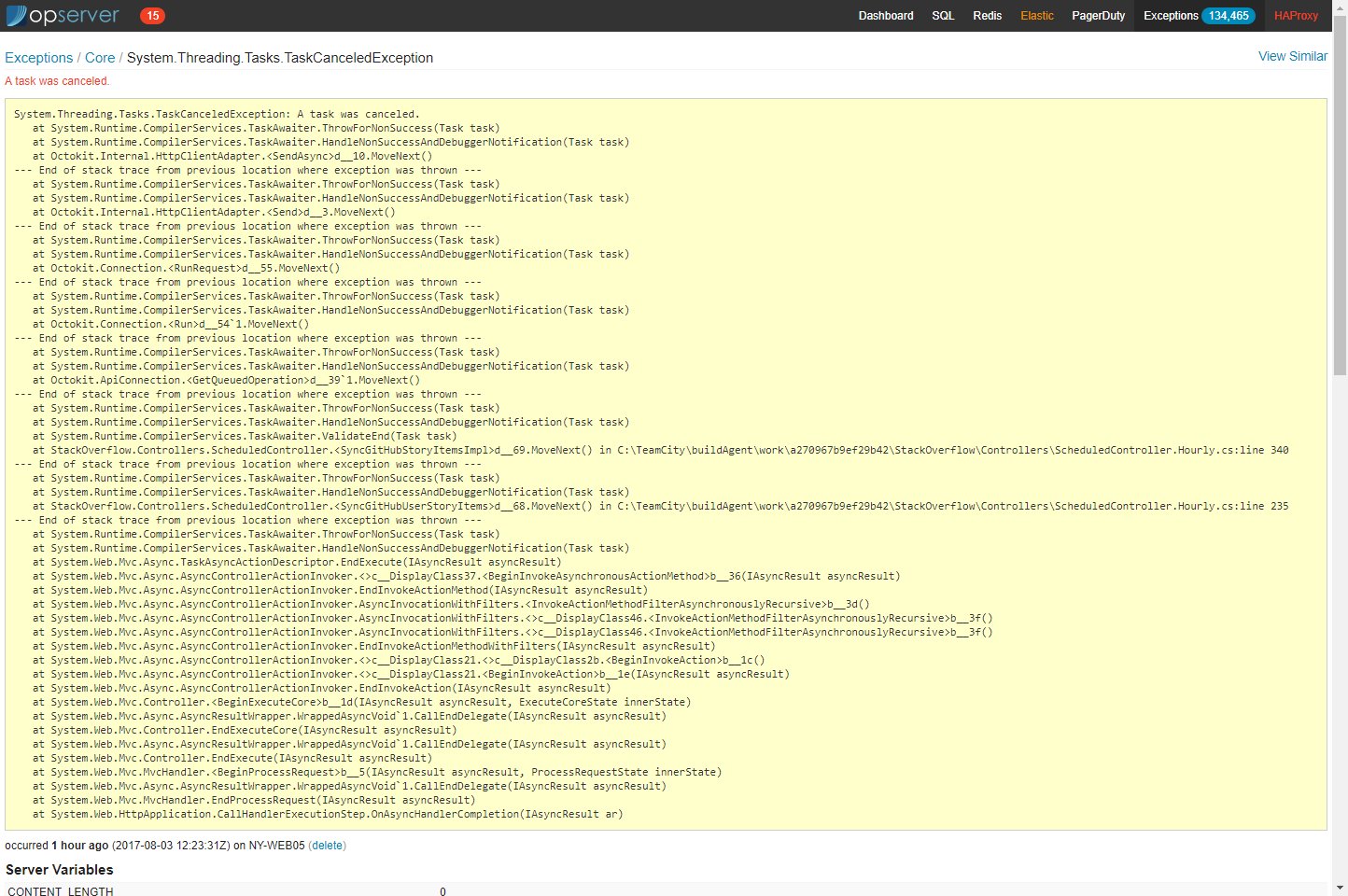

|
@jkotas - I wasn't clear if your comment was suggesting a specific implementation choice suggested here was bad or a broader statement that any policy that eliminates frames is bad, or simply to provide a good counter example to my theory that users have the same expections for callstacks in a debugger as they do for callstacks in the exception stacktrace?
What change in behavior did you observe with the NonUserCodeAttribute? I'm surprised it made a difference given that VS winds up treating all BCL code as non-user by default (because it is compiled in Release). If you happened to be building your own BCL libraries in debug and testing VS on that then you've accidentally sent yourself down a different path than the standard customer sees. @tmat - thinking about it NonUser does feel a better expression of this than DebuggerHidden and it already has an easy opt-out in VS, turn JMC off. I do want to sure we aren't inadvertently degrading some other debugger behavior though. I agree with @benaadams that on-by-default is where most of the value is, despite making things harder for us. |
Actually nothing when JMC was off; it only skipped the methods when it was on - so that's probably ok :) |
|
@dotnet-bot test OSX10.12 x64 Checked Build and Test |
benaadams
changed the title
benaadams
changed the title
|
Upping the ante with last change 48ae315 marking So public static void Main(string[] args)
{
var list = new List<int> { 0, 1, 2, 3 };
try
{
foreach (var item in list)
{
list.Add(item);
}
}
catch (Exception e)
{
Console.WriteLine(e);
}
}Outputs Instead of So the |
benaadams
changed the title

|
Please also port this to the desktop framework :) |
Think can go one better than just resolving the names; and add all the parameters back too. Changed flags to Reduced allocations by plumbing Added options |
|
*Moved Trace to second post #14608 (comment) For program public class Program
{
public static async Task Main(string[] args)
{
Console.ReadLine();
try
{
await MethodAsync(2);
}
catch (Exception e)
{
Console.WriteLine(e);
}
}
static List<int> _list = new List<int> { 1, 2, 3 };
private static bool FirstException(int value, int index)
{
foreach (var ii in _list)
{
_list.Add(ii - 1);
}
return true;
}
private static int LinqIteration(int count)
{
var sum = 0;
var list = new List<int>{1,2,3};
var data = list.SkipWhile((x, i) => FirstException(x, i)).ToArray();
return data.Sum();
}
private static IEnumerable<int> Iterator(long count, int value)
{
yield return 1;
yield return LinqIteration(2);
yield return 3;
}
private static int InnerException3()
{
try
{
int val = 0;
foreach (var i in Iterator(1L, 1))
{
val = i;
}
return val;
}
catch (Exception e)
{
throw new Exception("Inner3", e);
}
}
struct InnerType<T>
{
public static int InnerException2(int count)
{
try
{
return InnerException3();
}
catch (Exception e)
{
throw new Exception("Inner2", e);
}
}
}
private static int InnerException1<T>(int count)
{
try
{
return InnerType<int>.InnerException2(count);
}
catch (Exception e)
{
throw new Exception("Inner1", e);
}
}
private static ValueTask<int> NonAsyncValueTask(int count, string name)
{
return new ValueTask<int>(InnerException1<string>(count));
}
private static async ValueTask<int> ValueTaskAsync(string name)
{
return await NonAsyncValueTask(1, "");
}
private static async Task<int> TaskTAsync(long count)
{
return await ValueTaskAsync("");
}
private static async Task<int> TaskTAsync(int count)
{
return await ValueTaskAsync("");
}
private static async Task<int> TaskTAsync(long count, string name)
{
return await ValueTaskAsync("");
}
private static async Task ConfiguredAsync(int count)
{
await MethodAsync(count).ConfigureAwait(true);
}
private static async Task MethodAsync(int count)
{
if (count == 0)
{
await TaskTAsync(count);
}
else
{
await ConfiguredAsync(count - 1);
}
}
} |
|
Added some Linq; only item I can see that's not sane is the lambda (also closures); might have missed some variants? |

| // Builds a readable representation of the stack trace, specifying | ||
| // the format for backwards compatibility. | ||
| internal String ToString(TraceFormat traceFormat) | ||
| { |

There was a problem hiding this comment.
Thought about that but StringBuilderCache allocates a new one if current is too small; and has a retained limit of 350 chars - and the stack traces are pretty big; so its either going to bloat the cache or always allocate anyway :-/
| { | ||
| t = ResolveAsyncMethod(t, ref mb); | ||
| } | ||
| else if (FormattingOptions.HasFlag(StackTraceFormattingOptions.ResolveIteratorMethods) && typeof(IEnumerable).IsAssignableFrom(t)) |
There was a problem hiding this comment.
Should check for IEnumerator instead (works if iterator returns IEnumerable or IEnumerator)
| if (dt != null) | ||
| { | ||
| string fullName = t.FullName; | ||
| var start = fullName.LastIndexOf('<'); |
There was a problem hiding this comment.
Note this assumes a C#-specific mangled name format. I've suggested in the past that the compiler should emit an attribute on the state machine that resolves the method (e.g. by including a signature string or at least a name).
Also, I think this is a non-negligible computation for a "nice to have" feature (getting the list of argument types): resolving multiple MemberInfos, allocating an array, allocating attributes...
There was a problem hiding this comment.
Note this assumes a C#-specific mangled name format.
Need to check the names used across the languges, worse case it doesn't look it up and leaves the name alone
The compiler should emit an attribute on the state machine that resolves the method
Would be useful
Also, I think this is a non-negligible computation for a "nice to have" feature
Its an opt-in; but without it and without line numbers it makes it hard to workout which of the overloads in the example program is being called if the name alone was cleaned
async Task<int> TaskTAsync(long count);
async Task<int> TaskTAsync(int count);
async Task<int> TaskTAsync(long count, string name);There was a problem hiding this comment.
VB is something like
VB$StateMachine_3_BarAsync.MoveNext()There was a problem hiding this comment.
Will do some throughput and allocation testing, but
Program.TaskTAsync(Int32 count)
Adds a lot of value over
Program.<TaskTAsync>d__11.MoveNext()
as you know which overload it was rather than having to manually track back via the il and try to eyeball it
There was a problem hiding this comment.
Full prettification has an insignificant cost compared to the exception handling
There was a problem hiding this comment.
compiler should emit an attribute on the state machine that resolves the method
Is there a roslyn issue for this? Should I raise one?

There was a problem hiding this comment.
Please do not parse compiler generated names.
There was a problem hiding this comment.
I'd recommend leaving the type and method name pretty-printing for a separate PR as it needs more design and discussion.
There was a problem hiding this comment.
Agree with @tmat here. I'm behind the goal, but lets get the incremental progress on StackTraceHidden in the bag first. I imagine handling the compiler generated state machines in a robust way that doesn't tie the compiler's hands will take a little longer, using coordinated changes in both compiler and BCL.
|
For the program used as sample; the formatting has a pretty negligible effect on performance (the cost of the exceptions dominating) https://gist.github.com/benaadams/ebea3a947a57fe04e9fa0ee8bed48956 dotnet/master Total Iters: 100,000 Elapsed: 00:00:53.7281390 Bytes Allocated: 1609294360 StackTraceFormattingOptions.None Total Iters: 100,000 Elapsed: 00:00:54.3551537 Bytes Allocated: 1609283688 StackTraceFormattingOptions.ExcludeStackTraceHiddenAttribute Total Iters: 100,000 Elapsed: 00:00:54.3543527 Bytes Allocated: 1609283688 StackTraceFormattingOptions.ExcludeStackTraceHiddenAttribute | Total Iters: 100,000 Elapsed: 00:00:53.5627985 Bytes Allocated: 1609294360 |
|
With the rethrows from the async steps, its about 1M exceptions so 10k exceptions per second per core; which dwarfs any reflection |
|
After looking at the perf, I think at least resolving the methods is probably a good default e.g.
Then the stack trace matches the users code and the VS call stack window, which also has the methods resolved And it only shows the boundaries where it actually goes async; rather than just a transferring throw However, I'm not sure how to detect that in the stack trace |
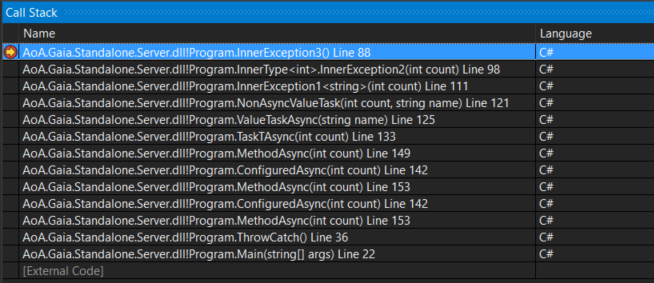
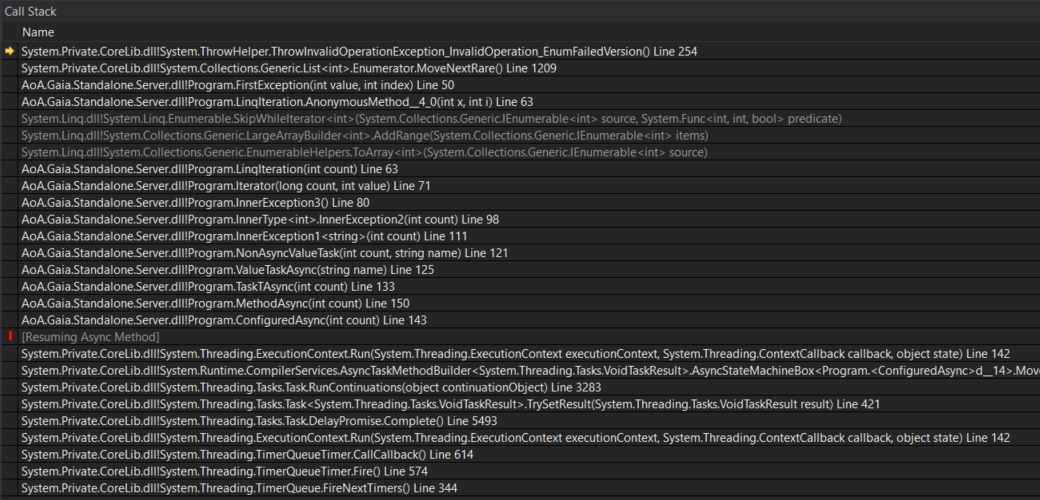

| internal enum StackTraceFormattingOptions | ||
| { | ||
| None = 0, | ||
| ExcludeStackTraceHiddenAttribute = 1 << 0, |
There was a problem hiding this comment.
ExcludeStackTraceHiddenAttribute [](start = 8, length = 32)
I like this enum. I wonder though, if we really need a new attribute now that we have an enum value specifying what should the behavior be. Having ExcludeNonUserCode flag and using DebuggerNonUserCodeAttribute would imo be better. Someone mentioned this attribute may already be used by some code generators. That's actually an argument for reusing the attribute. The intention of this attribute is to hide helpers that clutter debugging experience. To me that looks like what we are trying to do here as well. If we add a new attribute such generator will need to be updated to emit that attribute as well. Since we have a new flag that determines the stack formatting behavior it's not a breaking change to use the existing attribute.
There was a problem hiding this comment.
I think that will work very well; also can tie up with the statemachine back pointers (and other generated code)
There was a problem hiding this comment.
I could accept having an ExcludeNonUserCode flag on this enum, but at this point I have strong concerns about making it the default or considering it a replacement for the StackTraceHidden attribute. Pretty much same logic as above:
a) The msdn docs make it clear that DebuggerNonUserCode attribute doesn't have any runtime semantics. I don't want to make breaking changes on an unvalidated assumption that this is what users of that attribute would prefer.
b) Jan's example was excellent - .Net Native gave us a very strong example that users can be perfectly happy when VS hides something from them with JMC, but they complained extensively when the runtime hid that same thing from them in the exception callstack.
Its possible with a bunch of research about what code would be affected and talking to customers to see how they feel about those particular classes of methods we could ameliorate those concerns - but it strikes me as a lot of work and a lot of risk for a relatively small potential upside.
I still think we're better off sticking to the original ExcludeStackTraceHiddenAttribute and not even adding the ExcludeNonUserCodeAttribute until we've got a concrete customer pointing at a specific use case where the ability to customize that would help them.
There was a problem hiding this comment.
strong concerns about making it the default
I didn't mean it to be the default. On contrary. We should keep the default behavior as is. Having an option to treat DebuggerNonUserCode differently in StackTrace is not a breaking change. We can document that this flag exists in the attribute doc page.
If it is not a default and the code that displays the stack trace needs to pass in a new flag then (and only then) I believe adding a new attribute is not useful. It'd just add more complexity.
| // There is no good reason for the methods of this class to be virtual. | ||
| public class StackTrace | ||
| { | ||
| internal static StackTraceFormattingOptions FormattingOptions { get; set; } |
There was a problem hiding this comment.
If this is the proposed opt-out mechanism, presumably it needs to be public
There was a problem hiding this comment.
Its private public, can switch it off with reflection 😉
Will submit a corefx design for review when have agreed upon approach - though think we are close.
| None = 0, | ||
| ExcludeStackTraceHiddenAttribute = 1 << 0, | ||
| ExcludeDispatchBoundaries = 1 << 1, | ||
| ExcludeInnerExceptionBoundaries = 1 << 2, |
There was a problem hiding this comment.
Concatenating across inner exceptions feels like another one that we should segregate out of this PR and bring up separately. It doesn't seem unreasonable as something people would want, but I don't feel I've seen much feedback on it either way. I'd rather not lump it with the async stuff where we have seen significant feedback already.
 noahfalk
left a comment
noahfalk
left a comment
noahfalk
left a comment
There was a problem hiding this comment.
I'm concerned we're trying to do too much in this one PR. I think we should segregate out the inner exception change until we've got reasonable feedback that justify people explicitly want that part. I also think we should segregate out the state machines and iterators to have a more collaborative design with the Roslyn team. Parsing method names is a brittle solution that ties the compiler's hands.
Agree. The delta at 123b932 looked like a pretty reasonable step to me. I would recommend going back to that point for this PR. |
|
Will open new PR as I want to keep; the comments, but also squash |
|
PR #14650 |
9 participants


Follow on from #14564 but also works for Debug build and doesn't rely on Jit behavior
Currently from looking at a stack trace there's a lot of noise; but perhaps more importantly there isn't enough detail to tell what overloads of a method were called for
asyncanditeratorsdue to the name mangling prior toMoveNext().This PR seeks to address both these issues; so that using the stack trace output is a more productive experience; whether trying to identify causes from logs and what code to look at, or just to not be daunting to new developers. (Also provide opt-outs to previous behavior and allow future extensibility).
It adds the following internal items to
System.Diagnotsics(will seek api review to make public)The default formatting is
ExcludeStackTraceHiddenAttribute | ExcludeDispatchBoundaries | ResolveAsyncMethods | ResolveIteratorMethods.Adding
[StackTraceHidden]to a method will drop it from the StackTrace and adding it to the class/struct will drop all of its methods from the trace.For
asyncmethods and users ofExceptionDispatchInfoExcludeStackTraceHiddenAttributeOutputs
Instead of
For
ThrowHelpermethodsOutputs
Instead of
So they act as in-place
throwsResolveIteratorMethodsOutputs
Instead of
ResolveAsyncMethodsOutputs
Instead of
ExcludeDispatchBoundariesdropsExcludeInnerExceptionBoundariesdrops (included by default)Resolves: https://github.com/dotnet/corefx/issues/24627
@stephentoub @noahfalk PTAL