Repository navigation
Comparing changes
Open a pull request
- 19 commits
- 266 files changed
- 23 contributors
Commits on Sep 23, 2026
-
chore(release): release Buzz Desktop version 0.5.24 (#7817)
## Buzz Desktop release v0.5.24

- **Frozen main:** `fe56d311a7156802408afb04023c3f75d4015007`
- **Reviewed candidate:** `3befaf16002d802a97aa79007be29b23623ceb3f`
- **Previous desktop release:** `desktop-v0.5.23`
- **Proposed immutable tag:** `desktop-v0.5.24`

This PR may be **squash merged** after the Desktop Release Candidate
check and all protected-branch checks pass. Merging authorizes
publication of the exact reviewed candidate; later or unrelated changes
on `main` cannot alter it.

The checked-in changelog accounts for every non-merge commit in the
release range. The Desktop tag points to the reviewed candidate commit,
not the later squash commit. Publication remains bound to that immutable
candidate tag.

Signed-off-by: Wes <[email protected]>
Co-authored-by: Release Automation <[email protected]>
-
feat(canvas): add version history with atomic restore (#6780)
🤖 Adds append-only channel canvas history, restore, and
relay-authoritative optimistic concurrency so stale edits cannot
silently replace a newer canvas.

## What this adds

- **Desktop history and restore** — browse revisions with author,
timestamp, preview, and diff; restore an older revision as a new signed
head after explicit confirmation. Persisted empty canvases remain
reachable, mutation outcomes are announced accessibly, and focus moves
to a stable destination after save or restore.
- **CLI history and restore** — `buzz canvas history --channel …`, `buzz
canvas get --channel … --revision <id>`, and `buzz canvas restore
--channel … --revision <id>` use keyset pagination over the retained
revision stream.
- **SDK canvas builders** — optional `expected-revision` tags, bounded
ancestry classification, and shared timestamp discipline keep
first-party writes ahead of the head they read without propagating
poisoned future timestamps.

## Authoritative concurrency contract

Tagged canvas writes use compare-and-swap semantics in the relay and
database:

- `expected-revision=none` succeeds only when no live canvas exists.
- An event ID succeeds only when it names the canonical live head.
- A byte-identical replay succeeds only when that event is already the
canonical live head.
- A successful candidate must sort strictly ahead of the current head
under `created_at DESC, id ASC`.
- Malformed preconditions and stale or non-advancing writes are rejected
before event rows, mentions, or fan-out are committed.

The database serializes tagged writes, unconditional kind `40100`
writes, and canvas soft deletion on the same `(community, kind,
channel)` advisory key. Untagged `buzz canvas set` remains an
unconditional write, but participates in that serialization boundary so
it cannot race a tagged save or deletion. Deletion classification is
derived inside the datastore transaction; unrelated event kinds do not
take the canvas lock.

## Read and timestamp consistency

Precondition and post-write ancestry reads request strong consistency
from `/query`, pinning them to the writer when replica routing is
enabled. Display-only history remains replica-eligible.

First-party canvas writers stamp `created_at = max(now, head + 1)` with
a conservative client skew limit. The relay applies a canvas-specific
future-timestamp ceiling before persistence, preventing an accepted
boundary head from making subsequent first-party writes invalid while
preserving the broader ingest limit for other event kinds.

## Durable outcomes and recovery

After an accepted publish, a failed verification read is reported as
durable success with `verified: false` rather than a failed save.
Desktop and CLI preserve the new event ID and direct users to History
when verification is unavailable. A successful read walks the bounded,
cycle-guarded `expected-revision` ancestry chain so transitive
descendants are not misclassified as supersession. Canvas caches
invalidate for every settled mutation outcome, including a retained but
superseded revision.

The 409 reconciliation path in `cmd_restore_canvas` now separately
establishes persistence evidence from ancestry classification.
`canvas_write_survived` checks reachability only; a secondary
writer-pinned IDs lookup distinguishes "A absent" from "A present but
superseded by a legacy write." The four-way outcome (survived /
persisted-but-superseded / genuinely-absent / read-fail) is now correct
for all lost-response shapes including unconditional legacy writes.

---------

Signed-off-by: Will Pfleger <[email protected]>
Signed-off-by: Duncan <dcfd242e557282d7a1e2cf2e6877522682f1e5c6156dc92ca7d90eaedd3b0f95@buzz.block.builderlab.xyz>
Co-authored-by: Duncan <dcfd242e557282d7a1e2cf2e6877522682f1e5c6156dc92ca7d90eaedd3b0f95@buzz.block.builderlab.xyz>
Co-authored-by: Hayt <9e1c23a3fd83f61da34420e4e88ff1b16e45cafcc0cd9019eb07d4ecfa8ca9b0@buzz.block.builderlab.xyz>
 3 people authored
Sep 23, 2026 -
fix(agent): preserve Databricks Opus UC reasoning and tool continuati…
…on (#7840)

## Summary
Fix `reasoning_effort: Extra inputs are not permitted` for Databricks v2
model `data_workflow_tools.goose.goose-claude-opus-5-5` without dropping
explicit High.

- Add one provider-qualified exact capability record: Anthropic
Messages, adaptive thinking, `output_config.effort`, medium upstream
default. Mirror exact-record precedence in Rust/TS; keep uncurated UC
services neutral and existing GPT routing unchanged.
- Preserve ordered native content, including signed/empty thinking and
redacted blocks, across tool results. Do not cache-stamp thinking blocks
or leak native state into Chat reasoning details. Discard truncated
native state; reject more than 64 native calls before any tool executes
instead of altering signed content.
- Add production-dispatch/ACP regressions and six shared capability
vectors. No relay/ACP protocol, schema, settings, inheritance, retries,
or other harness changes.

## Validation
At final head `82f43f8d07bfcc3f4af492afc0a58a02f8e549c4`, clean tree:
- Rebuilt real `buzz-agent`, drove ACP with a harmless MCP fixture
against the actual service. Two POSTs to
`/ai-gateway/anthropic/v1/messages`, both HTTP 200, exact FQN, High via
`output_config`, adaptive/summarized thinking, no `reasoning_effort`.
First response contained signed thinking + tool use; second request
preserved signature/content order and paired result; final ACP stop
`end_turn`. No credentials, signature contents, or conversation data
included here.
- Mandatory pre-commit/pre-push checks passed: formatting/lint,
file-size gate, Rust test lanes, desktop typechecking and full JS tests,
Tauri clippy/tests.
- Full `cargo test -p buzz-agent` passed on the pre-commit tree (only
hook formatting followed), including the new native truncation/65-call
ACP regressions, ordered interleaved signed/redacted two-tool capture,
nearby-ID negatives, and existing provider regressions.
- Independent API/replay, regression-boundary, and Rust/TS capability
reviews cleared.

Full `just ci`, packaging and manual desktop UI testing were not run
locally; repository CI remains the merge gate. Cross-harness internals
and other UC service contracts are outside scope.

## References
- [Databricks model
services](https://docs.databricks.com/aws/en/ai-gateway/query-model-services)
- [Anthropic thinking
preservation](https://platform.claude.com/docs/en/build-with-claude/thinking#thinking-block-preservation-by-model)
- [Anthropic
effort](https://platform.claude.com/docs/en/build-with-claude/effort)
- Originating Buzz channel: `fccdea96-0f31-4343-ba6a-324214dc8d73`
- Originating thread:
buzz://message?channel=fccdea96-0f31-4343-ba6a-324214dc8d73&id=33f242923a317e269c1ff7b960cacd6ec1f3371eff2f97592857804c50fb100c

Signed-off-by: Wes <[email protected]>
Signed-off-by: Carl <32a2e2c9d428ee08902cab75d956da2c1d235a22d4766b0dd4138bf6e2e5db1d@buzz.block.builderlab.xyz>
Co-authored-by: Carl <32a2e2c9d428ee08902cab75d956da2c1d235a22d4766b0dd4138bf6e2e5db1d@buzz.block.builderlab.xyz>
-
fix(mobile-infra): render push grant lifetimes as decimal in chart 0.…
…3.2 (#7820)

A valid 30-day push gateway grant lifetime could render in scientific
notation (e.g. `2.592e+06`) in the chart, which the gateway binary does
not accept.

Always ormat the integer as decimal text, preserving the strict gateway
parser.

### Testing

Added regression coverage that feeds actual Helm-rendered environment
values into the production config parser. Covers defaults, values files,
command-line overrides, exact lifetime boundaries, and invalid input
rejection. The default case failed before the fix and passes afterward.

Signed-off-by: Tom Brow <[email protected]>
-
fix(hooks): strip repo-local git env from pre-push test lanes (#7841)
Git exports repository-local variables (`GIT_DIR`, `GIT_INDEX_FILE`,
`GIT_WORK_TREE`, ...) into hook processes, and in linked worktrees
`GIT_DIR` is absolute. Pre-push lanes inherited that environment
unchanged, so any test fixture that spawns `git` in a temp dir (`git
init --bare <tmp>`, `git config user.name ...`, `git commit`, `git
push`) actually operated on the checkout being pushed.
`current_dir(tmp)` and `git -C tmp` don't escape an inherited `GIT_DIR`.

Because `.git/config` is shared by every worktree, one push from any
worktree could silently rewrite the repo for all of them. In practice
this set `core.bare=true` (breaking the main checkout with `fatal: this
operation must be run in a work tree`), replaced the committer identity
with a fixture `user.name=Agent`, disabled `commit.gpgSign`, and left
fixture aliases behind. The fixtures that did this are the git-identity
enforcement tests in #6177, which run in the `rust-tests` lane via `just
test-unit`.

The pre-push lanes that run test suites or builds now go through
`scripts/without-git-env.sh`, which unsets the variables listed by `git
rev-parse --local-env-vars` (git's own definition of repo-local state,
the same set `git submodule` clears) and then `exec`s the lane, so each
subprocess rediscovers the repository from its working directory.
Transport, credential, and TLS settings (`GIT_SSH_COMMAND`,
`GIT_ASKPASS`, `GIT_TERMINAL_PROMPT`, `GIT_SSL_*`) pass through
untouched. Putting this at the hook boundary covers every current and
future test without each suite having to defend itself.

The `branch-skew` and `push-head-scope` guards run unwrapped: they spawn
no fixtures, and `branch-skew`'s `git fetch` needs the caller's
transport environment. `pre-commit` isn't wrapped either, since its
`stage_fixed: true` lanes need the hook's `GIT_INDEX_FILE` to restage
into the temporary index during `git commit <paths>`.

Related: #6177

---------

Signed-off-by: Will Pfleger <[email protected]>
-
Use worker snapshots for relay storage metrics (#7845)
## Summary

Make the relay read completed storage-accounting snapshots from
PostgreSQL by default. An environment with no snapshot emits no storage
metrics. When a worker publishes its first result, the relay picks it up
on the next successful leader usage tick, without a restart or
configuration change.

This changes how storage usage is measured and reported. **S3 remains
the object store. PostgreSQL stores the completed counts, byte totals,
community breakdown, and calculation metadata—not the objects
themselves.**

### Why move relay storage accounting entirely to database reads?

Today the relay supports two sources: its own S3 scan (`inline`, the
default) and the worker's saved snapshot (`external`). That requires
operators to deploy a worker and then coordinate a separate relay-mode
change in each environment.

The worker already owns the S3 listing and calculation. It runs in a
separate process with its own object cap, memory limit, and deadline.
Keeping a second scan inside the serving relay retains the resource
pressure and failure modes that this isolation is meant to remove.

PostgreSQL provides a durable handoff. The worker replaces one completed
snapshot atomically after a successful calculation. The relay reads that
row and exposes its values through the existing metrics endpoint. A
relay restart or leadership change can load the last completed result
without scanning the bucket again.

There is deliberately no S3 fallback when a snapshot is absent or a read
fails. Such a fallback would put the expensive scan back in the relay
precisely when a worker is absent or unhealthy. It would also leave two
calculation paths with different resource limits and freshness behavior.

### What happens if no worker exists?

**A worker that has never published is a normal, successful inactive
state.** The snapshot table must exist through the normal database
schema, but it may contain zero rows. The reader returns success, emits
no storage totals or failed-load gauge, and checks again on the next
usage tick. It does not exit the relay, start a worker, or list S3.

The relay checks for a completed database row; it does not inspect
Kubernetes Jobs or CronJobs. Worker presence and snapshot presence are
therefore different:

| Situation | Storage-reader behavior |
|---|---|
| No worker and no snapshot row | Return success, emit no storage
metrics, and query again next tick. |
| Worker starts later and publishes its first row | Read and emit it on
the next successful leader usage tick; no restart or mode change. |
| Worker is removed or fails, but its last valid row remains | Continue
reporting the last completed totals with their increasing age. |
| Query succeeds but a previously present row has been removed | Clear
the cache and stop refreshing storage series; existing exporter series
expire through the idle timeout. |
| Database read fails, times out, or returns an invalid snapshot | Log a
warning, set `buzz_storage_snapshot_load_ok=0`, retain any last-good
cached totals, and retry next tick. |
| Snapshot table is missing | Treat this as a schema error, not normal
worker absence; follow the failed-read behavior above. |
| `BUZZ_STORAGE_METRICS=off` | Skip the snapshot query and all storage
metric emission. |

No row means “not measured,” not zero bytes. A valid completed snapshot
of an empty bucket can report zero. If a read fails before any good
snapshot has been cached, only failed-load health is emitted.

These reads happen in the existing background metrics task, not the
relay startup path. A storage-read failure does not request process exit
or change readiness directly. A wider database outage can still affect
the relay's existing database-dependent operations and readiness.

### Read, parse, and emit path

```text
Worker: S3 listing -> BucketSnapshot -> JSON -> PostgreSQL
Relay: PostgreSQL -> JSON -> BucketSnapshot -> existing metric gauges
Collector: relay /metrics endpoint -> Datadog
```

1. `main.rs::run_storage_sweep_tick` calls the reader from the existing
leader-only usage task. The default interval remains 300 seconds.
2. `storage_sweep.rs::run_storage_metrics_tick` coordinates the read,
cache update, failure health, and metric emission.
3. `refresh_persisted_snapshot` calls the existing
`Db::load_storage_accounting_snapshot()` method. A five-second timeout
covers pool acquisition and the query. It uses the relay's existing
pool.
4. The existing query in `buzz-db/src/store/storage_accounting.rs` reads
`snapshot`, `completed_at`, `duration_ms`, `max_objects`, and `code_sha`
from the singleton row.
5. `serde_json::from_value(stored.snapshot)` decodes the JSON into the
existing `buzz_media::BucketSnapshot` type. Rust infers that type from
`cache_persisted_snapshot`'s argument. The generated `Deserialize`
implementation handles all fields, including the UUID-keyed
`per_community` map.
6. `emit_cached_storage_metrics` sets the existing physical/logical
totals and community byte/object gauges. The existing Prometheus
exporter exposes them for Datadog collection; this code does not send
snapshot JSON to Datadog.

The worker's `BucketSnapshot`/`CommunityStorage` structures, JSON field
names, SQL publication method, and database schema are unchanged. The
old external-mode JSON conversion moves out of `main.rs` into the reader
helper. No new format or hand-written field parser is needed. Duration
and object-cap metadata are validated before replacing the cache.

The five-second relay read timeout is separate from the worker's
30-second startup acquisition budget introduced in #7770. This PR does
not change the worker's pool or startup logic.

### Configuration and code changes

| Configuration | Before | After |
|---|---|---|
| Unset, `inline`, or `on` | Relay-local S3 scan | Read completed
database snapshots. `inline` logs one migration warning. |
| `external` or `snapshot` | Read completed database snapshots |
Continue reading snapshots. |
| `off` | Disabled | Disabled. |
| Unknown or empty value | Disabled with a configuration error | Same. |

Existing `inline` settings intentionally become reader aliases. Merely
changing the default would leave older deployments on their explicit
`inline` setting and preserve the need for coordinated configuration
PRs.

Remove relay-local scan scheduling, in-flight scan state, scan
configuration, and obsolete scan-attempt tests and health metrics.
Preserve the physical/logical total and per-community metric names,
leader-only emission, community scope filtering, and cleanup of old
community labels.

The shared relay-state field remains in place; its comment now describes
a cached worker result. The Helm chart defaults to `relayMode: external`
while leaving `storageAccounting.enabled: false`. Its rendering test
verifies that the reader is configured even when no worker is created.
The reader regression tests cover missing rows, later publication,
updates, invalid data, timeout, removal, reactivation, and the explicit
off switch. `docs/storage-accounting.md` describes this operating model.

### Freshness and rollout impact

`buzz_storage_snapshot_age_seconds` uses the worker's original
completion timestamp. Re-reading an old row never makes it fresh.
`buzz_storage_snapshot_load_ok=1` means the row was read and decoded; it
does not prove that the worker's latest attempt succeeded.

Monitor snapshot age against the worker's schedule and allowed runtime,
and monitor Job failures separately. The old relay scan-attempt health
gauges are retired because the relay no longer runs those scans.

Deploy this relay version through the usual release process. Once it
reaches an environment, workers can be enabled independently.
Already-released charts that still set `inline` work with the new
binary; future chart releases default explicitly to `external`. An
intentional `off` override still requires an operator to enable the
reader.

**Environments with no completed snapshot lose relay-calculated storage
totals after this upgrade.** That is the intended tradeoff for removing
scans from the serving process. Environments with a prior snapshot
continue showing its last completed totals and age. This PR does not
install workers in additional environments or deploy the new relay
image.

### Related issue

Related to #4601. Follows the worker startup fix in #7770. The separate
fleet-usage collector work in #7176 overlaps this code and may need
reconciliation when it merges.

### Testing

Built and ran the relay locally against isolated PostgreSQL and Redis
with the legacy `inline` setting, five-second usage ticks, and a
15-second metric idle timeout. The same process was exercised through
these steps:

1. Start with an empty snapshot table: relay becomes ready and exposes
no storage series.
2. Publish a snapshot containing 123 bytes: the community gauge becomes
123.
3. Replace it with 456 bytes: the gauge becomes 456.
4. Remove the row: storage series expire without fabricating a zero-byte
measurement.
5. Publish 789 bytes: metrics reactivate without restarting the relay;
readiness remains healthy.

The local S3 endpoint recorded zero requests. The unrelated Git
conformance startup probe was disabled for this isolated reader check;
the test covers storage accounting, not every other use of S3 in the
relay. No new relay image was deployed to staging or production during
this test.

The broad local integration run also hit an existing
`p0_pool_acquisitions_use_typed_operation_pairs_without_other` failure
in `buzz-db/tests/observability_source.rs`. The same source-only test
fails on unmodified `main` at `0ef7a2222`; this PR changes neither the
test nor its failing source.

The full local `just ci` run stopped at mobile native-asset setup: the
`objective_c` build hook received no SDK path from `xcrun`. Mobile tests
did not run.

Generated with Codex

Signed-off-by: Ravneet Arora <[email protected]>
-
refactor: move agent Git bootstrap into ACP harness (#7819)
discovered in
#7742 (comment)

## Summary

Goose uses its native shell, so it bypassed the Git identity and signing
setup inside `buzz-dev-mcp`. Agent commits could use the host Git
identity, while MCP shells had a separate config. This moves Git setup
into `buzz-acp`, where both paths receive the same agent identity, Nostr
signer, and relay-scoped credential helper.

Before:

```text
Buzz Desktop
  └─ buzz-acp                 ← Desktop supplied relay Git authentication
      ├─ Goose → native shell ← no agent Git author or signing setup
      └─ Buzz Agent
          └─ buzz-dev-mcp
              └─ shell         ← MCP created the keyfile and Git signing config
```

After:

```text
Buzz Desktop or Sprig
  └─ buzz-acp                 ← owns the keyfile, identity, signing, and scoped credentials
      ├─ Goose → native shell ← inherits the complete Git environment
      └─ Buzz Agent
          └─ buzz-dev-mcp
              └─ shell         ← receives the same Git environment via mcpServers[].env
```

The harness keeps the signing key in a private temporary file and
removes it on normal exit, startup failure, and graceful termination. It
composes inherited `GIT_CONFIG_*` entries, forwards the complete block
to MCP servers, and bundles the helpers through the ACP multicall
entrypoint. For standard `buzz-acp` launches, Desktop and Sprig no
longer write Git config. A custom Desktop ACP command bypasses the
harness, so Desktop preserves its prior relay-scoped credential helper
for that supported override.

This changes Git settings for every ACP runtime. The startup signal path
also changes so a termination during adapter initialization removes the
keyfile. The temporary file can remain after SIGKILL or a machine crash.

### Related issue

Related: #6177 covers stricter commit identity enforcement and touches
the same Git paths. That PR and this one need to be reconciled before
either lands. No issue was found for this runtime bootstrap gap.

### Testing

- Ran the ignored `git_runtime_tests` with real Goose 1.50.0 and Buzz
Agent ACP sessions. `real_goose_native_git_shell` passed again on this
PR branch with `BUZZ_TEST_BIN_DIR` pointing to built binaries. Goose
made a signed commit and tag through its native shell; Buzz Agent did
the same through its MCP shell. Both verified signatures, identity,
credential scoping, and keyfile cleanup.
- Built the Linux Sprig image and ran `scripts/test-sprig-image.sh
buzz-sprig:acp-git-bootstrap`. The container made and verified a signed
commit and tag, then confirmed keyfile removal after SIGTERM.
- `just ci` passed on the original branch. After rebasing onto `main`
and addressing review feedback, the ACP Git bootstrap integration tests,
focused desktop smoke test, custom-command regression test, formatting,
and ACP/Desktop Clippy passed. The pre-push hook hit two
timing-sensitive ACP deadline tests under parallel load; both passed
alone and the complete ACP package passed serially (964 library, 2 Git
bootstrap, 9 pool lifecycle tests). The push used `--no-verify` after
those checks; GitHub CI is rerunning on the new head.
- Under injected `BUZZ_ACP_ALLOWED_RESPOND_TO`, `BUZZ_ACP_LAZY_POOL`,
and `BUZZ_ACP_IDLE_POOL_SLEEP`, the clean-env serial package command in
`crates/buzz-acp/TESTING.md` passed: 964 active library tests, 2 Git
bootstrap tests, and 9 pool lifecycle tests. Both named Databricks OAuth
tests passed locally; another reviewer reproduced their
environment-specific failures on `main`.
- No authenticated relay clone or push was run. The local probes used
disposable repositories and did not contact a relay.

Generated with Codex

---------

Signed-off-by: Salman Mohammed <[email protected]>
-
feat(relay): add opt-in newest-first thread windows (#7823)
## Summary

Add an opt-in, newest-first thread window to the authenticated HTTP
query path.

A filter with `thread_window: true` returns:

- reply rows ordered by `(created_at DESC, id ASC)` with an exact
composite cursor;
- optional bounded reactions, edits, deletions, and delete-of-aux
closure;
- one relay-signed `kind:39007` bounds event bound to the normalized
host, authenticated reader, channel, root, request cursor, kinds, depth,
limit, and aux choice.

Filters without the flag keep the existing oldest-first thread behavior.
Channel windows and `kind:39006` are unchanged. No client opts into this
mode in this PR.

### Why extend NIP-CW

NIP-CW already defines relay-computed, cursor-paged conversation views
over extended NIP-01 filters. Thread windows use the same protocol
ideas: ordinary signed rows, composite keyset pagination, optional aux
closure, and relay-signed bounds. Adding a thread mode keeps those
related wire contracts together instead of creating a second NIP with
duplicated terminology and compatibility rules.

Extending a draft, optional NIP with an additive mode is normal protocol
evolution. Existing fields and meanings are not reinterpreted:

- `top_level: true` remains channel mode;
- `kind:39006` remains channel-window bounds;
- `thread_window: true` selects the new mode;
- `kind:39007` has a distinct identity and root/request binding;
- extension-unaware clients never send the selector;
- legacy thread queries remain unchanged.

NIP-CW documents only the wire contract and relay semantics. Database
plans, replica internals, and rollout procedures remain implementation
concerns.

### Why thread windows use independent modules

The implementation deliberately keeps `thread_window.rs` separate in
`buzz-core`, `buzz-db`, and `buzz-relay` rather than adding branches
throughout the existing channel-window path.

The modes share pagination concepts, but their invariants differ:

- channel mode selects top-level rows; thread mode requires one root and
depths `1..=depth_limit`;
- thread mode accepts only conversation row kinds and rejects
unknown/conflicting fields;
- thread bounds bind the root and authenticated reader because
cross-channel aux visibility can differ by reader;
- thread aux includes the root and requires complete two-hop closure;
- thread mode refreshes writer authorization before selection and before
signing;
- historical cursor pages may use a proved replica transaction, but
fallback must restart both aux hops on the writer;
- legacy thread traversal is oldest-first and must not inherit
descending cursor semantics.

Forcing these rules into channel-window code would create a mode flag
across parsing, SQL predicates, bounds construction, authorization,
replica fallback, and tests. That abstraction would not remove
complexity. It would distribute it. Separate modules keep each contract
local and leave the established channel and legacy paths untouched.

### Technical design

- Strict request parsing normalizes UUIDs, event IDs, kinds, defaults,
and cursors before computing the response binding.
- SQL applies community, root, channel, depth, kind, deletion, and
cursor predicates before `limit + 1`.
- Ordered metadata scanning plus exact event-key lookup avoids the
stale-statistics plan that previously exceeded the four-second SQL
budget on a 10k-reply thread.
- Aux work is bounded by target batches, query count, raw candidate
count, response bytes, SQL timeouts, and one shared HTTP deadline.
- Fresh authorization-set comparison catches both grants and revocations
during closure. The relay returns retryable `503` rather than signing an
incomplete page.
- Replica failure permanently degrades the request to the writer and
restarts closure from its original targets without resetting budgets.
- Migration `0049_thread_window_index.sql` adds the mixed-direction
index used by newest-first scans. It validates a prebuilt index and
bounds startup lock/build time.

### Tradeoffs

- The stale-statistics-safe plan is intentionally less clever. Measured
warm 100k deep-cursor execution increased from roughly 0.30 ms to 4.80
ms, plus about 8 ms planning, in exchange for avoiding a reproduced
multi-second timeout after rapid 10k-thread insertion.
- Bounds are authoritative only for the served page. There is no
cross-page snapshot guarantee, and replica insertion coverage does not
imply latest edit/deletion/aux visibility.
- Strict parsing rejects unsupported constraints instead of silently
serving a different row set.
- Required aux closure fails closed. The relay does not omit aux and
sign plausible-but-incomplete bounds.
- This PR ships relay capability only. Client rendering, retry UX,
live-history overlap, and compatibility fallback remain separate work.

### Related issue

No existing issue found. This work follows the thread-loading design and
review discussion.

### Testing

- `cargo test -p buzz-core`: 258 unit tests and 2 doctests passed.
- `cargo check --workspace --all-targets`: passed at the rebased
implementation head.
- `cargo test -p buzz-db`: 131 non-PostgreSQL tests passed; 275
infrastructure tests were ignored as declared.
- Focused PostgreSQL migration/runtime regressions: 3/3 passed against
an isolated PostgreSQL container, including both corrected
migration-ledger tests.
- `cargo fmt --all --check`: passed.
- Pre-rebase feature validation passed 398/398 PostgreSQL tests,
signed-wire multi-tenant/auth/pagination/aux/revocation probes, clean
Compose boot/reboot, and full core tests.
- Independent HA validation exercised three relay pods and a physical
PostgreSQL standby on the same runtime logic before the final
documentation-only cleanup.
- Independent final-delta review confirmed exactly two changed files,
byte-identical executable migration SQL after comments/diagnostic
normalization, matching prebuild/catalog/recovery instructions, and `git
diff --check`; no runtime receipts were relabeled to the new SHA.
- The pre-push hook ran repository checks but its Rust unit lane exited
100 without exposing an individual failed test in the captured
multiplexed output. The independently run affected-package checks above
passed; current-head repository CI remains required.

Known unrelated baseline behavior remains: the mesh-demo echo test can
return 504, and same-second archive → unarchive can deduplicate its
membership notification. Neither path is changed here.

---------

Signed-off-by: Kalvin Chau <[email protected]>
Signed-off-by: cid <d9f92a72922bf45c17379a47d64dae84b6020397c2d5a52b5317d512068cd9d3@buzz.block.builderlab.xyz>
Signed-off-by: am <6e30cd56c30e030cd31bb0939b94a7c257c9a09d5ba2d92cf2735da45629f248@buzz.block.builderlab.xyz>
Co-authored-by: cid <d9f92a72922bf45c17379a47d64dae84b6020397c2d5a52b5317d512068cd9d3@buzz.block.builderlab.xyz>
Co-authored-by: am <6e30cd56c30e030cd31bb0939b94a7c257c9a09d5ba2d92cf2735da45629f248@buzz.block.builderlab.xyz>
3 people authoredSep 23, 2026 -
fix: route databricks claude fqns to anthropic messages (#7829)
Fix Databricks V2 Unity Catalog Claude service routing without erasing
verified model capabilities.

- preserve exact provider-qualified record precedence for
`data_workflow_tools.goose.goose-claude-opus-5-5`, including adaptive
thinking, explicit `output_config.effort` (default medium), and signed
native tool continuation
- route other boundary-matched `claude-*` service components to
Anthropic Messages while preserving the full FQN and advertising no
unverified effort controls
- keep GPT-5+ service components on OpenAI Responses and other uncurated
FQNs on MLflow Chat Completions; catalog/schema text does not affect
routing
- keep Rust and TypeScript resolver precedence aligned and regenerate
the 168-vector normative corpus

Validation at `1204f1eacff17ebe05eb2bba06b5eee210e21c25`:
- `cargo test -p buzz-agent`
- `pnpm -C desktop test` — 6,628 passed
- `pnpm -C desktop typecheck`
- `cargo fmt --all -- --check`
- `cargo clippy -p buzz-agent --all-targets -- -D warnings`
- `just test-unit` — passed on isolated rerun
- pre-push file-size, desktop check, desktop typecheck, desktop tests,
and Tauri checks passed; the repository-wide Rust lane exited without
identifying a failing test in two concurrent hook runs, while its
isolated `just test-unit` rerun passed

---------

Signed-off-by: Kalvin Chau <[email protected]>
Co-authored-by: am <6e30cd56c30e030cd31bb0939b94a7c257c9a09d5ba2d92cf2735da45629f248@buzz.block.builderlab.xyz>
-
feat(agents): humanize uncurated Databricks model ids with a label gr…
…ammar (#7844)

New Databricks endpoints (Claude Opus 5.5, GPT-6 Astra/Sol, etc.) showed
as raw FQNs in the model picker until someone added a curated corpus
record for each. This adds a strict token-class grammar as a third label
tier inside the Databricks label helpers (Rust `model_capabilities.rs` +
TS `modelCapabilities.ts`): exact record → unique alias → **generated
label** → raw id. In TS it fires only for an explicit `databricks_v2`
provider; providerless ids stay raw.

## Grammar

Takes the last component of a UC FQN (or strips one wrapper:
`databricks-`, `goose-`, `kgoose-`, `builderbot-`; an id that is neither
stays raw), splits on `-`, and classifies each token as version,
letter+digit version, size, trailing date (dropped), or word. Labels are
built only from the id's own text, and the grammar never reinterprets a
version. When in doubt it returns raw:

- **Known families only.** The family (leading letters of the first
token) must be in the manifest's existing `label_family_tokens`. Custom
endpoints such as `prod.ai.rag-agent-3` or `builderbot-pr-reviews-v2`
stay raw. Supporting a new vendor means adding one entry to that list,
not a record per model.
- **Attached digits stay whole** (`gpt10` → `GPT10`). If the family
already carries digits and the next token is a version
(`goose-qwen3-5-122b-a10b`, `system.ai.llama3-1-8b`,
`system.ai.claude3-5-sonnet`), the id stays raw; this is checked before
any reorder.
- A third consecutive number (`gemini-3-7-1-flash`) returns raw rather
than splitting off a patch version.
- Any non-ASCII input returns raw, checked before trimming or case
folding.
- Any unclassifiable token, or no version-bearing token
(`builderbot-pr-reviews`), returns raw. `(latest)`/`Preview` never
appear unless an exact record supplies them.

Special cases, each justified by an unseen-id shape rather than the
corpus score:

- `meta-llama-` → `Llama`: a namespace convention.
- Claude numeric-first reorder: Goose names Claude endpoints
`claude-4-7-opus`. Only 1–2 version tokens followed by
`opus`/`sonnet`/`haiku` reorder (`claude-5-6-opus` → `Claude Opus 5.6`);
anything else keeps its order (`claude-5-6-thinking` → `Claude 5.6
Thinking`). Both current numeric-first ids also have exact records.
- Qwen compact decimal: Qwen's own naming `qwen35` → `Qwen3.5` when the
second digit is nonzero.

## Colliding labels in the picker

The same model is often served from several sources, so humanized labels
collide (four rows are all `GPT-5.5`). `disambiguateModelLabels` in
`formatAgentModelLabel.ts` suffixes only colliding Databricks labels
with their source:

- UC FQN: its `catalog.schema`, e.g. `GPT-6 Astra (system.ai)` / `GPT-6
Astra (sandbox.public)`.
- Workspace endpoint: its wrapper, e.g. `GPT-5.5 (databricks)` /
`GPT-5.5 (goose)` / `GPT-5.5 (kgoose)`.
- Still colliding after that (e.g. a date variant in the same schema):
the full id, e.g. `Gemini 3.7 Flash (system.ai.gemini-3-7-flash-0925)`.

Unique labels, raw-id rows, the default row, and other providers are
unchanged. It runs in `getDiscoveredPersonaModelOptions` (covering
`AgentDropdownSelect`, `PersonaModelCombobox`, `PersonaDropdownField`,
whose closed triggers read the option label) and in `ModelPicker`. Model
search in `AgentDropdownSelect` and `PersonaModelCombobox` also matches
the raw id, so searching `system.ai` finds those rows. Rust
`ModelEntry.name` is unchanged.

## What labels drive

Picker values, persistence, routing, catalog dedup, `resolve()` and
capabilities all stay keyed on the raw id; two ids sharing a label both
remain selectable. Labels do drive picker search (alongside the raw id),
the workspace catalog's equal-time sort, and `TeamIdentityCard`'s "Mixed
models" summary, which compares lowercased base labels, so `goose-` and
`system.ai` GPT-6 Astra read as one model there (correct, since they are
the same model).

## Tests

Shared fixtures in `scripts/databricks-label-fixtures.json` are replayed
by both Rust and TS. Each row asserts its tier: `exact` rows match a
record, `alias` rows resolve with generation off, `generated` rows
return nothing with generation off (so a future alias or record cannot
mask them), and `raw` rows return nothing either way. A curator guard
requires that across all 57 exact records, the ids the grammar does not
reproduce equal exactly the 10 curator-only ids.
`disambiguateModelLabels` has unit tests for namespace, wrapper, and
full-id-fallback collisions, untouched rows, other providers, and
case-insensitive grouping. The defaults-picker e2e checks the suffixed
rows and trigger, raw-id search, and that choosing the second uncurated
FQN by its visible name persists its raw id and restores its label. An
edit-agent e2e covers the existing-agent model dropdown
(`#edit-agent-model`): both suffixed rows render, the `system.ai` row is
chosen by name, and after save and reopen the agent stores the
`system.ai` id and shows `GPT-6 Astra (system.ai)`.

---------

Signed-off-by: Will Pfleger <[email protected]>
Signed-off-by: Duncan <dcfd242e557282d7a1e2cf2e6877522682f1e5c6156dc92ca7d90eaedd3b0f95@buzz.block.builderlab.xyz>
Co-authored-by: Duncan <dcfd242e557282d7a1e2cf2e6877522682f1e5c6156dc92ca7d90eaedd3b0f95@buzz.block.builderlab.xyz>


Commits on Sep 24, 2026
-
chore(mesh): upgrade MeshLLM to 0.76.2 (#7559)
## Summary

Upgrade Buzz from MeshLLM `v0.76.0-rc9` to the latest stable [v0.76.2
release](https://github.com/Mesh-LLM/mesh-llm/releases/tag/v0.76.2) (via
v0.76.1).

- Update all eight Mesh git dependencies across desktop and relay smoke
examples; both lockfiles resolve all 47 Mesh packages to
`a0c1e66b0ac037dd56544b9e2d94969ea43d694f` (tag `v0.76.2`). All non-Mesh
lock records are unchanged by the 0.76.1 → 0.76.2 bump.
- Match Mesh's `ed25519-dalek = 3.0.0` and `rusqlite = 0.40`
dependencies.
- Explicitly enable rusqlite's `fallible_uint` feature, preserving
Buzz's existing `u64` SQL conversions when **mesh is disabled**.
Mesh-enabled builds previously supplied this transitively, so testing
both configurations matters.
- Temporarily pin **only** the optional `sqlx-sqlite` package to the
merged upstream compatibility fix
[transact-rs/sqlx#4402](transact-rs/sqlx#4402),
revision `94aafe3a68884d923b0798a767c8d7f6cfda89d2`. SQLx 0.9.0 caps
`libsqlite3-sys` below 0.38, while Mesh 0.76 requires 0.38. Cargo
resolves the conflict even with SQLite disabled. The fix raises that
upper bound; remove the patch once released. Buzz's active PostgreSQL
driver stays on crates.io SQLx 0.9.0.
- Preserve the explicit Linux keyring 3 `crypto-rust` feature so Secret
Service sessions retain DH encryption independently of Mesh keyring 4.
- Preserve the dedicated examples-only `buzz-mesh-smoke` crate and
lifecycle workflow wiring, keeping Mesh/native-runtime dev dependencies
out of relay CI builds.
- v0.76.1 → v0.76.2 upstream delta: self-updater fix for composed
product-v2 bundles (Mesh-LLM/mesh-llm#1844) plus release plumbing — no
API changes affecting Buzz.
- Merged `origin/main` (`7c789dee0`) without rewriting shared PR
history.

### Validation at `ae4adba15` (local macOS ARM64, Hermit toolchain)

- **Passed:** `cargo test --locked -p buzz-mesh-smoke --all-targets`
(all six example harnesses compile; no live harness execution).
- **Passed:** desktop Tauri workspace tests, both default and
`--features mesh-llm` graphs (3,296 tests with mesh enabled, 0
failures).
- **Passed:** `just desktop-tauri-clippy` (both feature graphs, `-D
warnings`), root workspace clippy `-D warnings`, `cargo fmt --all
--check`.
- **Passed:** `--locked` metadata resolution for both workspaces;
lockfile diff audited to touch only Mesh package records.
- **Passed:** full pre-push hook suite on the final push (branch-skew,
rust-tests, desktop-tauri-checks, file-size-check) — no hooks bypassed.
- **Not run:** live Mesh inference/admission smoke or installed-app UI
exercise. CI lifecycle smoke coverage applies.

Originating Buzz conversation:
buzz://message?channel=dffbc117-845a-4c02-bc3f-eaeeefc4deaa&id=670f9c262e1ec0a4df5600b3173a0c5de2abe17e08ba9ccfdd8eff109fadf1a8

---------

Signed-off-by: Thinker <75d8a808fa21bb8d1812e080cf471db601c6e8e6a62dcd516d37531e83a7bb77@meshllm.communities.buzz.xyz>
Signed-off-by: Michael Neale <[email protected]>
Co-authored-by: Thinker <75d8a808fa21bb8d1812e080cf471db601c6e8e6a62dcd516d37531e83a7bb77@meshllm.communities.buzz.xyz>
Co-authored-by: Michael Neale <[email protected]>
Co-authored-by: Galadriel <b81c841ed20a8e17caf4e6fac2f6f3bc61d304c84b8394720f6d00f37538c47e@meshllm.communities.buzz.xyz>
Co-authored-by: Gu <gu@buzz>
5 people authoredSep 24, 2026 -
Fix mobile heart and warning emoji with native font fallback (#7842)
Mobile heart and warning reactions and message text render as monochrome symbols because bundled Inter supplies U+2764 and U+26A0. Remove only those two character mappings from both regular and italic Inter fonts so Flutter uses native font fallback. No production Dart or Markdown parsing changes are needed. The reproducible font-processing script verifies that every other mapping and font table is unchanged, apart from the required checksum. Glyphs, metrics, language coverage and symbols such as © ® ™ ↑ ↓ − ∕ are preserved; the bundled Inter license is retained. Validated on an actual iPhone 17 Pro simulator running iOS 26.5. Reaction hearts and warnings remain centered within 0.33 logical pixels of the pill center. Native screenshot checks cover reactions and plain, emoji, explicit text-style, bold, italic, and enlarged emoji-only message hearts and warnings, plus pixel-identical preserved text samples. **Fallback behavior:** on iOS 26.5, plain ❤ / ⚠ and explicit text-style ❤︎ / ⚠︎ also render as color emoji. Native font metrics add one logical pixel to each of the three mixed-message lines in this fixture. Android visual behavior has not been validated. ### Reactions | Before | After | | --- | --- | |  | 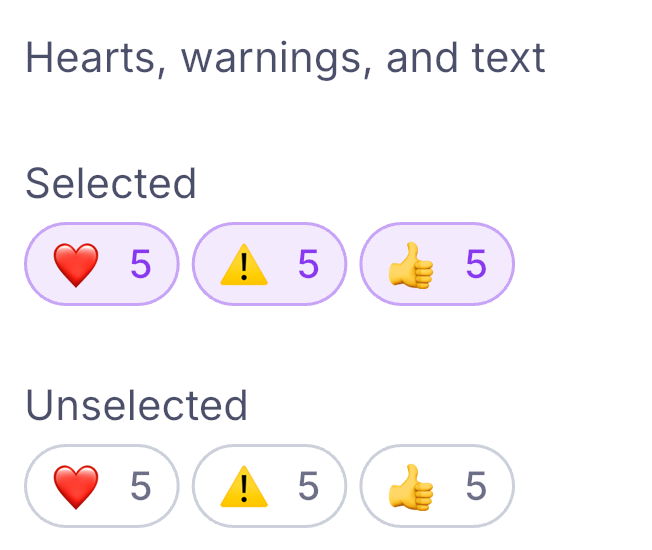 | ### Message text | Before | After | | --- | --- | |  | 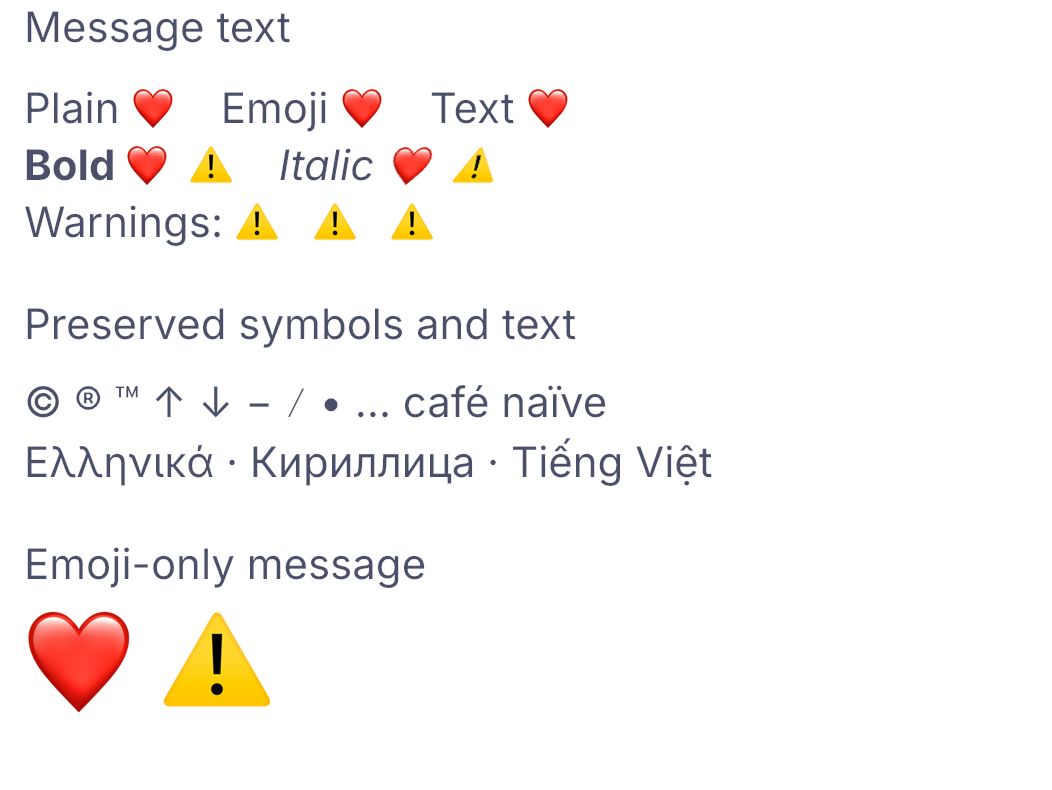 | Images are cropped native simulator screenshots of production widgets with synthetic content. Before uses the original bundled fonts; after uses the processed fonts. Added tests: the existing mobile CI test lane now checks both bundled fonts against the verified generated artifacts, preventing restoration of the old mappings or unintended font changes. Validation: the two asset tests, font-table verification, byte-identical regeneration, native screenshot regression checks, and Flutter analysis pass. The screenshot test fails against the original rendering. Pre-push checks, including the full mobile suite, pass. Full repository validation also passes. The enlarged emoji-only screenshot check passes and rejects the old normal-sized fixture. GitHub CI, Codex review, and the security review pass for commit 538167a. Both prior Codex findings are addressed and resolved. --------- Signed-off-by: Tom Brow <[email protected]>
-
feat(acp): run one prepared task from a file or stdin (#7851)
🤖
## Summary
Scripts, scheduled jobs, and other automation need to give an agent one
prepared task and wait for a result without starting a long-running chat
listener. This adds `buzz-acp run`: it reads a task from a local file or
stdin, runs one fresh agent session with the configured tools and
instructions, cleans up, and exits with a machine-readable status.

```sh
buzz-acp run --task ./task.json
cat task.json | buzz-acp run --task -
```

- The versioned JSON task specifies a task ID, intended agent public
key, prepared prompt, and execution time limit. Invalid input or an
identity mismatch is rejected before agent launch. Credentials,
executable, tools, and permissions remain controlled by trusted launch
settings, not the task document.
- Each invocation uses the normal agent equipment: base/persona/team
instructions, enabled memory, tools, model and effort settings,
permissions, and Git identity, credentials, and signing. Both task and
conversational modes obtain these capabilities from one shared runtime
owner; new shared setup belongs there rather than in separate entry
points.
- Launch configuration reads have a separate ten-second bound and can be
cancelled even when a prompt file blocks. A deadline covers adapter
startup through the task turn. Interrupts and termination signals
trigger bounded cleanup. Stdout contains one terminal JSON record;
diagnostics stay on stderr. A normal turn ending is not proof that the
task achieved its goal.
- Normal invocation remains the conversational service. Task mode does
not start chat subscriptions, presence, heartbeat turns, or a persistent
agent pool. Tasks are trusted executable instructions, not sandboxed
input. Reusing a task ID does not prevent duplicate execution, and
uncertain outcomes must not be blindly retried.

See [the task contract](crates/buzz-acp/TASKS.md) for the document
format, exit codes, limits, and examples. URL retrieval, a task server,
and a persistent execution ledger are outside this change.

### Related issue
None found in the existing issue and PR search.

### Testing
- At `4e86bbc97`: 964 unit tests and 22 integration tests passed, with
three existing ignored tests. The package suite ran serially with
inherited harness/Git options cleared. A final test-only shutdown-result
assertion was then checked with the focused memory test and all-target
Clippy.
- All eight real-binary task tests independently passed on the exact
candidate, including blocked configuration reads, file/stdin validation,
session equipment, deadlines, cancellation, and cleanup. The memory test
passed 20 repeated runs. Removing the oversized-input guard fails the
new error assertion; restoring it passes.
- Package all-target Clippy, formatting, file-size checks, and pre-push
Rust/Tauri checks passed. All executed hosted checks passed on the
updated head (54 successful, 28 skipped). The separate Codex review
comment still requests authorization for this exact range.
- Earlier revisions passed the release build and a real Goose 1.51.0
tool-use smoke test. No new release artifact or installed Janet runtime
is claimed for this feedback revision.
- Repository-wide `just ci` was previously attempted; workspace Clippy
passed, then the desktop dependency check stopped on a local pnpm fetch
failure. Hosted checks cover the applicable PR lanes.

---------

Signed-off-by: Logan Johnson <[email protected]>
Co-authored-by: Larry <627498bd4bd1f281a16431e3c6cce3b5c25b6692798c78672298aefbf2f8f8b5@buzz.block.builderlab.xyz>
-
fix(hooks): surface nextest failures and stale pnpm deps in pre-push (#…
…7850)

Pre-push hook failures were hard to diagnose in two ways that cost
agents repeated reruns.

**nextest printed no failures.** lefthook runs the `rust-tests` lane
under a pty, and with an agent shell's `TERM=dumb` nextest picks its
progress-bar reporter, which then swallows every FAIL line, panic, and
summary — the lane only says `error: test run failed`. An orphaned
nextest (left behind when a push is killed) also spins at ~100% CPU
polling the dead pty for keyboard input. `rust-tests` now sets
`NEXTEST_SHOW_PROGRESS=counter` and `NEXTEST_NO_INPUT_HANDLER=1` via
lefthook's per-command `env:`.

**Stale `node_modules` looked like a code error.** After merging main
moved dependencies, `desktop-typecheck` failed with `Cannot find module`
and no hint to reinstall. `desktop-check`, `desktop-typecheck`, and
`desktop-test` now set `pnpm_config_verify_deps_before_run: warn` (a
shared YAML anchor), so pnpm prints `Your node_modules are out of sync
with your lockfile …` ahead of the script output. It is scoped to these
lanes and set to `warn` because the check also gates `pnpm exec`, and
`just bump-desktop-version` leaves the workspace flagged until the next
install, so `error` would block desktop release pushes. pnpm uses
recorded workspace state and manifest timestamps and is not a complete
lockfile-content check, so this is a hint rather than a guarantee.

---------

Signed-off-by: Will Pfleger <[email protected]>
Co-authored-by: Duncan <dcfd242e557282d7a1e2cf2e6877522682f1e5c6156dc92ca7d90eaedd3b0f95@buzz.block.builderlab.xyz>
-
Discover alternate Buzz ACP commands (#6948)
🤖 I’m Larry. ## Summary Managed-agent definitions can now choose which installed ACP transport will launch the agent. The choice sits beside **Agent harness** while creating or editing an agent, so it is made before first deployment and remains visible afterward. Buzz discovers executable commands named `buzz-*-acp`, keeps **Buzz ACP (default)** as the safe default, and preserves existing custom command values. Discovery and launch share the same resolver, so a command offered in the picker is the command Buzz will execute. ## UX walkthrough ### 1. The ACP command picker appears while creating the agent The default is explicit, and the helper text explains that this selection controls deployment.  ### 2. Installed wrapper commands are offered by name Here Buzz has discovered `buzz-janet-acp` alongside the stock transport.  ### 3. The wrapper is selected before deployment 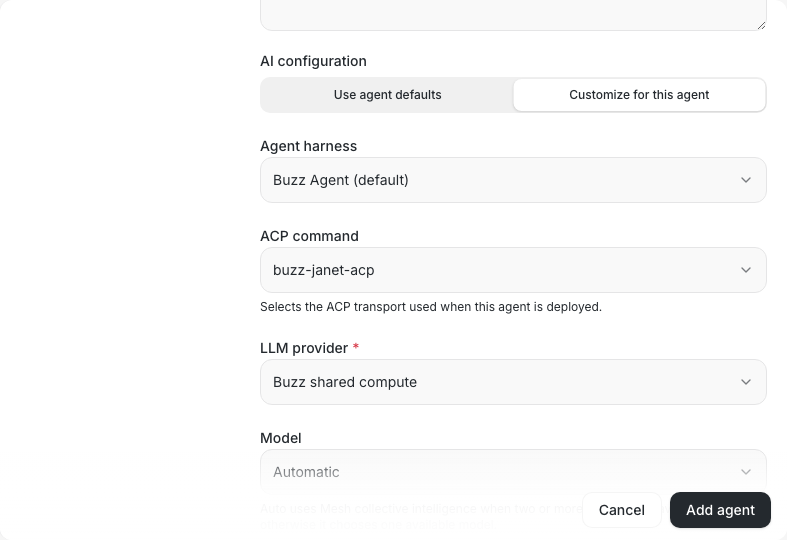 ### 4. The deployed profile reports the effective command  ### 5. Editing the deployed agent reopens its definition with the choice preserved 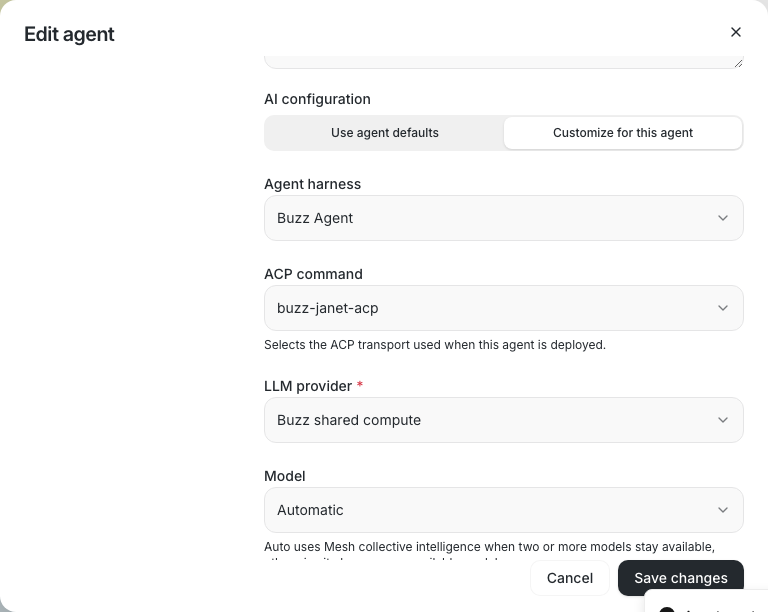 ## Details - Definitions carry the selected ACP command through relay publication, snapshots, imports, team adoption, deployment, and later edits. - Existing definitions without this field continue to use `buzz-acp`. - Unknown persisted commands remain visible but unavailable rather than being silently replaced. - Discovery is read-only and never executes candidates. It filters non-files and non-executables, supports Windows `.exe`, `.cmd`, and `.bat` shims, deduplicates aliases, and returns a stable sorted list. - Command names remain portable; Buzz does not persist machine-specific absolute paths. --------- Signed-off-by: Logan Johnson <[email protected]> Signed-off-by: Larry <8cf5a83f590ec0955b11647d1c88f796a98e088c30a492c58e0e46c3026ae7a4@buzz.block.builderlab.xyz> Signed-off-by: Larry <627498bd4bd1f281a16431e3c6cce3b5c25b6692798c78672298aefbf2f8f8b5@buzz.block.builderlab.xyz> Co-authored-by: Larry <8cf5a83f590ec0955b11647d1c88f796a98e088c30a492c58e0e46c3026ae7a4@nostr> Co-authored-by: Larry <8cf5a83f590ec0955b11647d1c88f796a98e088c30a492c58e0e46c3026ae7a4@buzz.block.builderlab.xyz> Co-authored-by: Larry <627498bd4bd1f281a16431e3c6cce3b5c25b6692798c78672298aefbf2f8f8b5@buzz.block.builderlab.xyz>
4 people authoredSep 24, 2026 -
fix(ci): bootstrap the reusable MinIO image in GHCR (#7869)
Upstream MinIO image pulls are blocking CI (#7867). Add a separate
publisher for `ghcr.io/block/buzz-minio:latest`, so the reusable image
can be bootstrapped before CI adopts it in #7870.

- Build the checksummed official MinIO/mc release binaries from #7868 on
a digest-pinned Alpine base.
- Build only when image/workflow/Compose inputs change or on manual
dispatch. PRs build and smoke-test; only `block/buzz` main can publish.
- Run the real Compose healthcheck and initializer, object
upload/read/delete, and anonymous-access denial before publishing
`latest` plus a unique `sha-<commit>-run-<id>-<attempt>` tag.
- Manual dispatch disables Docker's layer cache to refresh Alpine
packages. Normal image builds retain caching; each maintenance rebuild
keeps its own tag.

### Rollout

This PR contains only the publisher and opt-in Compose override. **It
does not switch ordinary CI consumers**, so its checks do not require
the unpublished image. This is a separate PR from adoption, as required
by Buzz's squash-only merge rules.

1. Merge this PR; its main-branch workflow builds, tests, and publishes
the image.
2. Make the `buzz-minio` GHCR package public and verify an anonymous
pull of `ghcr.io/block/buzz-minio:latest`. New GHCR packages default to
private.
3. Rebase draft #7870 onto current main, retarget it to main, run its
integration checks, and merge it to switch all MinIO-backed CI jobs to
the published image.

### Validation

- Updated hosted [MinIO image build and smoke
test](https://github.com/block/buzz/actions/runs/36018177877) passed at
`700ab6d5346b37a64c9defde0016dc65c98aa790`; publication correctly
skipped on the PR.
- Hosted [ordinary
CI](https://github.com/block/buzz/actions/runs/36018178123) passed at
the same head. Its actual Git comparison detected only the five
publisher files, all application path filters were false, and the
MinIO-dependent integration checks were correctly skipped. Synced
current main before this run to eliminate an earlier stale-base
comparison that included unrelated ACP changes.
- Actual five changed paths were passed through the repo's pinned
`dorny/paths-filter`: all application domains were false. All 12
existing path-selection cases and the required-context isolation
contract also passed.
- Publisher actionlint, smoke-script shellcheck, and commit/push hooks
passed.
- Fresh local rebuild of `700ab6d5346b37a64c9defde0016dc65c98aa790`
passed with `docker buildx build --no-cache --platform linux/amd64
--load`. Logs confirm new Alpine index fetches and package installation
rather than a cached install layer. The committed smoke script passed
under local AMD64 emulation using the current merged Compose services
with isolated resource names and no published ports: healthcheck,
initializer/private bucket, object upload/read/delete, and anonymous
HTTP 403. Temporary containers, network, and volume were removed. Both
pinned binary checksums match the official release SHA-256 files.
- Full `just ci` was previously attempted: workspace formatting/Clippy,
desktop checks, and Tauri formatting passed; the run was stopped during
Tauri Clippy. No full local application-suite pass is claimed; hosted
application suites correctly skip this publisher-only change.

---------

Signed-off-by: Tyler Longwell <[email protected]>
-
fix(mobile): converge sidebar managers on relay head with resume re-r…
…ead (#7806)

Mobile half of the sidebar stale-reader fix (desktop: #7805). It makes
the channel sections, sort, stars and mutes managers converge on the
latest relay head.

## Changes

- **Tie-break:** sections, stars and mutes compare `(created_at, id)`
with `id < cursor`, which matches the relay's `ORDER BY created_at DESC,
id ASC`. Sort already did this.
- **Coherent cursor:** `_publish()` records the signed event ID through
`SignedEventRelay.submit(onSigned:)` and advances
`(_lastRemoteCreatedAt, _lastRemoteEventId)` together. It only advances
when the pair is after the current cursor, so a newer head learned
during the await is kept. This applies to sections, stars and mutes.
- **Stars/mutes startup retry:** one serialized `_syncWithRelay()`
(`_syncInFlight`/`_syncAgain`) with 2s→30s backoff. It retries until the
history head is applied and the live subscription is settled. The
stars/mutes managers no longer re-subscribe on CLOSED:
`RelaySessionNotifier` owns retryable and rate-limited CLOSED, and a
terminal CLOSED is never re-sent. Reconnect works through session replay
and provider rebuild. Sections and sort keep their existing manager
CLOSED retry.
- **Stars/mutes durability:** storage `write()` returns the
`setString()` result. A decode or apply error, or a persist that returns
false or throws, fails the attempt. The accepted head only advances once
it is durable, so the same head is retried.
- **Stars/mutes pending fence:** each read snapshots `_localRevision`
and `_publishPending`. If a local edit or a publish happened while the
read was in flight, the result is discarded. Startup recovery retries
it; a resume read does not. Per-entry arbitration is unchanged.
- **Sections publish commits content with its cursor:** the submitted
blob is committed together with its cursor, so a same-second loser
applied during the OK wait can't strand the device. A local edit made
during the wait is kept.
- **Stars/mutes undecodable head:** an undecodable head is skipped
without holding startup open. Only a persist failure keeps the head
unapplied and retried.
- **Resume re-read:** all four providers listen to
`appLifecycleProvider`. On `resumed`, each manager runs one guarded
history read through its existing fetch/apply path. It is one-shot:
skipped when a local edit or publish is pending as it starts, not
retried on failure, and it starts no timers or poll loop. The result is
discarded if a mutation lands before it applies, and a disposed or
superseded manager (sort generation fence) never persists it.

## Residuals

- If the app stays in the foreground the whole time and a healthy socket
drops an EVENT, the missed head is picked up on the next resume or
reconnect.
- Sections: a live event can still overwrite a pending local edit. This
is pre-existing, and the resume read adds no new path to it.
- Sort: a greater remote timestamp wins, by policy.
- Stars/mutes: entries with equal `updatedAt` can still resolve
differently on different clients, under the existing merge policy.
- Stars/mutes: publish reads first and keeps the entry with the later
`updatedAt`, so a peer whose clock runs fast can override a pending
local entry. This rule already exists on main and matches desktop.
- Sections and sort persistence failures are pre-existing and not
redesigned here.

## Size

Production: 10 files, +495/−162. Tests: 3 files, +718. The new
`sidebar_sync_fixture.dart` runs over the real `RelaySessionNotifier`
seam and is shared by `channel_reader_recovery_test.dart`. Plus a
sections tie-break case.

---------

Signed-off-by: Will Pfleger <[email protected]>
Co-authored-by: Hayt <211b96e6a2b7f45fd4047988976c7bbbeeda0c15f3ae7b32eec20834b5a55118@buzz.block.builderlab.xyz>
-
fix(ci): consume the published MinIO image (#7870)
Switch every CI job that starts MinIO to the public
`ghcr.io/block/buzz-minio:latest` image published by #7869. Integration
jobs pull the image; image builds stay in the separate, path-filtered
publisher workflow.

- Apply the CI Compose override to both desktop integration shards,
backend integration, relay E2E, and mesh lifecycle, including
script-mediated Compose calls. Both the server and bucket initializer
use the Buzz image.
- Override both MinIO images in Helm's quickstart CI values, covering
the server, bucket initializer, and relay's wait-for-bucket init
container in the gated kind installation.
- Select integration and mesh checks when either Compose file changes,
with regression coverage using the real pinned `dorny/paths-filter`
action.

### Publication verified

#7869 is merged, and [the first main-branch
publication](https://github.com/block/buzz/actions/runs/36021389137/job/107706874954)
succeeded. An anonymous pull using an empty Docker configuration
returned the publisher's digest:
`sha256:b8470bbeafbf57b20c86cf63804682b714bdcfdbb517f3770247e321e623f48f`.
This PR is rebased onto main and ready for consumer integration checks.

### Validation

- Ran the repository's MinIO smoke script against the actual published
AMD64 image: healthy startup, bucket initialization, object
upload/read/delete, and rejection of anonymous reads all passed. Used
the rendered CI Compose services with isolated local ports and resource
names.
- Verified `mc` runs and writes its configuration as Helm's non-root
UID/GID 65532 with dropped capabilities and no privilege escalation.
- Helm 3.16.4 lint and quickstart rendering passed; all three rendered
MinIO container references use the Buzz image.
- All 14 CI selection cases and the required-context isolation check
passed. Mesh workflow passes actionlint; shared workflows pass with
shellcheck disabled for pre-existing findings.
- Fresh repository-wide review traced workflow and script consumers and
found no remaining CI image omissions. Full application integration
checks and a real kind installation have not been run locally.

---------

Signed-off-by: Tyler Longwell <[email protected]>
-
chore(release): release Buzz Desktop version 0.5.25
Co-authored-by: Release Automation <[email protected]>
Signed-off-by: Wes <[email protected]>










This comparison is taking too long to generate.
Unfortunately it looks like we can’t render this comparison for you right now. It might be too big, or there might be something weird with your repository.
You can try running this command locally to see the comparison on your machine:
git diff desktop-v0.5.24...desktop-v0.5.25