
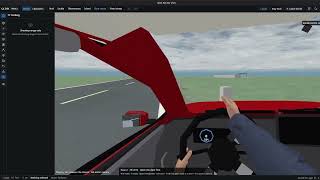
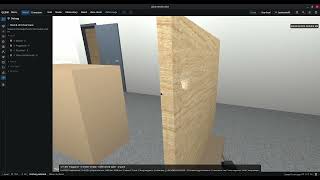
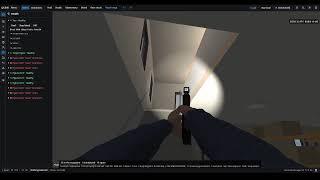
| Race Track Test & Soft-Body Damage | Bullet Penetration & Dynamic Surface | Early Build: Shoothouse Run |
|---|---|---|
 |
 |
 |
qlink is an independent research project that brings wired PC VR to Linux for the Meta Quest 3. The PC renders the whole VR world, including the home, the avatar and its body IK, the applications and the final frames. It streams the result over the USB cable to the stock Quest Link receiver. Nothing is installed on the headset, and no custom Quest app is involved.
- No Quest Link PC app. qlink runs on Linux without Meta's Quest Link (Oculus) PC software. The Linux host talks to the stock Link receiver on the headset directly.
- The PC world is the Link home. The headset shows a PC-rendered world in place of the usual Link home. The desktop can play the same world in 2D. A new shared simulation is being integrated; the headset path has not switched to it yet.
- Goal: replace the Link app completely. A future OpenXR runtime is meant to let Steam and other VR games start through qlink, and return to the home afterwards (see the roadmap). This is planned, not available yet.
This repository is a public preview. It shows progress through renders, videos and short write-ups. The source code, internal research notes and protocol documentation are not published here.
Status: experimental research, not a product. It has been tested on one Quest 3 with one PC (RTX 3080, Linux). Not affiliated with or endorsed by Meta.
Important
Very early development version. qlink is under active development. Work is focused on making the full path run reliably and on improving it step by step. Many parts are incomplete, and things change quickly.
Renders are updated regularly, so this repository shows how the project progresses over time. See the progress log.
Test versions and contributors: there are no public builds yet. Later, test versions and collaboration will be offered by invitation. If you are interested, open a tester interest or offer to help issue.
Ideas and feedback are welcome through issues and Discussions. See CONTRIBUTING.md.

- Native USB streaming to the stock Link receiver. On one Quest 3, the Linux host completed the session handshake and started the stock Link runtime. It streamed a PC-rendered world as 4128 × 2208 side-by-side HEVC at 72 Hz while receiving head, controller and optical-hand tracking. One bounded run displayed frames for 120 s.
- The PC does all the rendering. Vulkan is the current default and draws at full headset resolution with in-process HEVC encoding; its current headset appearance and cadence still need a live repeat. A multithreaded CPU renderer remains available as fallback.
- Own engine and worlds. Built-in worlds include an airfield, an island with shallow-water surf, an underwater reef, weather and grass and palms you can touch. There is also a race circuit with a drivable car and a shooting range with a two-storey, six-room training house.
- Full-body avatars. Anatomical characters with 49 joints, all ten fingers animated, faces with expressions, clothing layers, and IK driven by head and hand tracking.
- Player health simulation. Projectile paths are traced through body regions and internal organs. Fractures, bleeding, breathing, consciousness, movement, weapon grip and death all follow from the hits.
- Aircraft and weather. Three test aircraft (a Cessna-class light plane, a delta-canard twin-jet fighter and a utility helicopter) fly in an airfield world with dynamic weather: wind, gusts, rain on the glass, wing vapour and a clear-sky-to-thunderstorm cycle with rain, wind and thunder sound. Aircraft use original, unbranded models and invented, plausibly scaled numbers. Offline PC and desktop only.
- Aircraft damage and crew. Aircraft and a car have an internal structure: hits, overload, fires, explosions and crashes break it apart part by part. Pilots wear flight gear with oxygen and night vision, and can black out from altitude or g-force. Offline only.
- NPC tactics. Opt-in NPC sight, hearing, alert levels, morale and cover, squad commands and a squad leader trained by reinforcement learning. Offline only.
- Three new PC worlds. Arena stages melee and archery bouts, Biomes connects meadows and woodland with trails, and No Man's Land runs a trench battle with NPC squads and simulated mortar impacts.
- Market town and arena wars. Market Crossroads is lived in by named residents who trade, eat, rest and patrol, with missions where the town watch meets armed intruders. It lies in a mountain valley with a river and a timber bridge, and its south road hosts battles of up to 200 NPCs a side. The arena stages 17 authored NPC wars of up to 50 against 50: shield walls, pike blocks, archery lines and armour or skill matchups, with groups marching in formations. Offline PC only.
- Physical simulation. Firearm mechanics, material damage (bullet holes, shoot-through walls, breaking timber, ricochets and fragments), vehicle dynamics and crash deformation, shallow-water surf, foliage contact and ragdolls.
- Tooling. A desktop console and world editor, a character studio, plus Animation Lab, Sound Lab, Crash Lab and a scripted clip maker.
The project now has a fixed-tick Rust simulation with an entity component system, rigid-body physics and shared rules for players, NPCs, items, weapons, injuries and vehicles. The desktop console enables the new simulation path by default. Its shooting-range integration is still being completed: some course and player state remains in the older home code. The native headset session still uses that older path. Simulation details and the architecture show the current split.
A server-authoritative game network can replicate VR and desktop player inputs and simulation state. It has passed synthetic packet-loss tests and local UDP loopback tests. There has been no validated live multiplayer session between PCs or with a headset. Secure connections, interest management and a persistent shared world are future work. The game network is separate from the Quest Link USB connection.
These features run in the PC build or have passed offline PC tests and render reviews. Their appearance and controls in the current headset build still need separate validation.
- Places to explore: a generated island with beach, surf, underwater reef, swimming, rain, clouds, grass and touch-reactive plants; a race circuit; and a shooting range with targets, a shooting house and a two-storey, six-room training house.
- Training-house encounters: shuffled hostage and armed-suspect scenarios, backup gunmen, cover-aware return fire, wound reactions, dropped weapons, room progression and a saved score. The house has stairs, furnished rooms and a fire-escape route.
- Weapons and interaction: a P9 pistol and M4-style carbine with magazines and fire controls; loose cartridges, pickup and inventory; a P9 flashlight and red-dot sight; muzzle light, recoil and shot view shake. A desktop player can use bandages to stop bleeding in a reachable body region.
- Physical consequences: material-dependent bullet marks, shoot-through plywood, falling timber, ricochets and fragments; organ injuries, bleeding, fractures and visible wounds; car crashes that bend panels and damage tyres; sliding tyre marks.
- Players and presentation: full-body IK, animated fingers, facial expressions, clothing with protection and wet or damaged appearance, held-weapon animation, sun shadows and PC-side footsteps and weapon/vehicle sounds.
- PC tools: the desktop console and world editor, a categorized Asset Viewer, Character Studio, Animation Lab, Weapon Lab, Sound Lab, Cloth Lab, Crash Lab and scripted scene export.
The feature inventory separates offline, live and planned status for each area.
The November 28 gallery shows offline PC renders. The four dry Biomes landscapes come from the desktop OpenGL viewport. The rainy trail, Market Crossroads, the arena battles and the other game scenes use Vulkan on an RTX 3080. The Asset Lab renders below show each vehicle in isolation.
A timber-framed market town at a crossroads, lived in by named residents with their own work, meals, rest and rounds. Missions set the day: an everyday market, a harvest delivery, an evening at the forest lodge, or an armed stranger reaching the east watch, the farm road or the timber road. All views come from the shared simulation running the mission.
| Market square | East watch |
|---|---|
 |
 |
| Market day from above | Residents |
 |
 |
| The merchant greets a customer | Afternoon shift at the produce stall |
 |
 |
When a visitor steps up, the merchant greets them and shows his goods, then returns to waiting once they leave. In the afternoon the farmhand walks from the barn to the produce stall and takes over the counter. Customers at a counter are now served in arrival order, and residents on their way to work stop once a day to buy something and put it in their bag.
The town now lies in a valley about 700 m across, ringed by forested mountains with rock and snow on the peaks. A river comes down from a gorge in the north-east and passes the east watch, where the east road crosses it on a timber trestle bridge built from a modular kit (bay, trestle and abutment pieces). On the south road a muster field hosts battles of up to 200 NPCs a side, set up with the arena's fight panel.
| Valley and river from above | Timber bridge on the east road |
|---|---|
 |
 |
Two NPCs fight a longsword bout driven by the shared simulation. The side camera shows the fighters closing distance and raising their swords.
| Closing distance | High guard |
|---|---|
 |
 |
The arena also stages whole battles: 17 authored wars, most 50 against 50, in four groups (mixed wars, one weapon a side, matchups, and armour or skill). Every fighter is a simulated NPC with its own weapon, armour and morale; the player joins South's front rank in a red tunic. The views below were taken 6 to 10 s after the start, as the lines meet.
| Shield wall (30 vs 30, mail) | Great shield wall (50 vs 50) |
|---|---|
 |
 |
| Pikes against shields (38 vs 50) | Push of pike (40 vs 40) |
 |
 |
| Archery battle (50 vs 50) | Pitched battle (50 vs 50) |
 |
 |
NPC groups can now march in formation: besides the shield wall there are the testudo with a roof of shields against arrows, a two-rank spear wall, open order and the wedge. Leaders pick one from their group's weapons, or each side's drill is set for the round. On the war bench the formations hold their shape, but against archers they cost more than they save, so leaders take none against bows.
| Testudo walking in | Spear wall |
|---|---|
 |
 |
Trails link open meadow, broadleaf and conifer woods, heath, a river and a marsh lake. The map offers ten named starting points.
| Lake and forest overview | Meadow trail |
|---|---|
 |
 |
| Woodland edge | Birch grove |
 |
|
After one scripted walk, footprints press into the rain-soaked woodland trail. The two Vulkan views show the same trail from standing height and up close.
| Woodland trail in the rain | Footprints in the mud |
|---|---|
 |
 |
One simulated mortar impact seen from 35 m away. The flash gives way to thrown earth and a lingering dust column.
| Flash at 0.10 s | Thrown earth at 0.63 s | Dust at 2.53 s |
|---|---|---|
 |
 |
 |
 |
 |
| Delta-canard fighter: pilot in flight suit, helmet and oxygen mask, hands on stick and throttle | Fighter cockpit with the canopy open |
 |
 |
| Helicopter pilot with modular helmet, night-vision goggles and mask on cyclic and collective | Utility helicopter with its pilot at the airfield |
 |
 |
| Fighter on the apron with its pilot | Helicopter stores carrier: seven-tube rocket pod with a six-barrel gun below it |
 |
 |
| Cessna-class plane: seated pilot at the panel | Powered glass cockpit in the Asset Lab, with the primary flight display above three standby instruments |
 |
 |
| Drivable hatchback at the circuit's finish line | Airfield with runway, apron and hangars |
| Fighter | Cessna-class plane | Helicopter | Hatchback |
|---|---|---|---|
 |
 |
 |
 |
The bottom row shows the vehicle models in the Asset Lab. All vehicles are original, unbranded models.
| Operator | Civilian | Jet pilot | Helicopter pilot |
|---|---|---|---|
 |
 |
 |
 |
| Camouflage uniform, plate carrier, combat helmet | Dark shirt and jeans | Flight suit, helmet and oxygen mask | Modular helmet with night-vision goggles and oxygen mask |
 |
 |
| Jet helmet with visor and oxygen mask | Helicopter helmet with night-vision goggles |
All four outfits are shown on the same GPU-skinned avatar at the shooting range.
 |
 |
| Island with sea and surf from above | Palms, plants and grass that react to touch |
 |
 |
| Beach, palm shade and shoreline | Grass slope down to the beach |
Ocean video: surf and water motion over 4 s · beach view
 |
 |
| Range lanes with distance boards and targets | Shooting counter with pistol and magazines |
 |
 |
| Shoothouse and two-storey training house | The whole range from above |
 |
 |
| Race circuit start line | Circuit hillcrest |
 |
 |
| Anatomical face with eyes, teeth and expression rig | A grid of 128 GPU-skinned avatars |
| Clip | Video |
|---|---|
| Pistol reload: magazine change and slide rack | pistol-reload.mp4 |
| Pistol draw and aim, full body | pistol-draw-aim.mp4 |
| Walk cycle with foot locking | walk-cycle.mp4 |
Clips are rig-independent .qlanim files. They are edited in Animation Lab and can be recorded from the wearer's PC-solved pose in VR.
- Features: what exists today, and how far each part is validated
- Simulation and health: the shared simulation, multiplayer boundary, health, damage, vehicles, water and physics
- Architecture: how the pieces fit together at a high level
- Progress log: development timeline
- Roadmap: where the project is heading
- Clean-room. Behaviour is observed and documented independently. No proprietary runtime code, drivers, SDK headers or assets are copied or redistributed.
- No circumvention. No bypassing of authentication, entitlement, DRM or encryption, and no collection of credentials or account data.
- Evidence first. A capability is claimed only after a dated test under stated conditions. Offline and synthetic results are labelled as such.
Preview updated 2026-11-28.