Repository navigation
Add multirate split ODE work-precision benchmarks - #1629
Conversation


|
why is this a separate folder? Why not in the handwritten pdes? |

|
moved it into SimpleHandwrittenPDE as multirate_wpd.jmd, folder deleted. added the seven missing deps to that env (Multirate pinned 2.7 in compat, the resolver initially picked 2.6 which lacks ESDIRK46a) and re-ran all 12 blocks there, reference agreements at 1e-14. |
|
But why these other problems instead of the standard PDEs? I don't see a reason for a new file like this. |

3b1b3b1 to
a353a86
Compare
|
moved them into the standard notebooks and deleted the file. reran all three end to end, description updated with the new figures. the implicit mri-gark members genuinely win on ks, the explicit ones tie cnab2 there, and allen cahn stays as the null case where tsit5 wins. |
|
The cross family checks aren't consistent here. Tsit5, Rodas5P, FBDF (NordsieckBDF), KenCarp4, ETDRK4, and the new methods would get a good feel for how it's done. I'll probably do some passes to improve this a bit but it would be nice to at least see these plots for now.
It has an accuracy limit though, which is the expected issue. |
|
added the cross family set to every multirate plot and reran everything. the honest version: fbdf owns ks outright, tsit5 owns the middle of burgers and allen cahn, and the multirate members only earn their cost below 1e-8 on burgers or under a fixed split constraint on ks. also found a nasty one while debugging: calling a SplitFunction directly corrupts prob.u0 through its aliased internal cache, will file that upstream. |
|
Show the plots I'm curious |
|
they're in the updated PR description too, but inline: burgers (tsit5 mid-range, multirate below 1e-8): ks explicit (fbdf owns it): ks implicit (beats same-split kencarps 30-300x, still loses to fbdf/tsit5 unconstrained): allen cahn (null case, tsit5 wins): |
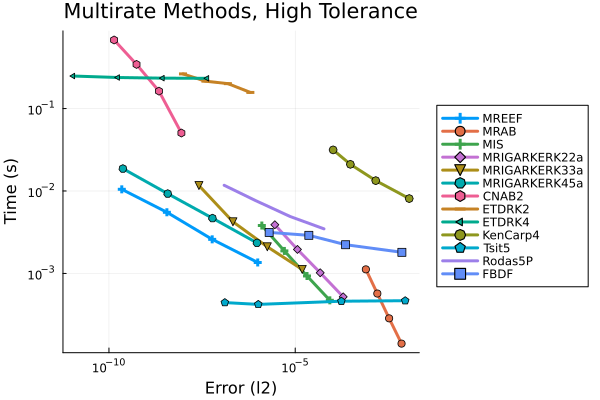
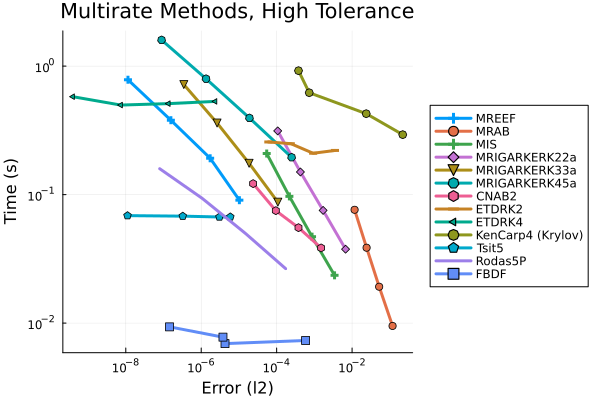
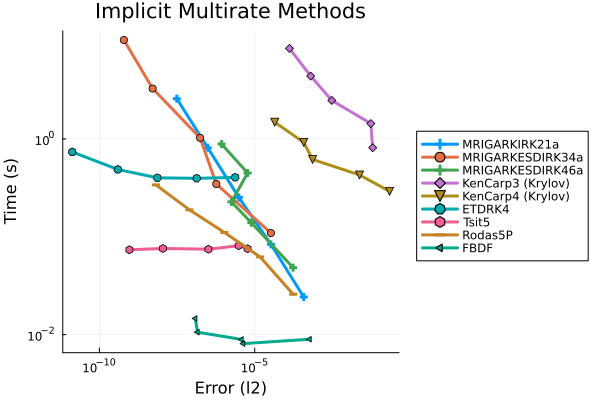
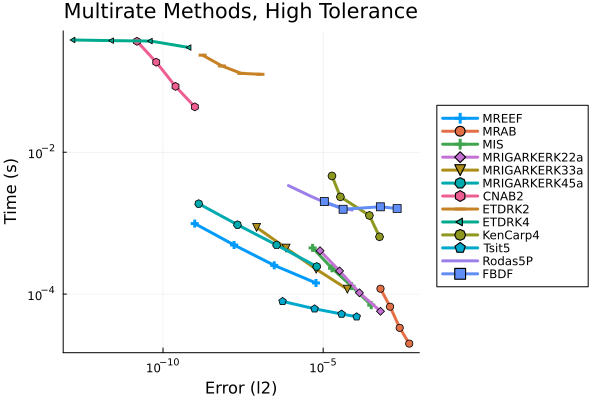

|
Not the best result but, maybe it can keep getting tuned. It's just the start for those methods. |


…currency (#1666)

The Benchmarks workflow used a single concurrency group for every master
run (`benchmarks-refs/heads/master`). GitHub permits one running + one
pending run per group and a newly queued run cancels the pending one, so:

- run 32024671720 (#1651) has held the group since Aug 19 because its
  SimpleHandwrittenPDE job is multi-day; LinearSolve / ComplicatedPDE /
  AstroChem / LinearSolveGPU results from that run can't publish until it
  ends (timeout is 200 h) while amdci1-1 sits idle;
- run 32389171706 (#1663, NonStiffSDE) was parked pending and then
  cancelled at 2026-08-21T19:27:27Z, the second run 32518558085 (#1641)
  was queued; its benchmark jobs never ran;
- run 31479805309 (#1629) had DynamicalODE / NonlinearProblem /
  LinearSolveDistributed succeed but queued siblings expired (>24 h), the
  run was marked cancelled, and Publish Results was skipped, so those
  results never reached SciMLBenchmarksOutput.

Changes:

* Group master runs (push and workflow_dispatch) by run id instead of by
  ref, so they run concurrently across the self-hosted runners and never
  evict each other. PR runs keep the per-ref cancel-in-progress group.
* Drop the job-level `scimlbenchmarks-deploy` group on Publish Results —
  it has the same one-pending semantics and would cancel a publish (and
  lose that run's results) when several master runs finish close together.
* Make publish_benchmark_output.sh tolerate concurrent publishers instead:
  clone → copy → commit → push in a retry loop; on a non-fast-forward
  rejection it re-clones and retries (default 6 attempts with jitter).
  Each attempt lays the same files over the newest output, so there is
  nothing to merge. Also exits early when no artifact dirs exist, and uses
  a depth-1 clone. The remote URL and a pre-push hook are overridable via
  env for local testing; a local two-publisher test against a bare repo
  exercised the rejected → retried → published path.


Claude-Session: https://claude.ai/code/session_01KrTtUuDkfgNEq3asQuZ3F6

Co-authored-by: Claude Fable 5 <[email protected]>


Adds work-precision benchmarks for the OrdinaryDiffEqMultirate solvers (MREEF, MRAB, MIS, and the explicit and solve-decoupled implicit MRI-GARK families) to the SimpleHandwrittenPDE suite. The methods run inside the existing Burgers, Kuramoto-Sivashinsky and Allen-Cahn notebooks against each file's own references plus a consistent cross-family reference set in every multirate plot: Tsit5, Rodas5P, FBDF, KenCarp4 and ETDRK4. No new files.
On Burgers, adaptive Tsit5 is the fastest method through the middle of the range (stability capped at half a millisecond while its error falls to 1.3e-7), and the multirate members' territory is the tight end: MREEF reaches 2.2e-10 in about 10 ms, errors no adaptive reference touches, with only fixed-step ETDRK4 going deeper at 25x the cost. The prose attributes that tight-end margin to step economics, not multirate structure:
Kuramoto-Sivashinsky is decided by the cross-family references: FBDF dominates outright (7 to 9 ms per solve across the sweep, one to two orders cheaper than anything else at matched error), and the explicit multirate members are not competitive there, which the notebook states plainly:
The implicit MRI-GARK members on the reversed split beat the KenCarps making the same term assignment by 30 to 300x at matched error, but the notebook caps the claim: FBDF and Tsit5 on the joined problem beat the best multirate member by one to two orders once the split constraint is dropped. One stated wart: ESDIRK46a's error stops responding at the tightest tolerances:
Allen-Cahn is the null case: no rate separation, Tsit5 fastest at every error it reaches, the micro substepping is pure overhead, and the section documents the boundary of the family's applicability:
All three notebooks were executed end to end (Burgers and Allen-Cahn fully in CI, KS through all multirate blocks in CI with the untouched pre-existing low-tolerance block verified separately); the figures above are from those runs and the benchmark server regenerates them from the jmd. Writing the cross-family blocks also surfaced that a direct call of a SplitFunction corrupts prob.u0 through its aliased internal cache, which will be filed upstream separately. The linearly implicit extrapolated member (MREIL) follows once OrdinaryDiffEqMultirateImplicit is registered.
AI Disclosure
Claude assisted with this work.