

Metamorphic coherence testing for typed probabilistic decision models
Do a model's probabilities fit together? 50 laws of probability and choice, no gold labels.


Typed probabilistic decision models answer questions about a fixed input with probability distributions over declared answers: yes or no (a Noul), one of several options (a Choice), or a level on an ordered scale (a Score). Beyond the robustness expected of any language model, these classification-like outputs raise a further question: do their probabilities stay coherent?
- A question and its negation should sum to one.
- Merging two options should merge their probabilities.
- A conjunction should never be more probable than either conjunct.
- Removing an irrelevant option should leave the others' relative probabilities unchanged.
- An answer should not depend on which other questions are asked with it.
JevBench turns such laws into 50 metamorphic relations. Every test edits only the question side, never the input, so no correct answer is needed; and every request is frozen in advance, so every model answers exactly the same tests.
| 50 relations | 240 cases | 12,000 frozen tests | 21 open models |
|---|---|---|---|
| in 5 dimensions | in 12 decision domains | 1,200 in the reported suite | 48M to 9.7B parameters |
| Dimension | What changes | Example law | Relations | |
|---|---|---|---|---|
| REP | Representation consistency | the description of the same events | options reordered: the probabilities follow the options | 15 |
| BAT | Batch independence | the other questions of the request | batch reversed: every answer stays the same | 5 |
| MEA | Probability measure coherence | the events of one probability measure | a question and its negation sum to one | 17 |
| LOG | Logical coherence | propositions ordered by entailment | P(A and B) ≤ min{P(A), P(B)} | 10 |
| CHO | Choice-set coherence | the menu a Choice is conditioned on | an option removed: the rest keep their proportions | 3 |
Each dimension is the mean of its relations' pass rates, and the overall score is the mean of the five dimensions. A test passes when its law holds within 0.05 in probability.
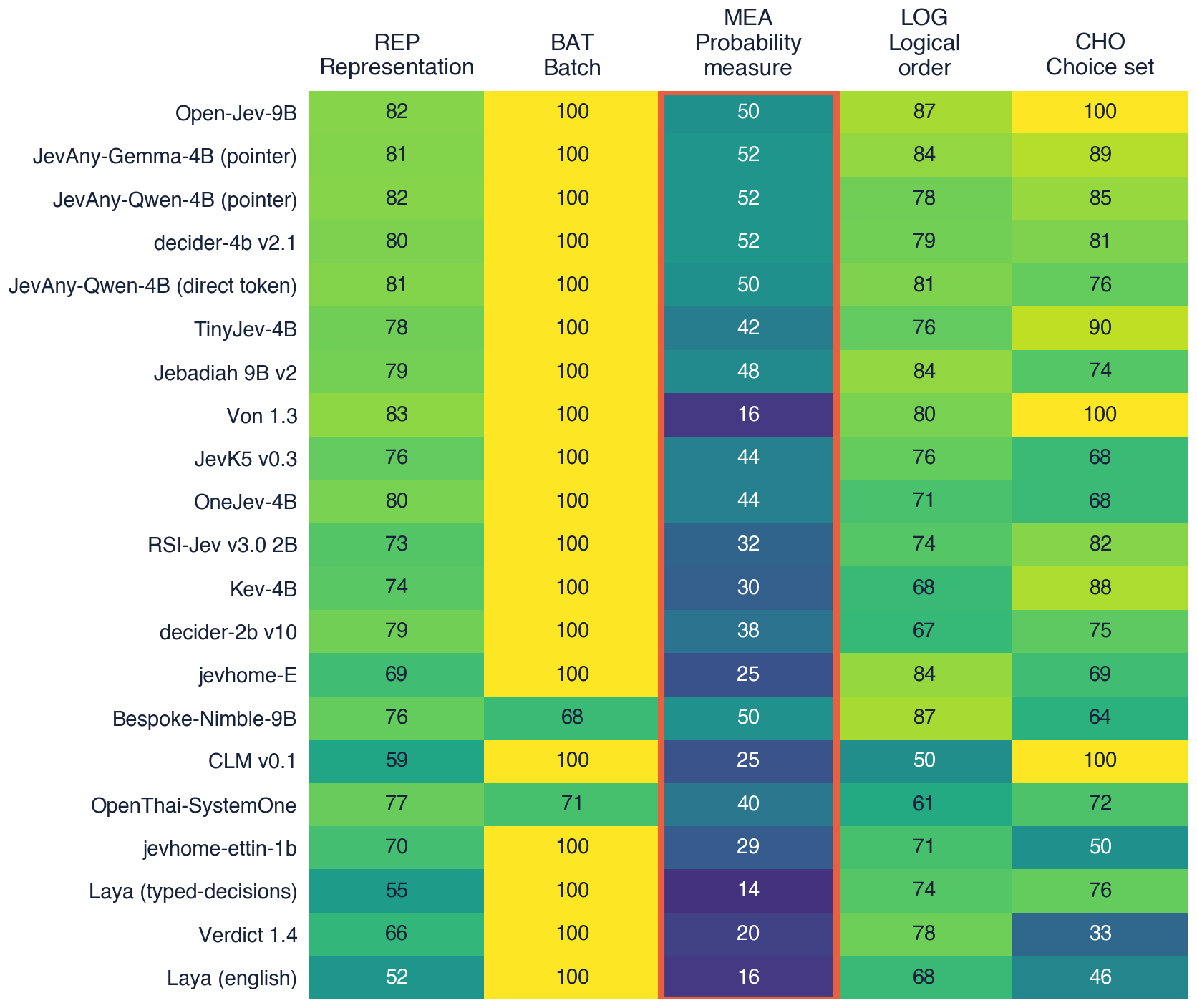
Dimension scores of the 21 models on JevBench-mini. Probability-measure coherence (MEA) is the weakest dimension of every model.
Top 10 of 21 openly released models on JevBench-mini (snapshot of release 0.1.0):
| # | Model | Readout | Size | Coherence | Accuracy |
|---|---|---|---|---|---|
| 1 | Open-Jev-9B | decoder · scorer head | 9.7B | 83.9 | 88.4% |
| 2 | JevAny-Gemma-4B (pointer) | decoder · pointer head | E4B | 81.2 | 87.6% |
| 3 | JevAny-Qwen-4B (pointer) | decoder · pointer head | 4B | 79.4 | 88.8% |
| 4 | decider-4b v2.1 | decoder · letter logits | 4.2B | 78.4 | 88.6% |
| 5 | JevAny-Qwen-4B (direct token) | decoder · letter logits | 4B | 77.8 | 88.6% |
| 6 | TinyJev-4B | decoder · pointer head | 4.0B | 77.3 | 86.6% |
| 7 | Jebadiah 9B v2 | decoder · letter logits | 9.65B | 76.9 | 89.1% |
| 8 | Von 1.3 | encoder · option markers | 395M | 75.9 | 72.2% |
| 9 | JevK5 v0.3 | decoder · letter logits | 4.2B | 72.8 | 88.1% |
| 10 | OneJev-4B | decoder · letter logits | 5.2B | 72.5 | 89.2% |
| – | Uniform reference (ignores its input) | reference | – | 89.4 | 39.8% |
Reading the scores. Coherence is not correctness: a model that ignores its input and answers uniformly scores 89.4 at chance accuracy, so read every score beside accuracy. Models a few points apart are ties (their 95% intervals overlap). The full leaderboard, the scores by dimension and group, and every model's complete report are on jevbench.github.io.
Key findings. Additivity is the weak spot: a templated negation sums to one with its question in only 7% of tests on average. Batch independence mostly holds (19 of 21 models keep every batch law). Among decoders, accuracy sits in a narrow 82–89% band while coherence ranges from 64 to 84.
pip install jevbench                                     # Python 3.10+, depends only on httpx
jevbench eval --backend fake:coherent --suite examples   # a few seconds: check the installation
import jevbench as jb
model = jb.systemone("http://127.0.0.1:8000/v1/systemone", model="my-model")
jb.check(model) # one request: is every answer in the standard format?
report = jb.evaluate(model) # JevBench-mini, the reported suite (1,248 requests)
print(report.table("dimension")) # also "group" and "relation"
report.save("runs/my-model.json")The same from the shell:
jevbench check --url http://127.0.0.1:8000/v1/systemone --model my-model
jevbench eval --url http://127.0.0.1:8000/v1/systemone --model my-model --out runs/my-model.json- Suites.
jevbench-mini(default, the one results are reported on),jevbench-240(every test, narrower intervals) andexamples(one case, to check that a model works). - Speed. Requests are cached. Pass several comma-separated URLs to use replicas of one model; JevBench keeps one request in flight per replica, which reproduces the sequential answers.
- In-process models.
jb.from_callable(fn, name="my-model-v1")tests any Python functionfn(state, questions) -> answers. - Your own data.
jb.evaluate(model, cases="my-cases.jsonl"); generate cases for a new domain withjevbench datagen(docs/datagen.md).
JevBench reads the standard Jev format and nothing else: a model that returns another format is asked to adapt,
with a message that says how. Check a model before a full run with jevbench check or jb.check(model).
What the model receives. A state (the input to decide about: text or JSON, never changed by JevBench) and a
batch of typed questions, keyed by question id:
{
  "model": "my-model",
  "state": "Customer writes: Our nightly export has failed three nights in a row...",
  "questions": {
    "export_failing": {"type": "noul", "instructions": "Is a scheduled data export currently failing?"},
    "primary_team":   {"type": "choice", "instructions": "Which team should own the primary issue?",
                       "criteria": {"engineering": "Fixes broken product functionality",
                                    "billing": "Handles invoices, charges and refunds"}},
    "frustration":    {"type": "score", "instructions": "How frustrated does the customer sound?",
                       "criteria": ["Calm", "Mildly annoyed", "Clearly frustrated", "Angry"]}
  }
}
A Noul is a yes/no question and has no criteria. A Choice names its options, each with a description. A Score lists ordered levels, lowest first. Question ids, option ids and the number of questions per request vary from test to test: a model must answer whatever it is asked.
What the model returns. One answer per question, under the same id:
{
  "answers": {
    "export_failing": {"type": "noul", "noul": 0.93},
    "primary_team":   {"type": "choice", "probabilities": {"engineering": 0.88, "billing": 0.12}},
    "frustration":    {"type": "score", "probabilities": {"0": 0.05, "1": 0.25, "2": 0.6, "3": 0.1}}
  }
}| Type | Answer | Rules |
|---|---|---|
| Noul | {"type": "noul", "noul": p} |
p is the probability of yes, a number in [0, 1] |
| Choice | {"type": "choice", "probabilities": {...}} |
a probability for every option id of the question |
| Score | {"type": "score", "probabilities": {...}} |
a probability for every level, keyed "0" ... "n-1" (or by level text) |
Probabilities are finite and non-negative; those of a Choice or Score should sum to 1 (JevBench renormalises them). Other fields of an answer are ignored.
As a server. Answer POST /v1/systemone with the request above and return {"answers": {...}} as JSON. An
HTTP 4xx response counts as a refused request; 429 and 5xx responses are retried. A bearer token, if the server
needs one, is read from JEVBENCH_API_KEY.
As a Python function. Return the answers object itself:
def my_model(state, questions):
    answers = {}
    for key, q in questions.items():
        if q["type"] == "noul":
            answers[key] = {"type": "noul", "noul": prob_yes(state, q)}
        elif q["type"] == "choice":
            answers[key] = {"type": "choice", "probabilities": {o: prob_option(state, q, o) for o in q["criteria"]}}
        else:   # score: q["criteria"] lists the levels, lowest first
            answers[key] = {"type": "score",
                            "probabilities": {str(i): prob_level(state, q, i) for i in range(len(q["criteria"]))}}
    return answers

model = jb.from_callable(my_model, name="my-model-v1")
When something is wrong. jb.evaluate sends the first request before the run and stops with
AnswerFormatError (an answer is not in the format above; the message names the question and shows what came
back) or ModelError (the model did not answer at all). Failures later in a run are recorded, and the relations
they affect are left unscored rather than scored on fewer tests.
| Technical report | the method, the 50 relations, the data and all results |
| Leaderboard | every model's scores, profiles and full report |
| Hugging Face dataset | the cases, gold answers, frozen suites and every evaluation report, loadable with datasets |
| docs/reproducing.md | recompute every score from the published reports, or rerun any model |
| docs/datagen.md | how the cases and the rewrite bank were generated |
| archived/taxonomy.md | the full relation taxonomy, generated from the code |
| archived/README-detailed.md | the detailed reference: case format, how a run works, scoring, templates and rewrites |
@misc{feng2026jevbench,
  title        = {{JevBench}: Metamorphic Coherence Testing for Typed Probabilistic Decision Models},
  author       = {Feng, Chen},
  year         = {2026},
  howpublished = {\url{https://www.alphaxiv.org/abs/2610.jevbench-metamorphic-coherence-testing}},
  note         = {Technical report, ML Lab, Queen's University Belfast},
  keywords     = {Computation and Language (cs.CL), Machine Learning (cs.LG), Benchmarking, Metamorphic Testing, Probabilistic Coherence, Typed Decision Models, Consistency Evaluation, Calibration}
}JevBench is developed by Chen Feng at the ML Lab, Queen's University Belfast ([email protected]). Issues and contributions: https://github.com/JevBench/jevbench.
Apache-2.0. See the LICENSE and NOTICE files shipped with the package. JevBench is not affiliated with or endorsed
by TypeSafe AI; "Jev" names the wire interface (POST /v1/systemone) that JevBench speaks.