EB Isothermal BC for a supersonic channel case (@Mach 2.0) #263

Description

Hello everyone,
I am trying to simulate supersonic flow inside a channel using PeleC. To do so I have taken the EB-Bluffbody case in the Exec/RegTests folder and made the following changes to the inputs.3d file
- Made changes to the domain
geometry.prob_hi     =  15.0  6.0  1.5
amr.n_cell           =  160   64   16
- Modified BCs using:
pelec.lo_bc       =  "Hard"     "NoSlipWall" "Interior"
pelec.hi_bc       =  "FOExtrap" "NoSlipWall" "Interior"
- Made changes to the EB to cover the entire domain
eb2.use_eb2 = 1
eb2.geom_type = box
eb2.box_lo = 0.0 0.0 0.0
eb2.box_hi = 15.0 6.0 1.5
eb2.box_has_fluid_inside = 1
ebd.boundary_grad_stencil_type = 0
- Changed the problem parameters
prob.p = 1013250.0
prob.rho = 0.00116
prob.vx_in =  70000.0
prob.vy_in =  0.0
prob.Re_L = 625.0
prob.Pr = 0.7
Also since I want the walls to be isothermal at 300K I left the
pelec.eb_boundary_T =300
pelec.eb_isothermal =1
as is. My question is, is this methodology right for the problem at hand or I need to modify something more to run this case as intended? The results obtained from the above inputs file look something like so:

Here are the contours of the Mach number:
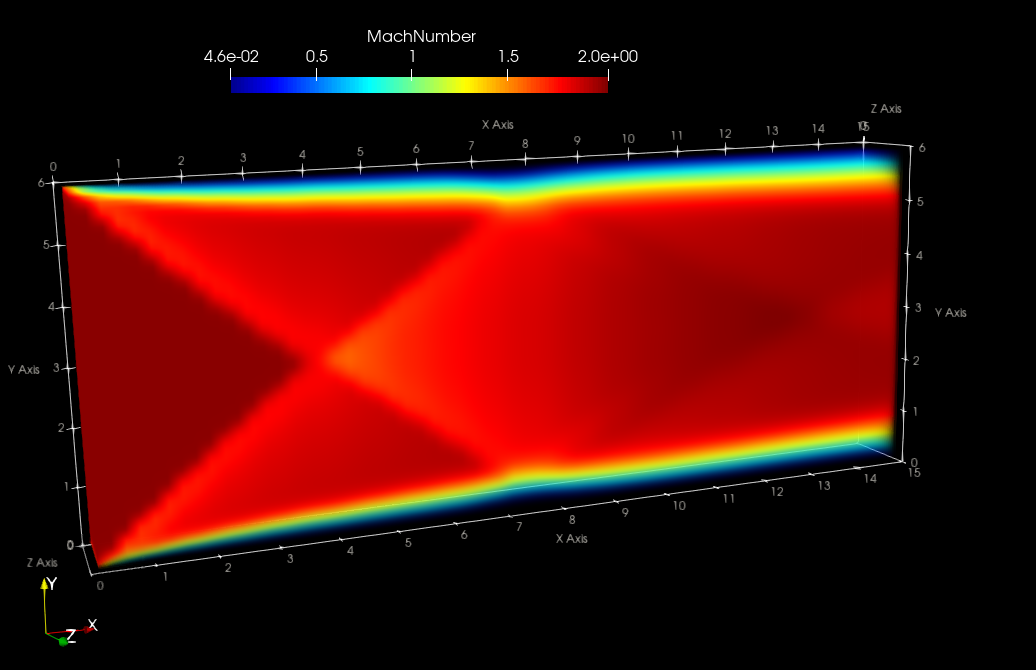
There is a nice shock wave and its reflections, however, the walls don't seem to maintain the 300K isothermal boundary condition, rather the temperatures vary along the length of the channel. Hence the whole question on the methodology behind the implementation. Thanks in advance.