
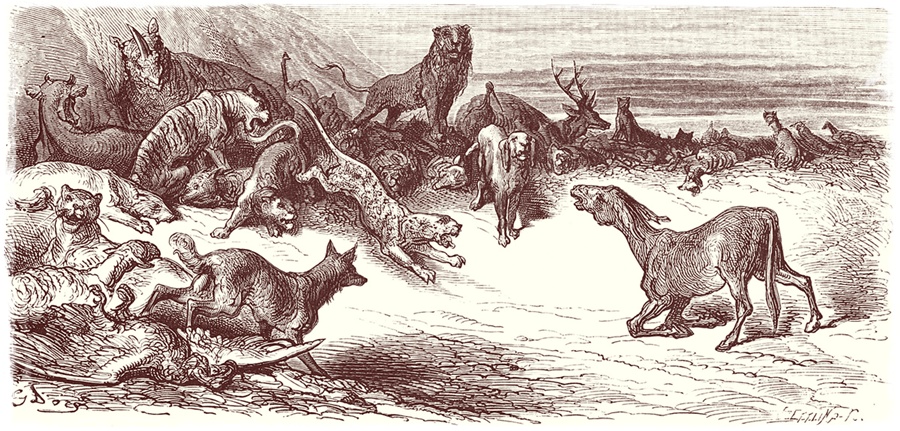
The Animals sick of the Plague
One of those dread evils which spread terror far and wide, and which Heaven, in its anger, ordains for the punishment of wickedness upon earth—a plague in fact; and so dire a one as to make rich in one day that grim ferryman who takes a coin from all who cross the river Acheron to the land of the dead—such a plague was once waging war against the animals. All were attacked, although all did not die. So hopeless was the case that not one of them attempted to sustain their sinking lives. Even the sight of food did not rouse them. Wolves and foxes no longer turned eager and calculating eyes upon their gentle and guileless prey. The turtle-doves went no more in cooing pairs, but were content to avoid each other. Love and the joy that comes of love were both at an end.
At length the lion called a council of all the beasts and addressed them in these words: « My dear friends, it seems to me that it is for our sins that Heaven has permitted this misfortune to fall upon us. Would it not be well if the most blameworthy among us allowed himself to be offered as a sacrifice to appease the celestial wrath? By so doing he might secure our recovery. History tells us that this course is usually pursued in such cases as ours. Let us look into our consciences without self-deception or condoning. For my own part, I freely admit that in order to satisfy my gluttony I have devoured an appalling number of sheep; and yet what had they done to me to deserve such a fate? Nothing that could be called an offence. Sometimes, indeed, I have gone so far as to eat the shepherd too! On the whole, I think I had better render myself for this act of sacrifice; that is, if we agree that it is a thing necessary to the general good. And yet I think it would be only fair that every one should declare his sins as well as I; for I could wish that, in justice, it were the most culpable that should perish. »
« Sire, » said the fox, « you are really too yielding for a king, and your scruples show too much delicacy of feeling. Eating sheep indeed! What of that?—a foolish and rascally tribe! Is that a crime? No! a hundred times no! On the contrary your noble jaws did but do them great honour. As for the shepherd, it may be fairly said that all the harm he got he merited, since he was one of those who fancy they have dominion over the animal kingdom. » Thus spake the fox and every other flatterer in the assembly applauded him. Nor did any seek to inquire deeply into the least pardonable offences of the tiger, the bear, and the other mighty ones. All those of an aggressive nature, right down to the simple watch-dog, were something like saints in their own opinions. When the ass stood forth in his turn he struck a different note: nothing of fangs and talons and blood, « I remember, » he said, « that once in passing a field belonging to a monastery I was urged by hunger, by opportunity, by the tenderness of the grass, and perhaps by the evil one egging me on, to enter and crop just a taste, about as much as the length of my tongue. I know that I did wrong, having really no right there. »
At these words all the assembly turned upon him. The wolf took upon himself to make a speech proving without doubt that the ass was an accursed wretch, a mangy brute, who certainly ought to be told off for sacrifice, since through his wickedness all their misfortunes had come about. His peccadillo was judged to be a hanging matter. « What! eat the grass belonging to another? How abominable a crime! Nothing but death could expiate such an outrage! » And forthwith they proved as much to the poor ass.
Accordingly as your power is great or small, the judgments of a court will whiten or blacken your reputation.
La Fontaine

Jean de La Fontaine – English
- La Fontaine – The Animals sick of the Plague
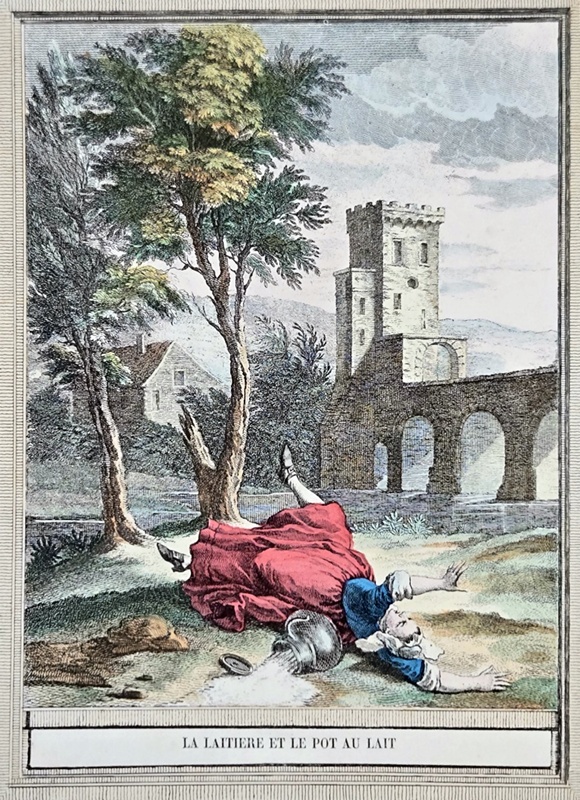
- La Fontaine – The Dairy-Woman and the Pail of Milk
- La Fontaine – The two mules
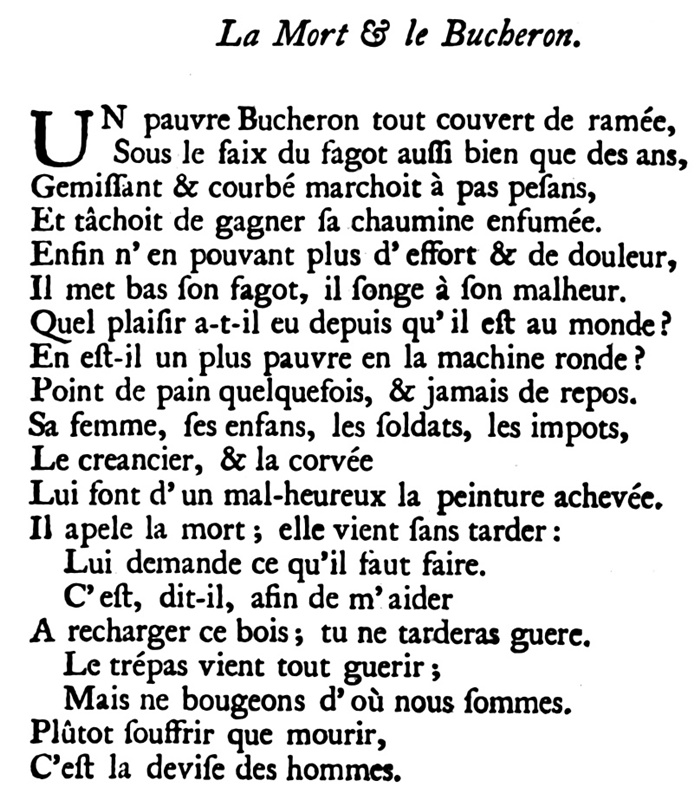
- La Fontaine – Death and the Woodman
- La Fontaine – The Wolf turned Shepherd
- The cock and the pearl
- The Hare and the Tortoise
- La Fontaine – The Raven and the Fox
- La Fontaine – The Swan and the Cook
- La Fontaine – The Thieves and the Ass
- La Fontaine – The Hare and the Partridge
- Death and the Woodman
- The Fox and the Stork
- The Grasshopper and the Ant
- La Fontaine – The boy and the schoolmaster
- La Fontaine – The Frog and the Ox
- The Crow and the Fox
Jean de La Fontaine – French






 À la française ...