Commercial GeoNames Web Services

A commercial version of our popular web services is now available to everybody. The commercial web services offer faster response time and higher uptime than their free siblings and come with two types of service level agreements. We recommend that professional users and mission critical applications upgrade to this premium service.

The GeoNames web services are incredibly popular and the growth rate is amazing. We regularly serve over 10 million requests per day. Donations, however, don’t keep pace with this increase and we will have to limit the number of requests per IP address on the free servers to be able to keep up with the exponentially growing demand. By the end of February this limit will be 100’000 credits per IP address and by the end of March it will be 50’000 credits. Luckily we have an alternative for heavy users with the commercial web services announced above. The credits policy accounts for the fact that not all web services generate the same load on the server. For most services a request equals one credit, some reverse geocoding services are more expensive whereas others like gtopo30 are less resource intensive and cost a fraction of a credit only.

Feature Extraction from Satellite Imagery

Spot Image, a leading provider of satellite imagery, are making a fantastic offer. Spot Image are teaming up with GeoNames to help improve the availability of free geographical data and offer high resolution 2.5m satellite imagery for automatic feature extraction.

Features that we think can be extracted from 2.5m imagery are city contours, airports, streets, shore lines, lakes, rivers and others. We believe this is a fantastic opportunity for researchers and student-works to find algorithms for feature identification and extraction. Drop me a line for more details if you are doing research in this area and would like to work on this challenging task.

Contact : Marc Wick, [email protected]

The data extracted from satellite imagery will be made available through GeoNames. Up to now GeoNames was exclusively focusing on point data due to the lack of good and free vector data. The extracted features will allow us to provide vector data and we will be able to include shapes of cities and other features into the GeoNames database. It will be a gigantic step forward for the availability, quality and coverage of free geographical data on global scale.

[Image : Spot Image Quality ZoomifyViewer Casablanca, Morocco]

Spot Image, based in Toulouse (France), are providing satellite imagery to GoogleEarth and they are selling images to professional and private users. If you are looking for images of a particular area you can use this gallery layer on GoogleEarth to view and find relevant images. As an example the 2.5m image from 24. Sept of Barcelona.

NGA Update

In the last days the newest GNS release (2008-01-28) has been integrated into GeoNames. The GNS dataset is maintained by the National Geospatial Intelligence Agency, a US department of defense support agency.

During this load we have updated 73’000 and inserted 44’000 new toponyms. We have only updated records that have not been modified by GeoNames users or other sources. With the next load we plan to merge the data on attribute level and compare the NGA change history with the GeoNames change history and update attributes that have not been touched. There are usually not many conflicts with other modifications or sources as the NGA has a completely different focus. The countries with the highest number of modifications or inserts in this release are Iran, Taiwan and Peru. Detailed numbers are in this forum posting.

Neighbourhood Reverse Geocoding

Zillow, the US real estate service, have released an awesome data set of neighbourhood boundaries for the US under a creative commons license.

Thanks to the Zillow boundaries we could add a new neighbourhood reverse geocoding service to our API. This neighbourhood web service returns the neighbourhood name, city name, county name and state name for a given latitude/longitude.

Zillow have aggregated the boundary data from online resources, chambers of commerce, tourism and convention boards as well as real estate agents.

Unfortunately they have not chosen the freest creative commons license, the cc-by license, like GeoNames, but have opted instead for the more restrictive cc-by-sa license. The share alike restriction will prevent people from improving upon it. GeoNames for instance cannot use it for their own database. While it is fantastic move by Zillow to release the boundaries, the sa restriction means the community will still need another dataset with a really free license. It is a pity since it will mean a duplication of efforts and reinventing the wheel. At the other hand I am confident that Zillow will change the license as the restriction does not stop their competitors from using it, it just hampers further development and Zillow would gain more without this restriction.

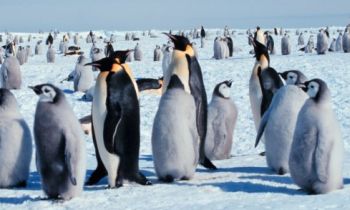
Penguins released: Antarctica – CGA

I am pleased to announce the integration of the Composite Gazetteer of Antarctica (CGA) with 18’104 places. The CGA is compiled by the Scientific Committee on Antarctic Research (SCAR) who have kindly given us the permission to use their data under the condition that we publish the disclaimer below. The CGA is itself an aggregator and includes data from 23 sources from 22 countries. 12’000 features are from US sources, Russia and the UK both contribute 4’800 places. Some places are contributed by several countries.

SCAR Disclaimer :

  • The SCAR CGA is a composite gazetteer and has no legal status.
  • The information in the CGA is that provided by national naming authorities to SCAR.
  • SCAR does not name any features, only SCAR member countries do.
  • The accuracy of the geographic coordinates (latitudes and longitudes) for the named features is unknown to SCAR, but SCAR is working with the national providers to improve them.
  • A third party with an enquiry about one of these names should always come back to the source of the data, that is SCAR.
  • The data would probably be adequate for most uses, but you should refrain from using it for showing information at a very detailed level

[Photos of Emperor Penguins thanks to NOAA Photo Library]

Live action Popfly tutorial

The Popfly development team have produced a funny tutorial over the holidays where the team members play the roles of the Popfly blocks (modules). In the video they create a facebook mashup to display facebook friends on Virtual Earth. GeoNames is used to geocode the friend’s locations.

GeoNames is a handy web service that will find the longitude and the latitude for a given location.

via go2web20 blog and John Montgomery

see also our blog posting on the initial Popfly release.

Barcelona

As a last posting of this year some personal notes. The past three months I spent in Barcelona invited by Properazzi the world’s largest property search engine to share office space with them.
Barcelona is a marvelous city, with the sea, the mountains, the architecture of the modernisme, the weather (in three months I used the umbrella only once). Public transport in the city in particular the local bike sharing system bicing is great.

bicing

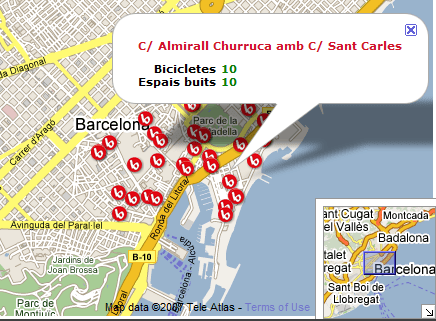
You just grab a bike at one of the hundreds of stations and return it at your destination. Though you shouldn’t expect to find an empty slot to return it at one of the beach stations on a sunny day.

Each station has a small real-time map display where you can see the next stations with their availability of empty slots or available bikes. A googlemaps application on the web site helps you plan in advance if you are not certain.

The local language spoken in Barcelona is Catalan. Nevertheless I could brush up my Spanish with some lessons.

Right now I am reading ‘La Sombra del Viento‘. The absolutely marvelous novel is located in Barcelona after the civil war and tells the mysterious and thrilling story of a boy, Daniel, who has adopted a book in the ‘Cemetery of Forgotten Books’ and has to protect it for the rest of his life. Soon the novel and the book begin to blend and the book and it’s author will become part of Daniel’s life for years to come.

GeoNames Ambassadors

In order to improve the way GeoNames is organized and account for its increasing complexity we are introducing the role of GeoNames Ambassador.
GeoNames has made huge progress in the last months and is now one of the major geo data providers used by thousands of applications. GeoNames Ambassadors serve as local contact to their country. They speak the local languages and are familiar with the local geo data situation. The importance of GeoNames is increasingly being recognized by national mapping agencies and the formalization of a local contact person will make communication with them easier. You find the first Ambassadors appointments on the team page.

The naming ‘Ambassador’ has been inspired by the Tagzania Diplomatic Service where it was coined by Luistxo who also serves as GeoNames Ambassador to the Basque Country and Gipuzkoa. Thanks to Luistxo’s local contacts we have already been able to integrate an official data set from Gipuzkoa.

I would like to express my thanks to all Ambassadors who have accepted the role as local contact person to their country and are ready to help us improve our data set.

Marc Belzunces, Ambassador to the Catalan Linguistic Area, has more information in his blog (in Catalan).

ongmap.com

The awesome google maps mashup ongmap.com has recently won the first price of the Mash up Award 3rd organized by Sun Microsystems Japan. Yuki Naotori, the ongmap founder and developer, is generously sharing part of the prize money with GeoNames and other open source projects and communities ongmap is relying on.
Thanks Yuki.

ONGMAPs mission is to collect a vast range of information about what is at a given location and to make it easily locatable on a map of the world.

Multimap is integrating GeoNames

Multimap has announced today the integration of GeoNames data into their services. GeoNames data on multimap is updated once per day and available with the multimap search on the website as well as with the multimap API. Multimap invites their users to “visit the GeoNames site to add new places, change a wrong location or add alternative names”.

Multimap is one of the earliest and largest internet mapping providers. According to some sources it is the largest online mapping site followed by google maps.