Links for Toponyms

A new pseudo language code ‘link‘ has been added to the alternate name edit function and the links to the English Wikipedia have been inserted as alternate names. The links to the corresponding wikipedia articles have often been requested. While they were available on the forum linked in some threads, they were not included in the normal dump. With this simple change they can now be included in the dump as alternate names and they can easily be maintained using the wiki interface. All other kind of links, I think of hotel websites for hotel entries, can also be added in the same manner.

The language code for the alternate names are normally the 2-character ISO 639 language codes, for more exotic languages that do not have a 2-character ISO code the 3-character code is used instead.

Pseudo codes

  • post‘ for postal codes
  • link‘ for a link to a website
  • iata‘, ‘icao‘ and ‘faac‘ for the respective airport codes
  • abbr‘ for an abbreviation
  • fr_1793‘ for names used during the French Revolution

New York Times data API with GeoNames

NYT Logo

The New York Times is adding GeoNames data to their subject headings and making it available as Linked Open Data under a cc-by license.

For ages the NYT has indexed articles with keywords (tags/subject headings) from an extensive vocabulary. Thousands of these keywords have now been mapped to their respective geonameId. This will help for instance enhance the search function with additional information from geonames like lat/lng for a reverse geocoded article search. The vocabulary is available under a cc-by license in various ways and formats. You can download a huge file or you can browse individual entries on the NYT website. As an example the keyword ‘Zurich’ in html or rdf format. The GeoNames data in the rdf format is using the GeoNames ontology. The subject headings can be used by developers to query the NYT api for articles on the topic.

GeoNames Logo

Some weeks ago GeoNames got a fantastic new index page design to replace the oversimplistic previous index page. The new index page does not only look nicer it also makes it easier for visitors to quickly get to the information they are looking for. Many thanks to Erik Bolstad for this great contribution.
GeoNames Homepage Mai 2009

Today I would like to ask you for your preference for a GeoNames logo. GeoNames did not have a real logo for many years, till Alexander Torrenegra and his team from LetMeGo finally stepped in and designed some cool logo ideas.

What to do against DDOS effects?

A week ago we had to take down the subdomain ws.geonames.org that we use for the free web services. The server was flooded with requests from iMob an iPhone application that has gone viral and become one of the most popular iPhone applications. It is currently number one in the free games section. There were too many connections attempts that blocking the requests by their user agent did not help and we had to disable the domain completely to get the service to work on an alternate sub domain.

To avoid a complete knockout by a single application we have now defined a list of alternate subdomain, that we are not going to publish to make sure an offending application is not using all subdomains and bringing down all application using the free services.

Drop me an email if you want to get one subdomain name you could use for your application.

IPhone applications are particularly nasty as they are not coming from a single IP address, it takes some time to get a new release approved by Apple and moved into the App Store and last but not least it takes time for all users to upgrade to the newest release.

Edit 10. March, Remark: The subdomains are using the same physical hardware. For better response time and higher availability use the commercial services.

Twitter GeoVisualisation

Walter Rafelsberger from MODUL/University Vienna/Department of New Media Technology is using GeoNames for some interesting and beautyful geo visualisation projects.

Twitter Conversations

The twitter conversation map shows where people talking to each other are located.
twitter conversation

Twitter Weather Map

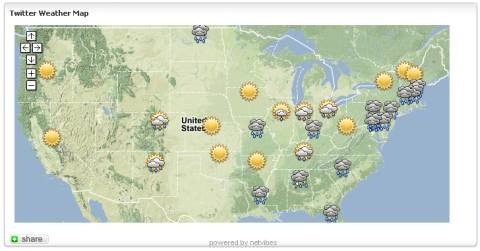
For the Twitter Weather Map the location and weather information twitter users are posting is parsed and visualised:

twitter weather map widget

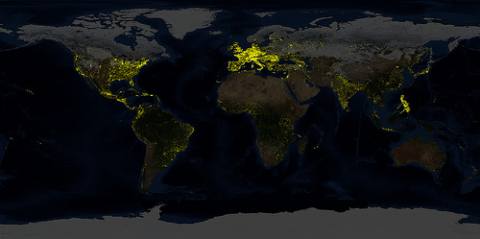
GeoNames cities over 1000/5mio

cities over 1000 and 5 million

GeoNames cities over 1000

cities over 1000

Geotagged Wikipedia Articles

We have updated our database of geotagged Wikipedia articles and increased the total number of articles to 1.2 million up from 800’000. The most popular language is still English with 170’000 articles (up from 137’000) followed by Dutch with 107’000 (up from 67’000). Fifth is “Volapük” a language I have to admit I have never heard of before. It is a constructed language derived from English and German. Most articles in Volapük, which literally translates to ‘world speak’, are stubs created by wikipedia bots.

The number of entries for German would have decreased hadn’t it been for our merging the previous parse result with the newest parse. The decrease is mainly caused by wikipedians who develop bots to alter established templates into new templates. The new templates are used only for a minuscule fraction of articles. This trend seems to show that while the wikipedia approach works well for unstructured textual data it does not work so well for structured data.

Wikinear

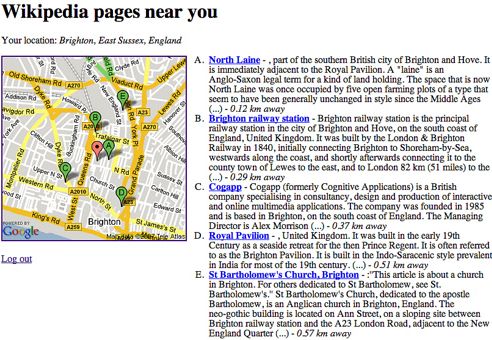
An application quite popular in the Blogosphere these days is Wikinear. It is a very simple application for mobile phones that makes use of some interesting new technologies and web services : OAuth, Fire Eagle, GeoNames and the Google Static Maps API.

GeoNames web service client r1.0

The GeoNames web service client for java has been released in version 1.0. The release includes the following changes and additions :

  • implemented children and neighbours service
  • throw exception if a field is accessed that has not been set due to insufficient style parameter
  • add adminname1 and adminname2 to Toponym
  • fixed a couple of minor bugs
  • added and improved documentation
  • support for username and token for authentication
  • client failover to alternative server if the main server is not accessible. The failover server will be used for some minutes before the client will automatically try to switch back to the main server. This is a simple and efficient approach to achieve high availability for an application.

Linked Data and the Semantic Web

The Semantic Web, the web of data, is coming of age and making it recently into main stream news coverage. GeoNames was among the first to offer a geographical ontology and RDF web services and GeoNames is also part of the Linked Data project. The Linked Data project brings together data from public sources and builds a web of open and free data where data sets are interlinked with each other. Geographic concepts are referred to using the GeoNames URI with the unique GeoNames Identifier the geoNameId.

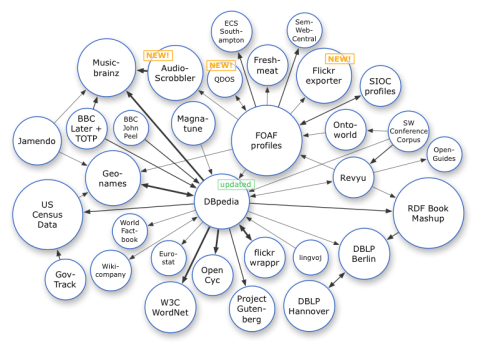
[Image : Projects involved in the Linked Data project (Feb 2008, Richard Cyganiak)]

Tim Berners-Lee has written an interesting blog posting about how a misquote from the Times interview spread over the web and could not be stopped. (He also mentions GeoNames.)

GeoTree – Hierarchical Toponym Browser

GeoTree is a new hierarchical toponym browser for GeoNames. It allows to drill down the continents and the administrative divisions of a country in an explorer like fashion. To the right of the tree view a map shows the toponym selected. An outstanding component of GeoTree are the flags and coat of arms displayed with most administrative features. The coat of arms are from the wikipedia Blasons (heraldry) project. Moving the mouse over the name of an administrative division will not only focus the map, it will also display a larger version of the coat of arms.

The GeoNames balloons are linking to the respective GeoTree representation of the toponym. GeoTree is using the GeoNames hierarchical webservices.

GeoTree is developed by Christophe, GeoNames Ambassador to France. Jan and Bernard are helping with the svg representation of the coat of arms. Check it out.

New Countries : Saint Martin & Saint Barthélemy

We have added two new country codes to our database : Saint Martin and Saint Barthélemy both of which are French overseas collectivities in the Caribbean and have previously been part of the French overseas department Guadeloupe. In 2007 they seceded from Guadeloupe and have received the ISO country codes MF and BL (ISO Newsletter PDF).

Saint Martin : MF, MAF, 663 (FIPS : RN)

Saint Barthélemy : BL, BLM, 652 (FIPS : TB)

Saint Barthélemy is named after Christopher Colombus’s brother Bartolomeo. It was a Swedish possession before being sold to France and it’s capital Gustavia bears the name of King Gustav III of Sweden. The Arrawak Indians called the island “Ouanalao“.

The island Saint Martin is separated into a northern part Saint Martin, a French overseas collectivity, and a southern part Sint Maarten which is part of the Netherlands Antilles.