
Upcoming Events


GEO-LDN Flagship
The GEO Land Degradation Neutrality Flagship (GEO-LDN) is a stakeholder-driven initiative that was launched in 2018 during the GEO Week in Kyoto, Japan, responding to a request by the UNCCD’s Conference of the Parties (COP13). It brings together Earth observation data providers and governments to develop minimum data quality standards, analytical tools and capacity building needed to strengthen land degradation monitoring and reporting, using remote sensing and data collected on site.
GEO-LDN helps governments to access the necessary datasets and tools to prioritize interventions, monitor outcomes to manage land better and to report on Sustainable Development Goal (SDG) indicator 15.3.1 (Decision 9/COP.13).
The LDN Toolbox is a user-oriented entry point to a suite of analytical tools, datasets and methods for land use planning towards land degradation neutrality. The workflow of the toolbox is structured according to the typical 5 phases of an integrated land use planning cycle, as presented in a report of the UNCCD Science-Policy interface on “The contribution of integrated land use planning and integrated landscape management to implementing Land Degradation Neutrality: Entry points and support tools”.
Latest News

GEO-LDN Leaders Win Prestigious International Award
10. March 2026
Professor Amos Tiereyangn Kabo-Bah and Professor Xiaosong Li, co-leaders of the GEO Land Degradation Neutrality initiative, received the Chinese Academy of Sciences’ 2025 International Cooperation Award for Young Scientists in January 2026.
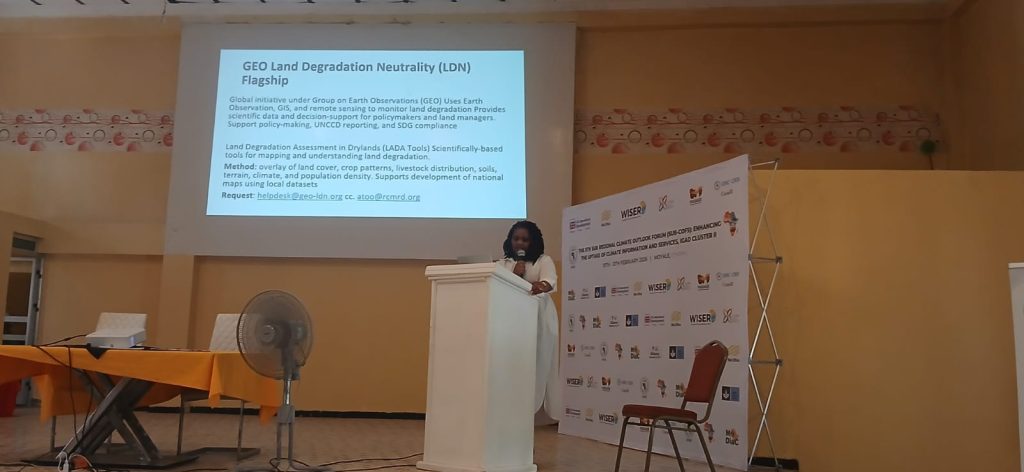
RCMRD’s Angela Too Highlights GEO-LDN Tools at IGAD Sub-COF5 Forum
25. February 2026
From 10–12 February 2026, the Sub-Regional Climate Outlook Forum (Sub-COF5) for IGAD Cluster II brought together regional climate experts, policymakers, meteorological services, and sector stakeholders in Moyale, at the Ethiopia–Kenya border. The forum focused on translating seasonal climate forecasts into actionable advisories to strengthen early warning systems, drought preparedness, and climate resilience across the region.

01 Newsletter 2026
27. January 2026
Happy New Year! As we begin 2026, we would like to briefly reflect on an active and engaging year for the GEO-LDN Flagship. In 2025, we connected through a range of events and exchanges, strengthening collaboration and advancing the dialogue on land degradation neutrality across regions.
