
Around the country and the world, we are seeing weather patterns that are increasingly extreme and unpredictable – ranging from severe winter storms, to intense heat waves, to historic floods, and more. To ensure grid reliability and affordability regardless of weather events, grid outages, or other periods of prolonged stress – while meeting rising energy demand – we need new technologies capable of storing energy for multiple days.
Our first commercial product is an iron-air battery system that can cost-effectively store and discharge energy for up to 100 hours. Unlike lithium-ion batteries, which can only provide energy for a few hours at a time due to their relatively high costs, iron-air batteries can deliver energy for multiple days at a time. Made from some of the safest, cheapest, and most abundant materials on the planet – low-cost iron, water, and air – our battery system provides a sustainable and safe solution to meeting the growing demand for grid security and resiliency.
Grid planning studies, performed by both Form Energy and our utility partners, have shown that over the next decade, achieving Form Energy’s cost and performance targets will unlock tens of gigawatts of demand for multi-day storage in the U.S. and accelerate the country’s trajectory towards a more reliable, clean, and resilient electric grid. At such levels of deployment, our technology will catalyze billions of dollars in savings to American electricity consumers.

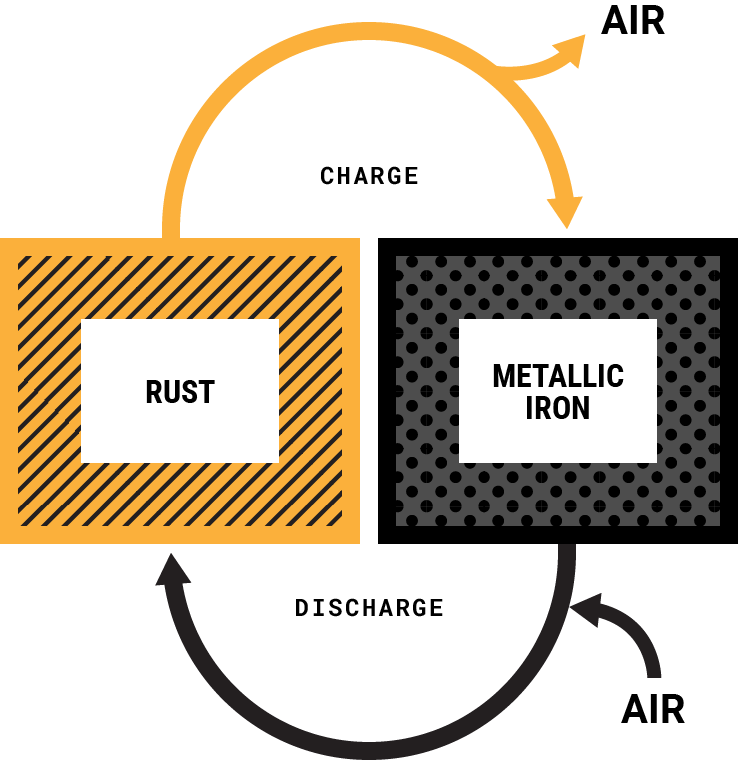
Each individual battery module is about the size of a side-by-side washer/dryer set and contains a stack of approximately 30 one meter-tall cells. Each cell is filled with iron and air electrodes, as well as water-based, non-flammable electrolyte – like the electrolyte used in AA batteries.
These battery modules are grouped together in environmentally protected enclosures about the size of a shipping container. Hundreds of these enclosures are grouped together in modular, megawatt-scale power blocks. Depending on the system size, tens to hundreds of these power blocks will be connected to the electric grid. For scale, in its least dense configuration, a one megawatt system comprises half an acre of land. Higher density configurations would achieve >3 MW/acre.
Our battery systems can be sited anywhere, even in urban areas, to meet utility-scale energy needs. Our batteries complement the function of lithium-ion batteries, allowing for an optimal balance of our technology and lithium-ion batteries to deliver a low-cost, clean, and reliable electric system year-round.

Capable of storing energy at less than 1/10th the cost of lithium-ion battery technology.
No risk of thermal runaway. No heavy metals. Highly recyclable.
Delivers 100+ hour duration required to make the grid reliable year round, anywhere in the world, across all weather conditions.
Allows utility operators to meet power demand with stored energy over time horizons previously not achievable.
Doesn't rely on specific geologic conditions, enabling siting anywhere for utility-scale needs.
Optimizes other resources such as wind, solar, lithium-ion energy storage, and thermal generation to deliver the least-cost, most reliable portfolio for customers.
Made from readily abundant materials to scale globally, without reliance on geopolitically risky supply chains.
| Cookie | Duration | Description |
|---|---|---|
| cookielawinfo-checkbox-analytics | 11 months | This cookie is set by GDPR Cookie Consent plugin. The cookie is used to store the user consent for the cookies in the category "Analytics". |
| cookielawinfo-checkbox-functional | 11 months | The cookie is set by GDPR cookie consent to record the user consent for the cookies in the category "Functional". |
| cookielawinfo-checkbox-necessary | 11 months | This cookie is set by GDPR Cookie Consent plugin. The cookies is used to store the user consent for the cookies in the category "Necessary". |
| cookielawinfo-checkbox-others | 11 months | This cookie is set by GDPR Cookie Consent plugin. The cookie is used to store the user consent for the cookies in the category "Other. |
| cookielawinfo-checkbox-performance | 11 months | This cookie is set by GDPR Cookie Consent plugin. The cookie is used to store the user consent for the cookies in the category "Performance". |
| viewed_cookie_policy | 11 months | The cookie is set by the GDPR Cookie Consent plugin and is used to store whether or not user has consented to the use of cookies. It does not store any personal data. |