Berlinale Film Festival

These past two weeks I’ve attended several films at the Berlinale – well, you have to, when a major film festival is on your doorstep (pretty much all of the venues were less than 30 minutes away from my door by public transport). That is, if you can get hold of tickets, despite the often huge venues where the films are screened. For most of the films you can only book online three days beforehand, so there I was with my fingers poised to click at 10 a.m. every morning, but things would sell out in less than a minute, and I was only successful on three days. Worse than rock and pop concerts! It amuses me to hear that people take days off work or travel all the way from Spain to attend the full ten days, but it also warms the cockles of my heart to see that a documentary from Ethiopia or a film from Ghana shown at 11 am on a weekday (for example) were sold out. Then again, what else can you do on a miserable February day in Berlin?

Most of the films were sad, thought-provoking and political (with a capital or a small P), which made all the questions about politics that journalists kept asking jury members, actors and directors seem rather unnecessary. I can completely understand the anger about the hypocrisy and silence surrounding Gaza (particularly in Germany), but let the art speak for itself and stop expecting actors to make valuable contributions to political discourse (if they choose to do so, that’s fine, but most of them won’t have anything very valuable to add to those topics). However, I got to attend Q&As with the directors and some of the actors at three of the events (another bonus of the Berlinale) and the questions were all about the films and the characters, so that was quite nice.

I did not get to watch any of the major prize winners, but here is a list:

GOLDEN BEAR FOR BEST FILM Gelbe Briefe (Yellow Letters)
by İlker Çatak (Turkish/French/German co-production)
SILVER BEAR GRAND JURY PRIZE Kurtuluş (Salvation)
by Emin Alper (Turkish)
SILVER BEAR JURY PRIZE Queen at Sea
by Lance Hammer (UK/US)

But here are the films that I did see and I thought all of them were quite good. Since most of these films are not out on general release yet, I’ll also make comparisons to other films that are similar in tone.

The Rose: Come Back to Me

Not strictly speaking part of the Berlinale, but released on 14th February as a love letter to the Black Roses (the name of the band’s fan base), this is a film about a K rock band who did not get on with the K pop trainee system and did things their own way, and managed to survive despite lack of promotion in South Korea, having to sue their management company, people trying to create distrust between the band members, military service, depression and a marijuana scandal. I discovered this band last year and attended their concert in London, so this was a great way to get to know them better, but also an inspirational story about the power of music and of being true to yourself. Comparisons: Sing Street, The Commitments.

Enjoy Your Stay – A Swiss-Filipino co-production, about Filipina cleaners working in a luxury Swiss resorts like Verbier. Some of them are abused, but all of them appear invisible to the wealthy people holidaying in the resort. The script follows the ‘found stories’ approach, so presents many real-life, but slightly fictionalised cases. The main protagonist Luz tries to help others but is faced with some tough choices and therefore cannot afford to be an angel herself. Strong ensemble cast and three-dimensional main characters, never entirely evil, just trying to survive in a ruthless global capitalist machine. Comparisons: A Better Life, Dirty Pretty Things, My Name Is Loh Kiwan, A Season in France, Eastern Boys.

De Capul Nostru (On Our Own) – Romanian film about teenagers whose parents have gone abroad for work and they are left to fend for themselves (sometimes with elderly, ineffectual grandparents in the background, or older siblings who are busy with their own lives). I did feel angry with the parents who kept promising to return home, but I also realised they genuinely thought they were working hard to offer a better life for their kids. A film that blends painful dialogue with teenage fun, deep social and personal problems with a dream-like atmosphere (and beautiful moments of a found-family dynamic). Filmed near where my parents live. Amazing acting and improv work by a very young cast in their first roles. Possibly my favourite film of the Berlinale. Reminded me of: Shoplifters, Kids, Happyend. This film did win a prize in one of the many categories: CICAE Art Cinema Award.

Videograms of a Revolution – documentary (based on footage created at the time) about the 1989 Romanian uprising. I knew this would bring back memories and it did: not so much the euphoria I felt at the time, as anger, sadness and shame at the chaos, confusion and power-grabbing going on behind the scenes. An amazing piece of history. Another plus of the Berlinale was that I got to explore various venues that are not normally cinemas, such as the German Cinematheque Museum, which is where this screening took place.

Wo Men Bu Shi Mo Sheng Ren – We Are All Strangers – the underbelly of Singapore’s wealthy society, via the story of a patchwork family. Scenes of everyday life, small joys but also painful dramas, all handled in a fairly matter-of-fact way, as part of life, with a great deal of humour as well as pathos. Particularly poignant juxtaposition of the older generation going on a date just travelling around on a city bus, while the younger generation frolic in the swimming pool of a luxury hotel. But both of them have to deal with the consequences, although I’d have liked to see more of the point of view of the young girl – I felt that was missing. Comparisons: Taipei Story, Comrades: Almost a Love Story.

Shibire (Numb) – a young Japanese director’s partly autobiographical story of a boy growing up in Niigata with neglectful and violent parents, who becomes mute as a result of this. There was a great deal of silence therefore in the film, as we watch the boy at four different stages in his life: from youngster dropping out of school to look after the household while his mother goes off to drink and spend time with men to drug-dealing yakuza. Hard to watch at times, but I rather liked the small details that get shown and the silence. The eyes do the talking. The profile shots of the boy at various life stages got a bit repetitive though and I’m not sure why the only character who attempts to befriend the boy, Ivan, had to be Russian. Comparisons: Moonlight, This Boy’s Life.

A New Dawn – animated film from Japan about three young people fighting a losing battle to turn back time and revive respect and admiration for old crafts such as fireworks. Fighting against inevitable development and ‘progress’ – their house will be demolished, the bay will be drained and built up with solar panels. They are fighting a losing battle but manage to create one last glorious display. Although the story tried too hard to be interesting in structure and bring in flashbacks, it left me with a sense of sadness that is probably exactly what the director intended (he was also art director on Your Name) and shows the abandonment and decay of rural communities (not just in Japan). Pretty pastel visuals and some hilarious stop-motion animation too. I left singing the catchy title song by Imase. Comparisons: Your Name, Princess Mononoke.

En Route To – a touching story of solidarity and friendship among teenage girls. After the disappearance of the married homeroom teacher she’d been having an affair with, Yunji buys illegal pills off the internet to induce an abortion. She ‘borrows’ the money from her roommate, Kyung-sun, who is furious initially but then decides to help her rather clueless classmate. Lots of subtext there, especially for South Korean society that does not really want to know about sex with minors or teenage pregnancies or abortions, but interspersed with lighter moments, especially from the wise-cracking Kyung-sun. A much more positive spin on this kind of story than my comparison film: 4 Months, 3 Weeks and 2 Days; Celine Sciamma’s Girlhood.

#FridayFun: German Writers’ Homes

You knew this was coming, didn’t you? I’ve always been fascinated by writers’ homes and back when I lived in France/Switzerland, I visited a fair few in person. Here are some German writers’ homes which I have not visited yet but fully intend to.

Heinrich Heine’s parental home in Lüneburg, from luneburg.info
Erich Kästner’s house in Dresden, from gpsmycity.com
Goethe’s garden ‘hut’ in Weimar. He had a full-size house in the centre of town as well. From International Architecture Database.
Hans Fallada’s house in Carwitz, Mecklenburg-Vorpommern. From FalladaMuseum.de
Closer to Berlin, the Brecht Weigele weekend home in Buckow, from ADAC site.
So after all these privileged male writers, shall we have a look at how a woman writer like Anna Seghers lived? Yep, in a small flat in the south-east of Berlin. From Berlin.de

#ReadIndies and #HungarianLitMonth: Metropole

Ferenc Karinthy: Metropole, transl. George Szirtes, Telegram Books, 2007.

The book was originally published in 1970 in Hungary but needed over 35 years to get translated and published by a literary fiction imprint of Saqi Books (thus fitting into the indie publishers reading project). It’s been lurking on my Kindle for quite a while, and I finally took the opportunity to read it to fit with Stu’s Hungarian Lit Month initiative for this February.

Hungarian linguist Budai is on his way to a conference in Helsinki but gets on the wrong plane and ends up in a town and country where he can’t understand a word of the language, nor read the writing. He’s staying in a hotel where no one seems to understand any of the languages he attempts to use. The city is grey and constantly full of commuters, rude people pushing him aside with their elbows. The population is mixed, of all races, so he cannot even guess what continent he is on. He cannot find an airport or railway station, the maps make no sense to him. The only person who seems to show him any compassion is the girl operating the hotel lift, who might be called Epepe or maybe Pepet or Bebe or Tchetchetche… the fact that he can never quite catch or confirm her name is typical of this story of incomprehension. And maybe also a dig at the mentality of certain types of dominant cultures when deciding that a foreign name is too difficult to pronounce.

It’s an odd book: dystopian and disquieting, but also quite funny (and occasionally disturbing). It’s been compared to the nightmarish worlds of Kafka or Jose Saramago, but it also reminded me of the claustrophobic conditions with apparently no escape of On the Calculation of Volume by Solvej Balle. There is a lot of information about linguistics and writing which I personally enjoyed, given my own formation as a linguist, but which I can see might be a bit dull for other readers. I think the author is also making a little fun of the Hungarian language, because the way he describes this strange language sounds an awful lot like Hungarian might sound to people who’ve never heard it before.

It’s also a great metaphor for the culture shock experienced by expats I used to work with, when their attempts at using logic to settle into a new culture failed, because there was nothing familiar to which one might compare things, and none of the usual rules seemed to apply. The only complaint I have is that these scenes do feel a little repetitive – probably a deliberate stylistic choice.

The city itself naturally becomes one of the main characters in the story. It is vast and bewildering, possibly a metaphor for how urban sprawl is causing alienation.

The city spread over a plain into distances further than the eye could see. Whichever way he turned there was no end to it, nothing but houses and apartment blocks, streets, squares, towers, old and new quarters of town, mildewy storm-battered rented barracks and skyscrapers faced with modern marbles… and chimneys, chimneys everywhere he looked, chimneys like so many long-necked dragons stretching towards the sky…

Sounds like the view of Tokyo from a skyscraper (albeit with no chimneys). Gradually, the longer Budai stays in the city, he begins to notice all its shortcomings. This is another typical stage of culture shock – after the curiosity and anticipation of the honeymoon stage, then anger, depression and hostility of the rejection stage. But what he describes will be familiar to anyone living in a big city anywhere in the world.

Filth and mess everywhere – had it been like this from the beginning or had he simply not noticed? When the wind blew, as it was doing now, it lifted and carried the discarded wrappers and other rubbish with it… He noticed how many old people there seemed to be in town: lame, crippled, half and half-paralysed, they stumbled, lurched and staggered on sticks through the crowd… Waves of alien humanity regularly washed over them. Frail old grannies, sickly frightened little sparrow struggled against the overwhelming crowd, dragging their helpless bodies along… constantly being shoved aside, squashed and trodden on in the mêlée… Then there were the crazies, those who wriggled and babbled, who talked and muttered to themselves, the furious who screamed and roamed the streets uttering terrible cries… Then the mumbling beggars thrusting tins in front of passers-by, the moaning, the insane, the paralysed, the skeletal, the subnormal crawling on all fours – all of them full of the desire to live…

Despite Budai’s unlikeable, prickly nature, full of self-pity yet also prone to turn violent when feeling helpless, it’s hard not to feel some sympathy for him when things take a turn and he finds himself kicked out of his hotel. He sleeps rough on the streets, works as a labourer to make a tiny amount of money for food and, above all, for drink. These passages reminiscent of Orwell’s Down and Out in Paris and London show just how easy it is to reach rock bottom.

Having finished work Budai too took to the bar in the next street… It was part of his current way of life, after all, much more so than a clean shirt. Where was he to wash a shirt? His lack of resources also had him choosing between clean underwear and getting drunk, and it was in perfectly sober mood, after considerable thought, that he opted for the latter. His situation would have been simply intolerable without alcohol.

Having recently read several books about the immigrant experience, and how constant ill-treatment, poverty and poor living conditions make one an angry, selfish and ‘bad’ immigrant (see Drndic’s Canzone di Guerra, for example), I was not surprised to see Budai becoming hostile and aggressive. [Incidentally, last night I watched Enjoy Your Stay, a film about undocumented Filipino workers in a luxury Swiss resort, and that too raised the question of the point at which being a victim of exploitation forces you to lose your own humanity and exploit others in turn.]

Wherever he wandered in town – and now he was deliberately crossing roads against the lights – he strewed rubbish, trod over floral borders and generally sought to break as many rules as he could. He had convinced himself that such rules had nothing to do with him, that he did not belong here, that he was simply a foreigner, an alien. If someone pushed him in the crowd, as often happened, of course, he craftily kicked the person back, or hit him with his fists, or if he lacked the opportunity to do that immediately, kept following the guilty party until he caught up with him and was able to exact full revenge by beating, slapping, punching and tearing at him. When he passed an empty telephone box he would enter, tear off the receiver and crush it under his heel. He would kick over the rubbish bins people had put out in front of their houses and enjoy seeing the rubbish spill out. He would throw stones at windows at night and smash streetlights.

Budai then gets caught up in some kind of workers’ strike or revolution – of course, he has no idea what is going on but simply gets swept along by the crowd, participates in the siege of a building, even gets a gun pressed into his hand and is expected to shoot, and then finally witnesses some revenge scenes and executions, very much in the brutal style of Blindness by Jose Saramago. But the next day, everything seems to have been cleaned up and forgotten. This reminded me of the Tiananmen Square protests (I went to Beijing for the first time just a month or two after the events), but for the author it might have been a reference to the 1956 Hungarian uprising and how the memory of that was instantly suppressed. Those of us used to censorship tend to see elaborate political metaphors everywhere we go. What does emerge from his biography is that for the next 4 years after 1956, he gave up his journalistic activities and dedicated himself predominantly to translation.

Incidentally, the name of the novel in the original Hungarian is Epepe but I feel that the publishers were wise to use Metropole instead, partly because the city is a main character in the story, while Epepe is initially marginal and later on disappears from the story, and partly because the crowd scenes and huge tower blocks remind one of the Fritz Lang film Metropolis.

Photo from Femina.hu with the occasion of centenary of his birth

Wikipedia has the following rather intriguing entry about Karinthy Ferenc (Hungarian name order is the same as in the Far East – surname first, followed by first name): a Hungarian novelist, playwright, journalist, editor and translator, as well as a water polo champion.

George Szirtes is the translator and I’ve loved his poetry and translations for many years now. I believe he deliberately chose a slightly more old-fashioned vocabulary when translating this book, perhaps in keeping with the time it was written, but also giving it a certain timeless fable-like quality.

#FridayFun: Dreamy Architectural Projects

I think my blog is being attacked by bots, because there is no way the traffic has ramped up so dramatically following a couple of book reviews and escapist pictures. But I will ignore all of that and keep going, as long as they don’t try to infect me or you readers with some kind of virus. For today, I was dreaming of escaping to places with better weather, or at least to places where there might be summer at present, with some beautiful buildings that have actually been properly designed by architects rather than cookie-cutter building.

John Marsh Davis house in California – love the doors that slide open and of course the bookcases. From Instagram.
Yes, I know this only works during a dry summer, but I could imagine some kind of sliding doors being used in winter. From Japandi
A modest ‘holiday cottage’ in the Austrian Alps, from Booking.com, with plenty of outdoor space for partying.
The boathouse on the Lingholm Estate in the UK is a dream – I wouldn’t need anything bigger than that. From TheLingholmEstate.co.uk
Kengo Kuma’s tea house and museum in the Japanese Gardens in Portland, Oregon
But I’ve saved the best for last, with this gem from Bay of Islands, New Zealand, designed by Pete Bossley, from homemagazine.nz
Built to hug the slope, this is what it looks like on the inside. From homemagazine.nz

#ReadIndies and #JapaneseLiteratureChallenge: An Explosive Book

Murakami Ryu: From the Fatherland, with Love. Transl. Ralph McCarthy, Charles De Wolf, Ginny Tapley Takemori. Pushkin Press, 2013.

I ‘may’ have mentioned before that I used to love the dark, twisted tales of Murakami Ryu, and that I liked him more for his social and political commentary than the shock and gore elements he likes to pile on. So this chunky novel from 2005, which imagines a 2011 Japan in economic and political freefall, was bound to appeal, especially since it is set in Fukuoka, a city I intend to visit as soon as I can. (Murakami is from Kyushu and several of his books describe that tension between Tokyoites and those deemed to be ‘provincial’).

Murakami imagines a Japan where economic stagnation has led to the country becoming insignificant on the world stage. The US dollar has plummeted since the US committed to the War on Terror, and the new administration formed by Democrats is seeking to improve ties with Europe, China and Russia. (All of this sounded plausible back in 2005). So they are withdrawing their troops and increasing the price of grains that they are exporting to Japan – which leads to that country feeling abandoned. North Korea perceives Japan as ‘a dying elephant that lacked the will to heal itself’ and sees this as an opportunity to start a top-secret operation ‘From the Fatherland, with Love’, sending a small elite group of special forces to hold the residents of Fukuoka hostage. The North Korean government will officially call them a ‘rebel army’ faction and disown them… until they send more troops along and occupy Kyushu, making it independent from Japan, and thus trapping South Korea in the middle.

The Japanese central government is just as ineffective as they expected, and the local population is cowed by the terrorists but also angry at their own government for leaving them at their mercies. The only people to show any initiative are a band of frankly quite psychotic, violent young Japanese misfits who’ve found a home of sorts with an aging off-grid rebel. At first they rather admire the ruthless invading forces, but then they decide to fight them through their combined know-how of poisonous insects and reptiles, guns, explosives and boomerangs. But before we get to the final showdown, there are many, many pages of research notes which the author could not bear to throw away and therefore incorporated into the book. When those notes are about politics, I can sort of go along with it, but when there’s lots of detail about explosives or guns or army uniforms or torture methods, I really think that those could have been pruned and been all the more effective when used sparingly.

There is also a huge cast of characters, not all of whom are clearly enough differentiated or even necessary. (There is a glossary at the front of the more important characters, but… even that is so over-filled that it’s hard to keep track of them.) At some points, there were simply long lists of names and job titles of all the politicians who participated in an emergency meeting and I pitied the poor translators who had to possibly research every single name (which could be read in a number of ways in Japanese) to guess which one the author meant.

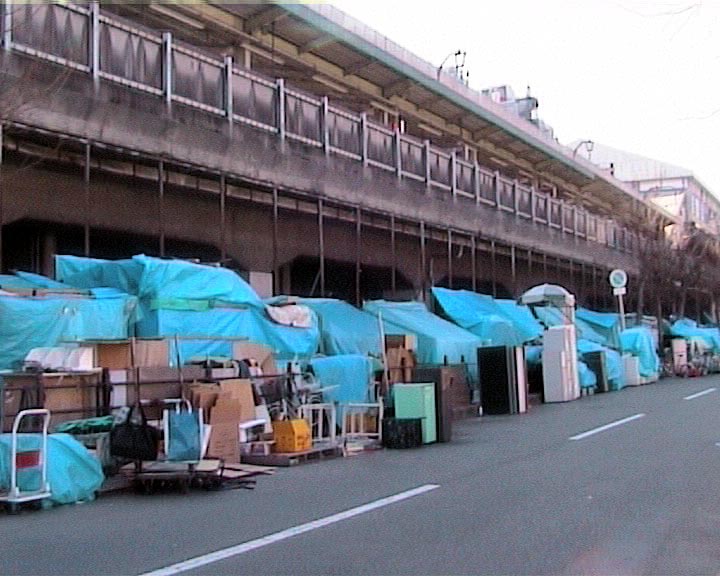
Yet in spite of these digressions (which I have to admit I frequently skimmed through), I raced through the novel: its blend of suspense, political commentary and sarcasm is exactly my cup of tea, although I no longer have the stomach for Murakami’s descriptions of violence (which in this book includes not just youth crime and fighting, but also North Korean army training methods and torture and an execution squad). As always, he offers an alternative picture of Japan which is so far removed from the currently highly popular theme park vision that most tourists want to see. His descriptions of homeless camps in Japan after a long period of economic downturn are certainly drawn from life (see also Yu Miri’s Tokyo Ueno Park).

…the homeless are the easiest people in the world to kill. Kids are scared of becoming failures themselves in later life, and the media reinforce the fear by depicting the homeless as shameful losers in a winner-take-all society, people who’ll never get back on their feet and will have to scrounge for leftover food, wearing dirty rags, smelling to high heaven and living in cardboard boxes till they day they die. After bank accounts were frozen and inflation had set in, the poor came to be scorned even more openly. Some kids probably reasoned that if it was all right to look down on the destitute, it must be all right to knock them around as well.

Homeless in Japan. Photo credit: Reannon Muth.

Although the book is very much rooted in its (fictionally dystopian) Japanese setting, there are parallels to other countries that are experiencing economic decline and problematic politics that feel all too relevant today.

The mayor and the KEF commander kept repeating the words ‘peace’ and ‘coexistence’. It was to coexist with the citizens of Fukuoka, and to bring true peace and prosperity to the city, that they had come from North Korea. They had not invaded Fukuoka and intended no harm to its citizens, but any individuals or organizations hostile to the project… would be punished. It was a transparently contrived rationale, which Yamagiwa felt he’d heard before. It wasn’t all that different from what the Americans had said after invading Afghanistan and Iraq, and in fact Saddam Hussein had made similar announcements after invading Kuwait. The Japanese military had probably said something of the sort while establishing their rule over Manchuria.

It’s good to see that Murakami’s hippie protest stance has not softened over the years. Most of his social critique is voiced by the rebellious youngsters, although they are considered (and indeed are) criminals, murderers, arsonists and so on. No one’s definition of normal, and yet they rattle off some of the best home truths:

Hino’s teachers, the attendants at the institution, and other adults had always trotted out, like a mantra, the proposition that nothing was more precious than human life. Great numbers of people were being killed every day in the continuing upheavals in the Middle East, and tens of thousands of children were dying of starvation in Sudan and Ethiopia and other African countries. But these authority figures never spoke about the preciousness of those lives – apparently only the lives in their immediate circle counted. What were children supposed to make of people like that telling them how to live?

The darkness of the subject matter is lightened by humour. Two scenes that come to mind are the North Korean soldiers attempting to make small talk or marvelling over the tissue packs being handed out for free by taxi drivers. This book won’t be to everyone’s taste, and it could certainly have done with some serious editing, but I enjoyed its craziness a lot more than I initially expected. Kudo points to Pushkin Press for translating such a mammoth work (as well as several other works by Murakami Ryu) and for the striking cover art.

#6Degrees of Separation February 2026

I might even be on time this month with the Six Degrees of Separation meme hosted by Kate over at Books Are My Favourite and Best. The starting point for our game of literary links is Flashlight by Susan Choi, which sounds like exactly my type of novel (about cross-cultural identity and family traumas, with a good dash of mystery). But I haven’t yet had the chance to read it and now it’s a bit harder to get hold of it in the flesh.

So for the first link in today’s post, I’ll choose another book that has been on my TBR list for a long, long time, but I haven’t yet read, for whatever reason. In fact, it’s the one that has been there the longest: Robert Olen Butler’s A Good Scent from a Strange Mountain, a collection of short stories about the aftermath of the Vietnam War and its survivors. Opinions about it are divided though, and I can well understand that, as I sometimes struggle with journalists’ views of Eastern Europe and Romania in particular (as not being nuanced enough).

My next link is to an anthropologist writing about Romania which also received lower ratings from irked local readers. This is a book I’ve not yet read, but one I own by an anthropologist I respect (and whose other books I’ve read). Katherine Verdery’s My Life as a Spy is not so much about the Romanian people as about the government surveillance she experienced while doing fieldwork in Romania in the 1970s.

From a putative spy to a real one – or at least a fictional one written by a real one. John le Carré is certainly my favourite spy novelist and The Spy Who Came In from the Cold is one of my favourite books by him. Not least because of its (partial) Berlin setting and its disillusionment with spying methods.

Next in my set of links is another book published 1962, although it has the feel of a much older book, because it depicts a vanished world in pre-WW2 Italy: Giorgio Bassani’s The Garden of the Finzi-Continis, which I really should reread some day.

Screenshot

For a long time I kept confusing Giorgio Bassani with Giorgio Vasari, and was puzzled why a 20th century writer was so interested in and knew so much gossip about The Lives of the Most Excellent Painters, Sculptors, and Architects in the 12th to 16th centuries.

I think I’ve written myself into a corner now, as I can’t think of any other intelligent links, so I’ll just use a simple trick and for my final book choose one that has a painter as the main character (and is once again a book I haven’t read in a long, long while): Cat’s Eye by Margaret Atwood. I don’t remember much about the plot points, but I do remember it as being very atmospheric and somehow inspiring for a teenager who was keen to become an artist (or rather, a writer) herself.

This month I’ve travelled to Vietnam, Romania, Cold War Berlin, pre-war Ferrara, Renaissance Italy and Canada. Where will your Six Degrees of Separation take you?

#FridayFun: One Sunny Day in Bucharest

It has been quite a harsh winter in Bucharest too: snow, ice, freezing cold, low clouds and fog. I had one sunny day while I was there last week and I made the most of it.

The Hotel Lido has been renovated, but I’m not sure the once-famous pool (lido) at the back is open to the public once more.
I couldn’t resist a short visit to my old university department. I was pleased to see there was a far broader spread of languages being studied than before – but shocked to see that Chinese is no longer one of the languages offered.
I love the relatively modest 19th century bourgeois (merchant) houses, which are abundant in some neihbourhoods despite Ceausescu’s efforts to pull down most of them. Especially when they are as nicely renovated as this one.
Had a rather lovely dinner here in the famous Mitsa Biciclista house. There is a bistro and bakery on the ground floor, a restaurant on the first floor and an exhibition about interwar Bucharest on the second floor. For more about the owner of the house and the house itself, go here.
And here is a glimpse of the restaurant inside…
Of course I visited a few bookshops and here is a sample of new releases…
More here… and as you can see, a LOT of translations

January 2026 Wrap-Up

I used to think that 6 was my lucky number and was really looking forward to 2016… and look how that turned out. So I’ve learnt to dampen down my expectations for 2026 and certainly the month of January around the world seemed to provide plenty of proof that I was right to do so. However, my personal summary of this seemingly endless month hasn’t been too horrid: I’m clearly lucky and privileged. I spent the first few days of the New Year with my older son and then a friend came over briefly to visit. I got to see the rather lovely exhibition at the Alte Nationalgalerie of largely impressionist and contemporary art from the private Scharf Collection. My bookcases got delivered and built. I got to go back to Romania to see my parents and also managed to see doctors and quell any anxiety I had about my health.

I also got to read some interesting books, although I can’t say any of them really blew my socks off.

Ten books read, only one of which was in English in the original (the non-fiction one). Four books for January in Japan, and I’m happy to say that I’ve reviewed every one of them. Two very interesting takes on Japanese history, a slightly sinister and enigmatic novella and a crime novel about industrial espionage. Three books in German borrowed from the library, two of them also crime fiction set in interesting periods of German history in Berlin (1939 and 1968). A reread of a Catalan crime novel by one of our Corylus authors at my parents’ flat. A memoir by one of the best-known Romanian women writers since the 1980s and a non-fiction work about our very personal relationships with AI.

This last book Love Machines was very eye-opening, containing some information that I knew from before (because I’m fascinated by this subject and read everything I can about it), but also a lot that I didn’t. James Muldoon does a good job of remaining fairly non-judgemental about people’s use of AI, but does warn of the dangers of leaving all that sensitive personal data to corporations (although I wouldn’t feel comfortable with governments having access to it either). I often feel like saying: ‘Honestly, guys, why are you willing to give out so much personal stuff online – maybe you should have grown up with the experience of having your phones tapped and checking out your flats and hotel rooms for bugs.’

In February I’m not quite ready to leave the Far East yet, and I also want to participate in the wonderful #ReadIndies initiative, so I have books from Japan, Taiwan, South Korea and Vietnam lined up (and the publishers Pushkin Press, NYRB, Honford Star and Tilted Axis respectively).

I also watched quite a lot of films (by my standards) this past month, eight new ones and one rewatch (Ponyo). I started on a project of watching films set in Berlin (thanks to FilmFriend, a platform I have access to thanks to my local library) and was quite taken by the energetic, natural style of Victoria and was struck by the curiosity that is Angry Young Men meet GDR propaganda in Ecke Schonhauser. Ozon’s adaptation of L’Etranger had some choices I couldn’t quite agree with, but it was visually very attractive. The most memorable film of the month was Sentimental Value.

My film plans for February include: more Berlin films, No Other Choice, It Was Just an Accident, Silent Friend, possibly Marty Supreme if it comes out in Germany by the end of the month, as well as a documentary about a Korean rock band I really like The Rose.

But first: today is the first public transport strike I’m experiencing in Berlin, which means I can’t go to my hip-hop class (it would involve 1 1/2 hours of walking each way on icy pavements). Boo!

#JanuaryinJapan: At the Edge of the Wood

Ono Masatsugu: At the Edge of the Wood, transl. Juliet Winters Carpenter, Strangers Press, 2017

In my Keshiki-New Voices from Japan collection from Strangers Press, a lovely selection of chapbooks with short stories or novellas by contemporary Japanese authors, I found one that suited my desire to read one more Japanese book in Japan but also travel lightly to Romania. Ono is a professor of French literature at Waseda University in Tokyo and his key research area is the influence of French literature and thought on the process of (literary and other cultural) modernisation in Japan.

This chapbook features two linked short stories ‘A Breast’ and ‘The Pastry Shop at the Edge of the Wood’, but I was not aware that they were later Americanised and published together with two more linked stories (also translated by the wonderful Juliet Winters Carpenter) in 2022 by Two Lines Press in the States as ‘At the Edge of the Woods’ (plural). This perhaps explains why the chapbook I read felt somewhat incomplete, almost too enigmatic and opaque, yet the reviewers of the entire novel also seem to struggle to decipher its meaning.

A father and a son are living in a house on the edge of the woods, in a foreign, unnamed country. The wife and mother has gone back to her parents’ home in another country to give birth to the second child. Left to their own devices, the father and son seem to stumble through everyday life, unsettled by the dark forest on their doorstep and the strange sounds that could be coming from there or from the father’s own mind. Mysterious human beings appear in and out of the woods: a half-undressed, confused old woman that his son has brought home and adopted as a grandma; dwarves that could be refugees living in the woods or mischievous imps ready to kidnap children; a pregnant woman lying dead in the woods; a pastry chef and her oversized daughter; another mother and daughter pair that they see in the supermarket car park. The encounters they have with these people are odd, seemingly pointless, half-remembered, like scenes you are unsure whether they were dreams or reality upon awakening.

Two Lines Press marketed this novel as being about climate catastrophe (which is one way to interpret the refugees in the woods). Matt Matros in his excellent review believes it is more about the dizzying contradictions of parenthood. Reading it as I did, when I was recovering from minor sedation (possibly the best way to read this, without worrying too much about trying to make sense), it felt like all the things you start worrying about once you have children: the small things (like getting candles for a birthday cake or whether they are watching too much TV) to complex global issues. Most of the time this fear is diffuse, hard to explain – the minute you try to pin it down and examine it closely, you start rationalising it, you start searching for solutions or signs that it is misplaced or exaggerated. Yet the fear remains: the heart heavy, the reptilian mind in a state of alert, so much remains unknowable. How to keep a child safe and happy under these circumstances?

The language owes something to the simple yet heavily symbolic style espoused by so many French writers since Camus. I loved it for its poetry, for the half-formed images and thoughts it put in my head, and for the ache it left in my heart, even when I wasn’t sure I ‘got’ it. The description of the forest was particularly memorable.

[The trees] pat each other familiarly on the shoulders and back and sometimes wriggle their hips as they hurried ahead… Their whispers spread through the woods like the sound of distant waves. As they traveled, the whispers blotted out not only gaps in consciousness but also the interstices between trees, between branches. Unable to penetrate into the depths of the woods, we would come to a standstill.

But the (imaginary?) sound that so disturbs the narrator is also unforgettable:

The sound that came from the wood, piercing the night, was trying to strange my heart, too. It was echoing in the dreams of my son, asleep in the same bed. […] For an instant, the coughing from the night wood splits the sound of the television, Perhaps I should sneak through that cleft. I look outside. In the smooth windowpane without flaw or distortion, my son, hidden by the sofa, cannot be seen. My reflection in the window, though shaken by the lingering echo of coughing and seemingly on the point of fading away, goes on being there, alone, in the living room.

I always found Juliet Winters Carpenter’s translations supremely elegant and lyrical, and she certainly suits this author perfectly. This is my final review for the Japanese Literature Challenge for this month, although I will no doubt read many, many more Japanese books this year.

#JanuaryinJapan: Underdogs and Warlords

Joining both Tony in his January in Japan venture and Meredith in her Japanese Literature Challenge, because it’s always about Japan with me (and Romania and Germany and Austria and France and… you get the picture, but Japan does have a special place in my heart). Unfortunately, since I’ll be away in Romania for a week without internet access or laptop, I probably won’t get another chance to post something for January in Japan, so here are two in one go.

Ko Kyota: Underdogs of Japanese History: 11 tales of iconic characters who prevailed against the odds… or didn’t, 2023

I came across Kyota (that’s his first name, I’m using the Japanese convention as always, with surname first) on Instagram, where he gives very funny but also useful snippets of information about Japanese history and culture under the name @themetroclassic (I believe he is also on YouTube and perhaps Tiktok). I bought this e-book as an excuse to delve deeper into some of the characters he talks about, and found it really informative as well as witty. Although it can’t quite capture the full charisma of his video performances (I kept hearing his voice as I was reading it), but of course there is considerably more historical detail here.

Most of the eleven underdogs presented here naturally are warriors or warlords or samurai, since there was a LOT of fighting in Japanese history, especially during the Sengoku jidai (Warring States period). But a few women are also represented, although their powers were largely dependent on whom they married, which family they belonged to or whose harem they joined. My old favourite Murasaki Shikibu (author of Genji Monogatari) is also presented, from a social and historical rather than a literary perspective, which made it feel fresh, as someone who used the power of storytelling to ensure a more secure position for herself at court. Some of the interpretations are debatable (for example, that Oda Ujiharu was determined to protect his people rather than merely an incompetent or hot-headed warrior), but with old texts and the notorious Japanese propensity for obliqueness, who’s to say that it isn’t possible?

An enjoyable, painless way to learn more about Japan – far better than the history books I had to read in a rush so I could take over my colleague’s course on Japanese history during her maternity leave – and I was rather pleased to see that Kyota doesn’t like the great unifier Oda Nobunaga much either. (Toyotomi Hideyoshi is my man, especially because he rose from humble beginnings and was less slippery and wily than Tokugawa Ieyasu, but he really shouldn’t have attacked Korea!)

The chapter I was particularly interested in, because I knew very little about it, was the Satsuma Samurai. I only learnt the official summarised and sanitised version about the end of the shogunate and the Meiji Restoration in 1868, but after visiting the Ryozen History Museum in Kyoto, which is dedicated to that period (because it was more than just a year!), I became interested in finding out more about the great turmoil surrounding that transition.

Yokomitsu Riichi: Shanghai, transl. Dennis Washburn, Michigan Monograph Series in Japanese Studies, 2001.

This was a really difficult book to read, I kept having to pause it. Not because of the writing, which is often very beautiful and evocative. Nor because of its setting: Shanghai in the 1920s, yet again a period and place I know little about, other than that it was at a confluence of Eastern and Western influences and trade, and that those were troubled times, with a lot of anti-foreign sentiment, strikes and violent clashes which ultimately led to a civil war starting in 1927. This dragged on and on, and the declining economic influence of Japan in China at that time provided of course the pretext for the Japanese invasion of Manchuria a few years later.

Yokomitsu wrote this novel in 1929, having visited Shanghai only briefly in 1928, but he does an excellent job of describing the city in all its beauty, diversity, ugliness and messiness. He was very much influenced by Western literature and art, and attempted to unite the various European currents (realism, surrealism, futurism, expressionism, symbolism) under one flexible, all-encompassing umbrella called New Sensation. He is one of the leading modernist writers in Japan and was hugely influential at the time. For me, his descriptions of the city of Shanghai owe something to journalism and reportage, but are heavily indebted to painting, revealing almost a Pointillist technique: short sentences adding up to a coherent and colourful (not necessarily enticing) picture.

A district of crumbling brick buildings. Some Chinese, wearing long-sleeved black robes that were swollen and stagnant like kelp in the depth of the ocean, crowded together on a narrow street. A beggar groveled on the pebble-covered road. In a shop window above him hung fish bladders and bloody torsos of carp. In the fruit stand next door piles of bananas and mangos spilled out onto the pavement. And next to that a pork butcher. Skinned carcasses, suspended hoof-down, formed a flesh-colored grotto with a vague, dark recess from which the white point of a clock face sparkled like an eye.

What I struggled with in this book are the characters: the Japanese expats Sanki and Koya, who behave like entitled misogynists, and treat the women they come across, Russian, Chinese or Japanese, as objects not as real people (whether they use and discard them, or admire an idealised image of them from a distance). They also express nationalistic sentiments which mirror Yokomitsu’s own at the time. The translator’s afterword examines these controversial beliefs: while it would be fair to say that many in Asia at the time believed they were being subjugated by the great Western powers and deeply resented it, Yokomitsu’s solution to that is Japanese militarism and ascendancy (less obviousl in the novel, but expressed in essays he wrote at the time).

The drifting and nihilistic characters reminded me of several characters in 19th century Russian novels, so that often annoying (and hurtful to others) psychology is present here as well. While I don’t need my fictional characters to be flawless, I found their motivation rather impenetrable or aimless. It’s hard to tell if the racism and misogyny depicted are condoned by the author, but they are certainly reflective of their time. I did enjoy some of the political jabs at the British Empire’s craftiness though, which we seldom see in English language books covering that period. Yet at the same time, this passage stood out to me (and I wonder if that is any longer the case):

…the British have been more successful in Singapore than in other countries because they make use of young men who have been trained thoroughly in the language, customs and capacities of the Chinese. That’s something other foreigners can’t do very well.

Where Yokomitsu succeeds best is at the vivid crowd scenes: if there were nothing else but that, it would still make the book worthwhile in my eyes:

Sanki was forced back into the sunken entrance of a shop and could see only a pivoting transom opened horizontally above his head. The rioting crowd was reflected upside down in the transom glass. It was like being on the floor of an ocean that had lost its watery sky. Countless heads beneath shoulders, shoulders beneath feet. They described a weird, suspended canopy on the verge of falling, swaying like seaweed that drifted out, then drew back and drifted out again.

Two interesting perspectives on Japanese history, one more fun than the other, but both quite educational and eye-opening.