Archives mensuelles : juillet 2023

Eighteenth-Century Varnishes, an ambiguous and versatile material for the arts

Marie THÉBAUD-SORGER (CNRS/Koyré) and Romain THOMAS (University of Paris Nanterre)
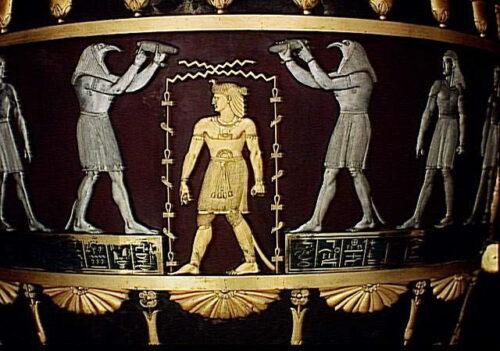
Détail, Vase Egyptien, 1804-1806
Manufacture de vernis sur métaux à Paris de Blaise-Louis Deharme
Louvre, Département des Objets d’art du Moyen Age, de la Renaissance et des temps modernes (LP 3275)

In this paper, we would like to focus on varnish as a material through the « chaîne opératoire » involved in the manufacture and application of this “surface” coating, common to the art and technology. From a corpus of recipes, encyclopedias, and even commercial prints, gathered within the framework of the ANR FabLight, we propose to study the terminology detailing the sensory and physical qualities of “varnish” at various moments of its implementation, in order to grasp its profoundly versatile nature. The description of the texture, consistency, and appearance of varnish brings to light the variety of materials used to make varnish (varnish, coating, lacquer), fruit of a hybridization of learned, artistic, and artisanal know-how. The properties of varnish refer on the one hand to the possible transfers according to the contexts of use (e.g., Watin’s copal varnish applied to paintings, furniture or the fabric of aerostats). On the other hand, it refers to the ambiguity of an interface that plays on its double useful and aesthetic function.

Beyond the Gloss: The Multi-sensory Experience of Eighteenth-Century Varnishes

03/07/2023 au 07/07/2023 à Rome, Italie

Participent au panel de recherche :

  • Marie THÉBAUD-SORGER et Romain THOMAS, “Eighteenth-Century Varnishes, an ambiguous and versatile material for the arts”
  • Marjolijn BOL et Grace KIM-BUTLER, “The many durabilities of urushi lacquer: a diptych presentation”
  • Érika WICKY, “The Lingering Scent of Eighteenth-Century Varnishes”

Cliquez ici pour allez sur le site de la Società Italiana di Studi sul Secolo XVIII

Au 18ème siècle, une réinterprétation de lAu XVIIIe siècle, une nouvelle interprétation de l’antiquité a émergé, qui a influencé la perception de la tradition et du passé. L’antiquité, auparavant une mémoire partagée et un héritage crucial, a été mise en parallèle avec le cosmopolitisme des Lumières, servant d’inspiration constante dans les événements historiques majeurs comme les révolutions et les luttes dynastiques. Elle a influencé la littérature, l’art, la musique et même les sciences, conduisant à un renouvellement des connaissances traditionnelles et au développement de domaines comme l’archéologie et la muséologie. Toutefois, cette réinterprétation de l’antiquité a également conduit à une attitude critique et analytique, transformant et modernisant la relation avec celle-ci. Le XVIIIe siècle a mis en lumière non seulement les différentes formes de connaissances, mais aussi la vie humaine actuelle, créant une rupture avec le passé et établissant les fondements pour de nouveaux modèles de pensée qui perdureraient jusqu’à l’époque contemporaine.  À travers des conférences, des sessions, des tables rondes, le congrès prévu vise à explorer la diversités de ces sujets.

Téléchargez la brochure du congrès 

Téléchargez le programme détaillé en PDF