


Staraya Ladoga
Staraya Ladoga
Старая Ладога | |
|---|---|
 | |
.svg) Flag .svg) Coat of arms | |
 Interactive map of Staraya Ladoga | |
  Staraya Ladoga Location of Staraya Ladoga .svg) Staraya Ladoga Staraya Ladoga (European Russia)  Staraya Ladoga Staraya Ladoga (Europe) | |
| Coordinates: 59°59′50″N 32°17′53″E / 59.99722°N 32.29806°E | |
| Country | Russia |
| Federal subject | Leningrad Oblast[1] |
| Administrative district | Volkhovsky District[1] |
| Rural settlementSelsoviet | Staroladozhskoye Rural Settlement[1] |
| Founded | 753[2] |
| Area | |
• Total | 139 km2 (54 sq mi) |
| Population | |
• Total | 2,012 |
• Estimate (2017) | 1,954 (−2.9%) |
| • Density | 14.5/km2 (37.5/sq mi) |
| • Capital of | Staroladozhskoye Rural Settlement[1] |
| • Municipal district | Volkhovsky Municipal District[4] |
| • Rural settlement | Staroladozhskoye Rural Settlement[4] |
| • Capital of | Staroladozhskoye Rural Settlement[4] |
| Time zone | UTC+3 (MSK  [5]) [5]) |
| Postal code[6] | 187412 |
| Dialing code | +7 81363 |
| OKTMO ID | 41609462101 |
Staraya Ladoga (Russian: Старая Ладога, [ˈstarəjə ˈladəɡə], lit. 'Old Ladoga'), known as Ladoga until 1704,[7] is a rural locality (a selo) in Volkhovsky District of Leningrad Oblast, Russia, located on the Volkhov River near Lake Ladoga, 8 kilometres (5.0 mi) north of the town of Volkhov, the administrative centre of the district.[7]
It used to be a prosperous trading outpost in the 8th and 9th centuries. During this period, it was known to the Norse as Aldeigjuborg.[8][9] It was dominated by Varangians who became known as the Rus'. For that reason, Staraya Ladoga is sometimes called the first capital of Russia;[10] it is also regarded as one of the original centres from which the name Rus' spread to other territories inhabited by the East Slavs.[11][12]
Etymology
[edit]The settlement takes its name from a tributary of the Volkhov River, which itself is taken from the Finnish name Alodejoki ("low-lying river"), from alode ("low place") and joki ("river").[13] It was known to the Varangians as Aldegjuborg.[14]
History
[edit]Origin
[edit]
A Scandinavian settlement was founded in the mid-8th century.[7] Dendrochronology suggests that Ladoga was founded in 753.[2] The Eastern Slavs became the dominant component of the population no later than the turn of the 760s and 770s.[7] From the late 8th and early 9th century, it served as an important stronghold on the trade route to the Byzantine Empire.[7] Around the 830s or 840s, it was captured by a group of Varangians, who established the Varangian Street on the left bank of the river.[7]
Until 950, it was one of the most important trading ports of Eastern Europe. Ladoga controlled access to the Volkhov River, which was one of the most important routes between the Baltic Sea and the Russian interior.[15] Merchant vessels sailed from the Baltic Sea through Ladoga to Novgorod and then to Constantinople or the Caspian Sea. This route is known as the trade route from the Varangians to the Greeks. An alternative way led down the Volga River along the Volga trade route to the Khazar capital of Atil, and then to the southern shores of the Caspian Sea, all the way to Baghdad. Tellingly, the oldest dirhams in European Russia were unearthed in Ladoga.[16][17] The earliest coins are dated to 786/787.[18] It is possible that the original Scandinavian inhabitants lived there seasonally, but as Ladoga grew, most, if not all of its Scandinavian inhabitants became permanent residents.[17] Ladoga, along with Rurikovo Gorodische, Sarskoye Gorodishche, Gnezdovo, and other bases, played an essential role in making Scandinavian trade with the Islamic world profitable.[19]
Early history
[edit]
According to the Hypatian Codex of the Primary Chronicle, the Varangian leader Rurik arrived at Ladoga in 862 and made it his seat of power in northern Russia.[7] It was devastated around 865.[7] Rurik later moved to Novgorod and subsequently his successors moved from there to Kiev where the foundations for the powerful state of Kievan Rus' were laid.[20] These Varangians, known as the Rus', gave their name to the land and subsequently the name of Russia.[21] The new state was known to them as Garðaríki.[22] The growth in commerce led to the construction of new buildings around 894.[20] Ladoga therefore served as a base and warehouse for a merchant association.[20] From the mid-10th century, Ladoga was a settlement with a Varangian presence until the 11th century.[7] The Novgorod First Chronicle says that Prince Oleg was buried in Ladoga.[7]
There are several huge tumuli, or royal funerary barrows, at the outskirts of Ladoga. One of them is said to be Rurik's grave, and another one—that of his successor Oleg. The Heimskringla and other Norse sources mention that in 997, the Norwegian earl Eric Haakonsson raided the coast and set the town ablaze.[7] Ladoga is also mentioned as Aldeigja in the poem Bandadrápa by Eyjólfr dáðaskáld and as Aldeigjuborg in Scandinavian sources.[7]
Ladoga is mentioned in 1019 as a central possession of Ingegerd Olofsdotter of Sweden, who married Yaroslav of Novgorod.[7] Under the terms of their marriage settlement, Yaroslav ceded Ladoga to his wife, who appointed her father's cousin, the Swedish earl Ragnvald Ulfsson, to rule the town.[23] This information is confirmed by sagas and archaeological evidence, which suggests that Ladoga gradually evolved into a primarily Varangian settlement. At least two Swedish kings spent their youth in Ladoga, Stenkil, Inge the Elder, and possibly also Anund from Russia (Anund Gårdske). Archaeologists have found several Scandinavian Christian graves in Ladoga dating to the 11th century, possibly belonging to Swedish soldiers serving Ragnvald.[23]
From 1136, Ladoga functioned as a trade outpost of the powerful Novgorod Republic. It was the most important prigorod (suburb) of Novgorod from the 13th century.[7] As the oldest town in the region, it was viewed as a defender of Russian lands against the Swedes.[24] However, its trade significance declined and most of the population engaged in fishing in the 15th century.[24] Ladoga was repeatedly targeted by Swedish forces, who captured and burned it in 1313.[7] In 1338, the fortress survived a siege, but the posad was destroyed.[7] After new fortresses such as Oreshek and Korela were constructed in the 14th century further to the west of Ladoga, the town's military significance also decreased, and by the end of the 15th century, it had lost all of its importance.[24] Ladoga belonged to Vodskaya pyatina of the Novgorod Republic and contained eighty-four homesteads in the 15th century; most of the land belonged to the Russian Orthodox Church.[24] The Novgorodians built there a citadel with five towers and several churches.
From the late 15th century, it was a border town of the centralized Russian state.[7] As a result of a shortage of land in Ladoga, the Muscovite authorities were compelled to take measures to ensure that citizens could acquire land.[24] The fortress was rebuilt in the 1580s with new towers erected.[7] In 1610, during the Time of Troubles, it was captured by Swedish troops but retaken by the Russians in February 1611.[7] Negotiations between Russia and Sweden took place in Ladoga in 1616, which led to the conclusion of the Treaty of Stolbovo in 1617 and the end of the Russo-Swedish War of 1610–1617.[7]
Later history
[edit]After the town of Novaya Ladoga (New Ladoga) was founded in 1704 by Peter the Great, Ladoga became known as Staraya Ladoga (Old Ladoga) and its importance decreased.[25] The town was converted into a prigorod (suburb).[25] Since 1764, it has had the status of a village (selo).[25]
Sights and landmarks
[edit]The heart of Staraya Ladoga is an old fortress where the Ladozhka flows into the Volkhov. In earlier times, it was a strategic site because it was the only possible harbor for sea-vessels that could not navigate through the Volkhov River. The fortress was rebuilt at the turn of the 15th and 16th centuries. In 1703, Peter the Great founded the town of Novaya Ladoga (New Ladoga) closer to the bank of Lake Ladoga. The ancient fortress thenceforth declined and came to be known as Staraya Ladoga (Old Ladoga), in order to distinguish it from the new town. The reconstruction of one of the towers of Staraya Ladoga's fortress was scheduled to be completed in 2010.[26]
- Ladoga Fortress
 Ladoga Fortress 1909 by Sergey Prokudin-Gorsky
 Ladoga Fortress 2013
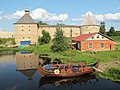 Ladoga Fortress 2013
 Ladoga Fortress 2017
 Ladoga Fortress 2017
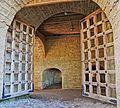 Ladoga Fortress main gate
 Ladoga Fortress wooden chapel
 Panorama of the Ladoga Fortress from the eastern bank of the Volkhov River


The mid-12th-century churches of St. George and of Mary's Assumption stand in all their original glory. Inside St. George's, some magnificent 12th-century frescoes are still visible. In addition, there is a mid-12th-century church of St. Climent, which stands in ruins.
- Landmark churches in Staraya Ladoga
 St. George's Church in the Ladoga Fortress.
 St. George's Church contains frescoes painted in 1167.
 The Assumption Cathedral in the Assumption Convent
 Church of St. John the Baptist on Malyshevaya Hill 1909 by Sergey Prokudin-Gorsky


There is also the Assumption Convent, and a monastery, dedicated to St. Nicholas, which was rebuilt in the 17th century. The Assumption Cathedral, built and consecrated in 1116, is located within the convent.[27]
- Monasteries in Staraya Ladoga
 The Assumption Convent
 The Assumption Convent
 The Assumption Convent
 The Assumption Convent
 The St Nicholas Monastery 1909 by Sergey Prokudin-Gorsky
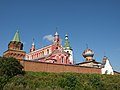 The St Nicholas Monastery 2011


Culture and art
[edit]Staraya Ladoga's barrows, architectural monuments, and romantic views of the Volkhov River have always drawn the attention of Russian painters. There were the artists Ivan Aivazovsky, Orest Kiprensky, Aleksander Orłowski, Ivan Ivanov, Alexey Venetsianov and many others in the 19th century.[28] A future member of the Imperial Academy of Arts and the Peredvizhniki group Vassily Maximov was born and laid to rest there. He portrayed scenes from an everyday life of peasants.
Nicholas Roerich painted his studies there during the summer of 1899. He named this landscape the best of his Russian ones.[29] Valentin Serov, Konstantin Korovin, and Boris Kustodiev also worked there. Alexander Samokhvalov visited Staraya Ladoga many times from 1924 to 1926. He took part in the restoration of St. George's Church.[30] According to him, that experience helped him understand the effect of combining monumental painting with architectural forms.[31] As a result, he painted "Staraya Ladoga" (1924) and "Family of Fisherman" (1926, Russian Museum).[32]
In February 1945, the former estate of the prince Shakhovskoy was given to artists from Leningrad as a retreat and workspace.[33] Rstoration work continued for 15 years from 1946.[34] Artists began arriving at Staraya Ladoga in the 1940s and it became a source of inspiration for Sergei Osipov, Gleb Savinov, Nikolai Timkov, Arseny Semionov, and many others over the following decades.[35]
The House of Creativity began to operate permanently at the beginning of the 1960s after restoration work was completed. It was an important centre of Russian art life for the next 30 years.[36] Artists such as Evsey Moiseenko, Alexander Samokhvalov, Vecheslav Zagonek, Dmitry Belyaev, Vladimir Ovchinnikov, Boris Ugarov, Boris Shamanov, Vsevolod Bazhenov, Piotr Buchkin, Zlata Bizova, Taisia Afonina, Marina Kozlovskaya, Dmitry Maevsky, Alexander Semionov, Arseny Semionov, Irina Dobrekova, Vladimir Sakson, Gleb Savinov, Elena Zhukova, Sergei Zakharov, Ivan Varichev, Veniamin Borisov, Valery Vatenin, Ivan Godlevsky, Vladimir Krantz, Lazar Yazgur, Irina Dobrekova, Pyotr Fomin, and many other painters and graphic artists worked there.
From 1970 to 1980, as the House of Creativity was expanding, new buildings were constructed and used year-round. All expenses for housing, food and travel were covered by the Art Foundation of the Russian Soviet Federative Socialist Republic.[29] The paintings created there were exhibited in first-rate art exhibitions.[37][38][39] They enriched the collections of major museums in the Soviet Union and as well as numerous private collections in Russia and abroad. The works also formed an important part of the collection of the Staraya Ladoga museum.[40]
The House of Creativity lost its funding in the early 1990s as a result of the dissolution of the Soviet Union and the liquidation of the Art Foundation, and was subsequently closed.
References
[edit]Notes
[edit]- 1 2 3 4 5 Oblast Law #32-oz
- 1 2 Chernykh, N.B. (1985). "Дендрохронология древнейших горизонтов Старой Ладоги (по материалам раскопки Земляного городище) (Dendrochronology of the Oldest Layers of Staraya Ladoga (from the Excavation Materials))". Новые археологические открытия (New Archeological Discoveries). I. Leningrad: 79.
- ↑ Russian Federal State Statistics Service (2011). Всероссийская перепись населения 2010 года. Том 1 [2010 All-Russian Population Census, vol. 1]. Всероссийская перепись населения 2010 года [2010 All-Russia Population Census] (in Russian). Federal State Statistics Service.
- 1 2 3 Oblast Law #56-oz
- ↑ "Об исчислении времени". Официальный интернет-портал правовой информации (in Russian). June 3, 2011. Retrieved January 19, 2019.
- ↑ Почта России. Информационно-вычислительный центр ОАСУ РПО. (Russian Post). Поиск объектов почтовой связи (Postal Objects Search) (in Russian)
- 1 2 3 4 5 6 7 8 9 10 11 12 13 14 15 16 17 18 19 20 Kravets 2016, p. 171.
- ↑ Pritsak, Omeljan (1981). The Origin of Rus': Old Scandinavian Sources Other than the Sagas. Cambridge, Massachusetts: Harvard University Press. ISBN 0-674-64465-4. p. 31:
Archaeology confirms that Old Ladoga, the first town in eastern Europe, had been founded as early as the second half of the eighth century
- ↑ Thomsen, Vilhelm (1877). Bondarovski, Paul (ed.). The Relations between Ancient Russia and Scandinavia, and the Origin of the Russian State. Oxford, London: Paul Bondarovski (published 2017). p. 70:
Thus mention is often made of the old commercial town Aldegjuborg, the Russian (Old-)Ladoga, standing on the little river Volkhov, at some distance from its fall into lake Ladoga, called by the Scandinavians Aldegja
- ↑ Oliver, Neil (October 4, 2012). Vikings. Orion. p. 160. ISBN 978-0-297-86788-3.
- ↑ Duczko 2004, p. 60, "These two original centres of Rus were Staraja Ladoga and Rurikovo Gorodishche, two points on the ends of an axis, the Volkhov, a river running for 200 km between two lakes, from the Ilmen in the south to the Ladoga in the north. This was the territory that most probably was originally called by the Norsemen Gardar, a name that long after Viking Age was given much wider content and become Gardariki, a denomination for whole Old Russian State. The area between the lakes was the original Rus, and it was from here its name was transferred to the Slav territories on the middle Dnieper, which eventually became 'Ruskaja zemlja'—the land of Rus".
- ↑ Price, Neil (2000), "Novgorod, Kiev and their Satellites: The City-State Model and the Viking Age Polities of European Russia", in Hansen, Mogens Herman (ed.), A Comparative Study of Thirty City-state Cultures: An Investigation, Copenhagen: Kgl. Danske Videnskabernes Selskab, pp. 263–275, p. 264:
The first material stage in the establishment of what would become the Rus' state seems to have been the settlement which sprang up near the mouth of the Volkhov, some 12 kilometres upstream from Lake Ladoga. Staraja (that is, "Old") Ladoga seems to have been founded sometime around the middle of the eighth century and served as the primary "gateway community" for Russian contacts with the Baltic and the west
- ↑ Everett-Heath, John (October 22, 2020). "Ladoga, Lake". Concise Oxford Dictionary of World Place Names. Oxford University Press. ISBN 978-0-19-190563-6.
- ↑ Meier, Dirk (2006). Seafarers, Merchants and Pirates in the Middle Ages. Boydell Press. p. 91. ISBN 978-1-84383-237-9.
- ↑ Sawyer 2001, p. 14.
- ↑ Kuzmin, Sergey L. (2008). "Кузьмин С. Л. ЛАДОГА В ЭПОХУ РАННЕГО СРЕДНЕВЕКОВЬЯ (СЕРЕДИНА VIII - НАЧАЛО XII ВВ.)" [Ladoga in the early Middle Ages (mid-8th to early 12th centuries)]. Nestor-History (2008(99):3). Archived from the original on December 16, 2023. Retrieved October 14, 2015.
- 1 2 Sawyer 2001, p. 142.
- ↑ Curta, Florin (July 8, 2019). Eastern Europe in the Middle Ages (500-1300) (2 vols). BRILL. ISBN 978-90-04-39519-0.
- ↑ Sawyer 2001, p. 145.
- 1 2 3 Sawyer 2001, p. 147.
- ↑ Duczko 2004, pp. 1, 60.
- ↑ Duczko 2004, p. 1.
- 1 2 Sawyer 2001, p. 155.
- 1 2 3 4 5 Bernardsky, V. N. (1961). Новгород и Новгородская земля в XV веке (in Russian). USSR Academy of Sciences. pp. 130–131.
- 1 2 3 Kravets 2016, pp. 171–172.
- ↑ В Старой Ладоге в 2010 году воссоздадут Стрелочную башню крепости [In 2010, Strelochnaya Fortress Tower Will Be Re-Created in Staraya Ladoga] (in Russian). Leningrad Oblast: karpovka.net. August 22, 2009. Retrieved July 27, 2015.
- ↑ "В день 900-летия Успенского собора Староладожского Свято-Успенского девичьего монастыря Президентская библиотека представила фотовыставку" [On the day of the 900th anniversary of the Staraya Ladoga Assumption Cathedral of the female Assumption Monastery the Presidential Library presented a photo exhibition]. www.prlib.ru. August 29, 2016.
- ↑ Н. В. Мурашова, Л. П. Мыслина. Дворянские усадьбы Санкт-Петербургской губернии. Южное Приладожье. Кировский и Волховский районы. — СПб, Алаборг, 2009. C. 207—224.
- 1 2 Д. П. Бучкин. О доме творчества «Старая Ладога» // Д. П. Бучкин. Гравюры и рассказы. — СПб, Бибилиотека «Невского альманаха», 2004. — С. 10.
- ↑ А. Н. Самохвалов. Ладога, и не только Ладога // А. Н. Самохвалов. Мой творческий путь. — Л: Художник РСФСР, 1977. — С. 102—113.
- ↑ А. Н. Самохвалов. В поисках монументальной выразительности // А. Н. Самохвалов. В годы беспокойного солнца. — СПб: Всемирное слово, 1996. — С. 193—194.
- ↑ Баршова И., Сазонова К. Александр Николаевич Самохвалов. — Л: Художник РСФСР, 1963. — С. 50.
- ↑ Стенографический отчёт заседания Правления ЛССХ совместно с Правлением Ленизо и Художественным фондом по обсуждению плана работ на 1945 год и о подготовке к выставке 1945 года // Центральный Государственный Архив литературы и искусства. СПб. Ф.78. Оп.1. Д.49, Л.8.
- ↑ Л. С. Конова. Санкт-Петербургский Союз художников. Краткая хроника 1932-2009 // Петербургские искусствоведческие тетради. Выпуск 20. — СПб, 2012. — С.176.
- ↑ А. Н. Семёнов, С. И. Осипов, К. А. Гущин. Выставка произведений. Каталог. Авт. вступ. статьи Г. Ф. Голенький. — Л: Художник РСФСР, 1977. — С. 4.
- ↑ "Дом творчества художников «Старая Ладога» в галерее «Голубая гостиная» Санкт-Петербургского Союза художников". Archived from the original on January 8, 2015. Retrieved January 9, 2015.
- ↑ Зональная выставка «Ленинград». — Л: Художник РСФСР, 1965. — С. 9, 13, 14, 15, 19, 21, 25, 31.
- ↑ Изобразительное искусство Ленинграда. — Л: Художник РСФСР, 1976. — С. 15, 16, 17, 19, 32.
- ↑ "Выставка произведений петербургских художников «Старая Ладога». 14 марта – 6 апреля 2014 года". Archived from the original on January 8, 2015. Retrieved January 9, 2015.
- ↑ "Фонд живописи, графики и скульптуры музея - заповедника «Старая Ладога»". Archived from the original on January 8, 2015. Retrieved January 9, 2015.
Sources
[edit]- . Brockhaus and Efron Encyclopedic Dictionary (in Russian). 1906.
- Законодательное собрание Ленинградской области. Областной закон №32-оз от 15 июня 2010 г. «Об административно-территориальном устройстве Ленинградской области и порядке его изменения», в ред. Областного закона №23-оз от 8 мая 2014 г. «Об объединении муниципальных образований "Приморское городское поселение" Выборгского района Ленинградской области и "Глебычевское сельское поселение" Выборгского района Ленинградской области и о внесении изменений в отдельные Областные законы». Вступил в силу со дня официального опубликования. Опубликован: "Вести", №112, 23 июня 2010 г. (Legislative Assembly of Leningrad Oblast. Oblast Law #32-oz of June 15, 2010 On the Administrative-Territorial Structure of Leningrad Oblast and on the Procedures for Its Change, as amended by the Oblast Law #23-oz of May 8, 2014 On Merging the Municipal Formations of "Primorskoye Urban Settlement" in Vyborgsky District of Leningrad Oblast and "Glebychevskoye Rural Settlement" in Vyborgsky District of Leningrad Oblast and on Amending Various Oblast Laws. Effective as of the day of the official publication.).
- Законодательное собрание Ленинградской области. Областной закон №56-оз от 6 сентября 2004 г. «Об установлении границ и наделении соответствующим статусом муниципального образования Волховский муниципальный район и муниципальных образований в его составе», в ред. Областного закона №17-оз от 6 мая 2010 г «О внесении изменений в некоторые областные законы в связи с принятием федерального закона "О внесении изменений в отдельные законодательные акты Российской Федерации в связи с совершенствованием организации местного самоуправления"». Вступил в силу через 10 дней со дня официального опубликования (24 сентября 2004 г.). Опубликован: "Вестник Правительства Ленинградской области", №27, 14 сентября 2004 г. (Legislative Assembly of Leningrad Oblast. Oblast Law #56-oz of September 6, 2004 On Establishing the Borders of and Granting an Appropriate Status to the Municipal Formation of Volkhovsky Municipal District and to the Municipal Formations Comprised By It, as amended by the Oblast Law #17-oz of May 6, 2010 On Amending Various Oblast Laws Due to the Adoption of the Federal Law "On Amending Various Legislative Acts of the Russian Federation Due to the Improvement of the Organization of the Local Self-Government". Effective as of after 10 days from the day of the official publication (September 24 2004).).
- Buchkin, D. P. (2004). О доме творчества «Старая Ладога». Гравюры и рассказы. — СПб, Бибилиотека «Невского альманаха».
- Duczko, Wladyslaw [in Polish] (2004). Viking Rus: Studies on the Presence of Scandinavians in Eastern Europe. The Northern World. Vol. 12. Brill. ISBN 90-04-13874-9. Retrieved May 5, 2013.
- Konova, L. S. (2012). Санкт-Петербургский Союз художников. Краткая хроника 1932–2009 // Петербургские искусствоведческие тетради. Выпуск 20. — СПб.
- Kravets, S. L., ed. (2016). "Старая Ладога". Большая Российская энциклопедия. Том 31: Социальное партнёрство — Телевидение (in Russian). Большая Российская энциклопедия. pp. 171–172. ISBN 978-5-85270-368-2.
- Murashova, N. V., Myslina, L. P. (2009). Дворянские усадьбы Санкт-Петербургской губернии. Южное Приладожье. Кировский и Волховский районы. — СПб, Алаборг.
- Samokhvalov, A. N. (1977). Ладога, и не только Ладога. Мой творческий путь. — Л: Художник РСФСР.
- Samokhvalov, A. N. (1996). В поисках монументальной выразительности. В годы беспокойного солнца. — СПб: Всемирное слово.
- Sawyer, P. H. (2001). The Oxford Illustrated History of the Vikings. Oxford University Press. ISBN 978-0-19-285434-6.

External links
[edit]
- History of Old Ladoga
- Detailed info on the fortress
- House of Creativity Staraya Ladoga in Art Gallery "Blue Living" Artist's Union of Saint Petersburg (VIDEO)
- The Fund of Painting, Grafics, and Sculptures of reserve-museum Staraya Ladoga
- (in Russian) Old Ladoga Museum
Names in italics are settlements whose Norse names are not recorded | ||
| Volkhov-Volga trade route |  | |
| Dvina-Dnieper trade route | ||
| Other locations | ||
| History |  | ||
|---|---|---|---|
| Expansion |
| ||
| Paganism and mythology | |||
| Cosmology | |||
| Rituals and worship | |||
| Society | |||
| Events | |||
| Sources | |||
| Settlements | |||
| International | |
|---|---|
| National | |
| Other | |
- Staraya Ladoga
- 753 establishments
- 8th-century establishments in Europe
- Archaeological sites in Leningrad Oblast
- Novgorod Republic
- Populated places established in the 8th century
- Populated places in Russia that lost city or town status
- Rural localities in Leningrad Oblast
- Rus' settlements
- Trading posts of the Hanseatic League
- Varangians