


Eparchy of Srem
Eparchy of Srem | |
|---|---|
 Saint Nicholas Cathedral, Sremski Karlovci | |
| Location | |
| Territory | Syrmia |
| Headquarters | Palace of the Patriarchate, Sremski Karlovci, Serbia |
| Information | |
| Denomination | Eastern Orthodox |
| Sui iuris church | Serbian Orthodox Church |
| Established | 1500 |
| Cathedral | Saint Nicholas Cathedral, Sremski Karlovci |
| Language | Church Slavonic, Serbian |
| Current leadership | |
| Bishop | Vasilije Vadić |
| Map | |
 | |
| Website | |
| Eparchy of Srem | |
The Eparchy of Srem (Serbian: Епархија сремска, romanized: Eparhija sremska, lit. 'Eparchy of Syrmia') is a diocese (eparchy) of the Serbian Orthodox Church covering Syrmia region in northwestern Serbia and eastern Croatia.
The episcopal see is located at the Saint Nicholas Cathedral, Sremski Karlovci. Its headquarters and bishop's residence, are also in Sremski Karlovci, both located at the Palace of the Patriarchate.[1]
History
[edit]The Eparchy of Srem is one of the oldest ecclesiastical institutions in this part of Southeastern Europe. The Diocese of Pannonia centered in Sirmium was an important ecclesiastical center of the late Roman Empire in the 4th and 5th centuries. The bishopric collapsed after 582 when ancient city was finally destroyed by the Avars.[2]
After the Christianization of the Slavs, the eparchy was revived, and from 1018 it belonged to the Eastern Orthodox Archbishopric of Ohrid.[3] The region was later conquered by the Kingdom of Hungary, and the eparchy was suppressed at the beginning of the 13th century, while on the same territory the Roman Catholic Diocese of Srijem was established. During the late Middle Ages, remaining Eastern Orthodox Christians in the region of Syrmia came under the jurisdiction of the Serbian Metropolitans of Belgrade. The most notable of these was Saint Maksim Branković, metropolitan of Belgrade and Syrmia (died 1516) who built the Monastery of Krušedol.[4] During the 16th and 17th centuries they styled themselves as Metropolitans of Belgrade and Syrmia, and the eparchy was under jurisdiction of the Serbian Patriarchate of Peć.[5]
In 1708, when the autonomous Metropolitanate of Karlovci was created within the Habsburg monarchy, the Eparchy of Srem became the archdiocese of the Metropolitan, whose seat was first in the Krušedol Monastery, and then in Sremski Karlovci.[6] The Eparchy remained part of the Metropolitanate of Karlovci until the end of the World War I.
After World War I and the creation of the Kingdom of Yugoslavia, its territory was united with other Serbian ecclesiastical provinces to form the unified Serbian Orthodox Church, a process completed in 1920.[7] It came under the administration of Archbishop of Belgrade, who was also the Serbian Patriarch. Final unification of two eparchies was completed in 1931 when the Eparchy of Srem and the Archdiocese of Belgrade were united as the Archdiocese of Belgrade and Karlovci. During that period, the diocesan administration was delegated to titular bishops as archdiocesan vicars.[citation needed]
In 1947, the region of Syrmia was excluded from the Archdiocese of Belgrade and Karlovci, and re-established as the separate Eparchy of Srem. Although the name of the Archdiocese of Belgrade and Karlovci still includes the name of the town of Sremski Karlovci, town is today part of the Eparchy of Srem and not of the Archdiocese of Belgrade and Karlovci.
List of bishops
[edit]Titular bishops
[edit]- Maksimilijan Hajdin (1920–1928)
- Irinej Đorđević (1928–1931)
- Tihon Radovanović (1931–1934)
- Sava Trlajić (1934–1938)
- Valerijan Pribićević (1940–1947)
Bishops of Srem
[edit]- Vikentije Prodanov (administrator) (1947–1951)
- Nikanor Iličić (1951–1955)
- Makarije Đorđević (1955–1978)
- Andrej Frušić (1980–1986)
- Vasilije Vadić (1986–present)
Notable monasteries
[edit]Gallery
[edit]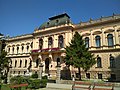
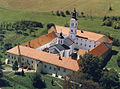 Krušedol Monastery
 Staro Hopovo Monastery
 Privina Glava Monastery
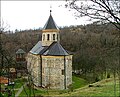 Mala Remeta Monastery
 Jazak Monastery
 Novo Hopovo Monastery
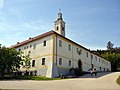 Velika Remeta Monastery
 Fenek Monastery
 Grgeteg Monastery


See also
[edit]References
[edit]- ↑ "35th anniversary of the episcopal service of Bishop Vasilije of Srem". Archived from the original on 2017-04-24. Retrieved 2017-04-23.
- ↑ Mirković 2017.
- ↑ Ćirković 2004, p. 30.
- ↑ Božanić 2015, p. 191-203.
- ↑ Sotirović 2011, p. 143–169.
- ↑ Točanac-Radović 2018, p. 155–167.
- ↑ Bataković 2005, p. 299-300.
Sources
[edit]- Bataković, Dušan T., ed. (2005). Histoire du peuple serbe [History of the Serbian People] (in French). Lausanne: L’Age d’Homme. ISBN 978-2-8251-1958-7.
- Božanić, Snežana (2015). "The Political and Cultural Life of Despot Đorđe Branković in Syrmia". The Cultural and Historical Heritage of Vojvodina in the Context of Classical and Medieval Studies. Novi Sad: Faculty of Philosophy. pp. 191–203.
- Ćirković, Sima (2004). The Serbs. Malden: Blackwell Publishing. ISBN 9781405142915.
- Gavrilović, Slavko (1993). "Serbs in Hungary, Slavonia and Croatia in struggles against the Turks (15th–18th centuries)". Serbs in European Civilization. Belgrade: Nova, Serbian Academy of Sciences and Arts, Institute for Balkan Studies. pp. 41–54. ISBN 978-86-7583-015-3.
- Isailović, Neven G.; Krstić, Aleksandar R. (2015). "Serbian Language and Cyrillic Script as a Means of Diplomatic Literacy in South Eastern Europe in 15th and 16th Centuries" (PDF). Literacy Experiences concerning Medieval and Early Modern Transylvania. Cluj-Napoca: George Bariţiu Institute of History. pp. 185–195. Archived from the original (PDF) on 7 June 2024.
- Ivić, Pavle, ed. (1995). The History of Serbian Culture. Edgware: Porthill Publishers. ISBN 978-1-870732-31-4.
- Mirković, Miroslava (2017). Sirmium: Its History from the First Century AD to 582 AD. Novi Sad: Center for Historical Research.
- Sotirović, Vladislav B. (2011). "The Serbian Patriarchate of Peć in the Ottoman Empire: The First Phase (1557–94)" (PDF). Serbian Studies. 25 (2): 143–169. doi:10.1353/ser.2011.0038. Archived from the original (PDF) on 10 August 2016.
- Točanac-Radović, Isidora (2018). "Belgrade - Seat of the Archbishopric and Metropolitanate (1718–1739)". Belgrade 1521-1867. Belgrade: The Institute of History. pp. 155–167. ISBN 978-86-7743-132-7.
External links
[edit]