


Dark matter

| Part of a series on |
| Physical cosmology |
|---|
 |


In astronomy and cosmology, dark matter is an invisible and hypothetical form of matter that does not interact with light or other electromagnetic radiation. Dark matter is implied by gravitational effects that cannot be explained by general relativity unless more matter is present than can be observed. Such effects occur in the context of formation and evolution of galaxies,[1] gravitational lensing,[2] the observable universe's current structure, mass position in galactic collisions,[3] the motion of galaxies within galaxy clusters, and cosmic microwave background anisotropies. Dark matter is thought to serve as gravitational scaffolding for cosmic structures.[4] After the Big Bang, dark matter clumped into blobs along narrow filaments with superclusters of galaxies forming a cosmic web at scales on which entire galaxies appear like tiny particles.[5][6]
In the standard Lambda-CDM model of cosmology, the mass–energy content of the universe is 5% ordinary matter, 26.8% dark matter, and 68.2% a form of energy known as dark energy.[7][8][9][10] Thus, dark matter constitutes 85% of the total mass, while dark energy and dark matter constitute 95% of the total mass–energy content.[11][12][13][14] While the density of dark matter is significant in the halo around a galaxy, its local density in the Solar System is much less than normal matter. The total of all the dark matter out to the orbit of Neptune would add up about 1017 kg, the same as a large asteroid.[15] Dark matter is classified as "cold", "warm", or "hot" according to velocity (more precisely, its free streaming length). Recent models have favored a cold dark matter scenario, in which structures emerge by the gradual accumulation of particles.
Dark matter is not known to interact with ordinary baryonic matter and radiation except through gravity, making it difficult to detect in the laboratory. The most prevalent explanation is that dark matter is some as-yet-undiscovered subatomic particle, such as either weakly interacting massive particles (WIMPs) or axions.[16] The other main possibility is that dark matter is composed of primordial black holes.[17][18][19]
Although the astrophysics community generally accepts the existence of dark matter,[20] a minority of astrophysicists, intrigued by specific observations that are not well explained by ordinary dark matter, argue for various modifications of the standard laws of general relativity. These include modified Newtonian dynamics (MOND), tensor–vector–scalar gravity, or entropic gravity. So far none of the proposed modified gravity theories can describe every piece of observational evidence at the same time, suggesting that even if gravity has to be modified, some form of dark matter will still be required.[21]
History
1884 to 1940
The hypothesis of dark matter has an elaborate history.[22][23] Lord Kelvin discussed the potential number of stars around the Sun in the appendices of a book based on a series of lectures given in 1884 in Baltimore.[24][22] He inferred their density using the observed velocity dispersion of the stars near the Sun, assuming that the Sun was 20–100 million years old. He posed what would happen if there were a thousand million stars within 1 kiloparsec of the Sun (at which distance their parallax would be 1 milli-arcsecond). Kelvin concluded:
"Many of our supposed thousand million stars — perhaps a great majority of them — may be dark bodies."[24][25]
In 1906, Henri Poincaré[26] used the French term [matière obscure] ("dark matter") in discussing Kelvin's work.[26][25] He concluded that the amount of dark matter would need to be less than that of visible matter, which was later found to be false.[25][22]
The second to suggest the existence of dark matter using stellar velocities was Dutch astronomer Jacobus Kapteyn in 1922.[27][28] A publication from 1930 by Swedish astronomer Knut Lundmark points to him being the first to hypothesize that the universe must contain much more mass than can be observed.[29] Dutch radio astronomy pioneer Jan Oort also hypothesized the existence of dark matter in 1932.[28][30][31] Oort was studying stellar motions in the galactic neighborhood and found the mass in the galactic plane must be greater than what was observed, but this measurement was later determined to be incorrect.[32]

In 1933, Swiss astrophysicist Fritz Zwicky studied galaxy clusters while working at Caltech and made a similar inference.[34][a][35] Zwicky applied the virial theorem to the Coma Cluster and obtained evidence of unseen mass he called dunkle Materie ('dark matter'). Zwicky estimated its mass based on the motions of galaxies near its edge and compared that to an estimate based on its brightness and number of galaxies. He estimated the cluster had about 400 times more mass than was visually observable. The gravity effect of the visible galaxies was far too small for such fast orbits, thus mass must be hidden from view. Based on these conclusions, Zwicky inferred some unseen matter provided the mass and associated gravitational attraction to hold the cluster together.[36] Zwicky's estimates were off by more than an order of magnitude, mainly due to an obsolete value of the Hubble constant;[37] the same calculation today shows a smaller fraction, using greater values for luminous mass. Nonetheless, Zwicky did correctly conclude from his calculation that most of the gravitational matter present was dark.[25] However, unlike modern theories, Zwicky considered "dark matter" to be non-luminous ordinary matter.[22]: III.A
Further indications of mass-to-light ratio anomalies came from measurements of galaxy rotation curves. In 1939, H.W. Babcock reported the rotation curve for the Andromeda Galaxy (then called the Andromeda Nebula), which suggested the mass-to-luminosity ratio increases radially.[38] He attributed it to either light absorption within the galaxy or modified dynamics in the outer portions of the spiral, rather than to unseen matter. Following Babcock's 1939 report of unexpectedly rapid rotation in the outskirts of the Andromeda Galaxy and a mass-to-light ratio of 50; in 1940, Oort discovered and wrote about the large non-visible halo of NGC 3115.[39]
1970s
The hypothesis of dark matter largely took root in the 1970s. Several different observations were synthesized to argue that galaxies should be surrounded by halos of unseen matter. In two papers that appeared in 1974, this conclusion was drawn in tandem by independent groups: in Princeton, New Jersey, by Jeremiah Ostriker, Jim Peebles, and Amos Yahil, and in Tartu, Estonia, by Jaan Einasto, Enn Saar, and Ants Kaasik.[40]
One of the observations that served as evidence for the existence of galactic halos of dark matter was the shape of galaxy rotation curves. These observations were done in optical and radio astronomy. In optical astronomy, Vera Rubin and Kent Ford worked with a new spectrograph to measure the velocity curve of edge-on spiral galaxies with greater accuracy.[41][42][43]
At the same time, radio astronomers were making use of new radio telescopes to map the 21 cm line of atomic hydrogen in nearby galaxies. The radial distribution of interstellar atomic hydrogen (HI) often extends to much greater galactic distances than can be observed as collective starlight, expanding the sampled distances for rotation curves – and thus of the total mass distribution – to a new dynamical regime. Early mapping of the Andromeda Galaxy with the 300-foot (91 m) telescope at Green Bank[44] and the 250-foot (76 m) dish at Jodrell Bank[45] already showed the HI rotation curve did not trace the decline expected from Keplerian orbits.
As more sensitive receivers became available, Roberts & Whitehurst (1975)[46] were able to trace the rotational velocity of Andromeda to 30 kpc, much beyond the optical measurements. Illustrating the advantage of tracing the gas disk at large radii; that paper's Figure 16[46] combines the optical data[43] (the cluster of points at radii of less than 15 kpc with a single point further out) with the HI data between 20 and 30 kpc, exhibiting the flatness of the outer galaxy rotation curve; the solid curve peaking at the center is the optical surface density, while the other curve shows the cumulative mass, still rising linearly at the outermost measurement. In parallel, the use of interferometric arrays for extragalactic HI spectroscopy was being developed. Rogstad & Shostak (1972)[47] published HI rotation curves of five spirals mapped with the Owens Valley interferometer; the rotation curves of all five were very flat, suggesting very large values of mass-to-light ratio in the outer parts of their extended HI disks.[47] In 1978, Albert Bosma showed further evidence of flat rotation curves using data from the Westerbork Synthesis Radio Telescope.[48]
In 1978, Steigman et al.[49] presented a study that extended earlier cosmological relic-density calculations to any hypothetical stable, electrically neutral, weak-scale lepton, showing how such a particle's abundance would "freeze out" in the early Universe and providing analytic expressions that linked its mass and weak interaction cross-section to the present-day matter density. By decoupling the analysis from specific neutrino properties and treating the candidate generically, the authors set out a framework that later became the standard template for weakly interacting massive particles (WIMPs)[50] and for comparing particle-physics models with cosmological constraints. Though subsequent work has refined the methodology and explored many alternative candidates, this paper marked the first explicit, systematic treatment of dark matter as a new particle species beyond the Standard Model.[51] By the late 1970s the existence of dark matter halos around galaxies was widely recognized as real, and became a major unsolved problem in astronomy.[40]
1980s and 90s

A stream of observations in the 1980–1990s supported the presence of dark matter. Persic, Salucci & Stel (1996) is notable for the investigation of 967 spirals.[52] The evidence for dark matter also included gravitational lensing of background objects by galaxy clusters,[53](pp 14–16) the temperature distribution of hot gas in galaxies and clusters, and the pattern of anisotropies in the cosmic microwave background.
2000s to present
Since the turn of the millennium, the search for particle dark matter has been dominated by the hypothesis of weakly interacting massive particles (WIMPs), driven by hypothesized connections to supersymmetry. Experimental efforts were characterized by a rapid increase in sensitivity using liquid xenon detectors, including XENON, LUX, PandaX, and LUX-ZEPLIN. Despite pushing interaction limits down by orders of magnitude, these direct detection experiments all reported null results for WIMPs across the standard GeV–TeV mass range.[54][55] As of late 2025, the LZ experiment had excluded WIMP cross-sections above 9 GeV/c2 and reported the first detection of boron-8 solar neutrinos via coherent elastic neutrino-nucleus scattering in a dark matter detector; this marks the experimental entry into the neutrino floor "fog," an irreducible background of neutrino noise that complicates future WIMP searches.[56] Concurrently, the failure of the Large Hadron Collider to detect supersymmetric particles has constrained the theoretical parameter space for WIMPs.[57] These constraints have shifted significant focus toward alternative candidates such as axions. The Axion Dark Matter Experiment achieved sensitivity to the plausible DFSZ axion model in the micro-electronvolt range by the early 2020s.[58][59]
The prevailing view among cosmologists remains that dark matter is composed primarily of some type of not-yet-characterized subatomic particle.[60][61] While this remains the majority opinion, the lack of particle detection has led to a divergence in consensus, with macroscopic candidates such as primordial black holes seeing renewed interest following observations by LIGO and JWST.[17][62] The search for such particles, by a variety of means, is one of the major efforts in particle physics.[63]
Technical definition
In standard cosmological calculations, "matter" means any constituent of the universe whose energy density scales with the inverse cube of the scale factor, i.e., ρ ∝ a−3 . This is in contrast to "radiation", which scales as the inverse fourth power of the scale factor ρ ∝ a−4 , and a cosmological constant, which does not change with respect to a (ρ ∝ a0).[64] The different scaling factors for matter and radiation are a consequence of radiation redshift. For example, after doubling the diameter of the observable Universe via cosmic expansion, the scale, a, has doubled. The energy of the cosmic microwave background radiation has been halved (because the wavelength of each photon has doubled);[65] the energy of ultra-relativistic particles, such as early-era standard-model neutrinos, is similarly halved.[b] The cosmological constant, as an intrinsic property of space, has a constant energy density regardless of the volume under consideration.[64]
In principle, "dark matter" means all components of the universe which are not visible but still obey ρ ∝ a−3 . In practice, the term "dark matter" is often used to mean only the non-baryonic component of dark matter, i.e., excluding "missing baryons".[66] Context will usually indicate which meaning is intended.
Observational evidence
Galaxy rotation curves
The arms of spiral galaxies rotate around their galactic center. The luminous mass density of a spiral galaxy decreases as one goes from the center to the outskirts. If luminous mass were all the matter, then the galaxy can be modelled as a point mass in the centre and test masses orbiting around it, similar to the Solar System.[c] From Kepler's Third Law, it is expected that the rotation velocities will decrease with distance from the center, similar to the Solar System. This is not observed.[67] Instead, the galaxy rotation curve remains flat or even increases as distance from the center increases.
If Kepler's laws are correct, then the obvious way to resolve this discrepancy is to conclude the mass distribution in spiral galaxies is not similar to that of the Solar System. In particular, there may be a lot of non-luminous matter (dark matter) in the outskirts of the galaxy.
Velocity dispersions
Stars in bound systems must obey the virial theorem. The theorem, together with the measured velocity distribution, can be used to measure the mass distribution in a bound system, such as elliptical galaxies or globular clusters. With some exceptions, velocity dispersion estimates of elliptical galaxies[68] do not match the predicted velocity dispersion from the observed mass distribution, even assuming complicated distributions of stellar orbits.[69] As with galaxy rotation curves, the obvious way to resolve the discrepancy is to postulate the existence of non-luminous matter.
Galaxy clustering
Galaxy clusters are particularly important for dark matter studies since their masses can be estimated in three independent ways:
- From the scatter in radial velocities of the galaxies within clusters
- From X-rays emitted by hot gas in the clusters. From the X-ray energy spectrum and flux, the gas temperature and density can be estimated, hence giving the pressure; assuming pressure and gravity balance determines the cluster's mass profile.
- Gravitational lensing (usually of more distant galaxies) can measure cluster masses without relying on observations of dynamics (e.g., velocity).
Generally, these three methods are in reasonable agreement that dark matter outweighs visible matter by approximately 5 to 1.[70]
On larger scales, large galaxy redshift surveys may be used to make a three-dimensional map of the galaxy distribution. These maps are slightly distorted because distances are estimated from observed redshifts; the redshift contains a contribution from the galaxy's so-called peculiar velocity in addition to the dominant Hubble expansion term. On average, superclusters are expanding more slowly than the cosmic mean due to their gravity, while voids are expanding faster than average. In a redshift map, galaxies in front of a supercluster have excess radial velocities towards it and have redshifts slightly higher than their distance would imply, while galaxies behind the supercluster have redshifts slightly low for their distance. This effect causes superclusters to appear squashed in the radial direction, and likewise voids are stretched. Their angular positions are unaffected. This effect is not detectable for any one structure since the true shape is not known, but can be measured by averaging over many structures. It was predicted quantitatively by Nick Kaiser in 1987, and first decisively measured in 2001 by the 2dF Galaxy Redshift Survey.[71] Results are in agreement with the Lambda-CDM model.
Bullet Cluster

The bullet cluster is the result of a recent collision of two galaxy clusters. It is of particular note because the location of the center of mass as measured by gravitational lensing is different from the location of the center of mass of visible matter. This is difficult for modified gravity theories, which generally predict lensing around visible matter, to explain.[72][73][74][75] Standard dark matter theory however has no issue: the hot, visible gas in each cluster would be cooled and slowed down by electromagnetic interactions, while dark matter (which does not interact electromagnetically) would not. This leads to the dark matter separating from the visible gas, producing the separate lensing peak as observed.[76]
Gravitational lensing
One of the consequences of general relativity is the gravitational lens. Gravitational lensing occurs when massive objects between a source of light and the observer act as a lens to bend light from this source. Lensing does not depend on the properties of the mass; it only requires there to be a mass. The more massive an object, the more lensing is observed. An example is a cluster of galaxies lying between a more distant source such as a quasar and an observer. In this case, the galaxy cluster will lens the quasar.
Strong lensing is the observed distortion of background galaxies into arcs when their light passes through such a gravitational lens. It has been observed around many distant clusters including Abell 1689.[77] By measuring the distortion geometry, the mass of the intervening cluster can be obtained. In the weak regime, lensing does not distort background galaxies into arcs, causing minute distortions instead. By examining the apparent shear deformation of the adjacent background galaxies, the mean distribution of dark matter can be characterized. The measured mass-to-light ratios correspond to dark matter densities predicted by other large-scale structure measurements.[78][79]
Type Ia supernova distance measurements

Type Ia supernovae can be used as standard candles to measure extragalactic distances, which can in turn be used to measure how fast the universe has expanded in the past.[80] Data indicates the universe is expanding at an accelerating rate, the cause of which is usually ascribed to dark energy.[81] Since observations indicate the universe is almost flat,[82][83][84] it is expected the total energy density of everything in the universe should sum to 1 (Ωtot ≈ 1). The measured dark energy density is ΩΛ ≈ 0.690; the observed ordinary (baryonic) matter energy density is Ωb ≈ 0.0482 and the energy density of radiation is negligible. This leaves a missing Ωdm ≈ 0.258 which nonetheless behaves like matter (see technical definition section above) – dark matter.[85]
Lyman-alpha forest
In astronomical spectroscopy, the Lyman-alpha forest is the sum of the absorption lines arising from the Lyman-alpha transition of neutral hydrogen in the spectra of distant galaxies and quasars. Lyman-alpha forest observations can also constrain cosmological models.[86] These constraints agree with those obtained from WMAP data.
Cosmic microwave background
Although both dark matter and ordinary matter are matter, they do not behave in the same way. In particular, in the early universe, ordinary matter was ionized and interacted strongly with radiation via Thomson scattering. Dark matter does not interact directly with radiation, but it does affect the cosmic microwave background (CMB) by its gravitational potential (mainly on large scales) and by its effects on the density and velocity of ordinary matter. Ordinary and dark matter perturbations, therefore, evolve differently with time and leave different imprints on the CMB.
The CMB is very close to a perfect blackbody but contains very small temperature anisotropies of a few parts in 100,000. A sky map of anisotropies can be decomposed into an angular power spectrum, which is observed to contain a series of acoustic peaks at near-equal spacing but different heights. The locations of these peaks depend on cosmological parameters. Matching theory to data, therefore, constrains cosmological parameters.[87]
The CMB anisotropy was first discovered by COBE in 1992, though this had too coarse resolution to detect the acoustic peaks. After the discovery of the first acoustic peak by the balloon-borne BOOMERanG experiment in 2000, the power spectrum was precisely observed by WMAP in 2003–2012, and even more precisely by the Planck spacecraft in 2013–2015. The results support the Lambda-CDM model.[88][89] The observed CMB angular power spectrum provides powerful evidence in support of dark matter, as its precise structure is well fitted by the Lambda-CDM model,[89] but difficult to reproduce with any competing model such as modified Newtonian dynamics (MOND).[90]
Structure formation
.jpg)
Structure formation refers to the period after the Big Bang when density perturbations collapsed to form stars, galaxies, and clusters. Prior to structure formation, the Friedmann solutions to general relativity describe a homogeneous universe. Later, small anisotropies gradually grew and condensed the homogeneous universe into stars, galaxies and larger structures. Ordinary matter is affected by radiation, which is the dominant element of the universe at very early times. As a result, its density perturbations are washed out and unable to condense into structure.[92] If there were only ordinary matter in the universe, there would not have been enough time for density perturbations to grow into the galaxies and clusters currently seen.
Dark matter provides a solution to this problem because it is unaffected by radiation. Therefore, its density perturbations can grow first. The resulting gravitational potential acts as an attractive potential well for ordinary matter collapsing later, speeding up the structure formation process.[92][93]
Sky surveys and baryon acoustic oscillations
Baryon acoustic oscillations (BAO) are fluctuations in the density of the visible baryonic matter (normal matter) of the universe on large scales. These are predicted to arise in the Lambda-CDM model due to acoustic oscillations in the photon–baryon fluid of the early universe and can be observed in the cosmic microwave background angular power spectrum. BAOs set up a preferred length scale for baryons. As the dark matter and baryons clumped together after recombination, the effect is much weaker in the galaxy distribution in the nearby universe, but is detectable as a subtle (~ 1%) preference for pairs of galaxies to be separated by 147 Mpc, compared to those separated by 130–160 Mpc. This feature was predicted theoretically in the 1990s and then discovered in 2005, in two large galaxy redshift surveys, the Sloan Digital Sky Survey and the 2dF Galaxy Redshift Survey.[94] Combining the CMB observations with BAO measurements from galaxy redshift surveys provides a precise estimate of the Hubble constant and the average matter density in the Universe.[95] The results support the Lambda-CDM model.
Theoretical classifications
Dark matter can be divided into cold, warm, and hot categories.[96] These categories refer to velocity rather than an actual temperature, and indicate how far corresponding objects moved due to random motions in the early universe, before they slowed due to cosmic expansion. This distance is called the free streaming length. The categories of dark matter are set with respect to the size of the collection of mass prior to structure formation that later collapses to form a dwarf galaxy. This collection of mass is sometimes called a protogalaxy. Dark matter particles are classified as cold, warm, or hot if their free streaming length is much smaller (cold), similar to (warm), or much larger (hot) than the protogalaxy of a dwarf galaxy.[97][98][99] Mixtures of the above are also possible: a theory of mixed dark matter was popular in the mid-1990s, but was rejected following the discovery of dark energy.[citation needed]
The significance of the free streaming length is that the universe began with some primordial density fluctuations from the Big Bang (in turn arising from quantum fluctuations at the microscale). Particles from overdense regions will naturally spread to underdense regions, but because the universe is expanding quickly, there is a time limit for them to do so. Faster particles (hot dark matter) can beat the time limit while slower particles cannot. The particles travel a free streaming length's worth of distance within the time limit; therefore this length sets a minimum scale for later structure formation. Because galaxy-size density fluctuations get washed out by free-streaming, hot dark matter implies the first objects that can form are huge supercluster-size pancakes, which then fragment into galaxies, while the reverse is true for cold dark matter.
Deep-field observations show that galaxies formed first, followed by clusters and superclusters as galaxies clump together,[63] and therefore that most dark matter is cold. This is also the reason why neutrinos, which move at nearly the speed of light and therefore would fall under hot dark matter, cannot make up the bulk of dark matter.[92]

.jpg)
Composition

The identity of dark matter is unknown, but there are many hypotheses about what dark matter could consist of, as set out in the table below.
| Light bosons | Axions |
| Axion-like particles | |
| Fuzzy cold dark matter | |
| Neutrinos | Standard Model[d] |
| Sterile neutrinos | |
| Other particles | Lightest supersymmetric particle |
| Weakly interacting massive particles (WIMPs) | |
| Self-interacting dark matter | |
| Atomic dark matter[107][108][109][110] | |
| Strangelet[111] | |
| Macroscopic | Primordial black holes (PBHs)[17][18][112][19][113][114][115][116][117][118] |
| Other massive compact halo objects (MACHOs) |
Baryonic matter
Dark matter can refer to any substance which interacts predominantly via gravity with visible matter (e.g., stars and planets). Hence in principle it need not be composed of a new type of fundamental particle but could, at least in part, be made up of standard baryonic matter, such as protons or neutrons. Most of the ordinary matter familiar to astronomers, including planets, brown dwarfs, red dwarfs, visible stars, white dwarfs, neutron stars, and black holes, fall into this category.[22][119] A black hole would ingest both baryonic and non-baryonic matter that comes close enough to its event horizon; afterwards, the distinction between the two is lost.[120]
These massive objects that are hard to detect are collectively known as MACHOs. Some scientists initially hoped that baryonic MACHOs could account for and explain all the dark matter.[53]: 286 [121]
However, multiple lines of evidence suggest the majority of dark matter is not baryonic:
- Sufficient diffuse, baryonic gas or dust would be visible when backlit by stars.
- The theory of Big Bang nucleosynthesis predicts the observed abundance of the chemical elements. If there are more baryons, then there should also be more helium, lithium and heavier elements synthesized during the Big Bang.[122][123] Agreement with observed abundances requires that baryonic matter makes up between 4–5% of the universe's critical density. In contrast, large-scale structure and other observations indicate that the total matter density is about 30% of the critical density.[85]
- Astronomical searches for gravitational microlensing in the Milky Way found at most only a small fraction of the dark matter may be in dark, compact, conventional objects (MACHOs, etc.); the excluded range of object masses is from half the Earth's mass up to 30 solar masses, which covers nearly all the plausible candidates.[124][125][126][127][128][129]
- Detailed analysis of the small irregularities (anisotropies) in the cosmic microwave background by WMAP and Planck indicate that around five-sixths of the total matter is in a form that only interacts significantly with ordinary matter or photons through gravitational effects.[130]
Non-baryonic matter
There are two main candidates for non-baryonic dark matter: new particles and primordial black holes. Unlike baryonic matter, nonbaryonic particles do not contribute to the formation of the elements in the early universe (Big Bang nucleosynthesis)[131][132][60] and so its presence is felt only via its gravitational effects (such as weak lensing). In addition, some dark matter candidates can interact with themselves (self-interacting dark matter) or with ordinary particles (e.g. WIMPs), possibly resulting in observable by-products such as gamma rays and neutrinos (indirect detection).[106] Candidates abound (see the table above), each with their own strengths and weaknesses.
Particle candidates
Weakly Interacting Massive Particles

There exists no formal definition of a Weakly Interacting Massive Particle (WIMP), but broadly, it is an elementary particle which interacts via gravity and any other force (or forces) which is as weak as or weaker than the weak nuclear force, but also non-vanishing in strength. Many WIMP candidates are expected to have been produced thermally in the early Universe, similarly to the particles of the Standard Model[133] according to Big Bang cosmology, and usually will constitute cold dark matter. Obtaining the correct abundance of dark matter today via thermal production requires a self-annihilation cross section of ≃ 3×10⁻²⁶ cm3⋅s−1, which is roughly what is expected for a new particle in the 100 GeV/c2 mass range that interacts via the electroweak force.

Because supersymmetric extensions of the Standard Model of particle physics readily predict a new particle with these properties, this apparent coincidence has been called the "WIMP miracle", and a stable supersymmetric partner has long been a prime explanation for dark matter.[134] Experimental efforts to detect WIMPs include the search for products of WIMP annihilation, including gamma rays, neutrinos and cosmic rays in nearby galaxies and galaxy clusters; direct detection experiments designed to measure the collision of WIMPs with nuclei in the laboratory, as well as attempts to directly produce WIMPs in colliders, such as the Large Hadron Collider at CERN. In the early 2010s, results from direct-detection experiments along with the lack of evidence for supersymmetry at the Large Hadron Collider (LHC) experiment[135][136] have cast doubt on the simplest WIMP hypothesis.[137]
Axions
Axions are hypothetical elementary particles originally theorized in 1978 independently by Frank Wilczek and Steven Weinberg as the Goldstone boson of Peccei–Quinn theory, which had been proposed in 1977 to solve the strong CP problem in quantum chromodynamics (QCD). QCD effects produce an effective periodic potential in which the axion field moves.[138] Expanding the potential about one of its minima, one finds that the product of the axion mass with the axion decay constant is determined by the topological susceptibility of the QCD vacuum. An axion with mass that is much less than 60 keV/c2 is long-lived and weakly interacting: a perfect dark matter candidate.
The oscillations of the axion field about the minimum of the effective potential, the so-called misalignment mechanism, generate a cosmological population of cold axions with an abundance depending on the mass of the axion.[139][140][141] With a mass above 5 μeV/c2 (10−11 times the electron mass) axions could account for dark matter, and thus be both a dark-matter candidate and a solution to the strong CP problem. If inflation occurs at a low scale and lasts sufficiently long, the axion mass can be as low as 1 peV/c2.[142][143][144]

Because axions have extremely low mass, their de Broglie wavelength is very large, in turn meaning that quantum effects could help resolve the small-scale problems of the Lambda-CDM model. A single ultralight axion with a decay constant at the grand unified theory scale provides the correct relic density without fine-tuning.[145] Axions as a dark matter candidate have gained in popularity in recent years, because of the non-detection of WIMPs.[146]
Particle aggregation and dense dark matter objects
If dark matter is composed of weakly interacting particles, then an obvious question is whether it can form objects equivalent to planets, stars, or black holes. Historically, the answer has been it cannot,[e][147][148][149] because of two factors:
- It lacks an efficient means to lose energy[147]
- Ordinary matter forms dense objects because it has numerous ways to lose energy. Losing energy would be essential for object formation, because a particle that gains energy during compaction or falling "inward" under gravity, and cannot lose it any other way, will heat up and increase velocity and momentum. Dark matter appears to lack a means to lose energy, simply because it is not capable of interacting strongly in other ways except through gravity. The virial theorem suggests that such a particle would not stay bound to the gradually forming object – as the object began to form and compact, the dark matter particles within it would speed up and tend to escape.
- It lacks a diversity of interactions needed to form structures[149]
- Ordinary matter interacts in many different ways, which allows the matter to form more complex structures. For example, stars form through gravity, but the particles within them interact and can emit energy in the form of neutrinos and electromagnetic radiation through fusion when they become energetic enough. Protons and neutrons can bind via the strong interaction and then form atoms with electrons largely through electromagnetic interaction. There is no evidence that dark matter is capable of such a wide variety of interactions, since it seems to only interact through gravity (and possibly through some means no stronger than the weak interaction, although until dark matter is better understood, this is only speculation).
Primordial black holes

Primordial black holes (PBHs) are hypothetical black holes that formed soon after the Big Bang. In the inflationary era and early radiation-dominated universe, extremely dense pockets of subatomic matter may have been tightly packed to the point of gravitational collapse, creating black holes without the supernova compression typically needed to create stellar black holes.[18] The idea was first suggested by Yakov Zeldovich and Igor Dmitriyevich Novikov in 1966,[150] and independently by Stephen Hawking in 1971.[151] Because PBHs would form prior to stellar evolution, they are non-baryonic dark matter candidates and are not limited to the narrow mass range of stellar black holes; they could range from Planck-mass relics to supermassive scales.[17]
Interest in PBHs as a primary component of dark matter was revived following the 2015 discovery of gravitational waves by LIGO. Their first detected merger involved black holes of approximately 30 solar masses; such objects are difficult to explain via standard stellar collapse but fit the predicted mass range for PBHs formed during the QCD transition in the early universe.[18] This interest was bolstered in November 2025, when the LIGO/Virgo/KAGRA collaboration reported a candidate gravitational wave signal from a sub-solar mass merger. As no astrophysical process is known to produce black holes below the Chandrasekhar limit (~1.4 solar masses), confirmed sub-solar mass objects would be strong evidence for a primordial origin.[152][153][154] As there have been no gravitational waves detected at z>1 (>6 Gya), and the sensitivity to lower-mass collisions falls off with distance, we are not currently able to detect collisions in the earliest half of the age of the universe.[155]
.jpg)
Further support for the PBH hypothesis has emerged from James Webb Space Telescope (JWST) observations of the high-redshift universe (z > 7). JWST discovered unexpected populations of "Little Red Dots" (compact very high redshift objects) and "overmassive black hole galaxies" such as UHZ1 and GHZ2, which contain supermassive black holes appearing less than 500 million years after the Big Bang and outweighing their galaxy's stars.[157][158] These active galactic nuclei challenge standard models of accretion from "light" stellar black hole seeds, and suggest "heavy seeds" formed via direct collapse or PBHs, which could account for a significant fraction of dark matter halos.[159]
Various observational constraints, such as gravitational microlensing data from the Subaru Telescope (HSC) and Voyager 1 measurements of Hawking radiation, have ruled out PBHs constituting 100% of dark matter in specific mass windows (e.g., evaporating tiny black holes or monochromatic intermediate-mass populations).[160] However, those constraints assume all PBHs have the same mass, a monochromatic mass distribution. More recent analyses utilizing extended mass distributions, predicted by inflation models and evident in gravitational wave and JWST observations, remove such constraints. A 2024 review indicates that PBHs with a broad, platykurtic mass distribution peaking around one solar mass could explain the entirety of dark matter, or coexist with other candidates in a mixed dark matter scenario.[17][161]

The primary theoretical challenge to the PBH hypothesis is the physical mechanism of their formation. Standard models of cosmic inflation, known as "slow-roll inflation," generate density fluctuations that are far too small to trigger primordial collapse. Consequently, producing the required abundance of PBHs typically necessitates "exotic" inflation models, often featuring inflection points, bumps, or plateaus in the inflaton potential, which can amplify fluctuations by orders of magnitude.[163] Critics argue that these models require significant fine-tuning, as the resulting PBH abundance is exponentially sensitive to the amplitude of these fluctuations; meaning that a slight deviation in parameters results in either a negligible amount of dark matter or a universe dominated entirely by black holes.[161][115] However, proponents contend that as the natural parameter space for WIMPs is increasingly excluded by null results from all detection experiments, particle dark matter theories now require comparable levels of fine-tuning. Furthermore, they argue that the specific mass structures predicted by these exotic inflation models provide a unified explanation for observational anomalies seen by LIGO and JWST that particle models do not address.[17]
Particle searches
If dark matter is made up of subatomic particles, then millions, possibly billions, of such particles must pass through every square centimeter of the Earth each second.[164][165] Many experiments aim to test this hypothesis. Although WIMPs have been the main search candidates,[63] axions have drawn renewed attention, with the Axion Dark Matter Experiment (ADMX) searches for axions and many more planned in the future.[166] Another candidate is heavy hidden sector particles which only interact with ordinary matter via gravity. These experiments can be divided into two classes: direct detection experiments, which search for the scattering of dark matter particles off atomic nuclei within a detector; and indirect detection, which look for the products of dark matter particle annihilations or decays.[106]
Direct particle detection
Direct detection experiments aim to observe interactions between dark matter particles passing through the Earth and ordinary matter detector targets. For Weakly interacting massive particles (WIMPs), the primary signature is a low-energy recoil of nuclei (typically a few keV), which induces energy in the form of scintillation light, ionization, or phonons (heat). For axions, experiments typically search for the conversion of axions into photons within a strong magnetic field (the Primakoff effect).
To detect these rare events effectively, it is crucial to maintain an extremely low background, which is why such experiments typically operate deep underground where interference from cosmic rays is minimized. Major underground laboratories hosting these experiments include SNOLAB (Canada), LNGS (Italy), CJPL (China), and the SURF (USA).
WIMPs

WIMP searches mostly use either cryogenic or noble liquid detector technologies. Cryogenic detectors, operating at temperatures below 100 mK, detect the heat produced when a particle hits an atom in a crystal absorber such as germanium. Experiments using this technology include SuperCDMS and EDELWEISS.
Noble liquid detectors detect scintillation and ionization produced by a particle collision in liquid xenon or argon. This technology has led the field in sensitivity for the last decade. Major current experiments include LZ (at SURF), XENONnT (at LNGS), and PandaX-4T (at CJPL), with future argon-based projects like DarkSide-20k in development.
As of late 2025, there has been no confirmed detection of dark matter from these standard WIMP searches. Instead, experiments have placed strong upper limits on the particle's interaction cross-section with nucleons.[54][55] In late 2025, the LZ experiment reported the exclusion of WIMP cross-sections above 9 GeV/c2 and the first detection of boron-8 solar neutrinos via coherent elastic neutrino-nucleus scattering in a dark matter detector. This was the first experimental entry into the "neutrino fog," an irreducible background of neutrino interactions that mimics dark matter signals and complicates future WIMP searches.[56]
Axions
As WIMP parameter space has become increasingly constrained, focus has also shifted toward axion searches. These experiments, such as the Axion Dark Matter Experiment, typically use resonant microwave cavities rather than nuclear recoil targets. By the early 2020s, ADMX had achieved sensitivity to the plausible DFSZ axion model in the micro-electronvolt range.[58]
Annual modulation and directionality
Despite the null results from major noble liquid and cryogenic experiments, the DAMA/NaI and DAMA/LIBRA collaborations have famously observed an annual modulation in their event rate,[167] which they claim is due to the Earth's motion through the dark matter halo. This claim remains in tension with the negative results from the more sensitive experiments (LZ, XENON, SuperCDMS) described above.
A special case of direct detection involves directional sensitivity, which attempts to correlate WIMP signals with the direction of the Solar System's motion towards Cygnus.[168] Directional experiments using low-pressure time projection chambers include DMTPC, DRIFT, CYGNUS, and MIMAC.
Indirect particle detection

Indirect detection experiments search for the products of the self-annihilation or decay of dark matter particles in outer space. For example, in regions of high dark matter density (e.g., the centre of the Milky Way) two dark matter particles could annihilate to produce gamma rays or Standard Model particle–antiparticle pairs.[170] Alternatively, if a dark matter particle is unstable, it could decay into Standard Model (or other) particles. These processes could be detected indirectly through an excess of gamma rays, antiprotons or positrons emanating from high density regions in the Milky Way and other galaxies.[171] A major difficulty inherent in such searches is that various astrophysical sources can mimic the signal expected from dark matter, and so multiple signals are likely required for a conclusive discovery.[63][106]
A few of the dark matter particles passing through the Sun or Earth may scatter off atoms and lose energy. Thus dark matter may accumulate at the center of these bodies, increasing the chance of collision/annihilation. This could produce a distinctive signal in the form of high-energy neutrinos.[172] Such a signal would be strong indirect proof of WIMP dark matter.[63] High-energy neutrino telescopes such as AMANDA, IceCube and ANTARES are searching for this signal.[53]: 298 Many experimental searches have been undertaken to look for such emission from dark matter annihilation or decay, examples of which follow:
- The Energetic Gamma Ray Experiment Telescope observed more gamma rays in 2008 than expected from the Milky Way, but scientists concluded this was most likely due to incorrect estimation of the telescope's sensitivity.[173]
- The Fermi Gamma-ray Space Telescope is searching for similar gamma rays.[174] In 2009, an as yet unexplained surplus of gamma rays from the Milky Way's galactic center was found in Fermi data. This Galactic Center GeV excess might be due to dark matter annihilation or to a population of pulsars.[175] In April 2012, an analysis of previously available data from Fermi's Large Area Telescope instrument produced statistical evidence of a 130 GeV signal in the gamma radiation coming from the center of the Milky Way.[176] WIMP annihilation was seen as the most probable explanation.[177]
- At higher energies, ground-based gamma-ray telescopes have set limits on the annihilation of dark matter in dwarf spheroidal galaxies[178] and in clusters of galaxies.[179]
- The PAMELA experiment (launched in 2006) detected excess positrons. They could be from dark matter annihilation or from pulsars. No excess antiprotons were observed.[180]
- In 2013, results from the Alpha Magnetic Spectrometer on the International Space Station indicated excess high-energy cosmic rays which could be due to dark matter annihilation.[181][182][183][184][185][186]
The detection by LIGO in September 2015 of gravitational waves opens the possibility of observing dark matter in a new way, particularly if it is in the form of primordial black holes.[187][188]
Astrophysical probes

Beyond searching for annihilation products, astrophysicists are using celestial objects as natural detectors to constrain dark matter particle properties.
- Stellar heating: If dark matter particles capture inside dense stars like neutron stars or white dwarfs, they can deposit kinetic energy during the capture process or through subsequent annihilation. This mechanism, known as "dark kinetic heating," would maintain the star at a temperature higher than expected for its age, potentially arresting its cooling indefinitely. The observation of old, "cold" neutron stars therefore places stringent limits on the scattering cross-section of dark matter particles with nucleons, as any significant interaction would have kept these stars hotter than observed.[189][190]
- Stellar cooling: New light particles, such as axions, could be produced in the hot cores of stars and escape freely, carrying away energy. This additional energy loss channel would alter the evolution of stars, cooling them faster than standard models predict. Comparisons of observed red giant branch tips and white dwarf cooling curves with theoretical models have set some of the strongest constraints on the coupling of axions to electrons and photons.[191][192]
- Black hole superradiance: Ultralight bosons, such as axions or dark photons, can extract rotational energy from spinning black holes through a process called superradiance. If the boson's Compton wavelength is comparable to the black hole's event horizon size, the particles form a dense "boson cloud" around the black hole, rapidly slowing its spin on astrophysical timescales. The observation of rapidly spinning black holes in X-ray binaries or through gravitational waves excludes the existence of such particles in specific mass ranges, as their existence would have spun these black holes down long ago.[193][194]
Collider searches

An alternative approach to the detection of dark matter particles in nature is to produce them in a laboratory. Experiments with the Large Hadron Collider (LHC) may be able to detect dark matter particles produced in collisions of the LHC proton beams. Because a dark matter particle should have negligible interactions with normal visible matter, it may be detected indirectly as large amounts of missing energy and momentum that escape the detectors, provided other non-negligible collision products are detected.[195]
Constraints on supersymmetry
For decades, the leading candidate for dark matter was the lightest neutralino predicted by supersymmetry. However, extensive searches through the conclusion of the LHC's run 3 (2022–2025) operations have failed to detect the superpartners (such as squarks and gluinos) predicted by supersymmetry models.[196] By late 2025, the ATLAS and CMS collaborations had pushed exclusion limits for gluinos beyond 2.4 TeV, and limits for charginos and neutralinos ("electroweak-inos") beyond 1 TeV in many scenarios.[197] This persistent absence has ruled out the most favored parameter space for WIMPs, forcing theorists to consider more complex and fine-tuned models such as "split supersymmetry," or to abandon supersymmetry candidates entirely.[197]
Shift to dark sectors and exotic signatures
In response to these null results, experimental focus has shifted toward "dark sector" theories and more exotic signatures that might have evaded earlier experiments.[198] Recent analyses from 2024 and 2025 have targeted signatures that do not fit the expected missing energy profile:
- Long-lived particles: These are particles that travel centimeters or meters through the detector before decaying, creating "displaced vertices" or "disappearing tracks." New triggers implemented in Run 3 specifically targeted these events, particularly looking for long-lived charginos that decay into invisible dark matter and very soft pions.[199]
- Dark jets and semi-visible jets: Signatures where dark matter is produced alongside visible matter in complex showers, which look different from standard quark-gluon jets. In 2025, ATLAS released results on "emerging jets" that appear mid-flight within the detector, setting the first exclusion limits on dark hadrons in that channel.[200]
- Dark photons: Lighter mediators that could bridge the Standard Model and the dark sector. Experiments like the FASER experiment and dedicated low-mass triggers at CMS have searched for these in the 2–8 GeV mass range, constraining the mixing parameters between dark and ordinary photons.[201]
While the LHC has not yet produced direct evidence of dark matter, the constraints established by the ATLAS and CMS collaborations have been crucial in narrowing their parameter spaces, closing the door on many WIMP models and redirecting future searches toward lighter, more elusive candidates or multi-TeV scales accessible only by future colliders like the Future Circular Collider.[202]
Alternative hypotheses
Modified gravity (including MOND)
The last major possibility is that general relativity, the theory underpinning modern cosmology, is incorrect. General relativity is well-tested on Solar System scales, but its validity on galactic or cosmological scales has not been well proven.[203] A suitable modification to general relativity can conceivably eliminate the need for dark matter. The best-known theories of this class are modified Newtonian dynamics (MOND) and its relativistic generalization tensor–vector–scalar gravity (TeVeS),[204] f(R) gravity,[205] negative mass, dark fluid,[206][207][208] entropic gravity,[209] conformal gravity, and massive gravity. Alternative theories abound.[210][211]
A problem with modifying gravity is that observational evidence for dark matter – let alone general relativity – comes from so many independent approaches (see the "observational evidence" section above). Explaining any individual observation is possible but explaining all of them in the absence of dark matter is very difficult. Nonetheless, there have been some scattered successes for alternative hypotheses, such as a 2016 test of gravitational lensing in entropic gravity[212][213][214] and a 2020 measurement of a unique MOND effect.[215][216] The prevailing opinion among most astrophysicists is that while modifications to general relativity can conceivably explain part of the observational evidence, there is probably enough data to conclude there must be some form of dark matter present in the universe.[21]
Non-mainstream and less established particle, field, and structure theories
While WIMPs, axions, and primordial black holes remain the primary candidates for dark matter, numerous other theories have been proposed to address specific observational anomalies or theoretical motivations. These alternative models often explore mass ranges and interaction strengths outside the standard parameter space, ranging from ultra-light scalar fields to massive composite states. Some hypotheses posit the existence of complex "dark sectors" with their own fundamental forces, while others suggest that dark matter may be unstable, dynamical, or composed of mirror particles. The following list encompasses these less established but theoretically motivated candidates and frameworks.
- Chameleon particle – Hypothetical scalar particle that couples to matter more weakly than gravity
- Dark galaxy – Hypothesized galaxy with no, or very few, stars
- Dark radiation – Postulated type of radiation that mediates interactions of dark matter
- Density wave theory – A theory in which waves of compressed gas, which move slower than the galaxy, maintain galaxies' structure
- Dynamical dark matter[217][218]
- Exotic matter – Physics term for multiple concepts
- Feebly interacting particles
- Light dark matter – Dark matter weakly interacting massive particles candidates with masses less than 1 GeV
- Mirror matter – Hypothetical counterpart to ordinary matter
- Neutralino – Neutral mass eigenstate formed from superpartners of gauge and Higgs bosons
- Scalar field dark matter – Conjectured dark matter in cosmology
- Strongly interacting massive particle (SIMP) – Hypothetical particle
- Weakly interacting slim particle (WISP) – Low-mass counterpart to WIMP
In popular culture
Dark matter regularly appears as a topic in hybrid periodicals that cover both factual scientific topics and science fiction,[219] and dark matter itself has been referred to as "the stuff of science fiction".[220]
Mention of dark matter is made in works of fiction. In such cases, it is usually attributed extraordinary physical or magical properties, thus becoming inconsistent with the hypothesized properties of dark matter in physics and cosmology. For example:
- Dark matter serves as a plot device in the 1995 X-Files episode "Soft Light".[221]
- A dark-matter-inspired substance known as "Dust" features prominently in Philip Pullman's His Dark Materials trilogy.[222]
- Beings made of dark matter are antagonists in Stephen Baxter's Xeelee Sequence.[223]
More broadly, the phrase "dark matter" is used metaphorically in fiction to evoke the unseen or invisible.[224]
Gallery
-

-
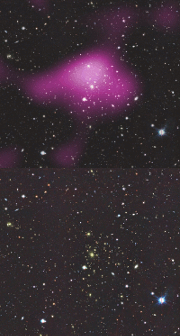
 DM map by the CFHT Lensing Survey (CFHTLenS) using the Canada–France–Hawaii Telescope (2012)[227][228] (COSMOS map at the center)
 -
-

-


See also
- Related theories
- Dark energy – Energy driving the accelerated expansion of the universe
- Unparticle physics – Speculative theory of non-particle matter
- Experiments
- DEAP – Dark matter search experiment, a search apparatus
- Dark Matter Particle Explorer (DAMPE) – Chinese science satellite
- General antiparticle spectrometer
- MultiDark, a research program
- Illustris project – Computer-simulated universes, astrophysical simulations
- Other
- Galactic Center GeV excess – Unexplained gamma rays from the Galactic Center
- Luminiferous aether – A once theorized invisible and infinite material with no interaction with physical objects, used to explain how light could travel through a vacuum (now disproven)
Notes
- ^
"Um, wie beobachtet, einen mittleren Dopplereffekt von 1000 km/sek oder mehr zu erhalten, müsste also die mittlere Dichte im Comasystem mindestens 400 mal grösser sein als die auf Grund von Beobachtungen an leuchtender Materie abgeleitete. Falls sich dies bewahrheiten sollte, würde sich also das überraschende Resultat ergeben, dass dunkle Materie in sehr viel grösserer Dichte vorhanden ist als leuchtende Materie."[34](p125)
- [In order to obtain an average Doppler effect of 1000 km/s or more, as observed, the average density in the Coma system would thus have to be at least 400 times greater than that derived on the basis of observations of luminous matter. If this were to be confirmed, the surprising result would then follow that dark matter is present in very much greater density than luminous matter.]
- ^ However, in the modern cosmic era, this neutrino field has cooled and started to behave more like matter and less like radiation.
- ^ This is a consequence of the shell theorem and the observation that spiral galaxies are spherically symmetric to a large extent (in 2D).
- ^ The three neutrino types already observed are indeed abundant, and dark, and matter, but their individual masses are almost certainly too tiny to account for more than a small fraction of dark matter, due to limits derived from large-scale structure and high-redshift galaxies.[106]
- ^ "One widely held belief about dark matter is it cannot cool off by radiating energy. If it could, then it might bunch together and create compact objects in the same way baryonic matter forms planets, stars, and galaxies. Observations so far suggest dark matter doesn't do that – it resides only in diffuse halos ... As a result, it is extremely unlikely there are very dense objects like stars made out of entirely (or even mostly) dark matter." — Buckley & Difranzo (2018)[147]
References
- ^ Siegfried, T. (5 July 1999). "Hidden space dimensions may permit parallel universes, explain cosmic mysteries". The Dallas Morning News. Archived from the original on 21 February 2015. Retrieved 24 October 2009.
- ^ Trimble, V. (1987). "Existence and nature of dark matter in the universe" (PDF). Annual Review of Astronomy and Astrophysics. 25: 425–472. Bibcode:1987ARA&A..25..425T. doi:10.1146/annurev.aa.25.090187.002233. ISSN 0066-4146. S2CID 123199266. Archived (PDF) from the original on 18 July 2018.
- ^ "A history of dark matter". 2017.
- ^ "The Milky Way May Be Missing a Trillion Suns' Worth of Mass". Scientific American. 10 October 2023.
- ^ Schilling, Govert (23 May 2001). "Filaments of the Early Universe". Science.
- ^ Stapelberg, Sebastian (5 December 2022). "The Cosmic Web of Galaxies, Dark Matter and How It Emerged". Structures Blog.
- ^ "Planck Mission Brings Universe into Sharp Focus". NASA Mission Pages. 21 March 2013. Archived from the original on 12 November 2020. Retrieved 1 May 2016.
- ^ "Dark Energy, Dark Matter". NASA Science: Astrophysics. 5 June 2015.
- ^ Ade, P. A. R.; Aghanim, N.; Armitage-Caplan, C.; et al. (Planck Collaboration) (22 March 2013). "Planck 2013 results. I. Overview of products and scientific results – Table 9". Astronomy and Astrophysics. 1303: 5062. arXiv:1303.5062. Bibcode:2014A&A...571A...1P. doi:10.1051/0004-6361/201321529. S2CID 218716838.
- ^ Francis, Matthew (22 March 2013). "First Planck results: the Universe is still weird and interesting". Ars Technica.
- ^ "Planck captures portrait of the young Universe, revealing earliest light". University of Cambridge. 21 March 2013. Retrieved 21 March 2013.
- ^ Carroll, Sean (2007). Dark Matter, Dark Energy: The dark side of the universe. The Teaching Company. Guidebook Part 2 p. 46.
... dark matter: An invisible, essentially collisionless component of matter that makes up about 25 percent of the energy density of the universe ... it's a different kind of particle... something not yet observed in the laboratory ...
- ^ Ferris, Timothy (January 2015). "Dark matter". Hidden cosmos. National Geographic Magazine. Archived from the original on 25 December 2014. Retrieved 10 June 2015.
- ^ Jarosik, N.; et al. (2011). "Seven-year Wilson microwave anisotropy probe (WMAP) observations: Sky maps, systematic errors, and basic results". Astrophysical Journal Supplement. 192 (2): 14. arXiv:1001.4744. Bibcode:2011ApJS..192...14J. doi:10.1088/0067-0049/192/2/14. S2CID 46171526.
- ^ Siegel, Ethan (3 July 2018). "This Is How Much Dark Matter Passes Through Your Body Every Second". Forbes.
- ^ Timmer, John (21 April 2023). "No WIMPS! Heavy particles don't explain gravitational lensing oddities". Ars Technica. Retrieved 21 June 2023.
- ^ a b c d e f Carr, B. J.; Clesse, S.; García-Bellido, J.; Hawkins, M. R. S.; Kühnel, F. (26 February 2024). "Observational evidence for primordial black holes: A positivist perspective". Physics Reports. 1054: 1–68. arXiv:2306.03903. Bibcode:2024PhR..1054....1C. doi:10.1016/j.physrep.2023.11.005. ISSN 0370-1573. See Figure 39.
- ^ a b c d Bird, Simeon; Albert, Andrea; Dawson, Will; Ali-Haïmoud, Yacine; Coogan, Adam; Drlica-Wagner, Alex; Feng, Qi; Inman, Derek; Inomata, Keisuke; Kovetz, Ely; Kusenko, Alexander; Lehmann, Benjamin V.; Muñoz, Julian B.; Singh, Rajeev; Takhistov, Volodymyr; Tsai, Yu-Dai (1 August 2023). "Primordial black hole dark matter". Physics of the Dark Universe. 41 101231. arXiv:2203.08967. Bibcode:2023PDU....4101231B. doi:10.1016/j.dark.2023.101231. ISSN 2212-6864. S2CID 247518939.
- ^ a b Carr, Bernard; Kühnel, Florian (2 May 2022). "Primordial black holes as dark matter candidates". SciPost Physics Lecture Notes 48. arXiv:2110.02821. doi:10.21468/SciPostPhysLectNotes.48. S2CID 238407875. Retrieved 13 February 2023. (See also the accompanying slide presentation.
- ^ Hossenfelder, Sabine; McGaugh, Stacy S. (August 2018). "Is dark matter real?". Scientific American. 319 (2): 36–43. Bibcode:2018SciAm.319b..36H. doi:10.1038/scientificamerican0818-36. PMID 30020902. S2CID 51697421.
Right now a few dozens of scientists are studying modified gravity, whereas several thousand are looking for particle dark matter.
- ^ a b Carroll, Sean (9 May 2012). "Dark matter vs. modified gravity: A trialogue". Retrieved 14 February 2017.
- ^ a b c d e Bertone, Gianfranco; Hooper, Dan (15 October 2018). "History of dark matter". Reviews of Modern Physics. 90 (4) 045002. arXiv:1605.04909. Bibcode:2018RvMP...90d5002B. doi:10.1103/RevModPhys.90.045002. S2CID 18596513.
- ^ de Swart, J.G.; Bertone, G.; van Dongen, J. (2017). "How dark matter came to matter". Nature Astronomy. 1 (59): 59. arXiv:1703.00013. Bibcode:2017NatAs...1E..59D. doi:10.1038/s41550-017-0059. S2CID 119092226.
- ^ a b Thompson, W., Lord Kelvin (1904). Baltimore Lectures on Molecular Dynamics and the Wave Theory of Light. London, UK: C.J. Clay and Sons. p. 274 – via hathitrust.org.
- ^ a b c d "A history of dark matter". Ars Technica. 3 February 2017. Retrieved 8 February 2017.
- ^ a b Poincaré, H. (1906). "La Voie lactée et la théorie des gaz" [The Milky Way and the theory of gases]. Bulletin de la Société astronomique de France (in French). 20: 153–165.
- ^ Kapteyn, J.C. (1922). "First attempt at a theory of the arrangement and motion of the sidereal system". Astrophysical Journal. 55: 302–327. Bibcode:1922ApJ....55..302K. doi:10.1086/142670.
It is incidentally suggested when the theory is perfected it may be possible to determine the amount of dark matter from its gravitational effect. [emphasis in original]
- ^ a b Rosenberg, Leslie J. (30 June 2014). Status of the Axion Dark-Matter Experiment (ADMX) (PDF). 10th PATRAS Workshop on Axions, WIMPs and WISPs. p. 2. Archived (PDF) from the original on 5 February 2016.
- ^ Lundmark, K. (1 January 1930). "Über die Bestimmung der Entfernungen, Dimensionen, Massen, und Dichtigkeit fur die nächstgelegenen anagalacktischen Sternsysteme" [On determination of distances, dimensions, masses, and densities for the nearest non-galactic star systems]. Meddelanden Fran Lunds Astronomiska Observatorium (in German). 125: 1–13. Bibcode:1930MeLuF.125....1L.
- ^ Oort, J.H. (1932). "The force exerted by the stellar system in the direction perpendicular to the galactic plane and some related problems". Bulletin of the Astronomical Institutes of the Netherlands. 6: 249–287. Bibcode:1932BAN.....6..249O.
- ^ "The hidden lives of galaxies: Hidden mass". Imagine the Universe. Greenbelt, MD: NASA / GSFC.
- ^ Kuijken, K.; Gilmore, G. (July 1989). "The Mass Distribution in the Galactic Disc – Part III – the Local Volume Mass Density". Monthly Notices of the Royal Astronomical Society. 239 (2): 651–664. Bibcode:1989MNRAS.239..651K. doi:10.1093/mnras/239.2.651.
- ^ "Hubble close-up on the Coma Cluster". ESA/Hubble Picture of the Week. Retrieved 18 January 2014.
- ^ a b Zwicky, F. (1933). "Die Rotverschiebung von extragalaktischen Nebeln" [The red shift of extragalactic nebulae]. Helvetica Physica Acta. 6: 110–127. Bibcode:1933AcHPh...6..110Z.
- ^ Zwicky, Fritz (1937). "On the Masses of Nebulae and of Clusters of Nebulae". The Astrophysical Journal. 86: 217–246. Bibcode:1937ApJ....86..217Z. doi:10.1086/143864.
- ^ Some details of Zwicky's calculation and of more modern values are given in Richmond, M. (c. 1999). Using the virial theorem: The mass of a cluster of galaxies (lecture notes). Physics 440. Rochester, NY: Rochester Institute of Technology. Retrieved 10 July 2007 – via spiff.rit.edu.
- ^ Freese, Katherine (2014). The Cosmic Cocktail: Three parts dark matter. Princeton University Press. ISBN 978-1-4008-5007-5.
- ^ Babcock, H.W. (1939). "The rotation of the Andromeda Nebula". Lick Observatory Bulletin. 19: 41–51. Bibcode:1939LicOB..19...41B. doi:10.5479/ADS/bib/1939LicOB.19.41B.
- ^ Oort, J.H. (April 1940). "Some problems concerning the structure and dynamics of the galactic system and the elliptical nebulae NGC 3115 and 4494" (PDF). The Astrophysical Journal. 91 (3): 273–306. Bibcode:1940ApJ....91..273O. doi:10.1086/144167. hdl:1887/8533 – via leidenuniv.nl.
- ^ a b de Swart, Jaco (1 August 2024). "Five decades of missing mass". Physics Today. 77: 34–43. doi:10.1063/pt.ozhk.lfeb.
- ^ Overbye, D. (27 December 2016). "Vera Rubin, 88, dies; opened doors in astronomy, and for women". The New York Times (obituary). Retrieved 27 December 2016.
- ^ "First observational evidence of dark matter". Darkmatterphysics.com. Archived from the original on 25 June 2013. Retrieved 6 August 2013.
- ^ a b Rubin, V.C.; Ford, W.K. Jr. (February 1970). "Rotation of the Andromeda nebula from a spectroscopic survey of emission regions". The Astrophysical Journal. 159: 379–403. Bibcode:1970ApJ...159..379R. doi:10.1086/150317. S2CID 122756867.
- ^ Roberts, Morton S. (May 1966). "A high-resolution 21 cm hydrogen-line survey of the Andromeda nebula". The Astrophysical Journal. 159: 639–656. Bibcode:1966ApJ...144..639R. doi:10.1086/148645.
- ^ Gottesman, S. T.; Davies, Rod D.; Reddish, Vincent Cartledge (1966). "A neutral hydrogen survey of the southern regions of the Andromeda nebula". Monthly Notices of the Royal Astronomical Society. 133 (4): 359–387. Bibcode:1966MNRAS.133..359G. doi:10.1093/mnras/133.4.359.
- ^ a b Roberts, Morton S. (October 1975). "The rotation curve and geometry of M 31 at large galactocentric distances". The Astrophysical Journal. 201: 327–346. Bibcode:1975ApJ...201..327R. doi:10.1086/153889.
- ^ a b Rogstad, David H.; Shostak, G. Seth (September 1972). "Gross properties of five Scd galaxies as determined from 21 centimeter observations". The Astrophysical Journal. 176: 315–321. Bibcode:1972ApJ...176..315R. doi:10.1086/151636.
- ^ Bosma, A. (1978). The distribution and kinematics of neutral hydrogen in spiral galaxies of various morphological types (Ph.D. thesis). Rijksuniversiteit Groningen.
- ^ Gunn, J. E.; Lee, B. W.; Lerche, I.; Schramm, D. N.; Steigman, G. (August 1978). "Some astrophysical consequences of the existence of a heavy stable neutral lepton". The Astrophysical Journal. 223: 1015–1031. Bibcode:1978ApJ...223.1015G. doi:10.1086/156335. ISSN 0004-637X.
- ^ Tan, Chung-i; Jevicki, Antal (1 May 1989). Particles, Strings And Supernovae - Proceedings Of Theoretical Advanced Study Institute In Elementary Particle Physics (In 2 Volumes). World Scientific. p. 191. ISBN 978-981-4590-77-8.
- ^ Mambrini, Yann (2021), Mambrini, Yann (ed.), "Introduction", Particles in the Dark Universe: A Student's Guide to Particle Physics and Cosmology, Cham: Springer International Publishing, pp. 1–22, doi:10.1007/978-3-030-78139-2_1, ISBN 978-3-030-78139-2, retrieved 26 April 2025
{{citation}}: CS1 maint: work parameter with ISBN (link) - ^ Persic, Massimo; Salucci, Paolo; Stel, Fulvio (1996). "The universal rotation curve of spiral galaxies — I. The dark matter connection". Monthly Notices of the Royal Astronomical Society. 281 (1): 27–47. arXiv:astro-ph/9506004. Bibcode:1996MNRAS.281...27P. doi:10.1093/mnras/278.1.27.
- ^ a b c {{cite book |first=Lisa |last=Randall |year=2015 |title=Dark Matter and the Dinosaurs: The astounding interconnectedness of the Universe |publisher=Ecco / HarperCollins Publishers |location=New York, NY |isbn=978-0-06-232847-2 }}
- ^ a b Akerib, D. S.; et al. (2017). "Results from a Search for Dark Matter in the Complete LUX Exposure". Physical Review Letters. 118 (2) 021303. arXiv:1608.07648. Bibcode:2017PhRvL.118b1303A. doi:10.1103/PhysRevLett.118.021303. PMID 28128598.
- ^ a b Aprile, E.; et al. (XENON Collaboration) (2018). "Dark Matter Search Results from a One Ton-Year Exposure of XENON1T". Physical Review Letters. 121 (11) 111302. arXiv:1805.12562. Bibcode:2018PhRvL.121k1302A. doi:10.1103/PhysRevLett.121.111302. PMID 30265108.
- ^ a b "LZ dark matter experiment sets a world's best and spots neutrinos from the sun's core". Lawrence Livermore National Laboratory. 8 December 2025. Retrieved 14 January 2026.
- ^ Canepa, Anadi (2019). "Searches for Supersymmetry at the Large Hadron Collider". Reviews in Physics. 4 100033. Bibcode:2019RvPhy...400033C. doi:10.1016/j.revip.2019.100033.
- ^ a b Braine, T.; et al. (ADMX Collaboration) (2020). "Extended Search for the Invisible Axion with the Axion Dark Matter Experiment". Physical Review Letters. 124 (10) 101303. arXiv:1910.08638. Bibcode:2020PhRvL.124j1303B. doi:10.1103/PhysRevLett.124.101303. PMID 32216421.
- ^ Rybka, Gray; et al. (ADMX Collaboration) (9 April 2025). "Search for Axion Dark Matter from 1.1 to 1.3 GHZ with ADMX". Physical Review Letters. 135 (19) 191001. arXiv:2504.07279. Bibcode:2025PhRvL.135s1001C. doi:10.1103/d7mg-6sqq. PMID 41269976.
- ^ a b Copi, C.J.; Schramm, D.N.; Turner, M.S. (1995). "Big-Bang nucleosynthesis and the baryon density of the universe". Science. 267 (5195): 192–199. arXiv:astro-ph/9407006. Bibcode:1995Sci...267..192C. doi:10.1126/science.7809624. PMID 7809624. S2CID 15613185.
- ^ Bergstrom, L. (2000). "Non-baryonic dark matter: Observational evidence and detection methods". Reports on Progress in Physics. 63 (5): 793–841. arXiv:hep-ph/0002126. Bibcode:2000RPPh...63..793B. doi:10.1088/0034-4885/63/5/2r3. S2CID 119349858.
- ^ Cooley, Jodi; Dutta, Bhaskar; Yu, Hai-Bo (April 2024). "Dark matter candidates and searches". Canadian Journal of Physics. 102 (4): 231–252. arXiv:2410.23454. Bibcode:2024CaJPh.103.0128B. doi:10.1139/cjp-2024-0128.
- ^ a b c d e Bertone, G.; Hooper, D.; Silk, J. (2005). "Particle dark matter: Evidence, candidates, and constraints". Physics Reports. 405 (5–6): 279–390. arXiv:hep-ph/0404175. Bibcode:2005PhR...405..279B. doi:10.1016/j.physrep.2004.08.031. S2CID 118979310.
- ^ a b Baumann, Daniel. "Cosmology: Part III" (PDF). Mathematical Tripos. Cambridge University. pp. 21–22. Archived from the original (PDF) on 2 February 2017. Retrieved 24 January 2017.
- ^ Siegel, Ethan (2019). "Is energy conserved when photons redshift in our expanding universe?". Starts With a Bang. Retrieved 5 November 2022.
- ^ Peter, Annika H. G. (18 January 2012). "Dark Matter: A Brief Review". arXiv:1201.3942 [astro-ph.CO].
- ^ Salucci, P. (2019). "The distribution of dark matter in galaxies". The Astronomy and Astrophysics Review. 27 (1) 2. arXiv:1811.08843. Bibcode:2019A&ARv..27....2S. doi:10.1007/s00159-018-0113-1.
- ^ Faber, S. M.; Jackson, R. E. (1976). "Velocity dispersions and mass-to-light ratios for elliptical galaxies". The Astrophysical Journal. 204: 668–683. Bibcode:1976ApJ...204..668F. doi:10.1086/154215.
- ^ Binny, James; Merrifield, Michael (1998). Galactic Astronomy. Princeton University Press. pp. 712–713.
- ^ Allen, Steven W.; Evrard, August E.; Mantz, Adam B. (2011). "Cosmological Parameters from Clusters of Galaxies". Annual Review of Astronomy and Astrophysics. 49 (1): 409–470. arXiv:1103.4829. Bibcode:2011ARA&A..49..409A. doi:10.1146/annurev-astro-081710-102514. S2CID 54922695.
- ^ Peacock, J.; et al. (2001). "A measurement of the cosmological mass density from clustering in the 2dF Galaxy Redshift Survey". Nature. 410 (6825): 169–173. arXiv:astro-ph/0103143. Bibcode:2001Natur.410..169P. doi:10.1038/35065528. PMID 11242069. S2CID 1546652.
- ^ Markevitch, M.; Randall, S.; Clowe, D.; Gonzalez, A. & Bradac, M. (16–23 July 2006). Dark matter and the Bullet Cluster (PDF). 36th COSPAR Scientific Assembly. Beijing, China. Archived (PDF) from the original on 21 August 2006. Abstract only
- ^ Clowe, Douglas; et al. (2006). "A Direct Empirical Proof of the Existence of Dark Matter". The Astrophysical Journal Letters. 648 (2): L109–L113. arXiv:astro-ph/0608407. Bibcode:2006ApJ...648L.109C. doi:10.1086/508162. S2CID 2897407.
- ^ Lee, Chris (21 September 2017). "Science-in-progress: Did the Bullet Cluster withstand scrutiny?". Ars Technica.
- ^ Siegel, Ethan (9 November 2017). "The Bullet Cluster proves dark matter exists, but not for the reason most physicists think". Forbes.
- ^ "Bullet Cluster: Direct Proof of Dark Matter" (PDF). NASA.
- ^ Taylor, A. N.; et al. (1998). "Gravitational lens magnification and the mass of Abell 1689". The Astrophysical Journal. 501 (2): 539–553. arXiv:astro-ph/9801158. Bibcode:1998ApJ...501..539T. doi:10.1086/305827. S2CID 14446661.
- ^ Refregier, A. (2003). "Weak gravitational lensing by large-scale structure". Annual Review of Astronomy and Astrophysics. 41 (1): 645–668. arXiv:astro-ph/0307212. Bibcode:2003ARA&A..41..645R. doi:10.1146/annurev.astro.41.111302.102207. S2CID 34450722.
- ^ Wu, X.; Chiueh, T.; Fang, L.; Xue, Y. (1998). "A comparison of different cluster mass estimates: consistency or discrepancy?". Monthly Notices of the Royal Astronomical Society. 301 (3): 861–871. arXiv:astro-ph/9808179. Bibcode:1998MNRAS.301..861W. CiteSeerX 10.1.1.256.8523. doi:10.1046/j.1365-8711.1998.02055.x. S2CID 1291475.
- ^ Planck Collaboration; Aghanim, N.; Akrami, Y.; Ashdown, M.; Aumont, J.; Baccigalupi, C.; Ballardini, M.; Banday, A. J.; Barreiro, R. B.; Bartolo, N.; Basak, S. (2020). "Planck 2018 results. VI. Cosmological parameters". Astronomy & Astrophysics. 641: A6. arXiv:1807.06209. Bibcode:2020A&A...641A...6P. doi:10.1051/0004-6361/201833910. S2CID 119335614.
- ^ Kowalski, M.; et al. (2008). "Improved Cosmological Constraints from New, Old, and Combined Supernova Data Sets". The Astrophysical Journal. 686 (2): 749–778. arXiv:0804.4142. Bibcode:2008ApJ...686..749K. doi:10.1086/589937. S2CID 119197696.
- ^ "Will the Universe expand forever?". NASA. 24 January 2014. Retrieved 28 March 2021.
- ^ "Our flat universe". FermiLab/SLAC. 7 April 2015. Retrieved 28 March 2021.
- ^ Yoo, Marcus Y. (2011). "Unexpected connections". Engineering & Science. 74 (1): 30.
- ^ a b "Planck Publications: Planck 2015 Results". European Space Agency. February 2015. Retrieved 9 February 2015.
- ^ Viel, M.; Bolton, J. S.; Haehnelt, M. G. (2009). "Cosmological and astrophysical constraints from the Lyman α forest flux probability distribution function". Monthly Notices of the Royal Astronomical Society. 399 (1): L39–L43. arXiv:0907.2927. Bibcode:2009MNRAS.399L..39V. doi:10.1111/j.1745-3933.2009.00720.x. S2CID 12470622.
- ^ The details are technical. For an intermediate-level introduction, see Hu, Wayne (2001). "Intermediate Guide to the Acoustic Peaks and Polarization".
- ^ Hinshaw, G.; et al. (2009). "Five-year Wilkinson microwave anisotropy probe (WMAP) observations: Data processing, sky maps, and basic results". The Astrophysical Journal Supplement. 180 (2): 225–245. arXiv:0803.0732. Bibcode:2009ApJS..180..225H. doi:10.1088/0067-0049/180/2/225. S2CID 3629998.
- ^ a b Ade, P.A.R.; et al. (2016). "Planck 2015 results. XIII. Cosmological parameters". Astron. Astrophys. 594 (13): A13. arXiv:1502.01589. Bibcode:2016A&A...594A..13P. doi:10.1051/0004-6361/201525830. S2CID 119262962.
- ^ Skordis, C.; et al. (2006). "Large scale structure in Bekenstein's theory of relativistic modified Newtonian dynamics". Phys. Rev. Lett. 96 (1) 011301. arXiv:astro-ph/0505519. Bibcode:2006PhRvL..96a1301S. doi:10.1103/PhysRevLett.96.011301. PMID 16486433. S2CID 46508316.
- ^ "Dark matter may be smoother than expected – Careful study of large area of sky imaged by VST reveals intriguing result". www.eso.org. Retrieved 8 December 2016.
- ^ a b c Jaffe, A. H. "Cosmology 2012: Lecture Notes" (PDF). Archived from the original (PDF) on 17 July 2016.
- ^ Low, L. F. (12 October 2016). "Constraints on the composite photon theory". Modern Physics Letters A. 31 (36): 1675002. Bibcode:2016MPLA...3175002L. doi:10.1142/S021773231675002X.
- ^ Percival, W. J.; et al. (2007). "Measuring the Baryon Acoustic Oscillation scale using the Sloan Digital Sky Survey and 2dF Galaxy Redshift Survey". Monthly Notices of the Royal Astronomical Society. 381 (3): 1053–1066. arXiv:0705.3323. Bibcode:2007MNRAS.381.1053P. doi:10.1111/j.1365-2966.2007.12268.x.
- ^ Komatsu, E.; et al. (2009). "Five-Year Wilkinson Microwave Anisotropy Probe Observations: Cosmological Interpretation". The Astrophysical Journal Supplement. 180 (2): 330–376. arXiv:0803.0547. Bibcode:2009ApJS..180..330K. doi:10.1088/0067-0049/180/2/330. S2CID 119290314.
- ^ Silk, Joseph (2000). "IX". The Big Bang: Third Edition. Henry Holt and Company. ISBN 978-0-8050-7256-3.
- ^ Bambi, Cosimo; D. Dolgov, Alexandre (2016). Introduction to Particle Cosmology. UNITEXT for Physics. Springer Berlin, Heidelberg. p. 178. doi:10.1007/978-3-662-48078-6. ISBN 978-3-662-48078-6.
- ^ Vittorio, N.; J. Silk (1984). "Fine-scale anisotropy of the cosmic microwave background in a universe dominated by cold dark matter". Astrophysical Journal Letters. 285: L39–L43. Bibcode:1984ApJ...285L..39V. doi:10.1086/184361.
- ^ Umemura, Masayuki; Satoru Ikeuchi (1985). "Formation of Subgalactic Objects within Two-Component Dark Matter". Astrophysical Journal. 299: 583–592. Bibcode:1985ApJ...299..583U. doi:10.1086/163726.
- ^ Garner, Rob (11 July 2022). "NASA's Webb Delivers Deepest Infrared Image of Universe Yet". NASA. Archived from the original on 12 July 2022. Retrieved 12 July 2022.
- ^ Overbye, Dennis; Chang, Kenneth; Tankersley, Jim (11 July 2022). "Biden and NASA Share First Webb Space Telescope Image – From the White House on Monday, humanity got its first glimpse of what the observatory in space has been seeing: a cluster of early galaxies". The New York Times. Archived from the original on 12 July 2022. Retrieved 12 July 2022.
- ^ Pacucci, Fabio (15 July 2022). "How Taking Pictures of 'Nothing' Changed Astronomy - Deep-field images of "empty" regions of the sky from Webb and other space telescopes are revealing more of the universe than we ever thought possible". Scientific American. Retrieved 16 July 2022.
- ^ Deliso, Meredith; Longo, Meredith; Rothenberg, Nicolas (14 July 2022). "Hubble vs. James Webb telescope images: See the difference". ABC News. Retrieved 15 July 2022.
- ^ Kooser, Amanda (13 July 2012). "Hubble and James Webb Space Telescope Images Compared: See the Difference - The James Webb Space Telescope builds on Hubble's legacy with stunning new views of the cosmos". CNET. Retrieved 16 July 2022.
- ^ Atkinson, Nancy (2 May 2022). "Now, We can Finally Compare Webb to Other Infrared Observatories". Universe Today. Archived from the original on 10 May 2022. Retrieved 12 May 2022.
- ^ a b c d Bertone, G.; Merritt, D. (2005). "Dark Matter Dynamics and Indirect Detection". Modern Physics Letters A. 20 (14): 1021–1036. arXiv:astro-ph/0504422. Bibcode:2005MPLA...20.1021B. doi:10.1142/S0217732305017391. S2CID 119405319.
- ^ Bansal, Saurabh; Barron, Jared; Curtin, David; Tsai, Yuhsin (16 October 2023). "Precision cosmological constraints on atomic dark matter". Journal of High Energy Physics. 2023 (10): 95. arXiv:2212.02487. Bibcode:2023JHEP...10..095B. doi:10.1007/JHEP10(2023)095. ISSN 1029-8479.
- ^ Bansal, Saurabh; Barron, Jared; Curtin, David; Tsai, Yuhsin (27 July 2023), "Precision Cosmological Constraints on Atomic Dark Matter", Journal of High Energy Physics, 2023 (10): 95, arXiv:2212.02487, Bibcode:2023JHEP...10..095B, doi:10.1007/JHEP10(2023)095,
leading to a better fit than ΛCDM or ΛCDM + dark radiation
- ^ Sutter, Paul Sutter (7 June 2023). "Dark matter atoms may form shadowy galaxies with rapid star formation". Space.com. Retrieved 9 January 2024.
- ^ Armstrong, Isabella; et al. (2024). "Electromagnetic Signatures of Mirror Stars". The Astrophysical Journal. 965 (1): 42. arXiv:2311.18086. Bibcode:2024ApJ...965...42A. doi:10.3847/1538-4357/ad283c.
- ^ VanDevender, J. Pace; VanDevender, Aaron P.; Sloan, T.; Swaim, Criss; Wilson, Peter; Schmitt, Robert G.; Zakirov, Rinat; Blum, Josh; Cross, James L.; McGinley, Niall (18 August 2017). "Detection of magnetized quark-nuggets, a candidate for dark matter". Scientific Reports. 7 (1): 8758. arXiv:1708.07490. Bibcode:2017NatSR...7.8758V. doi:10.1038/s41598-017-09087-3. ISSN 2045-2322. PMC 5562705. PMID 28821866.
- ^ Hütsi, Gert; Raidal, Martti; Urrutia, Juan; Vaskonen, Ville; Veermäe, Hardi (2 February 2023). "Did JWST observe imprints of axion miniclusters or primordial black holes?". Physical Review D. 107 (4) 043502. arXiv:2211.02651. Bibcode:2023PhRvD.107d3502H. doi:10.1103/PhysRevD.107.043502. S2CID 253370365.
- ^ Espinosa, J. R.; Racco, D.; Riotto, A. (23 March 2018). "A Cosmological Signature of the Standard Model Higgs Vacuum Instability: Primordial Black Holes as Dark Matter". Physical Review Letters. 120 (12) 121301. arXiv:1710.11196. Bibcode:2018PhRvL.120l1301E. doi:10.1103/PhysRevLett.120.121301. PMID 29694085. S2CID 206309027.
- ^ Clesse, Sebastien; García-Bellido, Juan (2018). "Seven Hints for Primordial Black Hole Dark Matter". Physics of the Dark Universe. 22: 137–146. arXiv:1711.10458. Bibcode:2018PDU....22..137C. doi:10.1016/j.dark.2018.08.004. S2CID 54594536.
- ^ a b Lacki, Brian C.; Beacom, John F. (12 August 2010). "Primordial Black Holes as Dark Matter: Almost All or Almost Nothing". The Astrophysical Journal. 720 (1): L67–L71. arXiv:1003.3466. Bibcode:2010ApJ...720L..67L. doi:10.1088/2041-8205/720/1/L67. ISSN 2041-8205. S2CID 118418220.
- ^ Kashlinsky, A. (23 May 2016). "LIGO gravitational wave detection, primordial black holes and the near-IR cosmic infrared background anisotropies". The Astrophysical Journal. 823 (2): L25. arXiv:1605.04023. Bibcode:2016ApJ...823L..25K. doi:10.3847/2041-8205/823/2/L25. ISSN 2041-8213. S2CID 118491150.
- ^ Frampton, Paul H.; Kawasaki, Masahiro; Takahashi, Fuminobu; Yanagida, Tsutomu T. (22 April 2010). "Primordial Black Holes as All Dark Matter". Journal of Cosmology and Astroparticle Physics. 2010 (4): 023. arXiv:1001.2308. Bibcode:2010JCAP...04..023F. doi:10.1088/1475-7516/2010/04/023. ISSN 1475-7516. S2CID 119256778.
- ^ Carneiro, S.; de Holanda, P.C.; Saa, A. (2021). "Neutrino primordial Planckian black holes". Physics Letters. B822 136670. Bibcode:2021PhLB..82236670C. doi:10.1016/j.physletb.2021.136670. hdl:20.500.12733/1987. ISSN 0370-2693. S2CID 244196281.
- ^ "Baryonic Matter". COSMOS – The SAO Encyclopedia of Astronomy. Swinburne University of Technology. Retrieved 16 November 2022.
- ^ "Baryonic Matter". astronomy.swin.edu.au. Melbourne, Victoria, Australia: Swinburne University of Technology: Cosmos: The Swinburne Astronomy Online Encyclopedia. Retrieved 3 October 2023.
- ^ "MACHOs may be out of the running as a dark matter candidate". Astronomy.com. 2016. Retrieved 16 November 2022.
- ^ Weiss, Achim (2006). Big bang nucleosynthesis: Cooking up the first light elements. Vol. 2. Einstein Online. p. 1017. Archived from the original on 6 February 2013. Retrieved 1 June 2013.
- ^ Raine, D.; Thomas, T. (2001). An Introduction to the Science of Cosmology. IOP Publishing. p. 30. ISBN 978-0-7503-0405-4. OCLC 864166846.
- ^ Tisserand, P.; Le Guillou, L.; Afonso, C.; Albert, J.N.; Andersen, J.; Ansari, R.; et al. (2007). "Limits on the Macho content of the Galactic Halo from the EROS-2 Survey of the Magellanic Clouds". Astronomy and Astrophysics. 469 (2): 387–404. arXiv:astro-ph/0607207. Bibcode:2007A&A...469..387T. doi:10.1051/0004-6361:20066017. S2CID 15389106.
- ^ Graff, D. S.; Freese, K. (1996). "Analysis of a Hubble Space Telescope Search for Red Dwarfs: Limits on Baryonic Matter in the Galactic Halo". The Astrophysical Journal. 456 (1996): L49. arXiv:astro-ph/9507097. Bibcode:1996ApJ...456L..49G. doi:10.1086/309850. S2CID 119417172.
- ^ Najita, J. R.; Tiede, G. P.; Carr, J. S. (2000). "From Stars to Superplanets: The Low-Mass Initial Mass Function in the Young Cluster IC 348". The Astrophysical Journal. 541 (2): 977–1003. arXiv:astro-ph/0005290. Bibcode:2000ApJ...541..977N. doi:10.1086/309477. S2CID 55757804.
- ^ Wyrzykowski, L.; Skowron, J.; Kozlowski, S.; Udalski, A.; Szymanski, M.K.; Kubiak, M.; et al. (2011). "The OGLE View of Microlensing towards the Magellanic Clouds. IV. OGLE-III SMC Data and Final Conclusions on MACHOs". Monthly Notices of the Royal Astronomical Society. 416 (4): 2949–2961. arXiv:1106.2925. Bibcode:2011MNRAS.416.2949W. doi:10.1111/j.1365-2966.2011.19243.x. S2CID 118660865.
- ^ Freese, Katherine; Fields, Brian; Graff, David (2000). "Death of stellar baryonic dark matter candidates". arXiv:astro-ph/0007444.
- ^ Freese, Katherine; Fields, Brian; Graff, David (2003). "Death of Stellar Baryonic Dark Matter". The First Stars. ESO Astrophysics Symposia. pp. 4–6. arXiv:astro-ph/0002058. Bibcode:2000fist.conf...18F. CiteSeerX 10.1.1.256.6883. doi:10.1007/10719504_3. ISBN 978-3-540-67222-7. S2CID 119326375.
- ^ Canetti, L.; Drewes, M.; Shaposhnikov, M. (2012). "Matter and Antimatter in the Universe". New J. Phys. 14 (9) 095012. arXiv:1204.4186. Bibcode:2012NJPh...14i5012C. doi:10.1088/1367-2630/14/9/095012. S2CID 119233888.
- ^ Kernan, Peter J.; Krauss, Lawrence M. (23 May 1994). "Refined big bang nucleosynthesis constraints on Ω B and N ν". Physical Review Letters. 72 (21): 3309–3312. arXiv:astro-ph/9402010. doi:10.1103/PhysRevLett.72.3309. ISSN 0031-9007. PMID 10056165.
- ^ Smith, Michael S.; Kawano, Lawrence H.; Malaney, Robert A. (1993). "Experimental, computational, and observational analysis of primordial nucleosynthesis". The Astrophysical Journal Supplement Series. 85: 219. Bibcode:1993ApJS...85..219S. doi:10.1086/191763. ISSN 0067-0049.
- ^ Garrett, Katherine (2010). "Dark matter: A primer". Advances in Astronomy. 2011 (968283): 1–22. arXiv:1006.2483. Bibcode:2011AdAst2011E...8G. doi:10.1155/2011/968283.
- ^ Jungman, Gerard; Kamionkowski, Marc; Griest, Kim (1996). "Supersymmetric dark matter". Physics Reports. 267 (5–6): 195–373. arXiv:hep-ph/9506380. Bibcode:1996PhR...267..195J. doi:10.1016/0370-1573(95)00058-5. S2CID 119067698.
- ^ "LHC discovery maims supersymmetry again". Discovery News. Archived from the original on 13 March 2016. Retrieved 16 January 2025.
- ^ Craig, Nathaniel (2013). "The State of Supersymmetry after Run I of the LHC". arXiv:1309.0528 [hep-ph].
- ^ Fox, Patrick J.; Jung, Gabriel; Sorensen, Peter; Weiner, Neal (2014). "Dark matter in light of LUX". Physical Review D. 89 (10) 103526. arXiv:1401.0216. Bibcode:2014PhRvD..89j3526F. doi:10.1103/PhysRevD.89.103526.
- ^ Peccei, R. D. (2008). "The Strong CP Problem and Axions". In Kuster, Markus; Raffelt, Georg; Beltrán, Berta (eds.). Axions: Theory, Cosmology, and Experimental Searches. Lecture Notes in Physics. Vol. 741. pp. 3–17. arXiv:hep-ph/0607268. doi:10.1007/978-3-540-73518-2_1. ISBN 978-3-540-73517-5. S2CID 119482294.
- ^ Preskill, J.; Wise, M.; Wilczek, F. (6 January 1983). "Cosmology of the invisible axion" (PDF). Physics Letters B. 120 (1–3): 127–132. Bibcode:1983PhLB..120..127P. CiteSeerX 10.1.1.147.8685. doi:10.1016/0370-2693(83)90637-8.
- ^ Abbott, L.; Sikivie, P. (1983). "A cosmological bound on the invisible axion". Physics Letters B. 120 (1–3): 133–136. Bibcode:1983PhLB..120..133A. CiteSeerX 10.1.1.362.5088. doi:10.1016/0370-2693(83)90638-X.
- ^ Dine, M.; Fischler, W. (1983). "The not-so-harmless axion". Physics Letters B. 120 (1–3): 137–141. Bibcode:1983PhLB..120..137D. doi:10.1016/0370-2693(83)90639-1.
- ^ di Luzio, L.; Nardi, E.; Giannotti, M.; Visinelli, L. (25 July 2020). "The landscape of QCD axion models". Physics Reports. 870: 1–117. arXiv:2003.01100. Bibcode:2020PhR...870....1D. doi:10.1016/j.physrep.2020.06.002. S2CID 211678181.
- ^ Graham, Peter W.; Scherlis, Adam (9 August 2018). "Stochastic axion scenario". Physical Review D. 98 (3) 035017. arXiv:1805.07362. Bibcode:2018PhRvD..98c5017G. doi:10.1103/PhysRevD.98.035017. S2CID 119432896.
- ^ Takahashi, Fuminobu; Yin, Wen; Guth, Alan H. (31 July 2018). "The QCD Axion Window and Low Scale Inflation". Physical Review D. 98 (1) 015042. arXiv:1805.08763. Bibcode:2018PhRvD..98a5042T. doi:10.1103/PhysRevD.98.015042. S2CID 54584447.
- ^ Marsh, David J.E. (2016). "Axion cosmology". Physics Reports. 643: 1–79. arXiv:1510.07633. Bibcode:2016PhR...643....1M. doi:10.1016/j.physrep.2016.06.005. S2CID 119264863.
- ^ "Dark matter's secret identity: WIMPs or axions?". Physics World. 25 June 2024.
- ^ a b c {{cite journal |last1=Buckley |first1=Matthew R. |last2=Difranzo |first2=Anthony |date=1 February 2018 |title=Synopsis: A way to cool dark matter |journal=Physical Review Letters |volume=120 |issue=5 |article-number=051102 |doi=10.1103/PhysRevLett.120.051102 |bibcode=2018PhRvL.120e1102B |pmid=29481169 |arxiv=1707.03829 |s2cid=3757868 |url=https://physics.aps.org/articles/v11/s15 |archive-url=https://archive.today/20201026224145/https://physics.aps.org/articles/v11/s15 |archive-date=26 October 2020 }}
- ^ {{cite web |title=Are there any dark stars or dark galaxies made of dark matter? |department=Ask an Astronomer |website=curious.astro.cornell.edu |publisher=Cornell University |url=https://curious.astro.cornell.edu/about-us/95-the-universe/galaxies/general-questions/508-are-there-any-dark-stars-or-dark-galaxies-made-of-dark-matter-advanced%0A%C2%A0 |archive-url=https://web.archive.org/web/20150302105015/http://curious.astro.cornell.edu/about-us/95-the-universe/galaxies/general-questions/508-are-there-any-dark-stars-or-dark-galaxies-made-of-dark-matter-advanced |archive-date=2 March 2015 |access-date=23 January 2026 |url-status=live }}
- ^ a b {{cite magazine |author-link=Ethan Siegel |author=Siegel, Ethan |date=28 October 2016 |title=Why doesn't dark matter form black holes? |magazine=Forbes |url=https://www.forbes.com/sites/startswithabang/2016/10/28/why-doesnt-dark-matter-form-black-holes/#4e5014943de1 }}
- ^ Zel'dovitch & Novikov (14 March 1966). "The Hypothesis of Cores Retarded During Expansion and the Hot Cosmological Model". Soviet Astronomy. 10 (4): 602–603. Bibcode:1966AZh....43..758Z.
- ^ Hawking, Stephen W. (1971). "Gravitationally collapsed objects of very low mass". Mon. Not. R. Astron. Soc. 152: 75. Bibcode:1971MNRAS.152...75H. doi:10.1093/mnras/152.1.75.
- ^ Cho, Adrian (18 November 2025). "Curious gravitational wave may be hint at primordial black holes—or just be noise". Science. American Association for the Advancement of Science. Retrieved 14 December 2025.
- ^ Carpineti, Alfredo (17 November 2025). "Candidate gravitational wave detection hints at first-of-its-kind incredibly small object". IFLScience. Retrieved 14 December 2025.
- ^ LIGO Scientific Collaboration, Virgo Collaboration, and KAGRA Collaboration (November 2025). "GCN Circular 42650". General Coordinates Network. NASA.
The source chirp mass falls with highest probability in the bin (0.1, 0.87) solar masses....
{{cite web}}: CS1 maint: multiple names: authors list (link) - ^ Abbott, R.; et al. (LIGO Scientific Collaboration, Virgo Collaboration, and KAGRA Collaboration) (2023). "The population of merging compact binaries inferred using gravitational waves through GWTC-3". Physical Review X. 13 (1) 011048. arXiv:2111.03634. Bibcode:2023PhRvX..13a1048A. doi:10.1103/PhysRevX.13.011048. Retrieved 13 January 2026.
- ^ Tripodi, Roberta; et al. (19 November 2025). "Extreme properties of a compact and massive accreting black hole host in the first 500 Myr". Nature Communications. 16 (1) 9830. arXiv:2412.04983. Bibcode:2025NatCo..16.9830T. doi:10.1038/s41467-025-65070-x. PMC 12630725. PMID 41257816.
- ^ Juodžbalis, Ignas; et al. (29 August 2025). "A direct black hole mass measurement in a Little Red Dot at the Epoch of Reionization". arXiv:2508.21748 [astro-ph.GA].
- ^ Chavez Ortiz, Oscar A.; et al. (4 November 2025). "Significant Evidence of an AGN Contribution in GHZ2 at z = 12.34". arXiv:2511.03035 [astro-ph.GA].
- ^ Liu, Boyuan; Bromm, Volker (27 September 2022). "Accelerating Early Massive Galaxy Formation with Primordial Black Holes". The Astrophysical Journal Letters. 937 (2): L30. arXiv:2208.13178. Bibcode:2022ApJ...937L..30L. doi:10.3847/2041-8213/ac927f. ISSN 2041-8205. S2CID 252355487.
- ^ Niikura, Hiroko (1 April 2019). "Microlensing constraints on primordial black holes with Subaru/HSC Andromeda observations". Nature Astronomy. 3 (6): 524–534. arXiv:1701.02151. Bibcode:2019NatAs...3..524N. doi:10.1038/s41550-019-0723-1. S2CID 118986293.
- ^ a b Villanueva-Domingo, Pablo; Mena, Olga; Palomares-Ruiz, Sergio (2021). "A Brief Review on Primordial Black Holes as Dark Matter". Frontiers in Astronomy and Space Sciences. 8 681084: 87. arXiv:2103.12087. Bibcode:2021FrASS...8...87V. doi:10.3389/fspas.2021.681084.
- ^ Kawasaki, Masahiro; Kitajima, Naoya; Yanagida, Tsutomu T. (18 March 2013). "Primordial black hole formation from an axionlike curvaton model". Physical Review D. 87 (6) 063519. arXiv:1207.2550. Bibcode:2013PhRvD..87f3519K. doi:10.1103/PhysRevD.87.063519. S2CID 119230374.
- ^ Green, Anne M.; Kavanagh, Bradley J. (2021). "Primordial Black Holes as a Dark Matter Candidate". Journal of Physics G: Nuclear and Particle Physics. 48 (4): 043001. arXiv:2007.10722. Bibcode:2021JPhG...48d3001G. doi:10.1088/1361-6471/abc534.
- ^ Gaitskell, Richard J. (2004). "Direct Detection of Dark Matter". Annual Review of Nuclear and Particle Science. 54: 315–359. Bibcode:2004ARNPS..54..315G. doi:10.1146/annurev.nucl.54.070103.181244. S2CID 11316578.
- ^ "Neutralino Dark Matter". Retrieved 26 December 2011. Griest, Kim. "WIMPs and MACHOs" (PDF). Archived (PDF) from the original on 23 September 2006. Retrieved 26 December 2011.
- ^ Chadha-Day, Francesca; Ellis, John; Marsh, David J. E. (23 February 2022). "Axion dark matter: What is it and why now?". Science Advances. 8 (8) eabj3618. arXiv:2105.01406. Bibcode:2022SciA....8J3618C. doi:10.1126/sciadv.abj3618. PMC 8865781. PMID 35196098.
- ^ Bernabei, R.; et al. (2008). "First results from DAMA/LIBRA and the combined results with DAMA/NaI". Eur. Phys. J. C. 56 (3): 333–355. arXiv:0804.2741. Bibcode:2008EPJC...56..333B. doi:10.1140/epjc/s10052-008-0662-y. S2CID 14354488.
- ^ Stonebraker, Alan (3 January 2014). "Synopsis: Dark-Matter Wind Sways through the Seasons". Physics – Synopses. American Physical Society. doi:10.1103/PhysRevLett.112.011301.
- ^ "Dark matter even darker than once thought". Space Telescope Science Institute. Retrieved 16 June 2015.
- ^ Bertone, Gianfranco (2010). "Dark Matter at the Centers of Galaxies". Particle Dark Matter: Observations, Models and Searches. Cambridge University Press. pp. 83–104. arXiv:1001.3706. Bibcode:2010arXiv1001.3706M. ISBN 978-0-521-76368-4.
- ^ Ellis, J.; Flores, R. A.; Freese, K.; Ritz, S.; Seckel, D.; Silk, J. (1988). "Cosmic ray constraints on the annihilations of relic particles in the galactic halo" (PDF). Physics Letters B. 214 (3): 403–412. Bibcode:1988PhLB..214..403E. doi:10.1016/0370-2693(88)91385-8. Archived (PDF) from the original on 28 July 2018.
- ^ Freese, K. (1986). "Can Scalar Neutrinos or Massive Dirac Neutrinos be the Missing Mass?". Physics Letters B. 167 (3): 295–300. Bibcode:1986PhLB..167..295F. doi:10.1016/0370-2693(86)90349-7.
- ^ Stecker, F. W.; Hunter, S.; Kniffen, D. (2008). "The likely cause of the EGRET GeV anomaly and its implications". Astroparticle Physics. 29 (1): 25–29. arXiv:0705.4311. Bibcode:2008APh....29...25S. doi:10.1016/j.astropartphys.2007.11.002. S2CID 15107441.
- ^ Atwood, W.B.; Abdo, A.A.; Ackermann, M.; Althouse, W.; Anderson, B.; Axelsson, M.; et al. (2009). "The large area telescope on the Fermi Gamma-ray Space Telescope Mission". Astrophysical Journal. 697 (2): 1071–1102. arXiv:0902.1089. Bibcode:2009ApJ...697.1071A. doi:10.1088/0004-637X/697/2/1071. S2CID 26361978.
- ^ "Physicists revive hunt for dark matter in the heart of the Milky Way". www.science.org. 12 November 2019. Retrieved 9 May 2023.
- ^ Weniger, Christoph (2012). "A tentative gamma-ray line from dark matter annihilation at the Fermi Large Area Telescope". Journal of Cosmology and Astroparticle Physics. 2012 (8): 7. arXiv:1204.2797. Bibcode:2012JCAP...08..007W. doi:10.1088/1475-7516/2012/08/007. S2CID 119229841.
- ^ Cartlidge, Edwin (24 April 2012). "Gamma rays hint at dark matter". Institute of Physics. Retrieved 23 April 2013.
- ^ Albert, J.; Aliu, E.; Anderhub, H.; Antoranz, P.; Backes, M.; Baixeras, C.; et al. (2008). "Upper Limit for γ-Ray Emission above 140 GeV from the Dwarf Spheroidal Galaxy Draco". The Astrophysical Journal. 679 (1): 428–431. arXiv:0711.2574. Bibcode:2008ApJ...679..428A. doi:10.1086/529135. S2CID 15324383.
- ^ Aleksić, J.; Antonelli, L.A.; Antoranz, P.; Backes, M.; Baixeras, C.; Balestra, S.; et al. (2010). "Magic Gamma-Ray Telescope observation of the Perseus Cluster of galaxies: Implications for cosmic rays, dark matter, and NGC 1275". The Astrophysical Journal. 710 (1): 634–647. arXiv:0909.3267. Bibcode:2010ApJ...710..634A. doi:10.1088/0004-637X/710/1/634. S2CID 53120203.
- ^ Adriani, O.; Barbarino, G.C.; Bazilevskaya, G.A.; Bellotti, R.; Boezio, M.; Bogomolov, E.A.; et al. (2009). "An anomalous positron abundance in cosmic rays with energies 1.5–100 GeV". Nature. 458 (7238): 607–609. arXiv:0810.4995. Bibcode:2009Natur.458..607A. doi:10.1038/nature07942. PMID 19340076. S2CID 11675154.
- ^ Aguilar, M.; et al. (AMS Collaboration) (3 April 2013). "First Result from the Alpha Magnetic Spectrometer on the International Space Station: Precision Measurement of the Positron Fraction in Primary Cosmic Rays of 0.5–350 GeV". Physical Review Letters. 110 (14) 141102. Bibcode:2013PhRvL.110n1102A. doi:10.1103/PhysRevLett.110.141102. hdl:1721.1/81241. PMID 25166975.
- ^ AMS Collaboration (3 April 2013). "First Result from the Alpha Magnetic Spectrometer Experiment". Archived from the original on 8 April 2013. Retrieved 3 April 2013.
- ^ Heilprin, John; Borenstein, Seth (3 April 2013). "Scientists find hint of dark matter from cosmos". Associated Press. Archived from the original on 10 May 2013. Retrieved 3 April 2013.
- ^ Amos, Jonathan (3 April 2013). "Alpha Magnetic Spectrometer zeroes in on dark matter". BBC. Retrieved 3 April 2013.
- ^ Perrotto, Trent J.; Byerly, Josh (2 April 2013). "NASA TV Briefing Discusses Alpha Magnetic Spectrometer Results". NASA. Retrieved 3 April 2013.
- ^ Overbye, Dennis (3 April 2013). "New Clues to the Mystery of Dark Matter". The New York Times. Archived from the original on 1 January 2022. Retrieved 3 April 2013.
- ^ Sokol, Joshua; et al. (20 February 2016). "Surfing gravity's waves". New Scientist. No. 3061.
- ^ Bird, Simeon; Cholis, Illian (2016). "Did LIGO detect dark matter?". Physical Review Letters. 116 (20) 201301. arXiv:1603.00464. Bibcode:2016PhRvL.116t1301B. doi:10.1103/PhysRevLett.116.201301. PMID 27258861. S2CID 23710177.
- ^ Baryakhtar, Masha; Bramante, Joseph; Li, Tim; Linden, Tim; Raj, N. (2017). "Dark Kinetic Heating of Neutron Stars and An Infrared Window On WIMPs, SIMPs, and Pure Higgsinos". Physical Review Letters. 119 (13): 131801. arXiv:1704.01577. doi:10.1103/PhysRevLett.119.131801.
{{cite journal}}: CS1 maint: article number as page number (link) - ^ Raj, Nirmal; Tanedo, Flip; Yu, Hai-Bo (2018). "Neutron stars at the dark matter direct detection frontier". Physical Review D. 97 (4): 043006. arXiv:1707.09442. doi:10.1103/PhysRevD.97.043006.
{{cite journal}}: CS1 maint: article number as page number (link) - ^ Raffelt, Georg G. (1996). Stars as laboratories for fundamental physics: the astrophysics of neutrinos, axions, and other weakly interacting particles (PDF). Chicago: University of Chicago Press. ISBN 978-0-226-70272-8. Retrieved 25 January 2026.
- ^ Fleury, Leesa; Obertas, Alysa; Richer, Harvey; Heyl, Jeremy (26 November 2025). "Axion Constraints from White Dwarf Cooling in 47 Tucanae". arXiv:2511.21676 [astro-ph.SR].
- ^ Cardoso, Vitor; Dias, Óscar J. C.; Hartnett, Gavin S.; Middleton, Matthew; Pani, Paolo; Santos, Nuno M. (2018). "Constraining the mass of dark photons and axion-like particles through black-hole superradiance". Journal of Cosmology and Astroparticle Physics. 2018 (03): 043. arXiv:1801.01420. doi:10.1088/1475-7516/2018/03/043.
- ^ Witte, Samuel J.; Gou, Lijun; Brito, Richard (2025). "Stepping up superradiance constraints on axions". Physical Review D. 111 (8): 083044. arXiv:2412.03655. doi:10.1103/PhysRevD.111.083044.
{{cite journal}}: CS1 maint: article number as page number (link) - ^ Kane, G.; Watson, S. (2008). "Dark Matter and LHC: what is the Connection?". Modern Physics Letters A. 23 (26): 2103–2123. arXiv:0807.2244. Bibcode:2008MPLA...23.2103K. doi:10.1142/S0217732308028314. S2CID 119286980.
- ^ "Accelerator Report: The final countdown to the end of Run 3". CERN. 28 November 2025. Retrieved 14 January 2026.
- ^ a b Kwon, O. (15 May 2025). "The LHC has ruled out supersymmetry – really?". Nuclear Physics B. 1018 117012. arXiv:2505.11251. Bibcode:2025NuPhB101817012C. doi:10.1016/j.nuclphysb.2025.117012.
- ^ "CMS maps out Dark Matter searches". University of Hamburg. 6 June 2024. Retrieved 20 January 2026.
- ^ "ATLAS probes uncharted territory with LHC Run 3 data". CERN. 26 July 2024. Retrieved 18 January 2026.
- ^ "Shedding light with jets from the dark side". ATLAS Experiment at CERN. 14 May 2025. Retrieved 15 January 2026.
- ^ "Search for Massive Dark Photons with the CMS Experiment". SMT 2025: Searches and QCD Studies at Colliders. American Physical Society. April 2025.
- ^ Searches for dark matter using LHC Run-2 and Run-3 data recorded by the ATLAS experiment (PDF). Cosmology 2025 @ Elba Island. 9 September 2025.
- ^ Peebles, P. J. E. (December 2004). "Probing General Relativity on the Scales of Cosmology". General Relativity and Gravitation. pp. 106–117. arXiv:astro-ph/0410284. Bibcode:2005grg..conf..106P. doi:10.1142/9789812701688_0010. ISBN 978-981-256-424-5. S2CID 1700265.
- ^ For a review, see: Kroupa, Pavel; et al. (December 2012). "The failures of the Standard Model of Cosmology require a new paradigm". International Journal of Modern Physics D. 21 (4): 1230003. arXiv:1301.3907. Bibcode:2012IJMPD..2130003K. doi:10.1142/S0218271812300030. S2CID 118461811.
- ^ For a review, see: Salvatore Capozziello; Mariafelicia De Laurentis (October 2012). "The dark matter problem from f(R) gravity viewpoint". Annalen der Physik. 524 (9–10): 545. Bibcode:2012AnP...524..545C. doi:10.1002/andp.201200109.
- ^ "Bringing balance to the Universe". University of Oxford. 5 December 2018.
- ^ "Bringing balance to the universe: New theory could explain missing 95 percent of the cosmos". Phys.Org.
- ^ Farnes, J. S. (2018). "A Unifying Theory of Dark Energy and Dark Matter: Negative Masses and Matter Creation within a Modified ΛCDM Framework". Astronomy & Astrophysics. 620: A92. arXiv:1712.07962. Bibcode:2018A&A...620A..92F. doi:10.1051/0004-6361/201832898. S2CID 53600834.
- ^ "New theory of gravity might explain dark matter". phys.org. November 2016.
- ^ Mannheim, Phillip D. (April 2006). "Alternatives to dark matter and dark energy". Progress in Particle and Nuclear Physics. 56 (2): 340–445. arXiv:astro-ph/0505266. Bibcode:2006PrPNP..56..340M. doi:10.1016/j.ppnp.2005.08.001. S2CID 14024934.
- ^ Joyce, Austin; et al. (March 2015). "Beyond the Cosmological Standard Model". Physics Reports. 568: 1–98. arXiv:1407.0059. Bibcode:2015PhR...568....1J. doi:10.1016/j.physrep.2014.12.002. S2CID 119187526.
- ^ "Verlinde's new theory of gravity passes first test". 16 December 2016.
- ^ Brouwer, Margot M.; et al. (April 2017). "First test of Verlinde's theory of Emergent Gravity using Weak Gravitational Lensing measurements". Monthly Notices of the Royal Astronomical Society. 466 (3): 2547–2559. arXiv:1612.03034. Bibcode:2017MNRAS.466.2547B. doi:10.1093/mnras/stw3192. S2CID 18916375.
- ^ "First test of rival to Einstein's gravity kills off dark matter". 15 December 2016. Retrieved 20 February 2017.
- ^ "Unique prediction of 'modified gravity' challenges dark matter". ScienceDaily. 16 December 2020. Retrieved 14 January 2021.
- ^ Chae, Kyu-Hyun; et al. (20 November 2020). "Testing the Strong Equivalence Principle: Detection of the External Field Effect in Rotationally Supported Galaxies". Astrophysical Journal. 904 (1): 51. arXiv:2009.11525. Bibcode:2020ApJ...904...51C. doi:10.3847/1538-4357/abbb96. S2CID 221879077.
- ^ Dienes, Keith R.; Thomas, Brooks (24 April 2012). "Dynamical dark matter. I. Theoretical overview". Physical Review D. 85 (8) 083523. arXiv:1106.4546. Bibcode:2012PhRvD..85h3523D. doi:10.1103/PhysRevD.85.083523.
- ^ Dienes, Keith R.; Thomas, Brooks (24 April 2012). "Dynamical dark matter. II. An explicit model". Physical Review D. 85 (8). doi:10.1103/PhysRevD.85.083524. ISSN 1550-7998.
- ^ Cramer, John G. (1 July 2003). "LSST – the dark matter telescope". Analog Science Fiction and Fact. 123 (7/8): 96. ISSN 1059-2113. ProQuest 215342129. (Registration required)
- ^ Ahern, James (16 February 2003). "Space travel: Outdated goal". The Record. p. O 02. ProQuest 425551312. (Registration required)
- ^ Halden, Grace (Spring 2015). "Incandescent: Light bulbs and conspiracies". Dandelion: Postgraduate Arts Journal and Research Network. Vol. 5, no. 2. doi:10.16995/ddl.318.
- ^ Gribbin, Mary; Gribbin, John (2007). The Science of Philip Pullman's His Dark Materials. Random House Children's Books. pp. 15–30. ISBN 978-0-375-83146-1.
- ^ Fraknoi, Andrew (2019). "Science fiction for scientists". Nature Physics. 12 (9): 819–820. doi:10.1038/nphys3873. S2CID 125376175.
- ^ Frank, Adam (9 February 2017). "Dark matter is in our DNA". Nautilus Quarterly. Retrieved 11 December 2022.
- ^ "First 3D map of the Universe's dark matter scaffolding". www.esa.int. Retrieved 23 November 2021.
- ^ Massey, Richard; Rhodes, Jason; Ellis, Richard; Scoville, Nick; Leauthaud, Alexie; Finoguenov, Alexis; Capak, Peter; Bacon, David; Aussel, Hervé; Kneib, Jean-Paul; Koekemoer, Anton (January 2007). "Dark matter maps reveal cosmic scaffolding". Nature. 445 (7125): 286–290. arXiv:astro-ph/0701594. Bibcode:2007Natur.445..286M. doi:10.1038/nature05497. ISSN 1476-4687. PMID 17206154. S2CID 4429955.
- ^ "News CFHT - Astronomers reach new frontiers of dark matter". www.cfht.hawaii.edu. Retrieved 26 November 2021.
- ^ Heymans, Catherine; Van Waerbeke, Ludovic; Miller, Lance; Erben, Thomas; Hildebrandt, Hendrik; Hoekstra, Henk; Kitching, Thomas D.; Mellier, Yannick; Simon, Patrick; Bonnett, Christopher; Coupon, Jean (21 November 2012). "CFHTLenS: the Canada–France–Hawaii Telescope Lensing Survey: CFHTLenS". Monthly Notices of the Royal Astronomical Society. 427 (1): 146–166. arXiv:1210.0032. doi:10.1111/j.1365-2966.2012.21952.x. S2CID 24731530.
- ^ "KiDS". kids.strw.leidenuniv.nl. Retrieved 27 November 2021.
- ^ Kuijken, Konrad; Heymans, Catherine; Hildebrandt, Hendrik; Nakajima, Reiko; Erben, Thomas; Jong, Jelte T. A.; Viola, Massimo; Choi, Ami; Hoekstra, Henk; Miller, Lance; van Uitert, Edo (10 October 2015). "Gravitational lensing analysis of the Kilo-Degree Survey". Monthly Notices of the Royal Astronomical Society. 454 (4): 3500–3532. arXiv:1507.00738. doi:10.1093/mnras/stv2140. ISSN 0035-8711.
- ^ University, Carnegie Mellon (26 September 2018). "Hyper Suprime-Cam Survey Maps Dark Matter in the Universe - News - Carnegie Mellon University". www.cmu.edu. Archived from the original on 7 September 2020.
- ^ Hikage, Chiaki; Oguri, Masamune; Hamana, Takashi; More, Surhud; Mandelbaum, Rachel; Takada, Masahiro; Köhlinger, Fabian; Miyatake, Hironao; Nishizawa, Atsushi J; Aihara, Hiroaki; Armstrong, Robert (1 April 2019). "Cosmology from cosmic shear power spectra with Subaru Hyper Suprime-Cam first-year data". Publications of the Astronomical Society of Japan. 71 (2): 43. arXiv:1809.09148. doi:10.1093/pasj/psz010. ISSN 0004-6264.
- ^ Jeffrey, N; Gatti, M; Chang, C; Whiteway, L; Demirbozan, U; Kovacs, A; Pollina, G; Bacon, D; Hamaus, N; Kacprzak, T; Lahav, O (25 June 2021). "Dark Energy Survey Year 3 results: Curved-sky weak lensing mass map reconstruction". Monthly Notices of the Royal Astronomical Society. 505 (3): 4626–4645. arXiv:2105.13539. doi:10.1093/mnras/stab1495. ISSN 0035-8711.
- ^ Castelvecchi, Davide (28 May 2021). "The most detailed 3D map of the Universe ever made". Nature: d41586–021–01466-1. doi:10.1038/d41586-021-01466-1. ISSN 0028-0836. PMID 34050347. S2CID 235242965.
Further reading
- Ferreras, Ignacio (2025). Fundamentals of Dark Matter. UCL Press. ISBN 978-1-80008-470-4.
- Freeman, Ken; MacNamara, Geoff (2006). In Search of Dark Matter. Springer-Praxis Books in Popular Astronomy. Berlin, Springer, Chichester: Springer/Praxis. ISBN 978-0-387-27616-8.
- Kimball, Derek; Bibber, Karl, eds. (2023). The Search for Ultralight Bosonic Dark Matter. Springer Nature. Bibcode:2023subd.book.....K. doi:10.1007/978-3-030-95852-7. ISBN 978-3-030-95852-7.
- Sanders, Robert H. (2010). The Dark Matter Problem: A historical perspective. Cambridge, New York: Cambridge University Press. ISBN 978-0-511-77357-0.
- Overduin, James M.; Wesson, Paul S. (2003). Dark Sky, Dark Matter. Series in Astronomy and Astrophysics. Bristol: Institute of Physics. ISBN 978-0-7503-0684-3.
- Bertone, Gianfranco (2010). Particle Dark Matter: Observations, models and searches. Cambridge: Cambridge University Press. ISBN 978-0-521-76368-4.
- Panek, Richard (2011). The 4 Percent Universe: Dark matter, dark energy, and the race to discover the rest of reality. Boston: Houghton Mifflin Harcourt. ISBN 978-0-618-98244-8.
- Weiss, Rainer, (July/August 2023) "The Dark Universe Comes into Focus" Scientific American, vol. 329, no. 1, pp. 7–8.
External links

- Tremaine, Scott. Lecture on dark matter (Video). IAS.
- Gray, Meghan; Merrifield, Mike; Copeland, Ed (2010). Haran, Brady (ed.). "Dark Matter". Sixty Symbols. University of Nottingham.
| Forms of dark matter | |||||||
|---|---|---|---|---|---|---|---|
| Hypothetical particles | |||||||
| Theories and objects | |||||||
| Search experiments |
| ||||||
| Potential dark galaxies | |||||||
| Related | |||||||
| State |  | |
|---|---|---|
| Low energy | ||
| High energy | ||
| Other states | ||
| Phase transitions |
| |
| Quantities | ||
| Concepts | ||
| Background |  | ||||||||
|---|---|---|---|---|---|---|---|---|---|
| Constituents | |||||||||
| Beyond the Standard Model |
| ||||||||
| Experiments | |||||||||
| Background | |
|---|---|
| History of cosmological theories | |
| Past universe | |
| Present universe | |
| Future universe | |
| Components | |
| Structure formation | |
| Experiments | |
| International | |
|---|---|
| National | |
| Other | |


