QSL: SER Radio Coruña 1080

Just like Radio Santander (below), my attempts in trying to get a response from Radio Coruña has been unfruitful untill I received a nice reply from their technical department last month. My reception of the station was made on the mostly uninteresting DX-pedition this past January. Despite poor conditions, there are always some DX to be heard. In this case local Spanish stations 🙂

Radio Coruña is one of 4 Spanish stations transmitting on 1080 kHz. With its location in Northwest Spain and along the coast, it it the most common of these here. Their mediumwave transmitter is listed with an output of just 2 kilowatts, but still get through fairly well.

QSL: SER Radio Santander 1485

Radio Santander is the most common station on 1485 kHz nowadays. The station has always been an easy catch here, also when they shared the frequency with the UK stations BBC Radio Humberside and BBC Radio Merseyside. After the closure of the English stations some years ago, Radio Santander is always heard on 1485 kHz. Other stations can occasionally be heard too, but usually Radio Santander owns the channel.

Radio Santander belongs to the SER Radio Network and is the main SER station in the Cantabria region. The mediumwave transmitter is listed with a power of 10 kilowatts and is located a few kilometres west of Santander.

Previous reports to Radio Santander have not resulted in any replies, but this time I got a short confirmation e-mail confirming my reception of the station from January.

QSL: COPE Gijón 882

The mediumwave transmitter of COPE Gijón was closed down in September 2023. The station had been broadcasting on mediumwave for 90 years. More about the closure ans the history of the station on this web page.

COPE Gijón used to be a fairly common visitor on 882 kHz at Lista, even though there was at times heavy interference from co-channel BBC Radio Wales. It was definitely the most common of several other COPE stations on this frequency.

My attempts to get a reply from the station have all been in vain. After seeing another DX-er getting a reply from neighbouring COPE Oviedo, I decided to give this a try too. And voila: After a couple of days I received an e-mail from Oviedo confirming my reception of COPE Gijón from March 2023. The city of Gijón is located in the northern Asturias province and has a population of roughly 280.000 inhabitants.

QSL: RNE Islas Baleares 621

I was pleased to hear Catalan on 621 kHz during one of the local breaks of RNE one morning in March 2023. This news bulletin belonged to RNE Islas Baleares / RNE Illes Balears, the only Catalan speaking station on the frequency. Usually RNE Ávila has the upper hand on this frequency, but not so this particular morning.

The signals of RNE Islas Baleares on 621 kHz originates from a 40 kilowatt transmitter located at Marratxí outside Palma, the largest city on the islands. Manuel Delgado Cañizares confirmed my reception with a full data electronic QSL card.

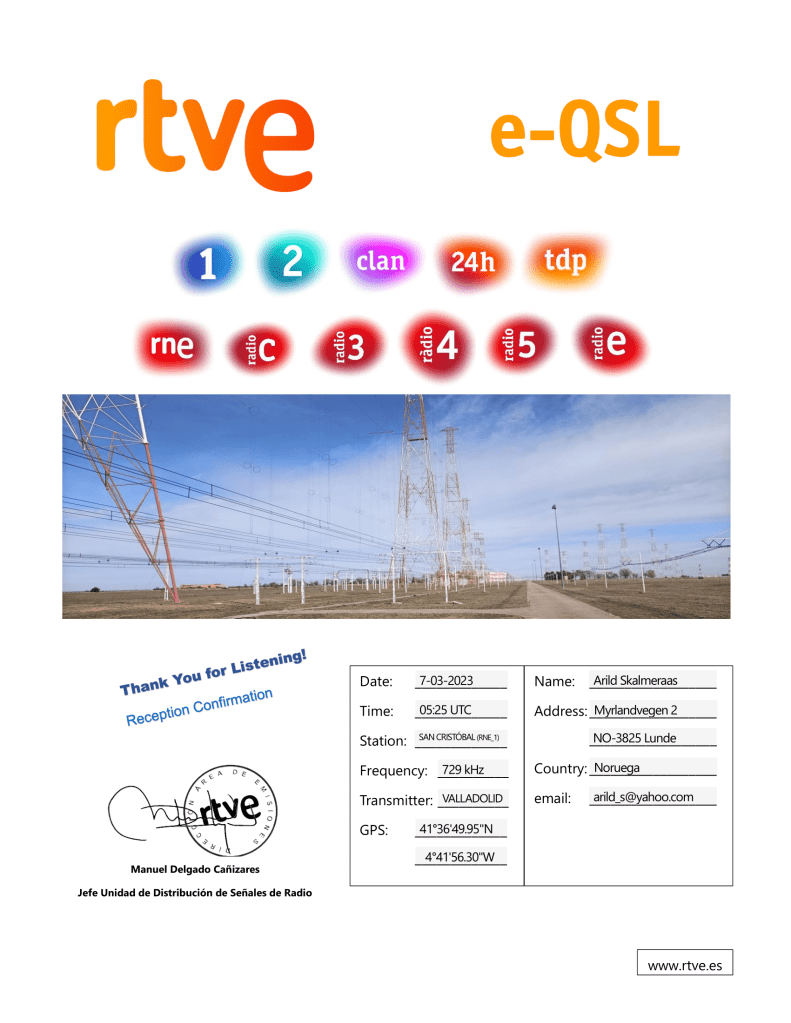
QSL: RNE Valladolid 729

Local news from RNE Valladolid was heard on 729 kHz one morning in March 2023. Usually RNE Asturias is the clear winner on this frequency, but occasionally some of the other Spanish transmitters can also be heard. No wonder RNE Asturias is the dominant station on the frequency. Not only is it located in along the coast in Northern Spain (which have the best signals here in Scandinavia), RNE Asturias is also listed with a power of 100 kilowatts compared to Valladolids mere 20 kilowatts.

Again, Manuel Delgado Cañizares confirmed my reception with a full data electronic QSL card depicted above. Valladolid is the largest city in the Castilla-y-León province and has a population of roughly 300.000 inhabitants.

QSL: RNE R5 Ourense 1305

RNE R5 in Ourense can occasionally be heard on 1305 kHz, usually along with RNE R5 Bilbao which usually has the most powerful signal on the frequency. RNE R5 Ourense was all alone on 1305 kHz one morning in March carrying local news for the region. An audio recording was sent along to Manuel Delgado Cañizares who confirmed my reception with a full data electronic QSL card.

The transmitter of RNE R5 Ourense is listed with a power output of 25 kilowatts. Ourense is an inland city in the Galicia region. It is the third largest city in Galicia with a population of around 100.000.

QSL: RNE R5 Lugo 1503

Manuel Delgado Cañizares also confirmed my reception of RNE R5 in Lugo on 1503 kHz with a full data QSL-card. Reception was made at Lista in March 2023.

Lugo is located in the northern Galicia province. Signals from this province often makes it to Norway and RNE Lugo is no exception. RNE Lugo can be heard without too many difficulties both on 972 kHz (Radio 1), 1098 kHz (R5) and 1503 kHz (also carrying R5). The transmitter on 1503 kHz is listed with the unusual power output of 6 kilowatts

QSL: RNE R5 Pontevedra 1413

My hopes for getting more verifications from Radio Nacional de España vaned considerably upon hearing that their veriesigner, the always friendly José Antonio Garcia Merino had retired. Thankfully, RNE has found his successor: Sr. Manuel Delgado Cañizares.

Manuel kindly confirmed my reception of 3 RNE stations, one of them being RNE Radio 5 in Pontevedra in Galicia. Stations in Galicia often comes with a strong signal at our DX site, but RNE Radio 5 is an exception. 1413 is usually occupied by either Russian station “Vesti FM” or more commonly Premier Christian Radio and BBC Radio Gloucestershire in the UK. Even with a listed power of 25 kilowatts, it is hard for Pontevedra to beat the signal of the competitors on the frequency.

At Lista in March most of the competition was gone and RNE R5 was heard with a local news bulletin one morning

QSL: RNE R5 Salamanca 1314

Many QSL requests are sent with little hope of getting a reply. Not so with Radio Nacional de España in Salamanca as ace DX-er Mauricio Molano Sánchez works at the station. Mauricio sure didn’t disappoint and sent me the full data QSL card above as well as a picture of their transmitter site. This was for a recording from our DX-pedition last March.

The RNE Radio 5 Todo Noticias transmitter in Salamanca on 1314 kHz is a common catch at our DX-site. It is frequently the dominant station on the frequency although Romania can also be heard with a strong signal at times, especially in the afternoons and early evenings. The transmitter of RNE in Salamanca on 1314 kHz transmits with a power of 10 kilowatts.

QSL: SER Radio Valencia 1179

We experienced good conditions towards Spain at Lista last March with no less than 102 different Spanish stations making it into our log.

One of the stations heard was SER Radio Valencia which frequently had a good signal on its mediumwave frequency of 1179 kHz, often accompanied with the signal of co-channel SER Radio Rioja.

I received a short e-mail confirming my reception of the station a fews days ago. The transmitter is listed with a power of 50 kilowatts, but I doubt it is operating on full power.

QSL: COPE Huelva 1224

There are several COPE stations transmitting on 1224 kHz. Although Lugo in Galicia usually has the best signal, both Huelva and Almería in Andalucia are not uncommon either. All 3 stations were noted at Lista last March.

I sent along a recording from March to COPE Huelva including an announcement for an important football match with the local team Recreativo de Huelva. Luckily, I received a reply from Pedro Rasco Martín from the technical department of COPE Huelva confirming my reception of the station.

Huelva is a city of around 150.000 inhabitants located in southwestern Spain not far away from the border with Portugal. Its football team has seen better days: A few years Recreativo de Huelva played with the big boys in the “Primera división”. They have been relegated twice since then and currently plays on level 3 in the Spanish league system. Curiously, Recreativo de Huelva is the oldest existing football club in Spain founded already in 1889.

QSL: COPE Valencia 1296

I have tried to get a reply from COPE Valencia many times, but no success untill this past week when Borja Rodríguez García confirmed my reception with an e-mail.

The only other station using 1296 kHz in Europe nowadays is Radio XL in Birmingham. As there is little interference, COPE Valencia is an easy catch in Norway (and probably across Europe as well). Their mediumwave transmitter is listed with a power of 50 kilowatts, but not sure if they are actually using so much power.

Valencia is the 3rd largest city in Spain with a population of around 800.000 inhabitants.

QSL: SER Radio Gandía 1584

1584 kHz is always an interesting frequency where many stations can pop up in our headphones. At Lista in March Jeo Radio in London was the dominant station, but several other stations were also noted. One of the more unusual stations heard was Radio Gandía, a first for us.

Radio Gandía, located in the city of the same name in the Valencia region, transmits with a power of 2 kilowatts on mediumwave. José Joaquín Gorrita at the Dept. Técnico of the station clearly knows what DX-ing and QSLs are all about and confirmed my recording with a perfect full data PDF letter in Spanish and English.

QSL: SER Radio Alicante 1008

Radio Alicante was heard on several occasions during our latest DX-pedition to Lista. The station broadcasts on 1008 kHz with a power of 5 kilowatts. It belongs to the SER network and is one of three stations using 1008 kHz. Radio Extremadura is usually the SER station heard here so catching Radio Alicante was a welcome change.

Pedro Alacid Clemente at the Dept. técnico of Radio Alicante confirmed my reception with a kind e-mail. Alicante is a city and a tourist destination on the Mediterranean coast. Many tourists visit the city every year, not least from Northern Europe.

QSL: RNE Ciudad Real 801

801 kHz is an interesting frequency. Radio Nacional de España is usually the strongest station also on this frequency. What makes 801 kHz is that RNE has no less than 6 transmitters on this frequency. 4 of them were heard at Lista in February 2022 (Burgos, Zamora, Lugo and Ciudad Real). Ciudad Real is probably the less common of these transmitters, but had the strongest signal one morning when their local news bulletin was broadcast.

José Antonio García Merino again confirmed my audio recording with a full data electronic QSL card. The transmitter in Ciudad Real has a power of 25 kilowatts

QSL: RNE Vitória 612

612 kHz is another frequency where Radio Nacional de España usually owns the frequency. RNE has 2 transmitters on 612 kHz located in Vitória and Lleida respectively. The transmitter in Vitoria is definitely the most common one at our QTH and was heard with a good signal in February 2022 with a local news bulletin. The transmitter in Vitoria is listed with a power of 10 kilowatts.

José Antonio García Merino again confirmed my audio recording with a full data electronic QSL card.

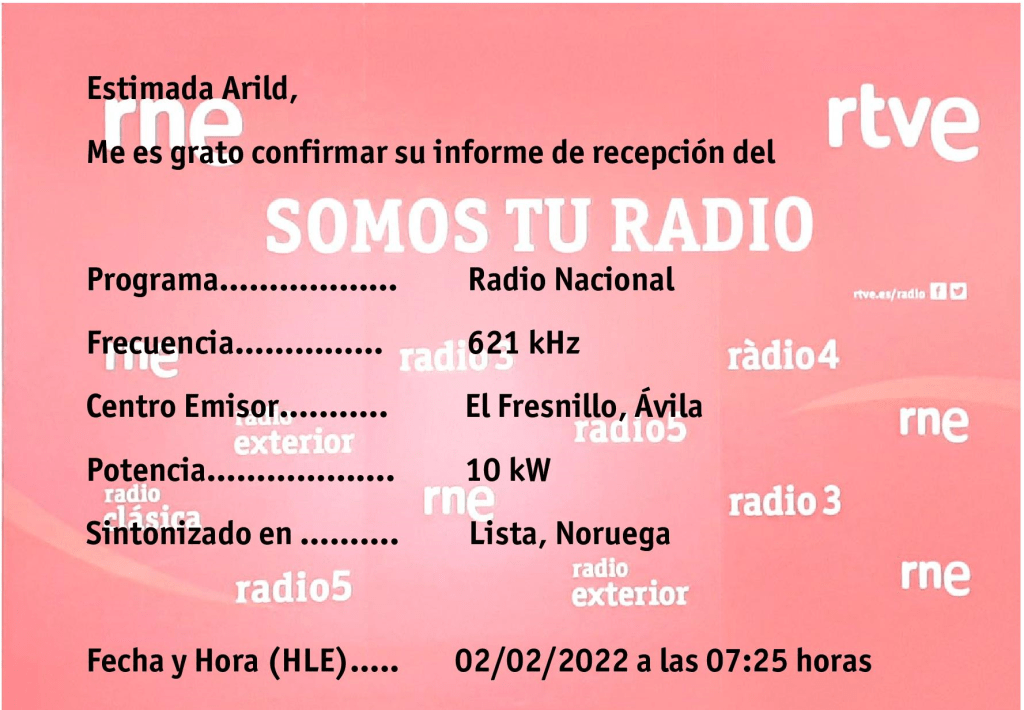
QSL: RNE Ávila 621

Radio Nacional de España is usually the only station heard on 621 kHz nowadays. Radio Nacional has several transmitters on this frequency. At our place the transmitter in Ávila is the most commonly heard. RNE Ávila was also heard with local news for Ávila one morning in February 2022. The transmitter has a power of 10 kilowatts.

José Antonio García Merino confirmed my reception with a full data electronic QSL card (see above). Ávila is a city in the Castilla y León province located about 1 hour northwest of Madrid.

QSL: RNE Bilbao 639

The transmitter of Radio Nacional de España in La Coruña is the clear dominant station on 639 kHz nowadays after Český rozhlas shut down their powerful transmitter on this frequency a couple of years ago. In February 2022 the transmitter in Bilbao was also heard with local news for Bilbao one morning. This transmitter is listed with a power of 50 kilowatts so not strange they are making it also to Scandinavia.

José Antonio García Merino confirmed my audio recording with a full data electronic QSL card.

SER Radio Extremadura 1008

1008 kHz is nowadays occupied by stations in Spain or The Netherlands. Of the 3 stations in Spain currently using 1008 kHz, SER Radio Extremadura is the easiest one to hear, at least at our DX location.

My previous attempts in getting a reply has not resulted in a reply, but this time I received a nice e-mail confirming my reception of the station. This was for a reception made in February 2022. Radio Extremadura transmits with a power of 10 kilowatts from the provincial capital city Badajoz.

QSL: SER Radio Lugo 1287

Several Spanish stations can be heard on 1287 kHz, all belonging to the SER network. One of the stations, SER Radio Lugo, was heard with a good signal and local programming in February 2022.

Juan Carlos Rodríguez, Director de Contenidos, confirmed my audio recording with a short e-mail. Radio Lugo is located in the city of Lugo in Galicia. The mediumwave transmitter is listed with a power of 10 kilowatts. Not sure if this is correct or whether the outpur is a bit less as I would have expected to be stronger if they indeed transmit with a power of 10 kilowatts.

QSL: COPE Granada 900

Another COPE QSL: This time from COPE Granada on 900 kHz. This is the most difficult to hear of the 3 Spanish stations broadcasting on the frequency. Still, COPE Granada made it to our SDR radios one morning in February.

Manuel Marín confirmed my audio recording with a short e-mail. Granada is a city with 200,000 inhabitants, especially known for its fabulous Alhambra palace.

As the dominant and very powerful RAI transmitter on 900 kHz closed down for good last month, I suppose it will be easier to catch the signal of COPE Granada now than it was last season. Their mediumwave transmitter is listed with a power of 5 kilowatts.

QSL: COPE Badajóz 1269

1269 kHz is another frequency vacated by European stations. COPE is the only European station still using the frequency with 2 transmitters located in Badajoz and Zamora respectively. Both transmitters are easily heard at Lista, often mixing with each others when they have regional or local programming.

COPE Badajoz confirmed my reception of the station made last February with a nice e-mail. They are a small station with a total of just 6 employees working there. Their mediumwave transmitter is listed with a power of 10 kilowatts. Badajoz is the capital of the Extremadura region close to the border to Portugal and has a population of around 155.000.

QSL: COPE Jaén 1143

1143 kHz is a frequency which has been vacated by most stations. At present there are just 2 stations left in Europe, both belonging to the Spanish COPE network and listed with a transmitting power of 5 kilowatts each.

Both COPE Ourense in Galicia and COPE Jaén in Andalucia were heard in February. Although Ourense usually had the better signal, Jaén was also heard with a fair signal at times.

Alfredo Simón Gonzalez, Jefe Técnico de Zona Andalucia Oriental, confirmed my reception with an e-mail. Jaén is an inland city in Andalucia, known among others for its production of olive oil. Jaén even describes itself as The World Capital of Olive Oil as the province of Jaén produces about 45% of all olive oil in Spain.

QSL: COPE Vigo 900

COPE Vigo was another Spanish station heard last February. Usually RAI in Italy and Radio Popular in Bilbao are the stations heard on 900 kHz, but on this DX-pedition both COPE stations (Vigo and Granada) were heard too.

COPE Vigo uses a 5 kilowatt transmitter on 900 kHz. Or may be used to transmit with a power of 5 kilowatt is a more precise formulation as COPE Vigo is not listed on MWlist anymore. Their own web page still lists “900 onda media” though, so may be the station still broadcasts on mediumwave.

A short but adequate e-mail signed by José Jardón Magdalena was received promptly confirming my audio recording of the station. Vigo is also located in the northwestern Galicia province, close to the border to Portugal.

QSL: COPE Ferrol 837

The DX-pedition to Lista last February resulted in a record number of Spanish stations in our logs. In fact, more than 100 stations from Spain was heard, a number which will be hard to beat especially now that also Spanish stations are abandoning the mediumwave band.

One of the stations noted was COPE in Ferrol on the northwestern coast of the country. COPE Ferrol is sometimes heard on 837 kHz, a frequency shared with three other COPE affiliates (Las Palmas, Sevilla and Burgos). All 4 COPE stations have been heard by us at Lista. Ferrol is the station with the least powerful transmitter with only 2 kilowatts of power.

My first attempt in getting a reply was not successfull, but the second attempt resulted in an e-mail confirming my reception of the station.

QSL: RNE R5 Valladolid 936

RNE Radio 5 has several transmitter on 936 kHz, one of them located in Valladolid in the Castilla-y-León province. This 20 kilowatt transmitter was heard in February 2021 with a local news bulletin for Valladolid. Pretty strong signal on the southern antenna too where RNE Radio 5 Valladolid easily outperformed the signals from the more usual British stations Dales Radio and Smooth Radio Wiltshire. A full data electronic QSL card was received from José Antonio García Merino for this reception too.

QSL: RNE R5 Logroño 1107

Spain often outperforms signals from the United Kingdom on our southern antenna. This also happens on 1107 kHz where the RNE stations usually dominates and overrides the signal of the Moray Firth Radio in Scotland. The 25 kilowatt transmitter in Logroño in Northern Spain, is along with the one in Santander, the most commonly heard here. A local news bulletin for La Rioja was heard one morning in February 2021. José Antonio García Merino also confirmed this recording. Logroño is the capital of the La Rioja province, famous of course for its wine production.

QSL: RNE R5 Almería 1098

One of the more surprising catches when examining the recordings from February 2021 was finding a station identification for RNE Radio 5 in Almería on 1098 kHz. Almería is far from being the most common of the RNE stations on this frequency, but made it to our radios one morning at 06.25 UTC. José Antonio García Merino again confirmed my audio clip with an electronic QSL card. The transmitter of RNE in Almería has a power of 25 kilowatts.

QSL: RNE R5 San Sebastián 558

Hearing Spain on 558 kHz is quite easy. There are several RNE transmitters on this frequency and the one in San Sebastián is probably the easiest one to hear. I caught this transmitter with local news from RNE Radio 5 in San Sebastián one morning in February 2021. The always friendly José Antonio García Merino confirmed my recording with an electronic QSL card.

RNE in San Sebastián transmits with a power of 50 kilowatts so not strange they are easily received here.

QSL: RNE Radio 5 Albacete 1152

This image has an empty alt attribute; its file name is rne_r5.jpg

We were very pleased about catching local identifications both for RNE Radio 5 Zamora and RNE Radio 5 Albacete on 1152 kHz at Lista in February 2021. We were especially pleased about Albacete as this is a station and a transmitter which is seldom reported. Like Zamora, RNE Radio 5 Albacete also transmits with a power of 10 kilowatts. Albacete was heard one morning at the start of the local news at 06.25 UTC.

José Antonio García Merino at RTVE in Madrid also confirmed my reception of RNE Radio 5 Albacete with a full data QSL card. The city of Albacete is located in the Castilla la Mancha region about halfway between Madrid and Murcia.

QSL: RNE R5 Zamora 1152

This image has an empty alt attribute; its file name is rne_r5.jpg

1152 kHz is a frequency usually occupied by UK stations exclusively at our location. Occasionally, Romania can also be heard but usually nothing else. In February 2021, however, RNE Radio 5 was noted even on 1152 kHz. We caught local identifications both for RNE Radio 5 Zamora and RNE Radio 5 Albacete during the days we spent there. I believe Zamora usually has the strongest signal of these stations.

The transmitter in Zamora transmits with a power of 10 kilowatts. The always helpful José Antonio García Merino also confirmed this station with a full data QSL card.

QSL: RNE R5 Vitoria 1125

This image has an empty alt attribute; its file name is rne_r5.jpg

RNE Radio 5 in Vitoria was another RNE station heard in February 2021. Like RNE Radio 5 Soria, this station also broadcast on 1125 kHz. It is the most common local RNE station on this frequency as stations located in the Basque (Euskadi) almost always has a powerful signal at our location.

José Antonio García Merino also confirmed this station with a full data QSL card. The transmitter is listed with a power of 10 kilowatts.


QSL: RNE R5 Soria 1125

The DX pedition in February 2021 resulted in an impressive number of Spanish stations heard on mediumwave. A station which we had not received previously was RNE Radio 5 in Soria in the Castilla y León province north east of Madrid.

RNE Radio 5 in Soria was heard with good quality one morning on 1125 kHz. José Antonio García Merino again confirmed my audio recording with a full data QSL card. This transmitter has a power of 10 kilowatts and is situated at the Monte Valonsadero mountain outside the city.

QSL: RNE R5 Cádiz 747

The Spanish Todo Notocias network can be received quite easily on 747 kHz. There are presently two transmitters on this frequency, one located in Cádiz and one on the Canary Islands. Both were heard in February 2021 with local news.

The 10 kilowatt transmitter in Cádiz is definitely the most common of these 2 transmitters. José Antonio García Merino, ND Ingenieria Area emisión, redes y comunicaciones, confirmed my reception of RNE Cádiz with a full detailed electronic QSL card.

QSL: RNE R5 Tarragona 1314

The Todo Notocias network of Radio Nacional de España has three transmitters on 1314 kHz. The strongest transmitter is located in Reus near Tarragona in Cataluña and has a power of 25 kilowatts. This transmitter is easily recognized as it has a strange “growling” audio indicating that the transmitter might have seen its better days.

José Antonio García Merino, ND Ingenieria Area emisión, redes y comunicaciones, at RNE in Madrid nevertheless confirmed my audio recording with a fully detailed electronic QSL card pictured above. This was for a recording made of their local news bulletin at 06.25 UTC one morning last February.

QSL: RNE R5 Bilbao 1305

Although the UK stations Greatest Hits Radio and Premier Radio usually occupies the frequency of 1305 kHz, it is not uncommon to hear Spanish either. RNE R5 has several transmitters also on this frequency. The most common of these, RNE R5 Bilbao was easily heard on our southern antenna in February with a local news bulletin. José Antonio Garcia Moreno also confirmed this audio recording with an electronic QSL card. The power of the transmitter in Bilbao is 10 kilowatts.

QSL: RNE R5 Santander 1107

Moray Firth Radio in Scotland usually “owns” the frequency of 1107 kHz at Lista, at least when our usual antenna is used. In February we also had an antenna pointing southwards, making reception of Spain possible on nearly every possible mediumwave frequency. On this southern antenna RNE R5 completely wiped out Moray Firth Radio.

RNE R5 has several transmitters on 1107 kHz too. As always the transmitters in Northern Spain have the most powerful signals. The most common one on 1107 kHz is RNE R5 Santander which had a very good signal on several occasions in February. This transmitter has a power of 20 kilowatts and is co-located with the mediumwave transmitter of RNE on 855 kHz (another blowtorch Spanish transmitter). José Antonio Garcia Moreno again confirmed my audio clip with an electronic QSL card.

QSL: RNE R5 Ávila 1098

RNE R5  is a regular on 1098 kHz too, along with Slovakia. RNE has 4 different transmitters on the frequency so several possibilities here. In February we heard the transmitter in Ávila north west of Madrid with local news one morning. José Antonio Garcia Moreno again confirmed my audio clip with another electronic QSL card.

The transmitter in Ávila transmits with a power of 10 kilowatts and is not the most powerful transmitter on the frequency.

QSL: RNE R5 Burgos 1017

Another frequency vacated by almost all stations is 1017 kHz. Spain now dominates this frequency completely. RNE R5 has 2 transmitters on 1017 kHz, located in Burgos and Granada respectively each with a transmitter output of 10 kilowatts. Of these, the transmitter in Burgos is by far the most common at our listening post.

José Antonio Garcia Moreno confirmed my reception of the morning news for Burgos with an electronic QSL card.

QSL: RNE R5 Zaragoza 936

936 kHz is a frequency usually covered by Italy, Iran or UK stations at our QTH, but an antenna in the right direction certainly helped hearing Spain on the frequency too! We heard both Spanish transmitters on the frequency, from Zaragoza and Valladolid respectively, last February.

Local news for Zaragoza from the Todo Notocias network was heard one morning on the frequency. The transmitter in Zaragoza uses a power of 25 kilowatts. The friendly José Antonio Garcia Moreno listened to my recording and also confirmed this station with an electronic QSL card.

QSL: RNE R5 Palencia 603

Another RNE Radio 5 station heard last February was the transmitter in Palencia on 603 kHz. Admittedly not the best signal quality, as this transmitter only has an output power of 5 kilowatts. Still, the signal came through quite well one morning with a local identification and local news.

José Antonio García Merino also confirmed this reception with a full detailed electronic QSL card.

QSL: RNE R5 Murcia 567

567 kHz is a frequency vacated by many stations. Currently, Romania and RNE are the only Europeans broadcasting on 567 kHz. RNE has only got one transmitter on the frequency carrying the Todo Notocias network. This transmitter is located in Murcia and was heard at Lista last February with local news for the region. The transmitter is listed with a power of 50 kilowatts.

José Antonio García Merino, ND Ingenieria Area emisión, redes y comunicaciones, confirmed my reception with a full detailed electronic QSL card.

QSL: RNE R5 Asturias 531

Transmitters located in Northern Spain are often heard with strong signals at Lista, especially if we have an antenna in that direction or during auroral conditions. The transmitter of the Todo Notocias network of Radio Nacional de España in Oviedo was one of the stations heard at Lista last February, easily beating the signal of the dominant station from the Faroe Islands on several occastions.

José Antonio García Merino, ND Ingenieria Area emisión, redes y comunicaciones, at RNE kindly confirmed my reception with a full detailed electronic QSL card and a long e-mail.

QSL: RNE Cataluña 738

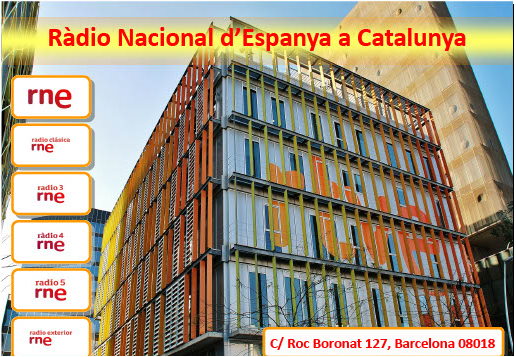
The mediumwave transmitter of Radio Nacional de España in Barcelona is an easy catch here. With a power of 300 kilowatts, the station is by far the most common station on 738 kHz here. The transmitter is located in Palau Solità i Plegamans north of Barcelona.

I didn’t have any luck with getting a reply from the station many years ago, but this time Antonio Catalán Serra, Resp. Técnico at RNE Cataluña, replied with a nice electronic QSL card (pictured above) for a report on the regional news carried on this channel. All regional news are of course in Catalán and not in Spanish.

QSL: RNE Castilla la Mancha 864

864 kHz is a pretty empty frequency with Radio Nacional’s transmitter in Socuéllamos being the only transmitter left in Europe on this frequency. As there is little competition, Radio Nacional is easily heard on this frequency despite a relatively modest transmitting power (5 kilowatts).

Regional news for Castilla la Mancha is carried on this frequency. José Antonio García Merino also confirmed my audio clip of this transmitter, heard last February.

QSL: RNE Castilla y León 801

Radio Nacional de España’s regional programmes can be heard on many mediumwave frequencies. Many of these are much easier to hear now than they used to be, thanks to most other European countries abandoing mediumwave. Spain, including Radio Nacional, still maintains a large presence on mediumwave, at least for the time being.

Last February we noted the regional programme for Castilla y León on both 774, 801 and 855 kHz with 801 kHz providing best reception. José Antonio García Merino at Radio Nacional in Madrid confirmed my reception with a full detailed QSL card. Radio Nacional has 2 two transmitters located in Castilla y León on 801 kHz, located in Burgos and Zamora respectively. Both are listed with a power of 10 kilowatts.

QSL: RNE R5 Madrid 657

The Radio 5 Todo Notocias network of Radio Nacional de España maintains an extensive presence on mediumwave. The stations are a nice DX target as all stations carries local and regional programmes at certain times. We have heard many of these stations over the years. Some of them are easily heard, others are a real challenge.

One of the easiest stations is their 100 kilowatt transmitter in Majadahonda outside Madrid on 657 kHz which carries local news for the city of Madrid at certain times. This transmitter site is also used for broadcasting RNE Radio 1 on 585 kHz as well as COPE on 999 kHz.

José Antonio García Merino, ND Ingenieria Area emisión, redes y comunicaciones, at RNE kindly confirmed my reception made last February with a full detailed electronic QSL card and a long e-mail.

QSL: COPE Mallorca 1224

A beverage antenna directed towards Spain (and South America) gave good results at our DX-pedition to Lista in February. No less than 76 different Spanish stations made it to our logs – a record number by far and a number which is going to be hard to beat as Spanish stations have also started closing their mediumwave transmitters.

One of the many stations heard was COPE Mallorca on 1224 kHz, a frequency shared with several other COPE outlets. My e-mail to the station resulted in a reply from Cristina de Ahumada at the station. A not so perfect verification admittedly, but I still count this as a QSL. The station broadcasts with a power of 5 kilowatts from a transmitter located close to the Mallorcan capital Palma.

QSL: SER Radio Bilbao 990

ser

Radio Bilbao is an easy catch on 990 kHz at Lista. Although there is usually some competition from the UK stations on the frequency, Radio Bilbao can often be heard with a good signal. Lista is an excellent QTH for Spain, and in particular for stations located in Northern Spain.

I received a polite e-mail from Radio Bilbao confirming my reception of the station made in January 2019. Radio Bilbao transmits with a power of 25 kilowatts from a tower located at Monte Artxanda outside the city.

QSL: SER Radio San Sebastián 1044

SER

Stations in Northern Spain are easy catches at Lista. One of the most powerful ones are Radio San Sebastián on 1044 kHz. I haven’t been successfull getting a reply from Radio San Sebastián untill now when Carlos Castronuño Fuentes, Jefe Técnico at the station, sent me a very kind e-mail reply. He attached a full data QSL letter with his e-mail and also sent along a few pictures of the transmitter site located at Monte Igeldo outside San Sebastián.

Although the station is listed with a power of 50 kilowatts in a.o. MWlists, Carlos says the actual power is 25 kilowatts.

SER Radio Santander 1485

Another station responding to a follow up sent a few days ago was SER Radio Santander in Santander, Spain. The station says they receive quite a number of e-mails and letters from “radioaficionados” in the Nordic countries every year. Radio Santander is an easy catch here in Norway on 1485 kHz, but getting a reply hasn’t been easy (I’ve tried a number of times previously). My report was from the February DX pedition to Lista.

QSL: COPE Menorca 1134

It’s been years since I last sent a reception report to a station in Spain. I have given priorities to stations in North America, Central America and South America instead. Spain is an interesting DX target though with many stations on the AM band. Spain seems to be one of only 2 European countries (the other one being the UK) where people actually still listens to AM radio.

Today I sent out a couple of e-mail reports to some Spanish stations which I have heard in the past. One of them was COPE Menorca in Menorca in the Baleares Islands. This seldomly heard station came through on 1134 kHz late one morning at 10.59 local time on the January 2007 DX-pedition to Lista. Francisca Marqués of the Dep. Comercial de Cope Menorca replied with a prompt e-mail this morning.

QSL: Radio Nacional de España, Ávila 1098

I was very surprised to find a large envelope from Radio Nacional de España in my mailbox just before Christmas. The reply came from the regional station in Ávila and was a reply to a reception report which I sent to the station more than 4 years ago.

Obviously, my letter must have been collecting dust there for a long long time before it was found by Francisco Javier Fernández Nieto, Jefe de Emisiones y Producción de RNE Ávila. Señor Fernández sent not only a full data QSL-card, but also a letter, a pin, some stickers, a 70 page booklet about the history of RNE Ávila 1952-2002 and even a CD. The CD accompanies the booklet and includes a.o. several historical audio clips of RNE Ávila and its predecessors Radio Ávila 1952-1960, Radio Gredos 1960-1980, RCE Radiocadena Española 1980-1989 and finally RNE / RNE5 1989-2002. The station also has a nice web site about the history of the station – very interesting!

My report, by the way, was for a report on the RNE R5 Ávila outlet on 1098 kHz back in October 2003 when I heard the station during a fierce solar storm at Lista. The storm completely knocked out the usual dominant transmitter in Slovakia. Many other Spanish stations were also heard at the same time.