Radio Delta AM is one of the most regular shortwave stations from The Netherlands. The station is broadcasting almost every weekend, usually on a frequency in the 49 metre band and occasionally on other bands as well.
I haven’t come across their signal untill discovering their signal on 6040 kHz one morning at our latest DX-pedition.Poor conditions on shortwave this morning and only fair to weak signal.
Radio Delta is a very DX friendly station. The station even has a listener map showing from where they have got reception reports. My reception report was of course also acknowledged, with the electronic QSL card shown above.
Religious broadcaster Bible Voice Broadcasting broadcasts in many languages and to many parts of the world using leased transmitters in Germany, Bulgaria and Uzbekistan.
I caught their broadcast in Spanish directed to Spain one evening in January. Very good signal for this broadcast which originated from the Nauen transmitter in Germany. According to Wikipedia, Nauen is the world’s oldest preserved radio transmitting installation having started transmitting already in 1906.
A full data electronic QSL card was received some weeks later confirming my reception of the station.
Legal shortwave stations are now appearing not only in The Netherlands, but also in a few other countries. In Finland, RealMix Radio has been on the air for 2 years broadcasting on weekends. RealMix Radio is operated and managed by Joakim Weckström who was only 16 years old when starting his shortwave broadcasts in 2024. Amazing!
RealMix Radio has been operating on several shortwave frequencies in the 49 metre band. Both 5950, 6005, 6185 and 6195 kHz have been used. I heard the station on 6005 kHz in January playing pop music with station identifications in several languages aired in between the music played. RealMix Radio has since settled down on 5950 kHz where it can be heard every weekend.
Joakim confirmed my reception report with a full data electronic QSL card. Joakim says that he now transmits with a power of 500 watts. Having started with a 15 watt transmitter 2 years ago, the power has since increased to 100 watts, then to 300 watts and now to 500 watts. RealMix Radio is located in Joakims hometown Raasepori on the south coast of Finland.
Many stations broadcasting from The Netherlands have gone legal and obtained a license during the last decade. Most lowpowered Dutch stations are found on mediumwave, but a few are instead broadcasting on shortwave.
One of the Dutch stations having a license on shortwave is SuperClan Radio. SuperClan Radio was heard with a weak signal on 5955 kHz one morning in January. A full detailed electronic QSL-card showing their antenna was received a few weeks later.
The QSL card was signed by Herbert Visser who also confirmed my reception of Sunlite Radio three years ago. Both Sunlite Radio and SuperClan Radio used/uses the shortwave frequency of 5955 kHz. The transmitter of both stations is also the same, but the transmitter has now been relocated to Putten in the Gelderland province. Sunlite Radio used to broadcast from Westdorpe in the south of the country. SuperClan Radio seems to be broadcasting quite irregularly so I guess I was a bit lucky to catch their signal in January.
Just like Radio Santander (below), my attempts in trying to get a response from Radio Coruña has been unfruitful untill I received a nice reply from their technical department last month. My reception of the station was made on the mostly uninteresting DX-pedition this past January. Despite poor conditions, there are always some DX to be heard. In this case local Spanish stations 🙂
Radio Coruña is one of 4 Spanish stations transmitting on 1080 kHz. With its location in Northwest Spain and along the coast, it it the most common of these here. Their mediumwave transmitter is listed with an output of just 2 kilowatts, but still get through fairly well.
Radio Santander is the most common station on 1485 kHz nowadays. The station has always been an easy catch here, also when they shared the frequency with the UK stations BBC Radio Humberside and BBC Radio Merseyside. After the closure of the English stations some years ago, Radio Santander is always heard on 1485 kHz. Other stations can occasionally be heard too, but usually Radio Santander owns the channel.
Radio Santander belongs to the SER Radio Network and is the main SER station in the Cantabria region. The mediumwave transmitter is listed with a power of 10 kilowatts and is located a few kilometres west of Santander.
Previous reports to Radio Santander have not resulted in any replies, but this time I got a short confirmation e-mail confirming my reception of the station from January.
Less than 2 weeks after our previous (and unsuccessfull) DX-pedition to Lista, Torgeir Nyen and myself was back at Lista for another listening session. I was only able to participate for two nights this time while Torgeir could stay three more nights combining the best of two worlds, remote work and DX-ing.
We were glad to see that the (mediumwave) world had recovered and returned to its normal self this time. All the expected stations from Newfoundland, New York, Boston, the Caribbean etc. were there – with normal signal levels.
Although conditions were not great this time either, I would rather desribe them as “average”, we were able to catch a number of new stations. These include Nigerian station 729 Radio Kano and graveyarders 1340 WENT Gloversville NY, 1340 WALL Middletown NY, 1490 WKNY Kingston NY and 1490 WNGZ Watkins Glen NY, all from New York State, as well as 1550 WYMM Jacksonville FL. A couple of unusual Latin Americans were also heard including 740 Radio Guatapurí in Colombia and 750 Radio Jesús es el Señor in the Dominican Republic.
All listening done on our 800 metre beverage antenna pointing towards the East Coast of North America and the Caribbean.
A Google Docs spreadsheet documenting our logs and updated continously is available. More stations to follow as we review the recordings from the DX-pedition.
On January 19, ace DX-er Andrew Brade wrote this on the e-mail list of Medium Wave Circle commenting on a major solar flare and consequent coronal mass ejections happening on January 18: “.. this major event is likely to have a significant impact on MW propagation for at least the next week. Previous similar events have resulted in practically no long-distance propagation for a few days before a gradual return, favouring trans-equatorial signals at first”.
Despite this ominous warning, we were all set for a new DX adventure Lista. We, in this case, were Torgeir Nyen, Harald Andersen and myself. The dates had been decided months in advance. Work commitments make it impossible to adjust the dates based on on good or poor propagation predictions. Pure luck is then the most important factor for a successfull or unsuccessfull DX-pedition.
We were frankly not too worried about Andrew Brades warnings in advance. Unfortunately, he was exactly right in his predictions: Propagation was severely suppressed, especially during the first days. The following graph, showing the Kp values for the last 2 weeks of January, illustrates the situation pretty well (credit: SpaceWeatherLive):
As a result of this huge solar storm, supposedly the strongestsolar storm in 24 years, North American stations were completely absent with no signs at all of the usual blowtorches from Newfoundland like 590 VOCM during the first 2 days of the DX-pedition. There was a window towards Paraguay and Argentina on the first night with stations like 970 Radio Universo, 1020 Radio Ñanduti and 1080 Radio Monumental coming through for a short time. Otherwise nothing. 1350 Radio Buenos Aires was the only transatlantic station noted on the second night. Propagation gradually became a bit better for the last two days, but nothing of interest was heard with an exception for 1450 CFAB Windsor NS.
All stations were heard on our usual 800 metre beverage antenna directed towards the East Coast of North America/Florida/Cuba. Additional antennas running towards the Midwest and towards the south produced no results at all.
Despite very poor conditions, it is always nice to participate in a DX-pedition and nice to chat about our radio hobby in great company. A log is, as always, available.
There must be hundreds of unlicensed stations (also known as “pirates”) broadcasting on shortwave from The Netherlands.
A couple of shortwave stations have over the last few years paid a license to Dutch PTT to operate on shortwave legally. One of the legal stations is Rockpower Radio which broadcasts on 7270 kHz in the 41 metre shortwave band. The station has a listed power of 1 kilowatt operating from the city of Nijmegen.
I received an e-mail confirming my reception of the station made in January 2025 when I heard Rockpower Radio with a fair signal and a nice selction of music. According to the station, Rockpower Radio is mostly on the air 09.00-16.00 UTC, possibly weekends only.
If you stumble across Chinese programming on 1480 kHz, it can’t be anything but New York station WZRC. WZRCs programming is actually Cantonese rather than Chinese, but for a European it is hard/impossible to separate these two languages.
Despite using a power of 5 kilowatts both day and night, WZRC is not a very frequent guest here. We managed to hear a station identification in English on the hour one night last February when the signal of usual dominant station WSAR was weaker than usual.
Arthur Liu, Retired Chairman at owner Multicultural Braodcasting, confirmed my audio of the station. Like many New York City stations, WZRCs transmitter is located in neighbouring New Jersey, in their case Ridgefield Park.
It is hard to hear anything but WRCA in Boston on 1330 kHz at our QTH, especially now that WRCA has switched to a rock music format. With some luck and some patience it is still possible to catch the signal of a few others. One of them is WJNX in Florida with its easily recognizable Mexican music format.
WJNX has been heard a number of times at Lista, including in February last year. Just like many other stations, WJNX only mentions their FM frequencies in their announcemens, in this case “La Ley 95.1 106.1”. WJNX is licensed to Fort Pierce, Florida, and covers the eastern coast of Florida known as the “Treasure Coast”. Their AM transmitter has an output power of 1 kilowatt.
Jim Johnson at parent company Glades Media kindly confirmed my recording of WJNX “La Ley” with a short e-mail. Jim is also a HAM with the call sign W4JBZ.
1160 kHz has become an interesting frequency after the UK stations left 1161 kHz a few years ago. One of the most common stations on the frequency is WSKW which I have heard on many occastions and with various formats through the years. For the last couple of years a sports formats has been carried branded as “11-60 The Score – Central Maines Sports Radio”.
My previous e-mails to the station has all been unsuccessfull, but this time Gracie Johnston, Business Development Director at owner company Mix Maine Media confirmed my audio recording with a nice e-mail. This recording was made at our last DX-pedition to Lista when WSKW could often be heard along with the signal of Caribbean Radio Lighthouse in Antigua.
WSKW broadcasts from Skowhegan, Maine, with a night time power of just 730 watts. Their listed day time power is 10 kilowatts.
Radio Cadena Habana – emisora de la música cubana – is a station which occasionally pops up on 1080 kHz at our listening post. The station is by no means a regular as the frequency is usually occupied by 50 kilowatt station WTIC in Connecticut and/or a couple of Spanish stations. It is hard to compete with 50 kilowatts when you run only a 5 kilowatt station as Radio Cadena Habana does. This mediumwave transmitter is located at Villa María outside the Cuban capital Habana.
As their slogan implies, Radio Cadena Habana plays Cuban music, usually old style Cuban music like Buena Social Vista Club etc. If you happen to like this kind of music, Radio Cadena Habana is not a bad choice although it would be advisable to listen to their online streaming rather than to mediumwave 1080 kHz!
Anabel Candelario Carmona, Directora, confirmed my audio recording made in January 2024 with a short e-mail a few days ago.
Catching radio stations from the Dakotas is never easy at our QTH. Over the years we have only managed to pick up just a handful of stations. We had good conditions towards North America in January 2024, mainly towards the East Coast, but a few prairie stations also made it to our radios. One of the stations on the prairies heard was KNWC in Sioux Falls, South Dakota, which was heard one morning on 1270 kHz mixing with the more common station WXYT in Detroit.
KNWC broadcasts Christian programming from the Faith Radio Network in Minneapolis. Faith Radio is owned and operated by University of Northwestern St. Paul, an evangelical Christian university. Chief Engineer Clayton Heeres confirmed my reception of the station with an e-mail a few days ago. KNWC is listed with a night time effect of 2,3 kilowatts.
As a teenager I tuned in to 1476 kHz quite regularly listening to the Austrian state broadcaster Österreichischer Rundfunk, particularly to some of their music programmes. With a powerful mediumwave transmitter this was an easy catch in Norway and could be heard on a portable radio without an external antenna.
Times have changed. Österreichischer Rundfunk has stopped transmitting on mediumwave, just like almost all state broadcasters in Europe. 1476 kHz is still actively broadcasting from Austria though, but now through the small hobby station Museumsradio AM. This museum radio only plays old German language records, branded as Plattenkiste (“record box”). The station is listed with a power of 500 watts transmitting from the town of Bad Ischl near Salzburg.
Museumsradio AM was heard by me for the first time last January just before they closed down at 21.02 UTC. Reinhard Pirnbacher at the station confirmed my reception with an e-mail and a nice non-detailed QSL-card, pictured above.
DX-ing low power mediumwave stations is great fun, but of course also challenging. Receiving Chamer Rundfunkmuseum on 801 kHz is a challenge as reception is only possible when the signals of co-channel Radio Nacional de España is absent. I have only managed to catch the signal of this museum radio on two occasions, in January 2024 and then again in January 2025. On both occasions the signal of Chamer Rundfunkmuseum was heard in the afternoon around 15.00 UTC with a weak but clear signal before the Spanish stations faded in. It is easy to recognize the station as it only plays old and mostly German records from the 1920s to the 1950s. No announcements, and alas no station identifications, but with a very distinct 10 seconds pause between each records played.
The Chamer Rundfunkmuseum is located in the town of Cham in Bavaria, not far away from the border with the Czech Republic. The museum transmitter on 801 kHz transmits with a power of just 10 watts, just like their museum colleagues at Radio Eule in Munich. 801 kHz is the old mediumwave frequency of Bayerischer Rundfunk, the Bavarian state broadcaster, but was closed down in 2015. The broadcasting museum in Cham has acquired their old 100 kilowatt mediumwave transmitter which is on display at the museum.
Earlier this month I received a nice e-mail from Günter Bauer at the station confirming my reception of the station. Günter says the station starts broadcasting every day at 14.00 Central European Time (13.00 UTC) with 100% “historic music” and very few announcements.
Very pleased about catching the signal of WEMG “La Mega” on 1310 kHz at our DX-pedition in January 2024. Their signal was discovered quite some time later when reviewing one of the many interesting recordings made during this DX-pedition. Reviewing recordings takes time!
1310 kHz is an interesting frequency with many possibilities, especially after usual dominant CIWW in Ottawa closed a couple of years ago. The most common station at our place is without doubt WLOB in Maine, but several other stations can also pop up from time to time. There are actually two different “La Mega” stations on 1310 kHz, WEMG and the bit more commonly heard WORC in Worcester, Massachusetts. As the name implies, “La Mega” serves the Latin population in their respective communities and usually plays Latin pop music such as salsas, merengues, bachatas etc.
WEMG broadcasts to the Greater Philadelphia area from a transmitter located in Camden, New Jersey. Their night effect is a mere 250 watts so very pleased about picking up their signal on this side of the Atlantic. Program Director Jorge Melendez confirmed my audio recording with a short e-mail.
The old interval signal of Radio Australia (“Waltzing Mathilda”) was heard on 1494 kHz one night at Lista. It didn’t take long for us to understand that this was not at all Australia, but rather Swedish radio station Asfalttelegrafen with one of their occasional test broadcasts. Very good signal, especially at the start of the transmission at 22.25.
Asfalttelegrafen has for years tried to get a permanent licence for mediumwave from Swedish telecommunications authorities. So far only short term licenses have been given, but station owner Torleif Roos does not give up.
Besides confirming my report, Torleif also tells that he is thinking of moving to another frequency because of interference from British pirate station Radio Blackbeard.
The mediumwave transmitter of Asfalttelegrafen is located in the town of Ludvika in Central Sweden.
BFBS Gurkha Radio has been heard many times on 1134 and 1278 kHz at Lista. Getting a reply has been very difficult though, at least for me. 6 attempts were needed before I received a reply in the form of an e-mail from Nicky Ness, Director of Broadcasting and Entertainment at BFBS. This for an audio recording made last February on 1134 kHz.
Currently BFBS Gurkha Radio is listed with transmitters at 4 different locations in the UK. Presumably it is the signal of the transmitter located closest to Norway which makes it across the North Sea, but it is hard/impossible to tell for sure. This transmitter is located at Catterick Garrison in North Yorkshire.
Catching the signals from tiny 1 watt stations in the UK is great fun – and Gurkha Radio is no exception. Gurkha Radio is easily recognized as the station always carries Nepali programming and Nepali music.
Replies from Cuban stations have become increasingly scarce over the years. Many of the listed e-mail addresses on the web pages of the stations bounce – and those that get through seldom result in anything.
I was thus very surprised to find a nice reply from José Miguel Solís Díaz at the Departamento informativo of Radio 26 in my inbox. Sr. Solís confirmed my audio recording of Radio 26 made on 1060 kHz in February.
Radio 26 is the provincial radio station of Cuban radio in the province of Matanzas. The station is broadcasting on 1060 kHz from a transmitter located in Jovellanos east of the Cuban capital Havana. It is listed with a power of 25 kilowatts, but I doubt they are using that much power. Radio 26 can be heard quite often on 1060 kHz at our listening post. Radio 216 also broadcasts on 1320 kHz, a frequency we have yet to catch their signal.
Radio Star Country has been a faithful companion or more or less my entire 30 year DX career. The station first came on the air back in 1988 according to the Irish Pirate Radio Audio Archive and has been broadcasting continuously since then, always on the mediumwave frequency of 981 kHz.
Radio Star Country is of course also a regular guest at Lista too, although not with such a good reception nowadays due to much interference from co-channel stations in Algeria and the Czech Republic. The station is listed with a power of 1 kilowatt from their transmitter location in Emyvale, County Monaghan just south of the border with Northern Ireland.
A couple of previous attempts in contacting the station has resulted in nothing, but this time I got an e-mail reply confirming my reception made last February.
One of the best catches, and possibly THE best catch, from the otherwise pretty mediocre DX-pedition last February was hearing WHNZ in Tampa, Florida, on 1250 kHz. WHNZ was heard at midnight UTC one night with a pretty clear station identification as “12-50 WHNZ Impact Radio”. This was presumably around (or more likely before) the time when the station reduced their power from the daytime power of 25 kilowatts to the nighttime power of 5,9 kilowatts.
Despite transmitting with a fairly high output, WHNZ is rarely noted on this side of the Atlantic. The likely reason is that WHNZ has a highly directional antenna directing their signal to the west and thus in the opposite direction of Europe as can be seen on this nighttime coverage map.
James Burlander, Assistant Program Director of WHNZ, confirmed my reception of the station with a very nice e-mail.
First QSL in 4 months: Mike Gilland, Operations Manager, confirmed my audio recording from February of WIWA on 1270 kHz. 5 years ago Mike also confirmed my reception of sister station WZRN on 720 kHz. WIWA and WZRN carry the same Christian programming branded as “The Shepherd”.
Whereas WZRN is a rarity, WIWA is a regular guest at Lista having been heard on more or less every DX-pedition for a number of years. WIWA is licenced to Eatonville, Florida serving the city of Orlando and surrounding areas. The station transmits with a night time power of 5 kilowatts.
The Dutch lowpower mediumwave scene is quite dynamic with stations signing on and off. Dutch station Studio Denakker used to be a frequent guest on 819 kHz here, but is now gone (listed as “inactive” at present on mwlist.org). Their signal has now been placed by a station which unusually have 2 names: Radio Zanussi and Radio Hercules.
To explain this, one can read the story of the station (or stations) in a nice feature at Radio Delta. The short version is that the station is run by two brothers, Johan and André de Ruiter, who have both been involved in pirate radio since 1977. Nowadays, as a legal station, Johan operates under the name Radio Hercules on Saturdays playing English and international music while his brother identifies as Radio Zanussi on Sundays playing polkas and Dutch piratenhits.
I listened in on a Saturday night in January when Johan and Radio Hercules was on the air. Johan also confirmed my audio recording with an e-mail earlier this month. The station is located in Mastenbroek close to the city of Zwolle and transmits with a power of 100 watts.
Hospital radio stations are a speciality in the United Kingdom – and also a speciality of mine. I have received a number of British hospital radio stations on mediumwave over the years. Sadly, there are not a lot of them left anymore as many has left for FM or closed down altogether.
One of the hospital radio stations still broadcasting on mediumwave is Radio Redhill located at East Surrey Hospital in Redhill south of London. Radio Redhill has been broadcasting on mediumwave 1431 kHz since 2000, but has also been granted a FM frequency (100.4) which has been in use since 2021. I wouldn’t be surprised if FM will replace mediumwave soon also for Radio Redhill, just like what has happened to so many radio stations in the UK over the past 5 years.
Like all(?) hospital radio stations, Radio Redhill operates with a power of just 1 watt. Nowadays 1431 kHz is a very empty frequency during nighttime. Ian Wilson, Station Engineer at Radio Redhill, writes that they receive signal reports from all over Europe. Not bad for 1 watt! My reception of Radio Redhill was made in January when the station could be heard with a weak signal one night.
Several stations have been on 891 kHz using a license for the town of Huissen near Arnhem in The Netherlands. Hot Radio Hits was, if I remember correctly, the first station using this license followed by Rivierenland Radio and then KBC Radio.
KBC Radio “The MIghty KBC” started using 891 kHz on December 1, 2024. The station is a very DX friendly station and also leases airtime to broadcast on shortwave a few hours a day. KBC Radio was heard with a fair signal at times in January with a.o. the rather inmodest jingle “We are officially the hottest AM station…. The Mighty KBC”
Eric van Willegen confirmed my audio recording with a full data electronic QSL card shown above.
Signals from Nebraska rarely makes it to our listening post on the southern coast of Norway. Over the years I have only managed to hear two stations: 1290 KOIL and 1620 KOZN, both serving Omaha, the largest city in the state.
My third station from Nebraska was heard in January 2024 when KFAB was heard one night on 1110 kHz. 1110 kHz has become a pretty clear frequency now after Moray Firth Radio, a real power house at Lista, left nearby 1107 kHz a couple of weeks earlier (December 11, 2023). WBT in North Carolina is the clear dominant US station on the frequency and rarely leaves room for something else. Thanks to a more northern antenna, KFAB came through with a pretty good signal one morning.
Program Director Scott Vorhees confirmed my reception with an e-mail this week. KFAB is a news station broadcasting with a power of 50 kilowatts. As can be seen on the logo, KFAB has been on the air for more than a century having started up already in 1924.
Another Dutch station heard for the first time in January was the station Radio de Vliegende Hollander broadcasting on 1467 kHz. The station had a good signal identifying as “Flying Dutchman” in English and often outperforming the other Dutch station broadcasting at the same time (Radio Paradijs).
Radio de Vliegende Hollander is another station with a preference for Dutch schlagers and polkas, but unlike others at least has announcements in between the music played. Koert Seinen, owner of the station, promises a real QSL card and adds that his station is on air mainly during weekends only.
The station is located in Meppel which is the northeastern part of The Netherlands.
DX-ing low power Dutch stations is not an interest shared by many, but for me it is great fun. One of my best catches was cathing the signal of Twents Gejengel on 675 kHz in January. The station was noted one evening playing nonstop Dutch music along with another Dutch station, Unique FM, which had the better signal most of the time. The usual dominant station, Radio Calypso (yet another Dutch station) was off during this DX-pedition making room for more interesting stations.
Twents Gejengel apparently translates to “Twente whining” in English – an original name for a radio station! To many, Dutch schlagers could be described as “whining” – or at least “loud irritating music” which is the other translation of the station name. The station broadcast from Westerhaar in the region of Twente.
Last week I received an e-mail confirming my reception of the station and today also an electronic verification card pictured above. Very pleased about catching this rare station!
I can seldom participate spontaneously in DX-peditions because of other commitments. Last weekend, however, the commitments were so few that I was able to drive down to Lista again for an unplanned weekend of DX-ing. My DX partner Torgeir Nyen was already there when I arrived on Friday afternoon. Torgeir had heroically and meticulously laid out 750 metres of antenna wire on his own. Installing bamboo canes in a frozen ground is hard work so not a small achievement!
A sudden change in weather this weekend meant the temperatures changed from frozen temperatures on Thursday to +7 degrees and rain on Friday and the remaining days of the weekend. A change for the worse compared to the sunny weather one month earlier.
Wet conditions at Lista this weekend
More importantly, a change for the better regarding the terrible noise we experienced in January. Although the general noise level was higher compared to, say 10 years ago, it was nowhere near the noise we suffered from in January. A real relief discovering that our DX site has not been destroyed by noise after all! (At least not yet. Higher noise are to be expected though as the number of electric gadgets increases).
We only had the usual East Coast / Caribbean antenna up during this short DX-pedition. Conditions were generally fair with the usual mix of East Coast and Caribbean stations heard. The most interesting station heard was probably 1470 Ecos del Naranjito in Ecuador, a new one for us. A number of Florida station was also noted, included several uncommon ones such as 1250 WHNZ Tampa FL, 1450 WKAT Miami FL, 1470 WMGG Egypt Lake FL and 1490 WWPR Bradenton FL. Both 1250 WHNZ and WWPR are new to us.
A number of legal Dutch stations playing Dutch schlagers have popped up on the medium wave band over the last years. This music, known as “piratenhits”, is definitely an acquired taste, but apparently quite popular in The Netherlands.
One of the stations with this format is Milano Team on 1098 kHz, heard with a fair signal both in January 2024 and in January 2025. On both occasions only non stop music was heard without any annoucements whatsoever, even though the station was heard for many hours.
Operator Henno Slagter confirmed that my audio recordings were indeed broadcast on Milano Team. The station is located in Punthorst in the northern part of The Netherlands.
It took some time to get a QSL from Danish station Radio 208. One year for a report on their mediumwave frequency 1440 kHz and more than two years for a report on their shortwave frequency 5970 kHz. Radio 208 and its twin station World Music Radio is operated by wellknown Danish DXer Stig Hartvig Nielsen, a man who of course knows all about QSLs and verifies reception reports to his stations. It just takes time to get a reply!
Radio 208 takes its name from the iconic Radio Luxembourg station which for decades broadcast pop music on 208 meters (1440 kHz) to a generation of music interested listeners across Europe. Radio 208 uses the same frequency, but with a different format playing nonstop classic rock music. Dubbed “The Rock of Copenhagen” the station broadcasts with a power of 650 watts on 1440 kHz from a transmitter in Ishøj and 100 watts on 5970 kHz from a transmitter in Hvidovre, both in the greater Copenhagen area.
Both frequencies are usually heard well here. I wonder who is actually listening to the station in the target area (Copenhagen). Probably only a handful of people, may be the real target is DXers. After all, Radio 208 is a hobby station.
590 kHz is a frequency where Newfoundland station VOCM is usually VERY dominant. If conditions are good, however, other stations can occasionally pop us as well.
One of the possibilities on 590 kHz is WROW in Albany, New York. WROW is not a very regular guest at our listening post, but its signal can occasionally pop up during such good conditions towards North America as we experienced in January 2024.
WROW, branded as “Albany’s Magic” or just “Magic”, has an oldies format and broadcasts with a night time power of 1 kilowatt. Randy Turner, Director of Creative Services and Commercial Production confirmed my reception with an e-mail some weeks ago.
Catching “670 The Score – Chicago’s Sports Station” is not too difficult at our DX-site. If conditions towards North America are reasonable, chances are good that this 50 kilowatt station can be heard. Fair to good conditions towards North America are required though as Cuba’s Radio Rebelde often dominates 670 kHz whenever conditions are more disturbed.
Getting a reply from the station has been hard, but this time Mitch Rosen, Vice President, confirmed my recording with a simple “confirmed” e-mail. Not pretty, but good enough for my purposes. This for a reception made during good North American conditions last January.
WSCR, as the station’s official call is, has a history going back all the way to 1922 and is the oldest surviving radio station in Chicago. The station broadcasts from towers located in the suburb of Bloomingdale west of the city.
NOISE! That’s what I will remember from this trip to our DX site. When conditions in addition were pretty poor, the results were meagre.
Lista has been a surprisingly quiet location for many years. Despite not being in the middle of nowhere, noise has never been a big problem. True, the general noise level has increased over the years, but seldom to a level which have made DX-ing weak signals impossible. This time, however, noise was a big problem on most frequencies below 1350 kHz and especially in the 1200-1300 kHz range. Hard to say what caused the noise. Possibly some electric Christmas decorations in the neighbourhood – or just as possibly something completely else. A lot of time was spent trying to find the source and to eliminate the noise, all in vain.
The noise was particularly strong during the last 2 days of the DX-pedition. I could only participate for the last 4 days myself this time, meaning I was affected more by the noise than my DX-partner Torgeir Nyen who had the opportunity to stay for an entire week from January 11 onwards.
The highlight of this trip, DX-wise, was some very good openings towards Peru and Bolivia at around midnight UTC. Stations noted were a.o. Peruvians 1140 Chami Radio, 1240 Radio Cumbre, 1250 Radio Cora, 1330 Radio Amistad, 1480 Radio Espinar and 1600 Antena 5 as well as 1540 Radio Bendita Trinidad and 1560 Radio Luz del Mundo from Bolivia. For my part, I was pleased about catching several of the new low power Dutch stations such as 675 Twente Gejengels and 1332 Parel de Twente which are nice DX targets despite a questionable music taste, Also happy about catching 2 new LPAM stations from the UK: Radio Redhill and Chichester Hospital Radio, both on 1431 kHz. Too bad there are now very few LPAM stations left in the UK.
We had no less than 3 antennas up and running this time: Our usual 750 metre long beverage antenna towards the East Coast of America and the Caribbean, a 400 metre long antenna directed towards the Midwest (rather useless, as it turned out) and a 150 metre long antenna wire for Europe (UK, Spain and The Netherlands).
Sunny – and no snow at all!
As usual, it is always nice to getaway from everyday life just to focus on something else than job and family. This time we also experienced sunny and mild winter weather – and (importantly) no snow at all, also a welcome change from home where there is plenty of snow.
1160 kHz was a very productive frequency at Lista in January 2024 providing 7 different US stations, 4 of them not heard by us previously. The most unexpected of these was catching the signal of WCFO “The Quest” one evening just 6 minutes before the station powered down from their daytime power of 50 kilowatts to their night time power of a mere 160 watts (22.45 UTC). US daytimers are always fun DX, especially catching new ones of course!
As the name “Atlanta Catholic Radio” implies, WCFO serves Atlanta and its surroundings with Catholic programming. The station is licensed to East Point, Georgia, with transmitters located in Austell northwest of Atlanta. Dave Savage, Programming and Production Manager, kindly verified my report with an e-mail.
960 kHz is usually occupied by sports radio station WEAV “The Game” in Plattsburgh, New York. Other North American stations can rarely compete with the signal of WEAV. Last January, however, even the signal of News Radio WERC in Birmingham, Alabama, made it to our radios on 960 kHz.
John Mountz, Program Director at the station, confirmed my reception of the station with a nice e-mail. He also enclosed a photo of their studio and a photo of their antenna tower. WERC is a news station with a power of 5 kilowatts day and night. The station only brands itself as “News Radio 105.5 WERC” with no mentioning of their AM frequency. “News Radio 105.5 WERC” was also the announcement we heard last year
“Yes, that’s my station” were the words of an e-mail from Greg Steckline, President of Steckline Communications which owns a.o. KGYN in Guymon, Oklahoma. A very short, but at the same time also a perfect verification! Also, my very first verification from a station in Oklahoma.
KGYN was heard for the first time in January 2024 when the station came up with equal strength to dominant station WPHT one morning. KGYN brands itself as “The Five State Big Talker” covering both Oklahoma, Texas, Kansas, Colorado and New Mexico with its 22 kilowatts daytime and 11 kilowatts nighttime signal.
Romanian station Radio Constanta has been on my “target list” for quite some time. The station nowadays broadcast on 909 and 1530 kHz, with the latter definitely being the frequency to watch out for.
Whenever I hear Romanian spoken on 909 and 1530 kHz, however, I only hear the signal of the other Romanian stations using these frequencies. On 1530 kHz I have only heard the national programming of Radio România Actualități. Untill last January, that is, when I noticed the signal of Radio Constanta mixing with the signal of Radio România Actualități one morning. The signal was good enough for submitting a reception report, a report which was confirmed with a short e-mail signed by Ionel Doxan at the station.
It is a bit strange that receiving Radio Constanta on 1530 kHz is so difficult as both the transmitter of Radio Constanta as well as the transmiter of Radio România Actualități is listed with a power of 15 kilowatts.
The mediumwave transmitter of Radio Constanta is located in Nufăru north of Constanta close to the border with Ukraine. The city of Constanta is a major port city and also a big tourist destination on the Black Sea coast. The city itself is one of the oldest cities in Europe, founded already around 600 BC.
Graveyard frequency 1240 kHz has become an interesting frequency after Absolute Radio closed down on mediumwave. Absolute Radio had several transmitters on nearby 1242 kHz rendering 1240 kHz a difficult frequency at our location.
Now Absolute is gone and 1240 kHz has really opened up, conditions permitting of course. We managed to hear no less than 8 different US stations on the frequency last January, 6 of them new to us. One of the stations which had a fair signal on many nights was news talk station WRTA in Altoona, Pennsylvania.
Andy Kreiser, General and Market Manager, confirmed my recording with a short e-mail some weeks ago.
Reviewing the recordings from Lista in January 2024 was (and still is!) great fun. Conditions were so good that graveyard frequencies provided many new stations for us, especially on 1240 and 1340 kHz.
One of the stations never heard before was WBRK on 1340 kHz. The station, located in Pittsfield, Massachusetts, is a real hometown station locally owned and operated unlike many other US stations. WBRK airs a classic hits radio format broadcasting with a power of 1 kilowatt day and night.
Len Bean, Program Director and Vice President at WBRK confirmed my audio recording with a nice e-mail letter. He says my e-mail was the third e-mail he received from Norwegian DX-ers during the last couple of months
Radio Centrale Milano has been the most common station on 1575 kHz since the station started broadcasting on mediumwave in 2023. 1575 kHz is a frequency which for many years was used by Italian state broadcaster RAI, untill they ceased broadcasting on mediumwave a number of years ago.
Radio Centrale Milano is a common guest at Lista and no doubt many other places around Europe too. The station can often be heard with a good signal with its pop music format despite a power of just 700 watts. As the name ot the station implies, the station targets Milano (Milan) and its surrounding areas. The station itself is also located in Milano while the mediumwave transmitter is located in Alessandria about midway between Milano and Genova.
After a couple of weeks I received a nice full data electronic QSL card confirming my reception of the station made at Lista last year. A couple of pictures of their studio was also enclosed.
WMAX is a station I have heard only a couple of times, including last January when the station came through on 1440 kHz one night identifying as “Ave Maria Radio”. As the name implies Ave Maria Radio is a Catholic radio station carrying programming from the Catholic EWTN network as well as own programming.
WMAX broadcasts from Bay City, Michigan, with a night time power of 2,5 kilowatts on 1440 kHz. President and CEO Michael P. Jones kindly confirmed my audio recording of the station today.
Our antennas are not at all directed towards India at our QTH. India is usually not a DX target or a top priority for us either. Receiving Indian stations is thus a rather rare occurrence. Receiving a QSL from an Indian station is even rarer – my last verificiation from All India Radio came 22 years ago!
20 years ago many of the local and regional stations of All India Radio could be heard on the tropical bands, some of them with a solid signal here in Norway. All stations have abandoned the tropical bands and shortwave now, If you want to DX India now, you have to turn to mediumwave. A number of Indian stations now comes through on mediumwave, thanks mainly to the many closures of high power stations in Europe.
1206 kHz is nowadays a clear channel with no powerful Europeans on the frequency. This allows for the signal of AIR Bhawanipatna (or rather Akashvani Bhawanipatra, which is the more correct name) to come through from time to time. The station was also heard at Lista one afternoon last January at midnight Indian Time (17.30 UTC). After a couple of months I received a full data QSL card from All India Radios headquarter in New Delhi. Bhawanipatna is a city with a population of 70,000 inhabitants (not a lot in Indian scale) located in the Eastern Odisha state.
Ing. Sandro A. Bermúdez Najera at Radiopólis also kindly confirmed my reception of XEW on 900 kHz. Although listed with 100 kilowatts, XEW is less common than e.g. XEQ on 940 at our QTH. XEW is not an unusual catch either, especially now that there are hardly any European stations left on 900 kHz.
XEW also transmits from México City under the name “W Radio”. The station carries a news and talk format, but has musical programming overnight and during weekends according to Wikipedia. This corresponds well to our reception in January when we only observed English language pop music and some “W Radio” IDs on the frrequency.
XEQ in México City on 940 kHz is one of the most regular Mexican stations here, despite a listed power of 30 kilowatts which is less than some of the most powerful Mexicans. My reports to XEQ, sent both by email as well as postal mail, over the years have all remained unanswered. Untill this week, that is, when Ing. Sandro A. Bermúdez Najera at parent company Radiopólis confirmed my audio recording with an e-mail in Norwegian (thanks to Google translate, he admits).
This was for an audio recording made during the good North American conditions we experienced in January. Several Mexican stations had a good signal at times at this DX-pedition, especially late in the morning just before the signals faded out.
XEQ has had several formats and slogans during the past decades, including “Bésame 940” (romantic music, as one would presume) and Ke Buena (Mexican music). Nowadays XEQ is branded as “La Q – pura música” playing a variety of Spanish language music from pop to salsa.
The small Italian radio station Amica Radio Veneta is only on air untill 18.00 UTC. Consequently their 1 kilowatt signal on 1017 kHz only makes it to Norway in the winter season. The station is a fairly regular guest here during winter afternoon, often playing a rather curious mix of music. Accordeon music seems to be particularly popular among the stations DJs, at least in the afternoons. Not the kind of music I usually relate to Italian music!
Amica Radio Veneta has previously been a poor verifier, but after they have appointed Italian DXer Dario Gabrielli as their QSL manager things have gotten considerably better. I have seen many replies in recent months and years from the station. I also got reply, a nice full data electronic QSL letter in Italian, signed by station manager Roberto Saccardo for a reception made in January. Amica Radio Veneta transmits from the Padova province, more precisely from the village of Peraga di Viconza.
WWWL, another first for us, was heard one morning at Lista last January. Not a great signal, but a pretty clear “The Bet 92.9 FM and 13-50 AM” announcement meant that we could put another new station in our log. Thankfully, Ian Hoch, Assistant Brand Manager at the station has good ears and could also recognize the announcement and confirm my reception of WWWL.
The night time power of WWWL is just 480 watts so not bad their signal reaches this far. WWWL is a rare guest here unlike sister station WWL which has a powerful signal on 870 kHz most nights whenever propagation towards North America is reasonable. But then WWL uses 49.520 watts of power more than WWWL, i.e. 50.000 watts… The tower of WWWL is located in the Algiers district of New Orleans.
WWWL is a sports station carrying sports betting and branded as “The Bet New Orleans”. Sports betting radio seems, at least for me, to be a pretty esoteric format for a radio station, but several US AM stations now carries this format. This includes well known (well known to DX-ers, that is 🙂 ) stations like 1270 WXYT, 1300 WJZ, 1490 WBSS and 1520 WWKB.
Daytimer WWNL made a surprise appearance in January, a first for us. The station was heard at closedown 23.00 UTC one night with a sufficiently strong enough signal to compete with dominant station WTIC in Connecticut.
WWNL signs off at night to protect the signal of WTIC and of KRLD in Dallas, Texas. The stations transmits with a power of 50 kilowatts during daytime and 25 kilowatts during critical hours.
WWNL is a Christian radio station broadcasting brokered programming to Pittsburgh, Pennsylvania. Blake Brown, Assistant Corporate Engineer & Director of Operations at parent company Wilkins Radio confirmed my audio recording today.
WWRV is another New York station which can be heard now and then on 1330 kHz. Its signal can usually not compete with dominant station WRCA in Boston on the frequency, but can pop up if conditions towards North America is reasonable. WWRV belongs to the Spanish Christian Radio Visión Cristiana network.
I have heard WWRV several times previously, but not with good enough signal to send a reception report. In January, however, the signal was fair at times and I sent along an audio recording to Franklin Mercedes who had verified my reception of sister station WWCL a couple of years ago. Mr Mercedes promptly confirmed my recording of WWRV too in just a matter of hours.
Like many New York stations, the transmitter of WWRV is located not in New York City itself, but rather in neighbouring New Jersey. In WWRVs case, the transmitter is located in Hackensack across the Hudson River transmitting with a day power of 10 kilowatts and a night power of 3,8 kilowatts.
WWRL in New York is a station which can be heard quite often on 1600 kHz at my place. The station is never dominant, despite a night power of 5 kilowatts and a daytime power of 25 kilowatts. The reason is probably that most of its signals are directed in a different direction than Scandinavia and Europe. WWRL also faces stiff competition from WUNR in Boston which has the better signal 9 of 10 times on 1600 kHz.
Josh Fadden, Vice President of Engineering and IT confirmed my reception made last January. WWRL now carries the Black Information Network, but has had many format changes during the past decades. Although the station is licenced to New York City, its transmitter is located in Secaucus, New Jersey, on a street aptly called Radio Avenue.
Catching the signal of CFFB on 1230 kHz at Lista requires quiet conditions. Despite many DXpeditions to Lista, I have only been able to catch the station on two or three occasions. Last January, however, we had such quiet conditions enabling us to hear CFFB several evenings around 1900-2100 UTC.
The reasons for CFFB being such an uncommon catch here is partly its rather low power of 1 kilowatt, but above all its extraordinarily northernly location. CFFB broadcasts from Iqaluit on Baffin Island in Canadas vast Nunavut province. I believe it is is the only AM station located in Nunavut. Iqaluit, previously known as Frobisher Bay, is the capital of the Nunavut province, but has only got a population of around 7,000. The cold Arctic temperatures is certainly not a plus for the city – the mean temperature in February is a freezing -27°C!
CFFB belongs to national broadcaster CBC and broadcasts their regional CBC North programming for most of the day. When we heard CFFB, we also noted programming in a local Inuit language, presumably Inuktitut. Bruce Willoughby confirmed my reception of CFFB with a short e-mail.
One of the most unexpected and fun loggings from January was catching the signal of country radio station WTWN on 1100 kHz one evening. Fro a change, WTWN was heard when DX-ing live and not found when combing through our recordings.
WTWN is a daytimer listed with a daytime power of 5 kilowatts and a critical hours power of 2 kilowatts and can only be heard before the signal of co-channel WTAM in Cleveland, Ohio, becomes too strong. WTWN does not have any own programming, it is only a repeater of FM station WYKR on 101.3 FM. The station is licenced to Wells River, Vermont on the border between Vermont and New Hampshire.
Owner Joshua Smith kindly confirmed my reception with an e-mail.
“The Team 980” (or WTEM as the station is officially known as) has been heard on a couple of occasions at Lista, including last January. WTEM is one of 2 sports stations (the other being WOFX) which can be heard on 980 kHz. In January, WTEM often had the best signal on the frequency.
Although the station is licensed to Washington DC, their mediumwave transmitter is located in Chillum, Maryland broadcasting with a power of 50 kilowatts day and 5 kilowatts night. Operations Manager Chris Kinnard confirmed my audio recording with an e-mail last week.
WWJ in Detroit has become the dominant North American station on 950 kHz after CKNB in New Brunswick, Canada, shut down their AM transmitter a couple of years ago. As WWJ has a power of 50 kilowatts both day and night, it is no surprise that WWJ is now the dominant on 950 kHz. Still, several other US stations were heard on the frequency during the good conditions we experienced in January.
I haven’t had any luck in getting a reply from WWJ previously, but this time Rob Davidek, Brand Manager/News Director at the station, confirmed my reception. WWJ is an all news station with local programming only. It has always been a news station with a history going back all the way to 1920.
ESPN Ithaca, with the call letters WPIE, was heard one evening on 1160 kHz in January, probably at a time when the station was still operating on its daytime power of 5 kilowatts rather than its night time power of 310 watts.
Operations Manager Nick Karski confirmed my reception with a nice e-mail. The transmitter of WPIE is located in the town of Trumansville, but their main audience is in the city of Ithaca. WPIE is an all sports station with ESPN programming. The station also cover local sports: A high school basketball match was broadcast at the time we heard the WPIE.
WRIN is a station listed as a daytimer with a power of 1 kilowatt (500 watts during critical hours). Not sure about the accuracy of this information as WRIN has been heard by many European DX-ers during the past winter season. Surely it can’t be an ordinary daytime station.
We very lucky to pick up the signal of WRIN one morning in January. 09.55 UTC (03.55 Indiana Time) to be precise, so definitely transmitting also at nights. Receiving stations from Indiana is a rare occurrence so very pleased about picking up their signal here.
WRIN is a country music station located in Rensselaer, Indiana, and branded as “Bear Country”. Chris Locken kindly confirmed my audio recording with an e-mail.
“That’s us” was the confirmation received for a report sent to WPGP on 1250 kHz signed by Mike Adams. Not the prettiest verification text I have received, but good enough for me.
WPGP is a 5 kilowatt station in Pittsburgh with a conservative talk format and branded as “The Answer”. For some reason I have never sent a reception report to the station untill now even though I have heard WPGP and its predecessors WEAE and WDDZ several times. For several years the station carried programming from Radio Disney, a format not very well suited to AM. WPGP was heard on several occasions in January, often with severe interference from dominant station CJOY in Toronto though.
The most common US station on the frequency of 1350 kHz at our place is definitely WOYK, a sports radio station located in York, Pennsylvania. Their distinctive “First in York, First in sports” identification is well known as it has been heard many many times by myself.
Getting a reply from the station has proven difficult (or rather impossible) on previous occasions. This time though, General Manager Darrell Henry sent a prompt reply confirming my reception of the station in January.
With a night time power of just 1 kilowatt, WOYK really gets out well with their sports programming format. WOYK is a Fox Sports Radio affiliate, but also has a lot of local sports coverage. Curiously, WOYK is owned by a professional baseball team, The York Revolution. I am sure it is not unique, but I can’t think of any other radio station being owned by a baseball team!
WNBF is one of the regulars on 1290 kHz and is noted more or less every time conditions towards North America are average (or better). I haven’t had any luck with getting a response from the station previously, but this time Bob Joseph, News Reporter and host of “Binghamton Now” confirmed my recording with a nice e-mail.
WNBF is a news radio station serving the city of Binghamton, New York, close to the border to Pennsylvania. The station has a night time power of 5 kilowatts.
WBAE in Portland, Maine, is the dominant station on the graveyard frequency of 1490 kHz here, with several other US stations also heard quite regularly. WICY is not one of the regulars though, the station was heard for the first time by me at Lista last January as early as 21.02 UTC (16.02 local time).
Located in Malone, New York, in the extreme north of the United States and more or less on the border with Canada, WICY targets communities both in the US and in Canada. We have also heard sister station WPDM on 1470 kHz previously, but not this time.
WICY and WPDM carry parallell programming, branded as “Wild Country”. Just like country station WCJW, the station(s) only announce their FM frequencies – in WICY/WPDMs case 100.1, 102.7 and 103.5 FM. Despite focusing on FM, Matt Maneely, Operations Manager/Production Director at the station, seemed to enjoy that their signal could also be picked up as far away as Norway.
A jingle ID as “La Brava 96.1” was surprisingly heard one evening on 1440 kHz at Lista last January. The signal belonged to WMVB in Millville, New Jersey, a station with a regional Mexican music format.
With a day time power of 460 watts and a night time power of a mere 46 watts, La Brava rarely makes it across the Atlantic on 1440 kHz. Good conditions and a piece of luck is definitely required in order to hear their signal in Europe. I believe I was lucky to catch their signal just before the station changed to night time power.
Efraín Muñiz-Campos, General Manager of the station confirmed my reception with a short but perfectly adequate e-mail.
Daytimer WCJW was heard several evenings on 1140 kHz last January. Although we have noted the station on several previous DX-peditions too, WCJW is not a very common catch. 1140 kHz is usually dominated by CBI in Nova Scotia in the evenings, leaving little room for other stations. If one is fortunate to hear country music on the frequency early in the evening, one can be pretty sure it is the signal of WCJW, or “CJ Country” as the station brands itself.
Last week I received a nice reply from their Technical Director Mark Humphrey confirming my reception of the station. Mark is also a HAM with the call sign K3XY, which certainly increases ones chances of getting a reply!
Mark writes that by the time I heard the station (22.00 UTC), WCJW was operating at a “critical hour” power of 2,3 kilowatts. During day time, they are using their full data power of 8 kilowatts. The reason for this is to protect the signal of co-channel WRVA in Virginia. Besides AM, WJCW operates no less than 6 FM transmitters covering much of Western New York. The station is licenced to and operates from the small town of Warsaw which is roughly halfway (and a bit south) between the cities of Buffalo and Rochester.
When a dominant station leaves a frequency, the frequency often opens up for new DX opportunities. This is certainly the case on 1310 kHz after CIWW in Ottawa suddenly closed down in October 2023.
If CIWW had still been on the air, I very much doubt that we would have been able to pick up the signal of WICH in Norwich, Connecticut. WICH was heard a few times on 1310 kHz in January. The stations airs talk and nostalgia music branding itself as “Personality Radio”. The power of the AM transmitter is 5 kilowatts day and night. Despite a relative high power, WICH is not a common station on the frequency. I presume this is caused by their pattern which is directed southwards rather than towards Europe.
Program Director Stu Bryer confirmed my recording with a short e-mail.
With 50 kilowatts of power, WLS in Chicago is a common catch at Lista if conditions towards North America are fair. There is often not much competition either, at least not when conditions favour the Great Lakes area as they did during our last visit.
Previous attempts in obtaining a reply from WLS have all been unfruitful, but this time I received a nice reply from Tim Wright, Senior Engineer at Cumulus Chicago. Tim also enclosed the electronic QSL card depicted above. He also writes that he occasionally uses KiWi SDR systems in Europe to listen for WLS on cold winter nights!
With its power of 50 kilowatts “News Radio WHAM” is a frequent guest on 1180 kHz when conditions favour North America. If conditions are just a bit disturbed, however, Cubas Radio Rebelde always dominates the frequency despite the powerful transmitter of WHAM.
Obtaining a verification from WHAM has been a bit difficult. My occasional attempts have not been successful untill now when Joe Lomonaco sent a nice confirmation e-mail in return for an audio recording from January.
WHAM is a clear channel station located in Rochester on the southern shore of Lake Ontario. It is an old station which went on the air already in 1922 with its distinctive WHAM call.
Lista is a good location for DXing AM stations from Florida. Conditions towards Florida were, however, not particularly good last January. A number of Florida stations were still heard though.
One of the stations which made it through was WLKF on 1430 kHz. WLKF was heard one evening with a promotion and a station identification along with dominant stations CHKT in Toronto and WENE in Binghamton, New York.
Bob Walker, Vice President of Programming, confirmed my reception of WLKF. WLKF is a talk radio station using a night time power of 1 kilowatt. It is located in Lakeland in Central Florida.
WHLI is a station we have heard several times previously, but no replies untill now when Program Director Jon Daniels confirmed my audio recording of the station.
WHLI is a daytimer station transmitting with a power of 10 kilowatts on 1100 kHz. The station signs off at sunset to protect WTAM in Cleveland. It is licensed to Hempstead, New York, targeting New Yorks Long Island with its oldies format.
WHLI was heard with a fairly good signal one evening in January with lots of music and an identification as “the station that keeps you dancing – the new 104.7 WHLI”.
One of the biggest surprises when reviewing my recordings from last winters DX-pedition to Lista was discovering the signal of WALG on 1590 kHz. The station surfaced one night with a clear identification as “Albanys talk radio 15-90 and 99.3 WALG”.
Quite pleased about logging WALG as it is a station rarely seen reported in Europe. Listed with a night power of 1 kilowatt, WALG is a news talk station serving the city of Albany, Georgia. Josh Strickland, Operations Manager at parent company First Media Services confirmed my reception of the the station with an e-mail. My thanks to Odd-Jørgen Sagdahl for providing a valid address to the station.
Scottish station Radio Tay has always had a strong signal on 1161 kHz at our DX site at Lista. Now that both Radio Tay and all the other British stations on the frequency has closed their mediumwave transmitters 1160 kHz has become an interesting DX frequency. Especially so early at night before dominant station WYLL in Chicago fades in.
One of several new (to us) stations heard at Lista this January was WCCS in Pennsylvania. This station was heard with a fair signal around 0000 UTC one night. Licensed to the small town of Homer City east of Pittsburgh, WCCS transmits with a night time power of 1 kilowatt on the frequency. The station has a news talk format and also carries sports programming.
Operations manager Andy Hart kindly confirmed my reception with a short e-mail.
WJZ in Baltimore on 1300 kHz is not a frequent guest at our listening post at Lista. This January, however, WJZ was heard reasonably well on a couple of occasions. This was of our first log of the station in many years.
WJZ transmits with a power of 5 kilowatts both day and night. It has carried sports programming for many years. It is now branded as “The Bet” and “The Bet Baltimore” and has a focus on sporting news and sports betting, just as the name implies. Sports betting sounds like a pretty narrow format in my ears, but obviously popular enough to run a radio station with such a focus.
Lang Sturgeon, Director of Technical Operations at Audacy Maryland confirmed my reception of WJZ with a long e-mail. He writes that the station first went on the air in 1922 at a frequency of 833 kHz as WEAR. It was later moved to a number of other frequencies until being granted 1300 kHz in 1941 where it has been ever since. WJZ regularly receives reports from DX-ers in Norway and Sweden. Lang says he really enjoys hearing how far their signals go – wish all stations did the same!!
VOCM in Newfoundland has always had a superb signal at Lista. If we can’t hear VOCM, we might as well disconnect our radio and roll in our antennas! This applies especially for the main station in the network on 590 kHz (VOCM), but also to its other stations on 570 kHz (CFCB), 620 kHz (CKCM), 650 kHz (CKGA), 710 kHz (CKVO) and 740 kHz (CHCM, now closed).
There’s one notable exception to the above: The VOCM station on 870 kHz has been exceptionally difficult to hear. During my more than 20 years at Lista, I have never succeeded catching this elusive station untill now. This winter we finally caught the signal of CFSX located in Stephenville with standard VOCM programming. CFSX came through one evening mixing with the dominants WWL in New Orleans and WHCU in Ithaca, New York.
Loren Butler, Broadcast Engineer at parent company Stingray (and also a HAM) confirmed my reception with an e-mail. He says the reason CFSX is so hard to hear is both its power (500 watts) as well as its location on the west coast of Newfoundland. By looking at its coverage map at radio-locator.com, it also looks as most of the signals of CFSX are beamed towards the west and not at all across the Atlantic.
My first of hopefully many replies from Canadian and US stations heard at our last DX-pedition last winter came from CFAJ in St. Catharines, Ontario. Peter Borbely. Program and Music Director at the station confirmed my reception with a short e-mail.
CFAJ “Classic 1220” is a music station playing oldies music, or “the best in 60’s, 70’s, 80’s, 90’s and 2000’s music” as the station describes its music format. CFAJ can be heard fairly often on 1220 kHz now that Absolute Radio has vacated 1215 kHz. Only WHKW in Cincinatti is more common on 1220 kHz.
CFAJ is a fairly new station having started broadcasting in 2020 with a power of 10 kilowatts both days and nights.
As have been mentioned many times before, we experienced very good conditions towards Colombia at Lista in October 2023. A number of stations from Ecuador and from the northern parts of Peru was also heard.
One of the Peruvian stations noted was Radio Campesina which had a good signal on 1380 kHz with many announcements and identifications. A couple of e-mails didn’t result in any responses, but again WhatsApp came to my rescue. I received a nice and enthusiastic message in WhatsApp. My first reply from a Peruvian station in 15 years! The response rate from Peru has gone down drastically in recent years 😦
Although listed with a power of just 1 kilowatt, the signal of Radio Campesina can be received in Europe quite often. The station has a typical “Andean” format playing music typical for the highlands and catering to the rural population, something the name of the station also implies. Radio Campesina is located in the beautiful city of Cajamarca, a city I myself had the pleasure of visiting a long time ago. Cajamarca is probably most known for being the place where emperor Atahualpa was brutally killed by the Spanish conquistadores in 1533 ending the Inca empire.
Radio Red in Neiva, Colombia was heard briefly on its AM frequency of 1100 kHz in October 2023. Not a great signal, but sufficiently strong for making a decent recording. I wasn’t able to find an e-mail to the station so I tried sending a message through WhatsApp instead. After a short time I received a message back from the station – my very first QSL via WhatsApp!
The mediumwave transmitter of Radio Red in Neiva is listed with a power of 15 kilowatts. Neiva is a city in the southern part of Colombia situated along the large Rio Magdalena river. The city has a population of roughly 350.000.
Shortwave Radio in Germany is one of several European stations which have popped up in the 49 metre shortwave band during the last 10 years. The station mainly relays programmes produced by others. “Skyline Radio Germany” was the programme I listened in to when tuning in to the station in October 2023. A nice programme playing a.o. several classic Kraftwerk songs such as “The Model” and “Radioactivity”. Surprisingly good signal and the best signal of all stations in the band despite a listed power of 1 kilowatt only. The transmitter is located in the town of Winsen north of Hannover.
As Shortwave Radio is a private hobby station without much financial resources, I happily paid a few Euros for a QSL card. A full data card was received by postal mail last week.
Años Maravillosos has been a frequent guest on 1340 kHz after BBC Radio Ulster closed their powerful transmitter on nearby 1341 kHz some years ago. Años Maravillosos (also known as, and at times also announcing as, Amor Bogotá) has, as the name suggests a memories format playing evergreens from the past.
I have sent a couple of e-mails to the station without getting any response. This time, however, I received a scanned QSL card confirming my reception of the station signed by José Alfredo Cano Romero, Gerente Nacional Técnico at RCN Radio.
My recording was made last October during an excellent Colombian opening. Años Maravillosos is listed with a power of 5 kilowatts in mwlist. My QSL card, however, states 30 kilowatts. Given how regular the station is heard, my bet is on the latter to be correct. Años Maravillosos transmits from and to the Colombian capital city Bogotá.
One of three Colombians heard on 1220 kHz last October was Radio Uno in the city of Montería. The station belongs to the Radio Uno radio chain owned by RCN, but was heard with a local and at times lively programme when we picked up the signal of the station. Pretty good signal at times too. The station is listed with a power of 10 kilowatts.
Montería is a city located in northern Colombia. It is the main city and the capital of the department of Córdoba. The city has a population of around 400,000 inhabitants and is known as “the cattle farming capital of Colombia”. Cattle is thus very important for the economy.
I am a little hesitant about counting the reply I received on Messenger as a QSL as the verification text is a bit vague, to put it mildly. Still, better than no reply and certainly better than a “thumbs up” on Facebook (which I have seen other DXers count as a QSL :-)).
The mediumwave transmitter of COPE Gijón was closed down in September 2023. The station had been broadcasting on mediumwave for 90 years. More about the closure ans the history of the station on this web page.
COPE Gijón used to be a fairly common visitor on 882 kHz at Lista, even though there was at times heavy interference from co-channel BBC Radio Wales. It was definitely the most common of several other COPE stations on this frequency.
My attempts to get a reply from the station have all been in vain. After seeing another DX-er getting a reply from neighbouring COPE Oviedo, I decided to give this a try too. And voila: After a couple of days I received an e-mail from Oviedo confirming my reception of COPE Gijón from March 2023. The city of Gijón is located in the northern Asturias province and has a population of roughly 280.000 inhabitants.
Colombian religious station Aviva 2 was noted on 1280 kHz at Lista last October. Not a great signal, but sufficient for sending an e-mail and an audio recording to the station. A not so perfect verification was received a few days later. I’ll count this as a verification despite the poor verification text.
Aviva 2 transmits from the capital Bogotá with a power of 5 kilowatts on 1280 kHz. The station belongs to the Avivamento media group. The group has got a rich presence in other channels, such as Youtube, podcasts, blogs etc. as can be seen on their web page. The Avivamento group also runs a lot of devotional meetings.
Reviewing recordings is often tedious, but sometimes gems are found. One of those gems was finding Emisora Radio Furatena which could be heard at sign off at 02.00 UTC on 1060 kHz one evening in October last year. The station was noted well off nominal frequency, I measured it to 1060,21 kHz. This made reception a bit easier although the station was only heard with audio for a few minutes this particular night.
Radio Furatena is located in the town of Chiquinquirá in the Central Boyacá province some 115 kilometres north of Bogotá. The station brands itself as “La Voz Mayor de Boyacá”, as can be seen on the logo depicted above. Their mediumwave transmitter is listed with a power of 10 kilowatts. I received a surprise e-mail from the station a week ago confirming my reception, surprising given that very few Colombians seem to respond to requests from DX-ers anymore.
Yesterday I received a very nice e-mail from Radio Red in Cali confirming my audio recording from October. Radio Red was one of many Colombians heard at our DX-pedition in October last year. At the time of writing 72 different stations from Colombia are present in our log, all heard on the night between October 28-29. Radio Red had a good signal during most of this night playing mostly soft music. The station is a common catch on 1200 kHz whenever conditions favour Colombia. Radio Red is listed with a power of 10 kilowatts on 1200 kHz.
View from the nearby harbour with wind mills in the background
In January Torgeir and myself were again back at Lista for a 4 day long DX-pedition. And what a difference conditions make: 2 months earlier it was, with a few exceptions, all about South America (in particular Colombia) due to disturbed conditions. This time conditions were quiet during the entire period and South Americans were more or less absent and replaced by US and Canadian stations on nearly all transatlantic frequencies..
Our antennas were the usual 700 metre antennas towards the East Coast and a 600 metre long antenna towards the West Coast, both elevated with bamboo canes. Elevating the antennas was an issue this time due to a long period with temperatures well below 0 degrees. The first 12 days of January all had temperatures below 0 at nearby Lista lighthouse going down to -9,1 degrees on January 9, an unusually cold period at such a coastal location as Lista were winters are usually mild and rainy.
Frosty conditions at Lista
The frosty conditions made it difficult to pin the bamboo canes to the ground in a durable manner. Although the wind was not that strong, it was strong enough to blow the canes down on several occasions resulting in less signal level on the antennas. Otherwise nice and cold weather all days with beautiful sunsets and sunrises in the afternoons and in the mornings.
Sunset at 15.45 UTC. Unfortunately, the photo doesn’t do justice to the beauty of the sunset
Propagation towards North America was fair to good all days, the first DX-pedition with nice conditions to North America for us since February 2021. Conditions particularly favoured the Great Lakes area, but stations were heard all the way from Texas to Newfoundland. The paths towards the Rocky Mountain area and the West Coast were unfortunately closed with a few exceptions for 1070 KNX and 1140 CHRB.
Reviewing the recordings has just started and will no doubt keep us busy for many months to come. Our log will as usuak be continuously updated in a Google Docs document. Interesting stations noted at this stage include 1070 WFRF Tallahassee FL, 1080 WWNL Pittsburgh PA, 1100 WTWN Wells River VT, 1220 WSLM Salem IN, 1310 WICH Norwich CT, 1340 WNCO Ashland OH, 1350 WIOU Kokomo IN, 1350 WHNM Laconia NH, 1350 WWWL New Orleans LA, 1350 WRNY Rome NY and 1560 WRIN Rensselaer IN with more hopefully to be added to the log later.
I made a recording of the entire 49 metre shortwave band on Sunday October 29 hoping to catch some new stations. There weren’t many surprises when reviewing the recordings, but at least I managed to hear a new Dutch station: Radio Casanova International. This ex-pirate station could be heard with a good signal on 6020 kHz playing mostly German and Dutch schlager music. The frequency was measured to 6019,95 kHz, so a but low in frequency.
Operator Ludwig Caarels sent the above electronic QSL-card in return needing just 30 minutes to reply! Radio Casanova transmits from the town of Winterswijk in the province of Gelderland close to the border with Germany.
One of many Colombians heard at Lista last October was W Radio on 1210 kHz. W Radio was heard with a fair signal during several hours on the night between October 28-29th along with another Colombian station, La Cariñosa. The two Colombians were easily separated as W Radio mainly played modern pop music while La Cariñosa played soft Latin evergreens.
Andrés Torres del Rio, Director y Productor at W Radio, confirmed my audio recording with a short e-mail. W Radio transmits with a power of 10 kilowatts on 1210 kHz from the southern city of Neiva. W Radio is also frequently heard on 700 kHz from Cali, but was surprisingly not noted on this DX-pedition.
Radio Koper in Slovenia is an easy catch on 549 kHz, a frequency where the only competition comes from “Jil FM” in Algeria. The station has local programming in Slovenian most of the day, but relays national programmes from Ljubljana at night.
Bojan Ramšak, Head of the development team confirmed my reception of Radio Koper in October with a nice full data electronic QSL shown above. Sadly he also says the days of Slovenia on mediumwave are numbered as there are plans to close both the broadcasts on 549 kHz as well as its Italian broadcasts (Radio Capodistria) on 1170 kHz. No date given as yet though.
I guess this will also be the end of the Beli Križ transmitter site located close to the Adriatic Sea. Beli Križ is used for mediumwave transmissions from both Radio Koper and Radio Capodistria, each with 15 kilowatts.
Hearing Radiolé from Ceuta has been an aim for us for a long time. We finally succeeded in October when the signal of Radiolé was heard with fair signal one evening. 1584 kHz is a difficult frequency as other stations usually dominates and Radiolé only transmits with a power of 1 kilowatt on this frequency.
Joaquín Fernando Guirval Díaz, Director at Radio Algeciras and Radio Ceuta confirmed my audio recording with a kind e-mail this week. Radiolé belongs to the SER Radio Network, but is mainly a music station.
Very pleased about being able to pick up this station, especially as the Spanish Ceuta enclave is judged as a separate radio country. Now it’s time for hunting the other Spanish enclave in Morocco, i.e. Melilla (972 kHz). Not to mention Gibraltar (1458 kHz), an even more difficult (and probably impossible) catch! 🙂
The only result of rolling out a beverage antenna directed towards the US Mid West in October was catching the signal of German museum radio Radio Eule on 1500 kHz. Conditions towards North America were lousy and no stations at all from the US Mid West or the West Coast were noted.
The antenna picked up Radio Eule from Munich on 1500 kHz, however. A very nice catch and almost worth the effort of pulling out a 400 metre long antenna wire 🙂 The power of this transmitter is just 10 watts! Their signal faded in and out for many hours on the first night with occasionally fair reception. Luise Allendorf-Hoefer who is Kuratorin Nachrichtentechnik und Elektronik at the Deutsches Museum and also a HAM with the call sign DO4LA confirmed my reception with a nice e-mail and an equally nice QSL-card.
The back side of the QSL card explains the goal of and the motivation for running a mediumwave transmitter very well:
“Since 20th October 2018 Radio Eule, the medium-wave station of Deutsches Museum, has been commemorating the beginnings of broadcasting in Germany. In the future, an educational programme is to be developed around Radio Eule that will enable schoolchildren to experience the groundbreaking technology of medium-wave radio, which has led to the development of communication technology, using the simplest receivers. Radio Eule broadcasts with 10W ERP on a frequency of 1500 kHz. The antenna is a symmetrically fed and resonant half-wave antenna.”
It was a surprise to find an announcement belonging to Unique Gold on 675 kHz when reviewing my recordings from March 2023. Usually another Dutch station, Radio Calypso, owns this channel leaving little room for anything else. It was thus a surprise to also hear pop music in the background one night. The pop music turned out to originate from Unique Gold, one of several stations branded under a Unique umbrella name. In addition to Unique Gold which plays oldies music, there’s also “Unique Smooth”, “Unique Classic Rock” and even a channel called “Unique Offshore Tribute”.
Unique Gold is the only one broadcast on mediumwave, the other stations can only be heard through Internet streaming. The transmitter is located in the town of Wijchen, not far away from Nijmegen. Owner Hans Coenen kindly confirmed my recording with an e-mail this week.
The only remaining mediumwave transmitter in Jordan belongs to the state radio Jordan Radio and Television and can be found on 612 kHz. The station was heard with a good signal in October when I heard them with a news bulletin in Arabic.
I sent along a recording of the signal to Mohammad Byouk, Engineering Director at the station and received a nice letter in return confirming my reception of the station. Mohammad writes that the mediumwave transmitter is located in Shobak in Southern Jordan not far away from the famous Petra heritage site. The signal is transmitted from a 230 metre guyed tower using a power of 100 kilowatts.
One of many Colombian stations heard during excellent conditions towards Colombia on October 28-29 was La Voz de Bogotá on 930 kHz. This is a station which I have heard on a few occasions previously, but no replies untill last week when I received a short e-mail signed by John Rodríguez who has the nice title of Coordinador de Gestión Empresarial.
La Voz de Bogotá is the flagship station of the Todelar network, one of the national commercial radio networks in Colombia. According to this Wikipedia article, the Todelar network has been in slow decline since its heydays in the 1960s and 1970s loosing both stations and listeners to the other two big networks, i.e. Caracol and RCN.
As the name implies, the station is located in the bustling capital city Bogotá using a 10 kilowatt transmitter on 930 kHz.
I was pleased to hear Catalan on 621 kHz during one of the local breaks of RNE one morning in March 2023. This news bulletin belonged to RNE Islas Baleares / RNE Illes Balears, the only Catalan speaking station on the frequency. Usually RNE Ávila has the upper hand on this frequency, but not so this particular morning.
The signals of RNE Islas Baleares on 621 kHz originates from a 40 kilowatt transmitter located at Marratxí outside Palma, the largest city on the islands. Manuel Delgado Cañizares confirmed my reception with a full data electronic QSL card.
Local news from RNE Valladolid was heard on 729 kHz one morning in March 2023. Usually RNE Asturias is the clear winner on this frequency, but occasionally some of the other Spanish transmitters can also be heard. No wonder RNE Asturias is the dominant station on the frequency. Not only is it located in along the coast in Northern Spain (which have the best signals here in Scandinavia), RNE Asturias is also listed with a power of 100 kilowatts compared to Valladolids mere 20 kilowatts.
Again, Manuel Delgado Cañizares confirmed my reception with a full data electronic QSL card depicted above. Valladolid is the largest city in the Castilla-y-León province and has a population of roughly 300.000 inhabitants.
I never thought I would be able to hear Madeira on mediumwave because of much interference from much more powerful co-channel stations. Thanks to exceptional circumstances, i.e. powerful station Greatest Hits Yorkshire in the UK shutting down their transmitter on 1530 kHz while the only remaining mediumwave transmitter in Madeira still operating, catching the signal of Posto Emissor do Funchal was a big target at the DX-pedition in March 2023.
I thought the chances of actually hearing Posto Emissor do Funchal were pretty slim and was surprised to find a Portuguese speaking station on 1530 kHz one night. Several station identifications were heard leaving no doubt about the identity of the station. Fair signal at times although with a bit of interference from co-channel Radio Romania Actualitate most of the time. Disturbed conditions and an antenna pointing towards South America no doubt helped the signal making it to our radios Very pleased about this catch – the definite highlight of an otherwise below average DX-pedition.
After a couple of attempts I received a short but polite answer from the station. Posto Emissor do Funchal is listed with a power of 3 kilowatts on 1530 kHz, but I wouldn’t be surprised if the actual power was less than that. The transmitter is located at Poiso outside the capital Funchal.
Smooth Radio Sussex is another station which have gone dark. The transmitters on 945 kHz (Bexhill, 700 watts) and 1323 kHz (Southwick, 500 watts) were both switched off for good on September 30, 2023.
Both these transmitters were regulars at our DX site on the southern coast of Norway, especially 1323 kHz. Steve Ord of Global’s Engineering Team confirmed my last time reception of the transmitters in March 2023 with 2 different full data verification letters.
The Smooth Radio network in the UK has closed most of their mediumwave transmitter over the last couple of years. Sad to see them leaving, not because of the music played (boring music taste), but because many of the Smooth stations have been regulars throughout my DX career. On the other hand, closing down regular stations also brings new opportunities for a DX-er! 🙂
One of the Smooth stations closed last year was Smooth Radio Wiltshire on 945 and 1161 kHz which had it last day on air on mediumwave on June 30, 2023. Both frequencies were heard with a fair signal in March last year. Steve Ord at the Global Engineering Team confirmed my recording from March with a full data verification letter.
The transmitter on 1161 kHz was located in Blunsdon ouside Swindon and used to have a transmitter output of 160 watts.
Despite broadcasting with a power of just 1 kilowatt and despite directing their signal towards the east, Radio Center in Latvia often has a powerful signal on 1602 kHz at my place. Or rather a powerful signal on 1602.14 kHz as the station is always on a high offset frequency.
Radio Center broadcasts religious programmes in Russian towards Russia with station identifications in Latvian, English and Russian inserted between the programmes. Radio Center used to operate within Russia, but has been forced to leave Russia only to relocate in the Latvian capital Riga. According to their web site, their office in Moscow has been “temporarily closed”. I guess the closure is permanent – at least as long as Vladimir Putin rules Russia with an iron fist.
Radio Center is run by the “Russian Christian Radio Center”. Their president and long time radio friend Andrey Nekrasov confirmed my reception of the station with a no-data QSL letter. This was for a reception made in March last year.
RNE R5 in Ourense can occasionally be heard on 1305 kHz, usually along with RNE R5 Bilbao which usually has the most powerful signal on the frequency. RNE R5 Ourense was all alone on 1305 kHz one morning in March carrying local news for the region. An audio recording was sent along to Manuel Delgado Cañizares who confirmed my reception with a full data electronic QSL card.
The transmitter of RNE R5 Ourense is listed with a power output of 25 kilowatts. Ourense is an inland city in the Galicia region. It is the third largest city in Galicia with a population of around 100.000.
Manuel Delgado Cañizares also confirmed my reception of RNE R5 in Lugo on 1503 kHz with a full data QSL-card. Reception was made at Lista in March 2023.
Lugo is located in the northern Galicia province. Signals from this province often makes it to Norway and RNE Lugo is no exception. RNE Lugo can be heard without too many difficulties both on 972 kHz (Radio 1), 1098 kHz (R5) and 1503 kHz (also carrying R5). The transmitter on 1503 kHz is listed with the unusual power output of 6 kilowatts
My hopes for getting more verifications from Radio Nacional de España vaned considerably upon hearing that their veriesigner, the always friendly José Antonio Garcia Merino had retired. Thankfully, RNE has found his successor: Sr. Manuel Delgado Cañizares.
Manuel kindly confirmed my reception of 3 RNE stations, one of them being RNE Radio 5 in Pontevedra in Galicia. Stations in Galicia often comes with a strong signal at our DX site, but RNE Radio 5 is an exception. 1413 is usually occupied by either Russian station “Vesti FM” or more commonly Premier Christian Radio and BBC Radio Gloucestershire in the UK. Even with a listed power of 25 kilowatts, it is hard for Pontevedra to beat the signal of the competitors on the frequency.
At Lista in March most of the competition was gone and RNE R5 was heard with a local news bulletin one morning


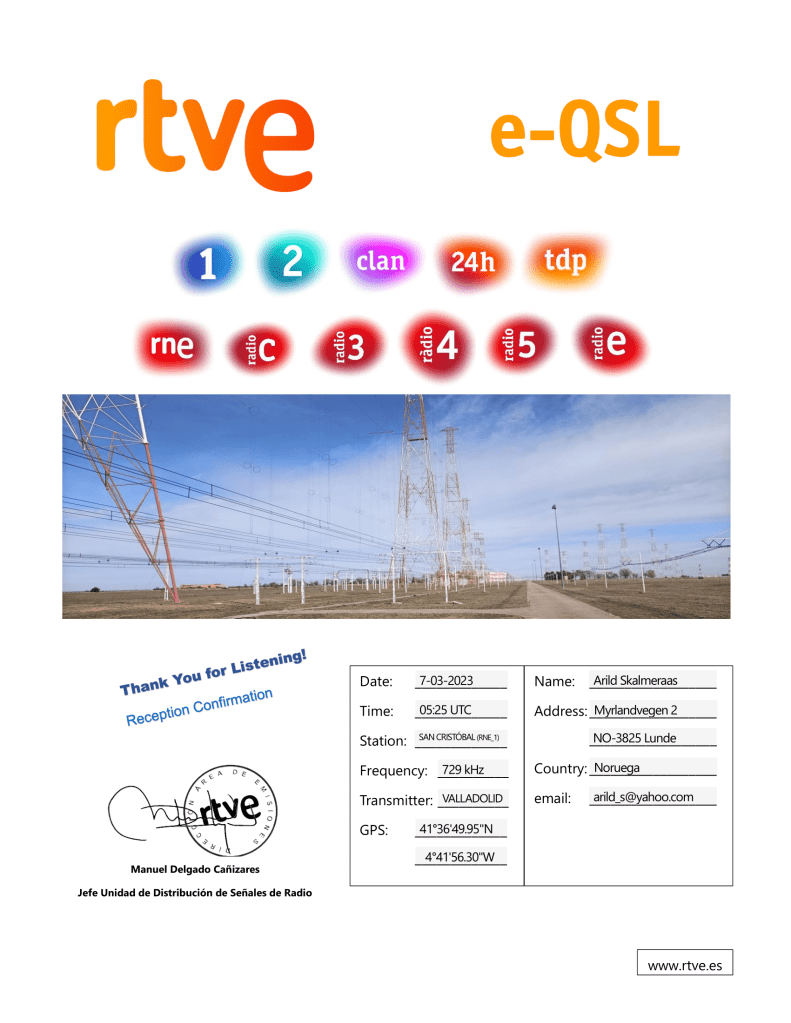


 Arild's DX Diary
You must be logged in to post a comment.