Feeds:
Posts
Comments

Archive for January, 2012

(UPDATE 31-Jan-14: This post has been superseded. See Collected Class Options for revisions of the sub-classes; skalds and staves are now full classes.)

Variant class options and sub-classes are a time-honoured tradition in fantasy role-playing games. Collected here is a selection of variant classes for potential use as PCs and NPCs: Berzerkers, Scouts, Skalds, and Staves.

The rules presented here supersede the previous posts. As with all house rules, use of these class options are subject to referee approval.

(more…)

Read Full Post »

I’ve decided to adopt the Alternate Core Rules which were proposed earlier. I’ve already updated the files on Google Docs.

Now I’m going through the various posts and revising any rules which are affected. After I’m done, there will still be a few places (like the Boneyard) which will reference the old, superseded rules.

Major changes include the following:

  • Adventuring Skills have been revamped; characters now receive a +3 bonus to their class skill.
  • The three save categories have been condensed into a single Saving Throw value. Saves are still typically divided into fortitude, reflex, or willpower categories, but these are dealt with on a case-by-case basis.
    Each class has its own modifier to saving throws, but loses the bonus to one specific save type. In most cases, it’s easier to make a saving throw now.

Also, I’ve given dwarves what used to be the ‘Goblin Foe’ quirk by default. The revised combat modifiers are as follows:

  • Gargun (goblins) are the racial enemies of dwarves. Dwarves gain a +1 on attack rolls vs. goblins.
  • Due to their small size, dwarves gain defensive bonuses against trolls and giants. Trolls have a -1 penalty on attack rolls vs. dwarves, and giants have a -2 penalty.

The old ‘Goblin Foe’ quirk is now replaced by ‘Giant Foe’; dwarves with this quirk get +1 Atk vs. trolls and giants instead of vs. goblins.

Read Full Post »

Dwarf Size Comparison

Here’s a picture from p. 18 of the AD&D Player’s Handbook:

It gives a good idea of the relative sizes of dwarves and men.

(They’re called dwarves for a reason.)

Read Full Post »

(UPDATE 31-Jan-14: This post has been superseded; see Collected Class Options for revisions.)

Scouts are fast-moving, lightly-armoured skirmishers. The scout is a hunter and a ranger who lives by his wits, and his abilities make him particularly good at tracking, woodcraft, infiltration, and spying.

Unless stated below, a scout is identical to a thief in terms of rule effects:

  • Level Limits: Dwarves are limited to 6th level as scouts, elves to 8th level, while humans have unlimited advancement.
  • Increased Movement: Scouts add +3” MV if wearing light or no armour.
    This replaces the thief’s backstab ability (but is available at 1st level instead of 2nd).
  • Foraging: Starting at 2nd level, scouts gain an improved chance to forage. Foraging reduces movement to ⅔ normal, and the scout provides a 3-in-6 chance of finding sustenance (instead of the regular 2-in-6 chance).
  • Tracking: It is possible for scouts to track both outdoors and underground in dungeons and like settings – even under conditions that would prevent most characters from following a trail.
    This replaces the thief’s ability to open locks, remove traps, and disable mechanical devices.

Read Full Post »

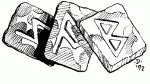
A starting runecaster may choose to master runes in exchange for initial equipment. The Runecasting supplement is a little bit vague about how runecasters can master additional runes, however, and says nothing about restrictions on the number of runes known.

Here is the actual text:

A starting runecaster may choose to master runes in exchange for initial equipment. After that, runes must be gained through adventuring. Although runes are a written type of magic, a character cannot learn how to use a rune just by studying one. There is much more to mastering a rune than simply writing it. The runecaster must have a living example of the rune – whether from an instructor, a power rune, or divine intervention. Learning runes from an instructor requires a teacher of higher level than the character and typically involve a high cost and/or some form of service (a “special quest”).

So as per the rules, you can’t study a ‘normal’ rune to master it. A runecaster can learn from a power runes, however (like a magic-user learning a spell from a scroll in AD&D). A character must study a power rune for at least a full day to master it and the power rune is destroyed when used in this manner.

The Runecasting supplement also mentions that an instructor can teach a student new runes. Without constraints, this would mean that every apprentice runecaster would simply teach his fellow students the secrets of the runes he has mastered until every rune was known by all. However, teaching somebody the secrets of rune magic has its costs. Like creating a power rune, it requires one day, 100 gp, and 50 XP from the instructor.

In addition, a runecaster is limited to a number of known runes equal his level +3 (generally equal to his Lore modifier). No take-backs, either – once you master a rune, you can’t forget it. Learning a rune is kind of like getting a tattoo; it’s permanent, so choose wisely

These rules prevents rampant copying of runes by apprentices and acquisition of an excessive number of runes at low levels, while allowing runecasters to gain runes more easily by adventuring (via power runes).

Read Full Post »

Older Posts »

Design a site like this with WordPress.com
Get started